MEDIATE
INTERFERENCE/SYLLOGISMS
SYLLOGISM
Aristotle define syllogism as a
"prepositional expression in which for
certain things which have been laid
down (premises), something other
than what has been laid down follows
of necessity from being so
(conclusion).
CATEGORICAL SYLLOGISM
Is a syllogism in which the
propositions are all categorical. It
is complex logical unit made up of
terms and propositions.
STRUCTURAL ELEMENTS OF
CATEGORICAL SYLLOGISM
BASIC PROPOSITION IN A CATEGORICAL
SYLLOGISM
1. Major Premise - the premise which contains the
major term. Generally, this premise has greater
extension than other propositions of the syllogism.
2. Minor Syllogism - the premise which contains
the minor term. Usually, this is the second
proposition and is preceded by the conjunction but.
3. Conclusion - the last proposition which has
been necessarily derived from the premises.
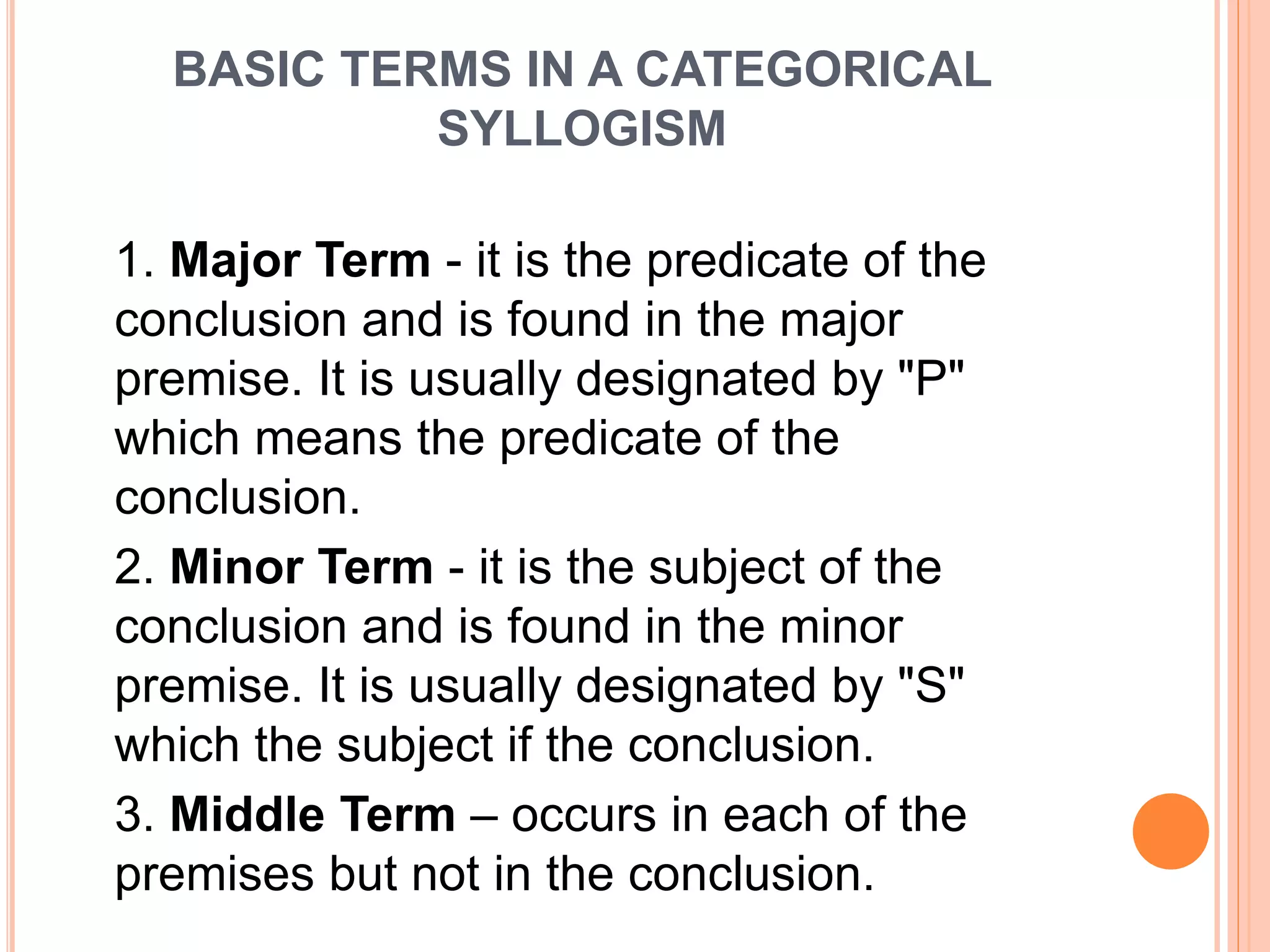
BASIC TERMS IN A CATEGORICAL
SYLLOGISM
1. Major Term - it is the predicate of the
conclusion and is found in the major
premise. It is usually designated by "P"
which means the predicate of the
conclusion.
2. Minor Term - it is the subject of the
conclusion and is found in the minor
premise. It is usually designated by "S"
which the subject if the conclusion.
3. Middle Term – occurs in each of the
premises but not in the conclusion.
Examples:
 Every BPSC student is a human being -------
--- Major Premise
 Mylene is a BPSC student ---------- Minor
Premise
 Therefore, Mylene is a human being ---------
Conclusion
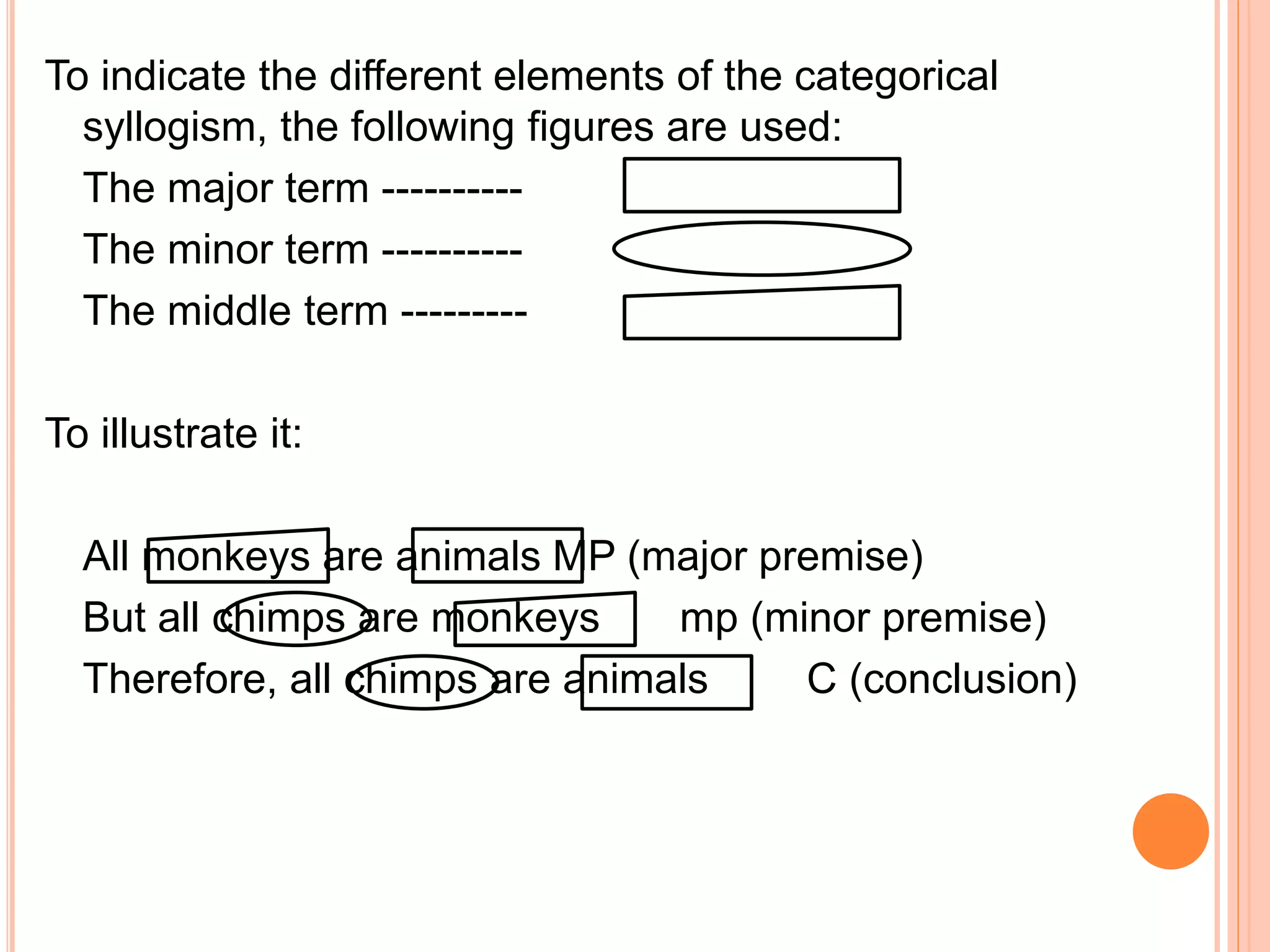
To indicate the different elements of the categorical
syllogism, the following figures are used:
The major term ----------
The minor term ----------
The middle term ---------
To illustrate it:
All monkeys are animals MP (major premise)
But all chimps are monkeys mp (minor premise)
Therefore, all chimps are animals C (conclusion)
RULES GOVERNING THE VALIDITY OF
CATEGORICAL SYLLOGISM
RULES OF TERMS
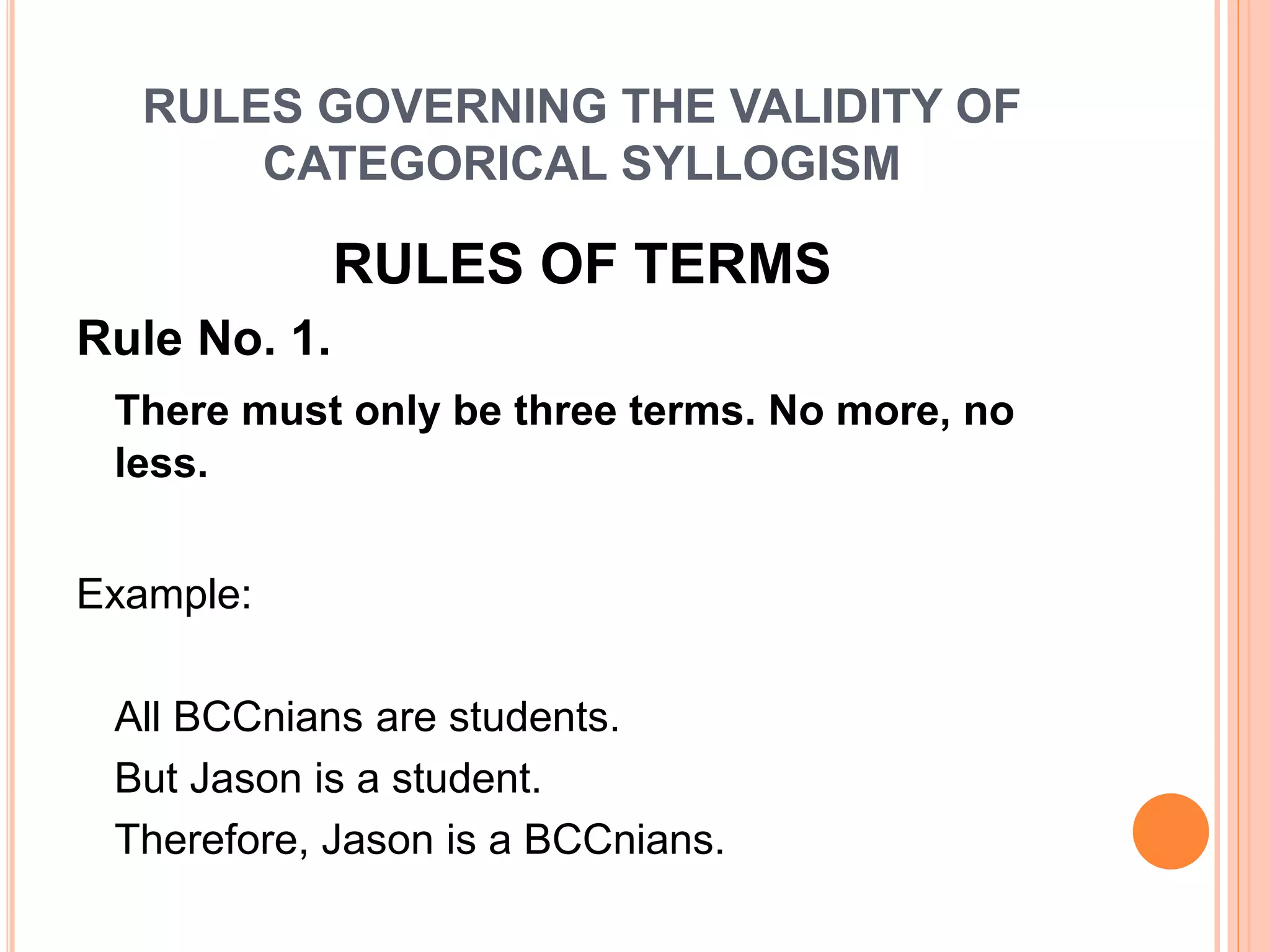
Rule No. 1.
There must only be three terms. No more, no
less.
Example:
All BCCnians are students.
But Jason is a student.
Therefore, Jason is a BCCnians.
FALLACIES COMMITTED ON THIS RULE
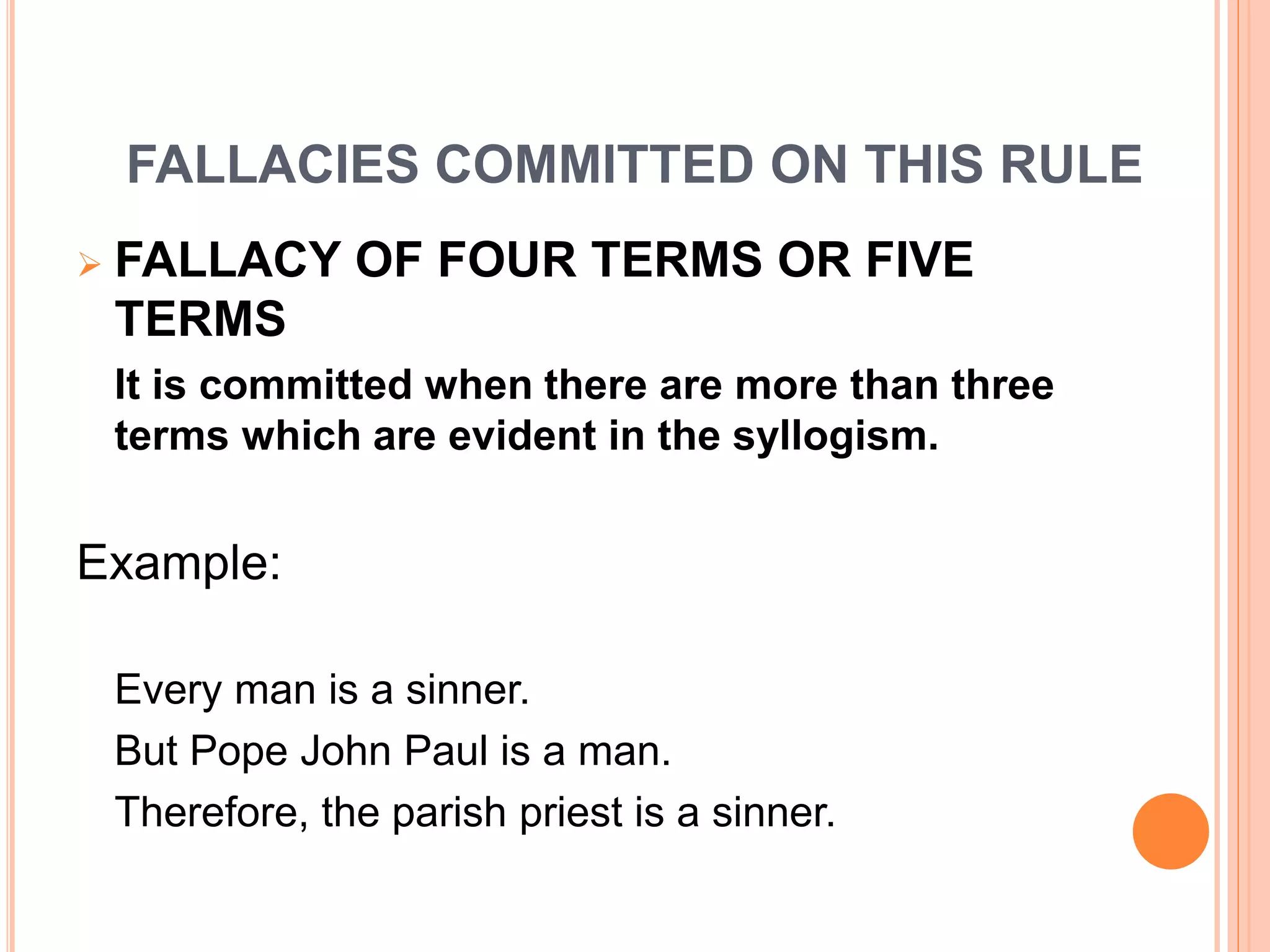
 FALLACY OF FOUR TERMS OR FIVE
TERMS
It is committed when there are more than three
terms which are evident in the syllogism.
Example:
Every man is a sinner.
But Pope John Paul is a man.
Therefore, the parish priest is a sinner.
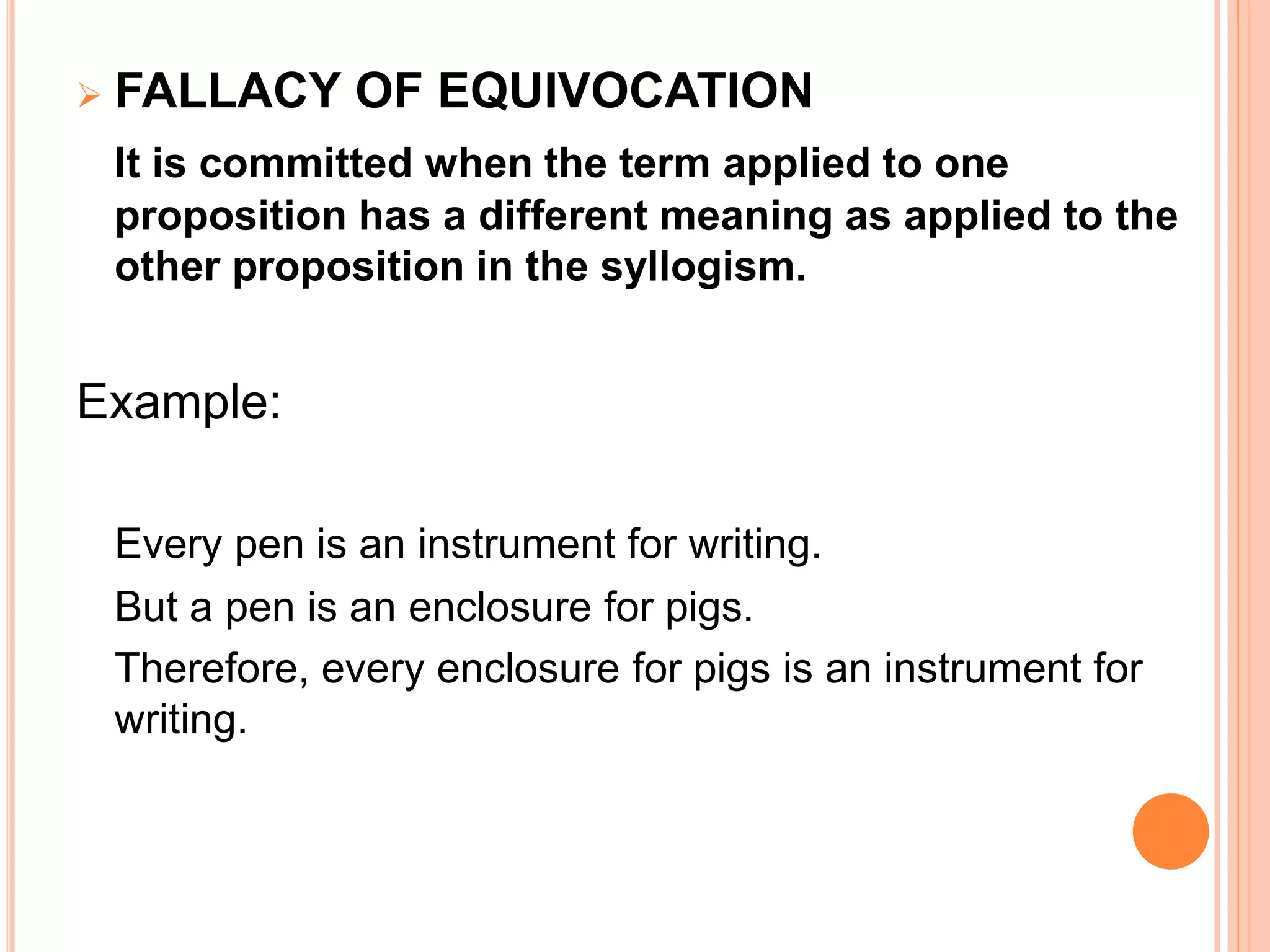
 FALLACY OF EQUIVOCATION
It is committed when the term applied to one
proposition has a different meaning as applied to the
other proposition in the syllogism.
Example:
Every pen is an instrument for writing.
But a pen is an enclosure for pigs.
Therefore, every enclosure for pigs is an instrument for
writing.
 FALLACY OF AMPHIBOLY
It is omitted when there is the use of analogous
terms.
Example:
God is love.
But love is blind.
Therefore, God is blind.
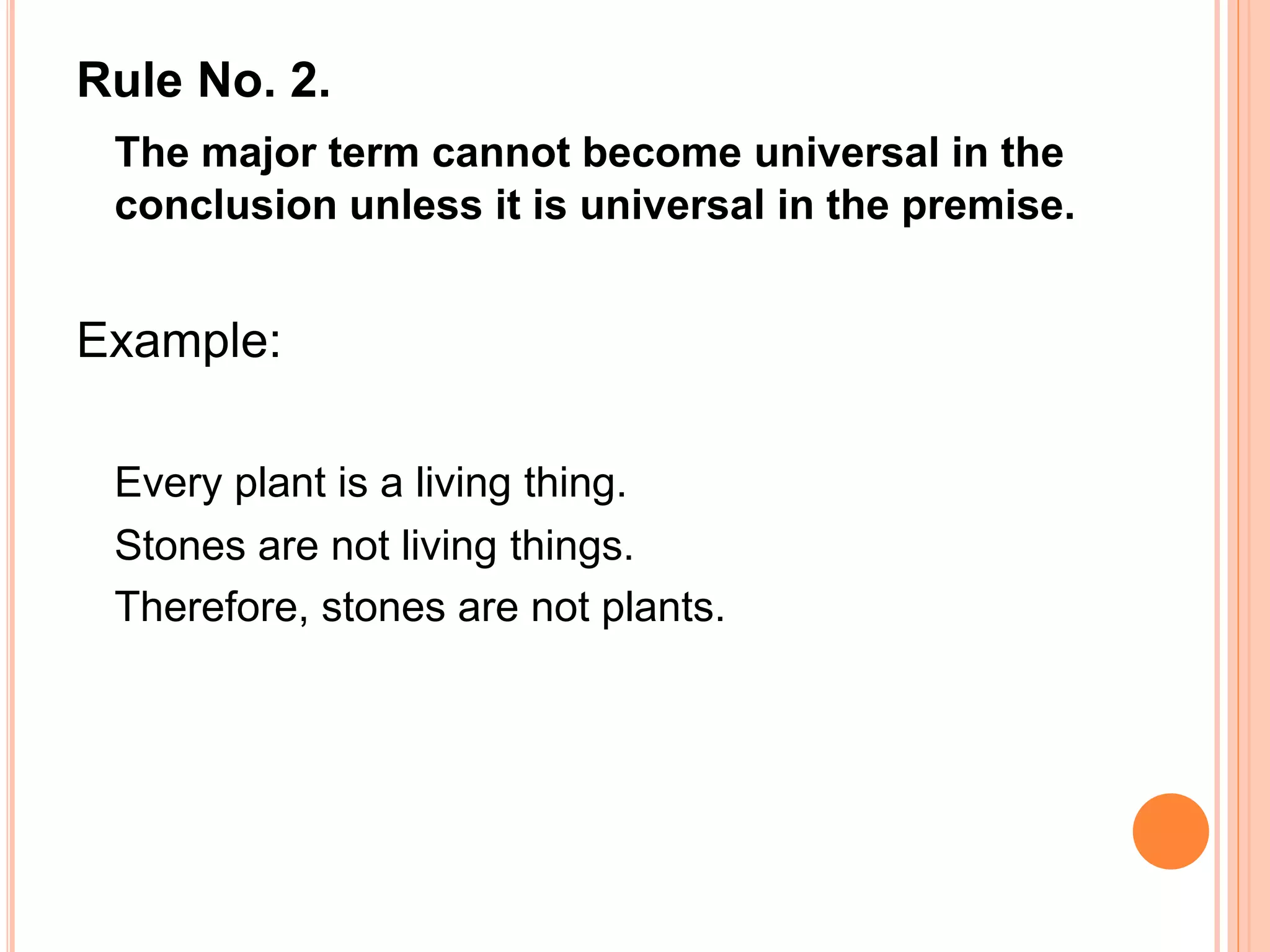
Rule No. 2.
The major term cannot become universal in the
conclusion unless it is universal in the premise.
Example:
Every plant is a living thing.
Stones are not living things.
Therefore, stones are not plants.
 FALLACY OF ILLICIT MAJOR
Example:
All cats are mammals. – particular
But no dogs are cats.
Therefore, no dogs are mammals. – universal
FALLACY COMMITTED ON THIS RULE
Rule No. 3.
The minor term cannot become universal in the
conclusion unless it is universal in the premise.
Example:
All singers are musicians.
But every musician is an artist.
Therefore, all singers are artists.
 FALLACY OF ILLICIT MINOR
Example:
Every circle is round.
But every circle is a figure.
Therefore, every figure is round.
FALLACY COMMITTED ON THIS RULE
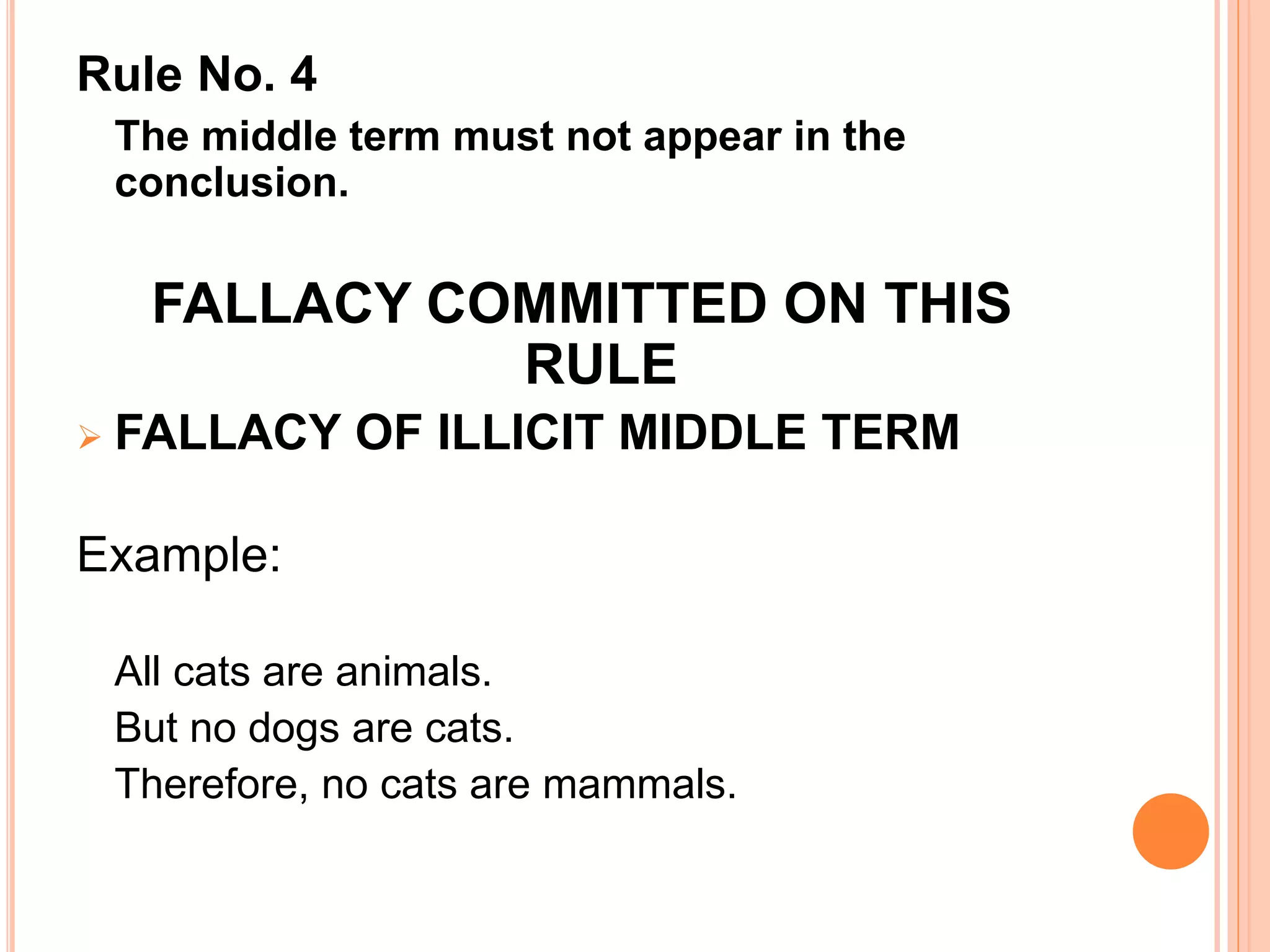
Rule No. 4
The middle term must not appear in the
conclusion.
FALLACY COMMITTED ON THIS
RULE
 FALLACY OF ILLICIT MIDDLE TERM
Example:
All cats are animals.
But no dogs are cats.
Therefore, no cats are mammals.
Rule No. 5
The middle term must be universal at least
once.
FALLACY COMMITTED ON THIS
RULE
 FALLACY OF UNDISTRIBUTED MIDDLE
TERM
Example:
The earth is a planet.
But the Mars is a planet.
Therefore, the Earth is Mars.
Rule No. 6
If both premises are affirmative, the conclusion
must also be affirmative.
FALLACY COMMITTED ON THIS RULE
 FALLACY ON NEGATIVE CONCLUSION
Example:
Labanos is not a fruit.
But all fruits are delicious.
Therefore, labanos is not delicious.
RULES ON THE QUALITY OF PROPOSITIONS
Rule No. 7
If one premise is affirmative and the other
premise is negative, the conclusion is negative.
FALLACY COMMITTED ON THIS
RULE
 FALLACY OF AFFIRMATIVE CONCLUSION
Example:
All Americans are not Asians.
But all Filipinos are Asians.
Therefore, all Filipinos are not Americans.
Rule No. 8
If both premises are negative, no conclusion
follows.
FALLACY COMMITTED ON THIS RULE
 FALLACY ON NEGATIVE PREMISES
Example:
Some insects are not flies.
But some insects are not grasshoppers.
Therefore, some grasshoppers are not flies.
Rule No. 9
At least one of the premises must be universal. If
both premises are particular, then no conclusion
follows.
FALLACY COMMITTED ON THIS RULE
 FALLACY OF UNIVERSAL CONCLUSION
Example:
Some insects are not grasshoppers.
But, all insects are small.
Therefore, all grasshoppers are small.
RULES ON THE QUANTITY OF
PROPOSITIONS
END OF
PRESENTATION
GROUP 1
Mediate Inference/Syllogisms

Mediate Inference/Syllogisms

  • 1.
  • 2.
    SYLLOGISM Aristotle define syllogismas a "prepositional expression in which for certain things which have been laid down (premises), something other than what has been laid down follows of necessity from being so (conclusion).
  • 3.
    CATEGORICAL SYLLOGISM Is asyllogism in which the propositions are all categorical. It is complex logical unit made up of terms and propositions.
  • 4.
    STRUCTURAL ELEMENTS OF CATEGORICALSYLLOGISM BASIC PROPOSITION IN A CATEGORICAL SYLLOGISM 1. Major Premise - the premise which contains the major term. Generally, this premise has greater extension than other propositions of the syllogism. 2. Minor Syllogism - the premise which contains the minor term. Usually, this is the second proposition and is preceded by the conjunction but. 3. Conclusion - the last proposition which has been necessarily derived from the premises.
  • 5.
    BASIC TERMS INA CATEGORICAL SYLLOGISM 1. Major Term - it is the predicate of the conclusion and is found in the major premise. It is usually designated by "P" which means the predicate of the conclusion. 2. Minor Term - it is the subject of the conclusion and is found in the minor premise. It is usually designated by "S" which the subject if the conclusion. 3. Middle Term – occurs in each of the premises but not in the conclusion.
  • 6.
    Examples:  Every BPSCstudent is a human being ------- --- Major Premise  Mylene is a BPSC student ---------- Minor Premise  Therefore, Mylene is a human being --------- Conclusion
  • 7.
    To indicate thedifferent elements of the categorical syllogism, the following figures are used: The major term ---------- The minor term ---------- The middle term --------- To illustrate it: All monkeys are animals MP (major premise) But all chimps are monkeys mp (minor premise) Therefore, all chimps are animals C (conclusion)
  • 8.
    RULES GOVERNING THEVALIDITY OF CATEGORICAL SYLLOGISM RULES OF TERMS Rule No. 1. There must only be three terms. No more, no less. Example: All BCCnians are students. But Jason is a student. Therefore, Jason is a BCCnians.
  • 9.
    FALLACIES COMMITTED ONTHIS RULE  FALLACY OF FOUR TERMS OR FIVE TERMS It is committed when there are more than three terms which are evident in the syllogism. Example: Every man is a sinner. But Pope John Paul is a man. Therefore, the parish priest is a sinner.
  • 10.
     FALLACY OFEQUIVOCATION It is committed when the term applied to one proposition has a different meaning as applied to the other proposition in the syllogism. Example: Every pen is an instrument for writing. But a pen is an enclosure for pigs. Therefore, every enclosure for pigs is an instrument for writing.
  • 11.
     FALLACY OFAMPHIBOLY It is omitted when there is the use of analogous terms. Example: God is love. But love is blind. Therefore, God is blind.
  • 12.
    Rule No. 2. Themajor term cannot become universal in the conclusion unless it is universal in the premise. Example: Every plant is a living thing. Stones are not living things. Therefore, stones are not plants.
  • 13.
     FALLACY OFILLICIT MAJOR Example: All cats are mammals. – particular But no dogs are cats. Therefore, no dogs are mammals. – universal FALLACY COMMITTED ON THIS RULE
  • 14.
    Rule No. 3. Theminor term cannot become universal in the conclusion unless it is universal in the premise. Example: All singers are musicians. But every musician is an artist. Therefore, all singers are artists.
  • 15.
     FALLACY OFILLICIT MINOR Example: Every circle is round. But every circle is a figure. Therefore, every figure is round. FALLACY COMMITTED ON THIS RULE
  • 16.
    Rule No. 4 Themiddle term must not appear in the conclusion. FALLACY COMMITTED ON THIS RULE  FALLACY OF ILLICIT MIDDLE TERM Example: All cats are animals. But no dogs are cats. Therefore, no cats are mammals.
  • 17.
    Rule No. 5 Themiddle term must be universal at least once. FALLACY COMMITTED ON THIS RULE  FALLACY OF UNDISTRIBUTED MIDDLE TERM Example: The earth is a planet. But the Mars is a planet. Therefore, the Earth is Mars.
  • 18.
    Rule No. 6 Ifboth premises are affirmative, the conclusion must also be affirmative. FALLACY COMMITTED ON THIS RULE  FALLACY ON NEGATIVE CONCLUSION Example: Labanos is not a fruit. But all fruits are delicious. Therefore, labanos is not delicious. RULES ON THE QUALITY OF PROPOSITIONS
  • 19.
    Rule No. 7 Ifone premise is affirmative and the other premise is negative, the conclusion is negative. FALLACY COMMITTED ON THIS RULE  FALLACY OF AFFIRMATIVE CONCLUSION Example: All Americans are not Asians. But all Filipinos are Asians. Therefore, all Filipinos are not Americans.
  • 20.
    Rule No. 8 Ifboth premises are negative, no conclusion follows. FALLACY COMMITTED ON THIS RULE  FALLACY ON NEGATIVE PREMISES Example: Some insects are not flies. But some insects are not grasshoppers. Therefore, some grasshoppers are not flies.
  • 21.
    Rule No. 9 Atleast one of the premises must be universal. If both premises are particular, then no conclusion follows. FALLACY COMMITTED ON THIS RULE  FALLACY OF UNIVERSAL CONCLUSION Example: Some insects are not grasshoppers. But, all insects are small. Therefore, all grasshoppers are small. RULES ON THE QUANTITY OF PROPOSITIONS
  • 22.
  • 23.