Standard Categorical Proposition Proposition external sign of judgment provides reason, explanation to support a judgment made expresses an idea, explanation feeling or emotion.  can be analyzed as either true or false definition a statement which affirms or denies something about a reality or object
Elements of a Proposition Subject term the point under discussion the central focus or the main idea or the content in a proposition term to be affirmed or denied Predicate term tells or describes something about the main idea (or the subject term) in a proposition that w/c is to be affirmed or denied of the subject Copula the connector b/w the subject & the predicate term; generally using the verb “to be”
Kinds of a Proposition Categorical proposition by which the affirmation or denial b/w two concepts is expressed in an  Absolute, Immediate, Direct or Unconditional manner Hypothetical proposition by which the affirmation or denial b/w two concepts is expressed in an  Indirect & Conditional manner If man can think then he is rational. Mangyans are the minorities from Mindoro.
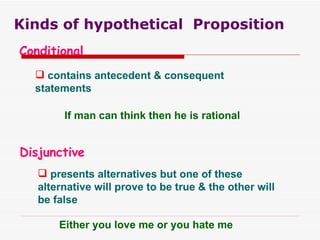
Kinds of hypothetical  Proposition Conditional contains antecedent & consequent statements If man can think then he is rational Disjunctive presents alternatives but one of these alternative will prove to be true & the other will be false Either you love me or you hate me
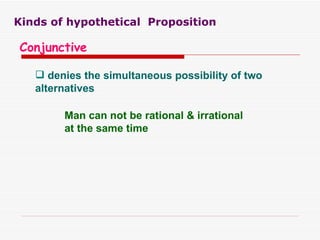
Kinds of hypothetical  Proposition Conjunctive denies the simultaneous possibility of two alternatives Man can not be rational & irrational at the same time
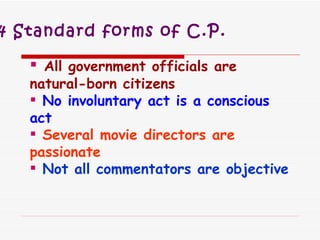
4 Standard forms of C.P. All government officials are natural-born citizens No involuntary act is a conscious act Several movie directors are passionate Not all commentators are objective
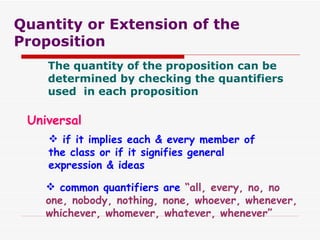
Quantity or Extension of the Proposition The quantity of the proposition can be determined by checking the quantifiers used  in each proposition Universal if it implies each & every member of the class or if it signifies general expression & ideas common quantifiers are  “all, every, no, no one, nobody, nothing, none, whoever, whenever, whichever, whomever, whatever, whenever”
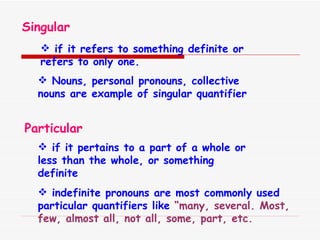
Singular if it refers to something definite or refers to only one. Nouns, personal pronouns, collective nouns are example of singular quantifier Particular if it pertains to a part of a whole or less than the whole, or something definite indefinite pronouns are most commonly used  particular quantifiers like  “many, several. Most, few, almost all, not all, some, part, etc.
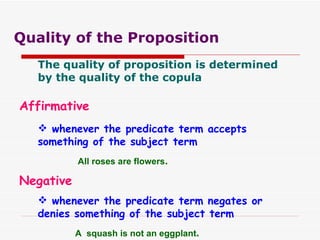
Quality of the Proposition The quality of proposition is determined by the quality of the copula Affirmative whenever the predicate term accepts something of the subject term Negative whenever the predicate term negates or denies something of the subject term All roses are flowers . A  squash is not an eggplant .
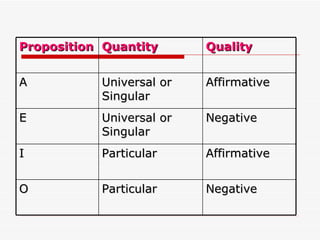
Proposition Quantity Quality A Universal or Singular Affirmative E Universal or Singular Negative I Particular Affirmative O Particular Negative
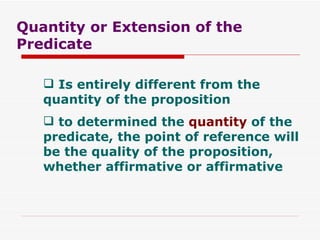
Quantity or Extension of the Predicate Is entirely different from the quantity of the proposition to determined the  quantity  of the predicate, the point of reference will be the quality of the proposition, whether affirmative or affirmative
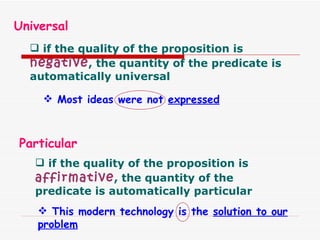
Particular if the quality of the proposition is  affirmative , the quantity of the predicate is automatically particular if the quality of the proposition is  negative , the quantity of the predicate is automatically universal Universal This modern technology is the  solution to our problem Most ideas were not  expressed
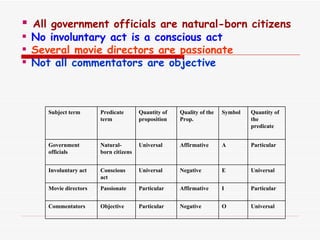
All government officials are natural-born citizens No involuntary act is a conscious act Several movie directors are passionate Not all commentators are objective Subject term Predicate term Quantity of proposition Quality of the Prop. Symbol Quantity of the predicate Government officials Natural-born citizens Universal Affirmative A Particular Involuntary act Conscious act Universal Negative E Universal Movie directors Passionate Particular Affirmative I Particular Commentators Objective Particular Negative O Universal
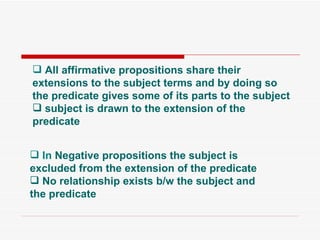
All affirmative propositions share their extensions to the subject terms and by doing so the predicate gives some of its parts to the subject subject is drawn to the extension of the predicate In  Negative propositions the subject is excluded from the extension of the predicate No relationship exists b/w the subject and the predicate

Logic hand outs#4

  • 1.
    Standard Categorical PropositionProposition external sign of judgment provides reason, explanation to support a judgment made expresses an idea, explanation feeling or emotion. can be analyzed as either true or false definition a statement which affirms or denies something about a reality or object
  • 2.
    Elements of aProposition Subject term the point under discussion the central focus or the main idea or the content in a proposition term to be affirmed or denied Predicate term tells or describes something about the main idea (or the subject term) in a proposition that w/c is to be affirmed or denied of the subject Copula the connector b/w the subject & the predicate term; generally using the verb “to be”
  • 3.
    Kinds of aProposition Categorical proposition by which the affirmation or denial b/w two concepts is expressed in an Absolute, Immediate, Direct or Unconditional manner Hypothetical proposition by which the affirmation or denial b/w two concepts is expressed in an Indirect & Conditional manner If man can think then he is rational. Mangyans are the minorities from Mindoro.
  • 4.
    Kinds of hypothetical Proposition Conditional contains antecedent & consequent statements If man can think then he is rational Disjunctive presents alternatives but one of these alternative will prove to be true & the other will be false Either you love me or you hate me
  • 5.
    Kinds of hypothetical Proposition Conjunctive denies the simultaneous possibility of two alternatives Man can not be rational & irrational at the same time
  • 6.
    4 Standard formsof C.P. All government officials are natural-born citizens No involuntary act is a conscious act Several movie directors are passionate Not all commentators are objective
  • 7.
    Quantity or Extensionof the Proposition The quantity of the proposition can be determined by checking the quantifiers used in each proposition Universal if it implies each & every member of the class or if it signifies general expression & ideas common quantifiers are “all, every, no, no one, nobody, nothing, none, whoever, whenever, whichever, whomever, whatever, whenever”
  • 8.
    Singular if itrefers to something definite or refers to only one. Nouns, personal pronouns, collective nouns are example of singular quantifier Particular if it pertains to a part of a whole or less than the whole, or something definite indefinite pronouns are most commonly used particular quantifiers like “many, several. Most, few, almost all, not all, some, part, etc.
  • 9.
    Quality of theProposition The quality of proposition is determined by the quality of the copula Affirmative whenever the predicate term accepts something of the subject term Negative whenever the predicate term negates or denies something of the subject term All roses are flowers . A squash is not an eggplant .
  • 10.
    Proposition Quantity QualityA Universal or Singular Affirmative E Universal or Singular Negative I Particular Affirmative O Particular Negative
  • 11.
    Quantity or Extensionof the Predicate Is entirely different from the quantity of the proposition to determined the quantity of the predicate, the point of reference will be the quality of the proposition, whether affirmative or affirmative
  • 12.
    Particular if thequality of the proposition is affirmative , the quantity of the predicate is automatically particular if the quality of the proposition is negative , the quantity of the predicate is automatically universal Universal This modern technology is the solution to our problem Most ideas were not expressed
  • 13.
    All government officialsare natural-born citizens No involuntary act is a conscious act Several movie directors are passionate Not all commentators are objective Subject term Predicate term Quantity of proposition Quality of the Prop. Symbol Quantity of the predicate Government officials Natural-born citizens Universal Affirmative A Particular Involuntary act Conscious act Universal Negative E Universal Movie directors Passionate Particular Affirmative I Particular Commentators Objective Particular Negative O Universal
  • 14.
    All affirmative propositionsshare their extensions to the subject terms and by doing so the predicate gives some of its parts to the subject subject is drawn to the extension of the predicate In Negative propositions the subject is excluded from the extension of the predicate No relationship exists b/w the subject and the predicate