Categorical versus Hypothetical Proposition
 Categorical proposition = declare something
 Hypothetical proposition = express condition
Hypothetical Proposition
 does not declare an unconditional affirmation or
denial, but expresses a relation of dependence such as
an opposition or a likeness between 2 clauses.
3 kinds of Hypothetical Proposition
1. Conditional Proposition
2. Disjunctive Proposition
3. Conjuctive Proposition
Conditional Proposition
 Expresses a condition or relation of dependence
between two propositions.
 Expressed relation points out that one proposition
necessarily follows from the other because of a definite
condition.
 Note that a conditional proposition is one in which
two parts are joined by
if, unless, when, where, suppose, in case.
 Sometimes called an if-then proposition
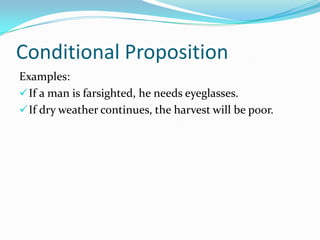
Conditional Proposition
Examples:
If a man is farsighted, he needs eyeglasses.
If dry weather continues, the harvest will be poor.
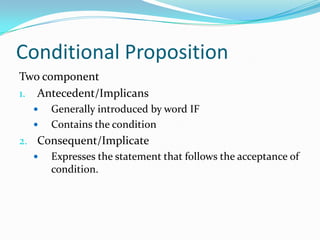
Conditional Proposition
Two component
1. Antecedent/Implicans
 Generally introduced by word IF
 Contains the condition
2. Consequent/Implicate
 Expresses the statement that follows the acceptance of
condition.
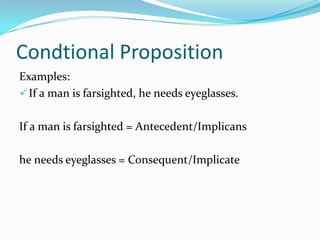
Condtional Proposition
Examples:
If a man is farsighted, he needs eyeglasses.
If a man is farsighted = Antecedent/Implicans
he needs eyeglasses = Consequent/Implicate
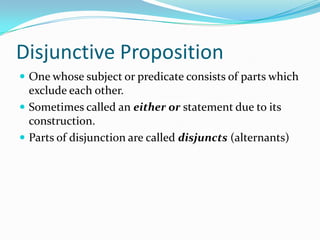
Disjunctive Proposition
 One whose subject or predicate consists of parts which
exclude each other.
 Sometimes called an either or statement due to its
construction.
 Parts of disjunction are called disjuncts (alternants)
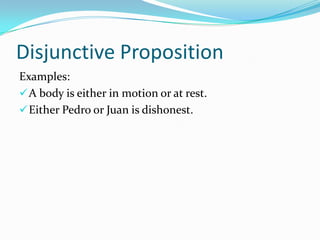
Disjunctive Proposition
Examples:
A body is either in motion or at rest.
Either Pedro or Juan is dishonest.
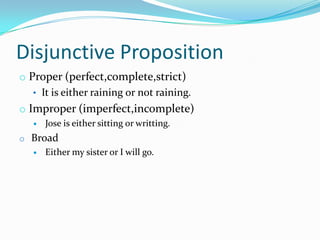
Disjunctive Proposition
o Proper (perfect,complete,strict)
• It is either raining or not raining.
o Improper (imperfect,incomplete)
 Jose is either sitting or writting.
o Broad
 Either my sister or I will go.
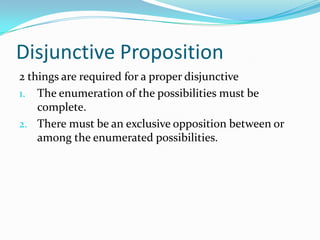
Disjunctive Proposition
2 things are required for a proper disjunctive
1. The enumeration of the possibilities must be
complete.
2. There must be an exclusive opposition between or
among the enumerated possibilities.
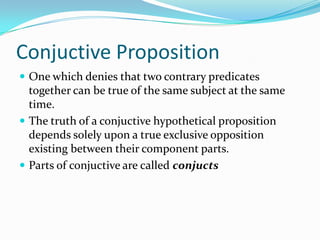
Conjuctive Proposition
 One which denies that two contrary predicates
together can be true of the same subject at the same
time.
 The truth of a conjuctive hypothetical proposition
depends solely upon a true exclusive opposition
existing between their component parts.
 Parts of conjuctive are called conjucts
Conjuctive Proposition
Examples
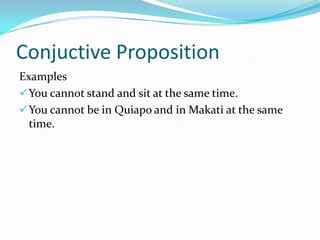
You cannot stand and sit at the same time.
You cannot be in Quiapo and in Makati at the same
time.
Conjuctive Proposition
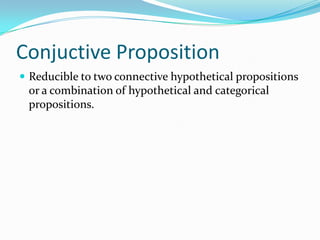
 Reducible to two connective hypothetical propositions
or a combination of hypothetical and categorical
propositions.
Conjuctive Proposition
Examples
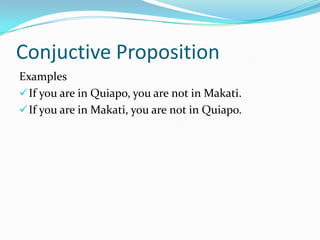
If you are in Quiapo, you are not in Makati.
If you are in Makati, you are not in Quiapo.
Hypothetical proposition

Hypothetical proposition

  • 2.
    Categorical versus HypotheticalProposition  Categorical proposition = declare something  Hypothetical proposition = express condition
  • 3.
    Hypothetical Proposition  doesnot declare an unconditional affirmation or denial, but expresses a relation of dependence such as an opposition or a likeness between 2 clauses.
  • 4.
    3 kinds ofHypothetical Proposition 1. Conditional Proposition 2. Disjunctive Proposition 3. Conjuctive Proposition
  • 5.
    Conditional Proposition  Expressesa condition or relation of dependence between two propositions.  Expressed relation points out that one proposition necessarily follows from the other because of a definite condition.  Note that a conditional proposition is one in which two parts are joined by if, unless, when, where, suppose, in case.  Sometimes called an if-then proposition
  • 6.
    Conditional Proposition Examples: If aman is farsighted, he needs eyeglasses. If dry weather continues, the harvest will be poor.
  • 7.
    Conditional Proposition Two component 1.Antecedent/Implicans  Generally introduced by word IF  Contains the condition 2. Consequent/Implicate  Expresses the statement that follows the acceptance of condition.
  • 8.
    Condtional Proposition Examples: If aman is farsighted, he needs eyeglasses. If a man is farsighted = Antecedent/Implicans he needs eyeglasses = Consequent/Implicate
  • 9.
    Disjunctive Proposition  Onewhose subject or predicate consists of parts which exclude each other.  Sometimes called an either or statement due to its construction.  Parts of disjunction are called disjuncts (alternants)
  • 10.
    Disjunctive Proposition Examples: A bodyis either in motion or at rest. Either Pedro or Juan is dishonest.
  • 11.
    Disjunctive Proposition o Proper(perfect,complete,strict) • It is either raining or not raining. o Improper (imperfect,incomplete)  Jose is either sitting or writting. o Broad  Either my sister or I will go.
  • 12.
    Disjunctive Proposition 2 thingsare required for a proper disjunctive 1. The enumeration of the possibilities must be complete. 2. There must be an exclusive opposition between or among the enumerated possibilities.
  • 13.
    Conjuctive Proposition  Onewhich denies that two contrary predicates together can be true of the same subject at the same time.  The truth of a conjuctive hypothetical proposition depends solely upon a true exclusive opposition existing between their component parts.  Parts of conjuctive are called conjucts
  • 14.
    Conjuctive Proposition Examples You cannotstand and sit at the same time. You cannot be in Quiapo and in Makati at the same time.
  • 15.
    Conjuctive Proposition  Reducibleto two connective hypothetical propositions or a combination of hypothetical and categorical propositions.
  • 16.
    Conjuctive Proposition Examples If youare in Quiapo, you are not in Makati. If you are in Makati, you are not in Quiapo.