CASE STUDY
CIDCO HOUSING, BELAPUR
INTRODUCTION
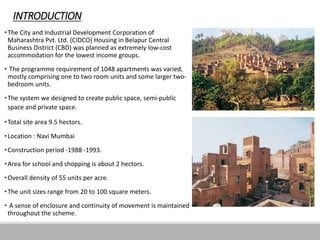
•The City and Industrial Development Corporation of
Maharashtra Pvt. Ltd. (CIDCO) Housing in Belapur Central
Business District (CBD) was planned as extremely low-cost
accommodation for the lowest income groups.
• The programme requirement of 1048 apartments was varied,
mostly comprising one to two room units and some larger two-
bedroom units.
•The system we designed to create public space, semi-public
space and private space.
•Total site area 9.5 hectors.
•Location : Navi Mumbai
•Construction period -1988 -1993.
•Area for school and shopping is about 2 hectors.
•Overall density of 55 units per acre.
•The unit sizes range from 20 to 100 square meters.
• A sense of enclosure and continuity of movement is maintained
throughout the scheme.
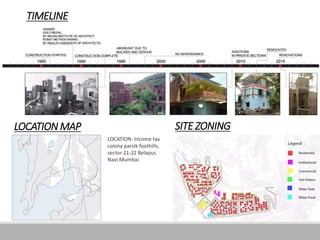
TIMELINE
LOCATION MAP
LOCATION- Income tax
colony parsik foothills,
sector 21-22 Belapur,
Navi Mumbai.
SITE ZONING
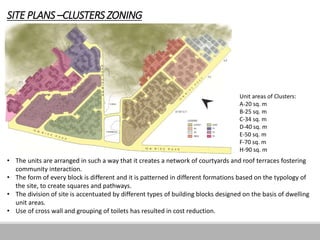
SITE PLANS –CLUSTERS ZONING
• The units are arranged in such a way that it creates a network of courtyards and roof terraces fostering
community interaction.
• The form of every block is different and it is patterned in different formations based on the typology of
the site, to create squares and pathways.
• The division of site is accentuated by different types of building blocks designed on the basis of dwelling
unit areas.
• Use of cross wall and grouping of toilets has resulted in cost reduction.
Unit areas of Clusters:
A-20 sq. m
B-25 sq. m
C-34 sq. m
D-40 sq. m
E-50 sq. m
F-70 sq. m
H-90 sq. m
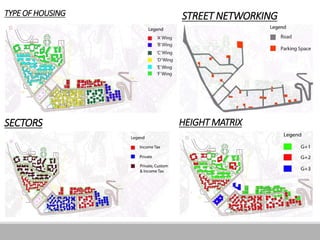
TYPE OF HOUSING
SECTORS
STREET NETWORKING
HEIGHT MATRIX
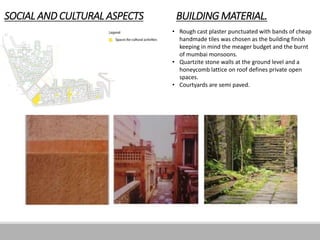
SOCIAL AND CULTURAL ASPECTS
• Rough cast plaster punctuated with bands of cheap
handmade tiles was chosen as the building finish
keeping in mind the meager budget and the burnt
of mumbai monsoons.
• Quartzite stone walls at the ground level and a
honeycomb lattice on roof defines private open
spaces.
• Courtyards are semi paved.
BUILDING MATERIAL.
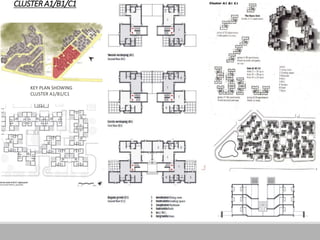
CLUSTER A1/B1/C1
KEY PLAN SHOWING
CLUSTER A1/B1/C1
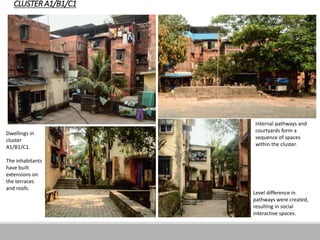
CLUSTER A1/B1/C1
Dwellings in
cluster
A1/B1/C1.
The inhabitants
have built
extensions on
the terraces
and roofs.
Internal pathways and
courtyards form a
sequence of spaces
within the cluster.
Level difference in
pathways were created,
resulting in social
interactive spaces.
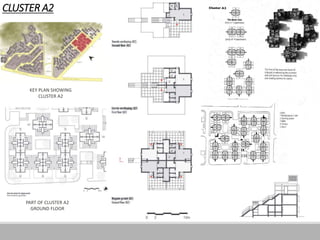
CLUSTER A2
KEY PLAN SHOWING
CLUSTER A2
PART OF CLUSTER A2
GROUND FLOOR
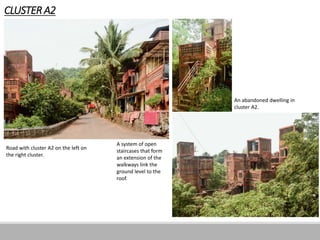
CLUSTER A2
An abandoned dwelling in
cluster A2.
A system of open
staircases that form
an extension of the
walkways link the
ground level to the
roof.
Road with cluster A2 on the left on
the right cluster.
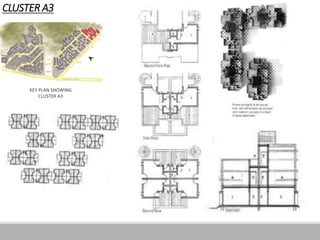
CLUSTER A3
KEY PLAN SHOWING
CLUSTER A3
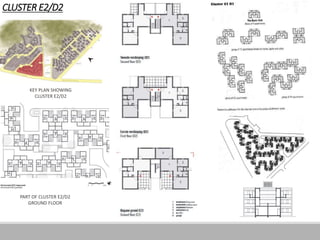
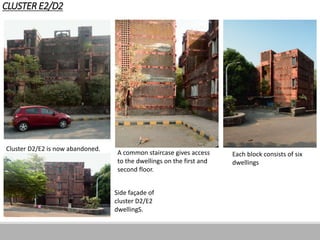
CLUSTER E2/D2
KEY PLAN SHOWING
CLUSTER E2/D2
PART OF CLUSTER E2/D2
GROUND FLOOR
CLUSTER E2/D2
Side façade of
cluster D2/E2
dwellingS.
Cluster D2/E2 is now abandoned.
Each block consists of six
dwellings
A common staircase gives access
to the dwellings on the first and
second floor.
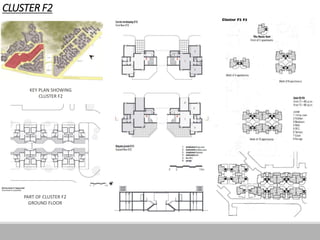
CLUSTER F2
KEY PLAN SHOWING
CLUSTER F2
PART OF CLUSTER F2
GROUND FLOOR
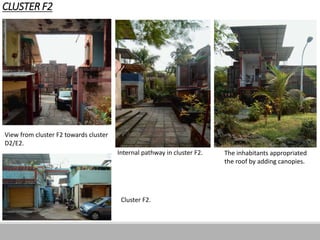
CLUSTER F2
View from cluster F2 towards cluster
D2/E2.
The inhabitants appropriated
the roof by adding canopies.
Internal pathway in cluster F2.
Cluster F2.
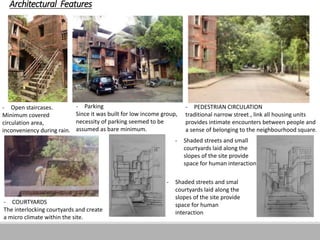
Architectural Features
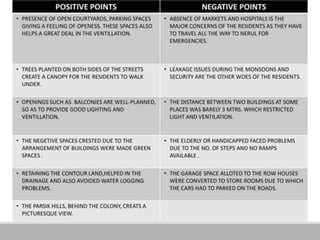
- Open staircases.
Minimum covered
circulation area,
inconveniency during rain.
- Parking
Since it was built for low income group,
necessity of parking seemed to be
assumed as bare minimum.
- PEDESTRIAN CIRCULATION
traditional narrow street , link all housing units
provides intimate encounters between people and
a sense of belonging to the neighbourhood square.
- COURTYARDS
The interlocking courtyards and create
a micro climate within the site.
- Shaded streets and small
courtyards laid along the
slopes of the site provide
space for human interaction
- Shaded streets and smal
courtyards laid along the
slopes of the site provide
space for human
interaction
Architectural Features
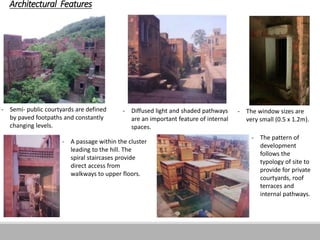
- Semi- public courtyards are defined
by paved footpaths and constantly
changing levels.
- Diffused light and shaded pathways
are an important feature of internal
spaces.
- The window sizes are
very small (0.5 x 1.2m).
- The pattern of
development
follows the
typology of site to
provide for private
courtyards, roof
terraces and
internal pathways.
- A passage within the cluster
leading to the hill. The
spiral staircases provide
direct access from
walkways to upper floors.
CIDCO HOUSING BELAPUR

CIDCO HOUSING BELAPUR

  • 1.
  • 2.
    INTRODUCTION •The City andIndustrial Development Corporation of Maharashtra Pvt. Ltd. (CIDCO) Housing in Belapur Central Business District (CBD) was planned as extremely low-cost accommodation for the lowest income groups. • The programme requirement of 1048 apartments was varied, mostly comprising one to two room units and some larger two- bedroom units. •The system we designed to create public space, semi-public space and private space. •Total site area 9.5 hectors. •Location : Navi Mumbai •Construction period -1988 -1993. •Area for school and shopping is about 2 hectors. •Overall density of 55 units per acre. •The unit sizes range from 20 to 100 square meters. • A sense of enclosure and continuity of movement is maintained throughout the scheme.
  • 3.
    TIMELINE LOCATION MAP LOCATION- Incometax colony parsik foothills, sector 21-22 Belapur, Navi Mumbai. SITE ZONING
  • 4.
    SITE PLANS –CLUSTERSZONING • The units are arranged in such a way that it creates a network of courtyards and roof terraces fostering community interaction. • The form of every block is different and it is patterned in different formations based on the typology of the site, to create squares and pathways. • The division of site is accentuated by different types of building blocks designed on the basis of dwelling unit areas. • Use of cross wall and grouping of toilets has resulted in cost reduction. Unit areas of Clusters: A-20 sq. m B-25 sq. m C-34 sq. m D-40 sq. m E-50 sq. m F-70 sq. m H-90 sq. m
  • 5.
    TYPE OF HOUSING SECTORS STREETNETWORKING HEIGHT MATRIX
  • 6.
    SOCIAL AND CULTURALASPECTS • Rough cast plaster punctuated with bands of cheap handmade tiles was chosen as the building finish keeping in mind the meager budget and the burnt of mumbai monsoons. • Quartzite stone walls at the ground level and a honeycomb lattice on roof defines private open spaces. • Courtyards are semi paved. BUILDING MATERIAL.
  • 7.
    CLUSTER A1/B1/C1 KEY PLANSHOWING CLUSTER A1/B1/C1
  • 8.
    CLUSTER A1/B1/C1 Dwellings in cluster A1/B1/C1. Theinhabitants have built extensions on the terraces and roofs. Internal pathways and courtyards form a sequence of spaces within the cluster. Level difference in pathways were created, resulting in social interactive spaces.
  • 9.
    CLUSTER A2 KEY PLANSHOWING CLUSTER A2 PART OF CLUSTER A2 GROUND FLOOR
  • 10.
    CLUSTER A2 An abandoneddwelling in cluster A2. A system of open staircases that form an extension of the walkways link the ground level to the roof. Road with cluster A2 on the left on the right cluster.
  • 11.
    CLUSTER A3 KEY PLANSHOWING CLUSTER A3
  • 12.
    CLUSTER E2/D2 KEY PLANSHOWING CLUSTER E2/D2 PART OF CLUSTER E2/D2 GROUND FLOOR
  • 13.
    CLUSTER E2/D2 Side façadeof cluster D2/E2 dwellingS. Cluster D2/E2 is now abandoned. Each block consists of six dwellings A common staircase gives access to the dwellings on the first and second floor.
  • 14.
    CLUSTER F2 KEY PLANSHOWING CLUSTER F2 PART OF CLUSTER F2 GROUND FLOOR
  • 15.
    CLUSTER F2 View fromcluster F2 towards cluster D2/E2. The inhabitants appropriated the roof by adding canopies. Internal pathway in cluster F2. Cluster F2.
  • 16.
    Architectural Features - Openstaircases. Minimum covered circulation area, inconveniency during rain. - Parking Since it was built for low income group, necessity of parking seemed to be assumed as bare minimum. - PEDESTRIAN CIRCULATION traditional narrow street , link all housing units provides intimate encounters between people and a sense of belonging to the neighbourhood square. - COURTYARDS The interlocking courtyards and create a micro climate within the site. - Shaded streets and small courtyards laid along the slopes of the site provide space for human interaction - Shaded streets and smal courtyards laid along the slopes of the site provide space for human interaction
  • 17.
    Architectural Features - Semi-public courtyards are defined by paved footpaths and constantly changing levels. - Diffused light and shaded pathways are an important feature of internal spaces. - The window sizes are very small (0.5 x 1.2m). - The pattern of development follows the typology of site to provide for private courtyards, roof terraces and internal pathways. - A passage within the cluster leading to the hill. The spiral staircases provide direct access from walkways to upper floors.