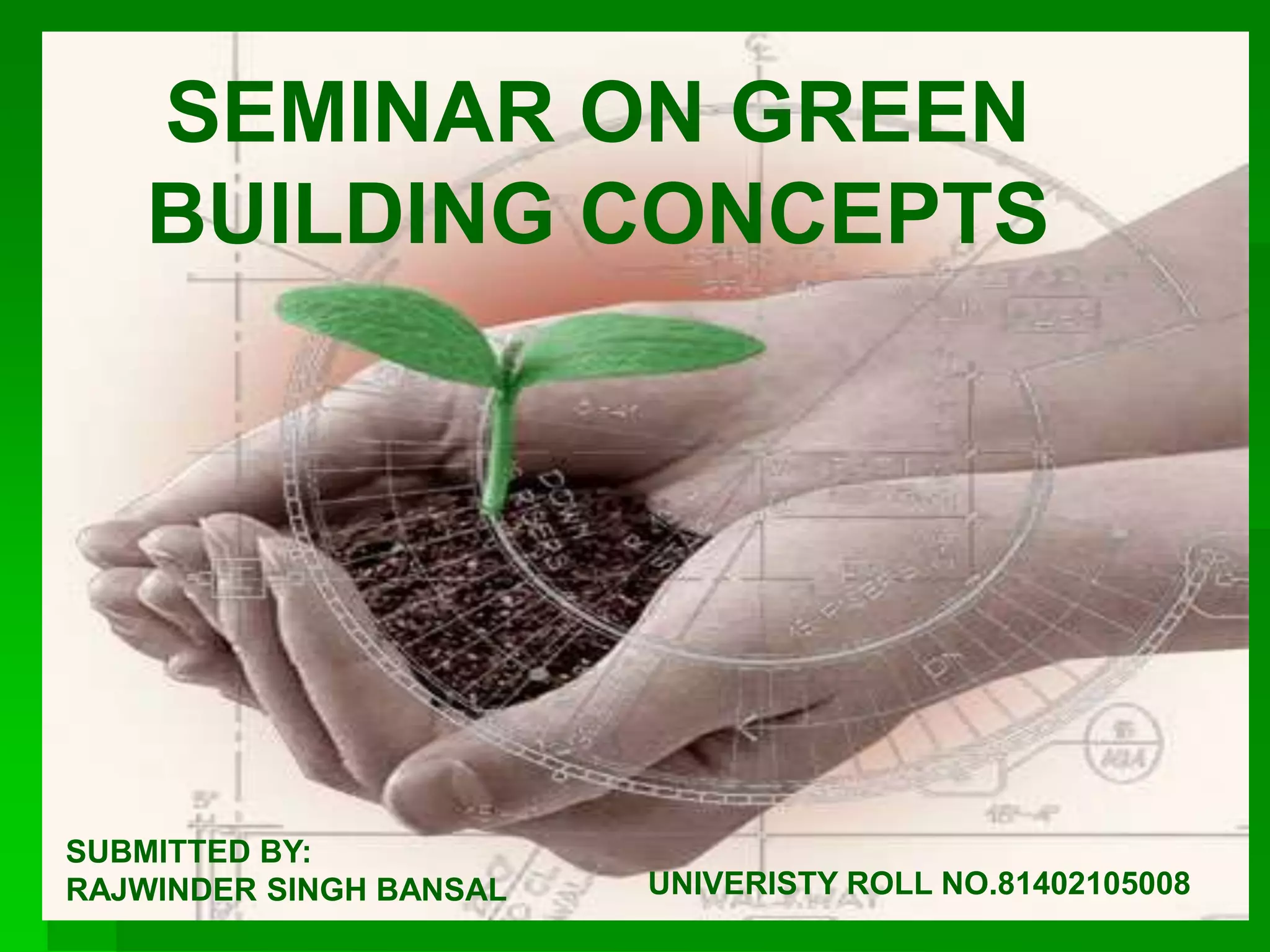
SEMINAR ON GREEN
BUILDING CONCEPTS
SUBMITTED BY:
RAJWINDER SINGH BANSAL UNIVERISTY ROLL NO.81402105008
Green Building
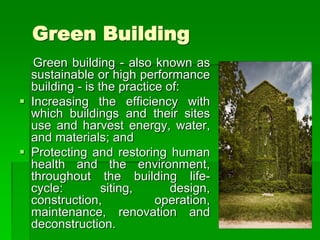
Green building - also known as
sustainable or high performance
building - is the practice of:
 Increasing the efficiency with
which buildings and their sites
use and harvest energy, water,
and materials; and
 Protecting and restoring human
health and the environment,
throughout the building life-
cycle: siting, design,
construction, operation,
maintenance, renovation and
deconstruction.
Green Building Concept
The `Green Building' concept is gaining
importance in various countries, including
India. These are buildings that ensure
that waste is minimized at every stage
during the construction and operation of
the building, resulting in low costs,
according to experts in the technology.
Cont….
 The techniques associated with the
`Green Building' include measures to
prevent erosion of soil, rainwater
harvesting, preparation of landscapes to
reduce heat, reduction in usage of
potable water, recycling of waste water
and use of world class energy efficient
practices.
What makes a building
"green"?
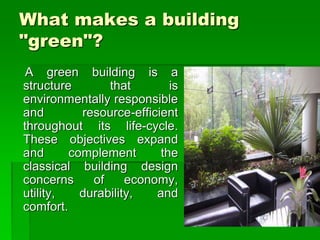
A green building is a
structure that is
environmentally responsible
and resource-efficient
throughout its life-cycle.
These objectives expand
and complement the
classical building design
concerns of economy,
utility, durability, and
comfort.
Green buildings are designed to reduce the
overall impact of the built environment on
human health and the natural environment
by:
 Efficiently using energy, water, and other
resources
 Protecting occupant health and improving
employee productivity
 Reducing waste, pollution and
environment degradation
For example……….
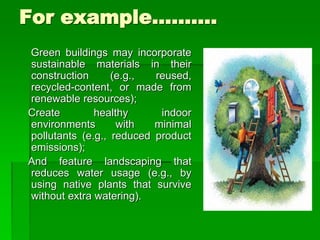
Green buildings may incorporate
sustainable materials in their
construction (e.g., reused,
recycled-content, or made from
renewable resources);
Create healthy indoor
environments with minimal
pollutants (e.g., reduced product
emissions);
And feature landscaping that
reduces water usage (e.g., by
using native plants that survive
without extra watering).
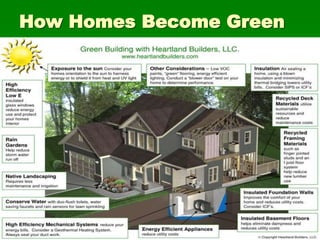
How Homes Become Green
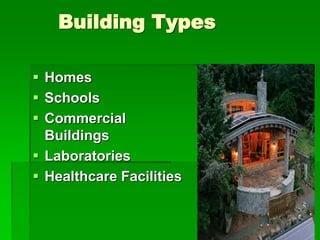
Building Types
 Homes
 Schools
 Commercial
Buildings
 Laboratories
 Healthcare Facilities
STAGES OF GREEN
BUILDING DESIGN
PLANNING PROCESS
 1. Site selection and planning
 2. Budget planning
 3. Capital planning
 4. Program planning
contd…..
DESIGN PROCESS
1. Client awareness and goal setting
2. Green visions, project goals, and green
criteria
3. Team development
4. Well-integrated design
5. Resource management
6. Performance goals
Contd.
OPERATION AND MAINTAINENCE
1. Commissioning of building systems
2. Building operation
3. Maintenance practices
4. Renovation
5. Demolition
ELEMENTS OF A
GREEN BUILDING
(A) Site Selection
(B) Energy Efficiency
(C) Materials
(d) Water
(e) Waster
(f) Building Operation and Maintenance
CLIMATIC ZONES OF
INDIA
1Cold Zone
2 Composite Zone
3 Moderate zone
4 Hot and Dry Zone
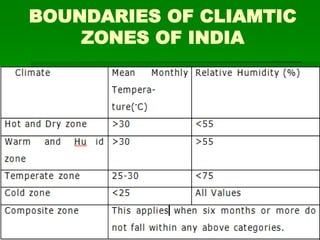
BOUNDARIES OF CLIAMTIC
ZONES OF INDIA
MAIN CRITARIA FOR
DESIGN
A. COLD REGION:
1. Resisting heat loss by insulation& infiltration
2. Promoting heat gain by directly admitting &
trapping solar radiation within living space
3. Installing specially designed solar air heating
systems at roof tops
Contd.
B. Hot & Dry Zone:
1. Resisting heat gain by providing shading,
reducing exposed area ,controlling &
scheduling ventilation
2. Increasing thermal capacity
3. Having water bodies to increase the humidity
so as to lower the air temperature
Contd…
 C. COMPSITE ZONE :
 Same as that of Hot & Dry Zone except that
maximising of cross ventilation is desire able in
the monsoon period.
 D. MODERATE ZONE
 1. Reducing heat gain by providing
shading
 2. Promoting heat loss by ventilation
PERCEPTION AND
REALITIES
 Perception # 1
 Green Building are costly
 While the initial one time increment in
cost is 8-10% more ,the operating cost
work out to be 80-85% over its life cycle.
Hence the initial additional investment can
be paid back in 6-7 years,& we can have
savings for the remaining life of the
building
Cond…
 PERCEPTION # 2
 GREEN BUILDINGS TAKE MORE TIME
 In the initial stages when we started building
green buildings , the design & planning period
was off course higher than normal buildings but
now since so much capacity building has
happened in the country , there is absolutely
no difference in constructing a green building
vis-a -vis a normal building
Contd….
 PERCEPTIONS # 3
 GREEN BUIDINGS REQUIRE AIR
CONDITIONING
 But the reality is that it can be applied to non –
air conditioned buildings also, examples are
IGP office Gulbarga, Royal Engineering College
Hyderabad, & LIC office Shimoga
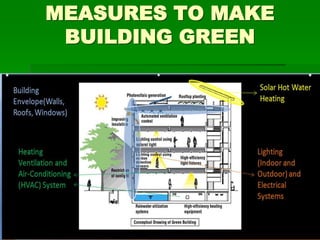
MEASURES TO MAKE
BUILDING GREEN
GREEN BUILDINGS- ENERGY
PERSPECTIVE
 Green homes will allow home owners, to
significantly save on electricity and water,
even generate less waste. Suggested energy
saving methods are –
 1. Use structural insulated panels for floors
, walls and roofs
 2. Apply water heater jacket
 3. Insulate hot water pipes
 4. Convert gas to tank less heaters
 5. Install compact fluorescent light bulbs
(CFL)
Contd….
 6. Install lighting controls
 7. Install high efficiency ceiling fans with
CFLs
 8. Install house hold appliances with EPA
energy star label
 9. Install floor installations over crawl
space
 10 .Install Energy efficient windows
 11.Ensure proper roof insulation and
venting
 12.Use duct mastic on all duct joints
Contd……
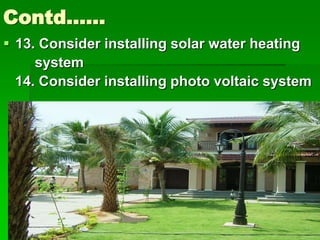
 13. Consider installing solar water heating
system
14. Consider installing photo voltaic system
Contd…..
15. WATER MANAGEMENT
a.Indoor Water Management
b. Outdoor Water Management
c. Waste Water Reuse:
Contd….
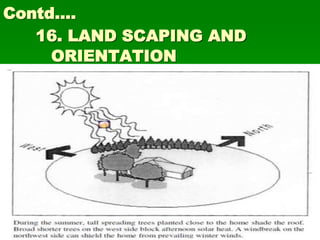
16. LAND SCAPING AND
ORIENTATION
Contd….
17. WIND PROTECTION
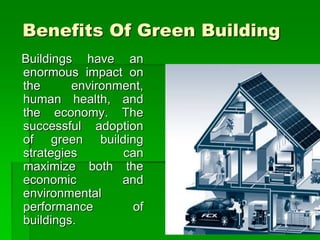
Benefits Of Green Building
Buildings have an
enormous impact on
the environment,
human health, and
the economy. The
successful adoption
of green building
strategies can
maximize both the
economic and
environmental
performance of
buildings.
Environmental benefits
 Enhance and protect
biodiversity and
ecosystems
 Improve air and water
quality
 Reduce waste
streams
 Conserve and restore
natural resources
Economic benefits
 Reduce operating costs
 Create, expand, and shape markets for
green product and services
 Improve occupant productivity
 Optimize life-cycle economic
performance
Social benefits
 Enhance occupant comfort and health
 Heighten aesthetic qualities
 Minimize strain on local infrastructure
 Improve overall quality of life
How do buildings affect
natural resources?
 Buildings and development have significant
environmental impacts on our natural resources,
including:
 According to surveys conducted in 2002, 27.3
million acres of the 0.683 billion acres of total land
area in the INDIA is developed, which represents
an increase of 24 percent in developed land over
the past 10 years.
 In terms of energy, buildings accounted for 42
percent of total energy consumption and 67.9
percent of total electricity consumption in 2002.
Cont….
 Building occupants use 12.2 percent of the total water
consumed in the INDIA per day.
 Buildings, and the transportation infrastructure that
serves them, replace natural surfaces with
impermeable materials, creating runoff that washes
pollutants and sediments into surface waters. Urban
runoff constitutes a major threat to water resources, as
it has been identified as the fourth leading source of
impairment in rivers, third in lakes, and second on
estuaries.
How do buildings affect
climate change?
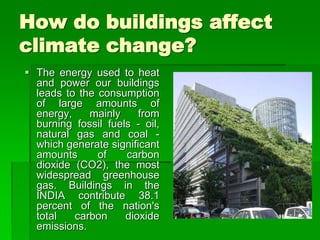
 The energy used to heat
and power our buildings
leads to the consumption
of large amounts of
energy, mainly from
burning fossil fuels - oil,
natural gas and coal -
which generate significant
amounts of carbon
dioxide (CO2), the most
widespread greenhouse
gas. Buildings in the
INDIA contribute 38.1
percent of the nation's
total carbon dioxide
emissions.
Cont….
 Reducing the energy use and greenhouse gas
emissions produced by buildings is therefore
fundamental to the effort to slow the pace of
global climate change. Buildings may be
associated with the release of greenhouse
gases in other ways, for example, construction
and demolition debris that degrades in landfills
may generate methane, and the extraction and
manufacturing of building materials may also
generate greenhouse gas emissions.
CONCLUSION
 Green building Concept can be
achieved by the following:
 Establish a vision that embraces
sustainable principles and an integrated
design approach.
 Develop a clear statement of the project's
vision, goals, design criteria, and
priorities.
Contd…..
 Develop a project budget that covers green
building measures. Allocate contingencies for
additional research and analysis of specific
options.
 Seek advice of a design professional with green
building experience.
 Select a design and construction team that is
committed to the project vision.
Contd…….
 Develop a project schedule that allows for
systems testing and commissioning.
 Develop contract plans and specifications to
ensure that the building design is at a suitable
level of building performance.
 Create effective incentives and oversight.
Contd…
Hence the drive to “go green” is undoubtedly
welcome as the problems of water shortage,
energy crisis and climate change are seemingly
here to stay. Also the green concept has to be
developed for local context so that they can be
still be applied within the local and financial
needs.
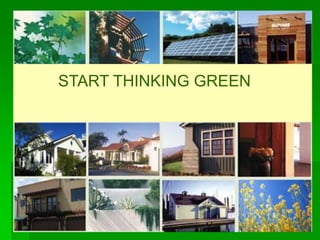
START THINKING GREEN
Kala Bansal.ppt

Kala Bansal.ppt

  • 1.
    SEMINAR ON GREEN BUILDINGCONCEPTS SUBMITTED BY: RAJWINDER SINGH BANSAL UNIVERISTY ROLL NO.81402105008
  • 2.
    Green Building Green building- also known as sustainable or high performance building - is the practice of:  Increasing the efficiency with which buildings and their sites use and harvest energy, water, and materials; and  Protecting and restoring human health and the environment, throughout the building life- cycle: siting, design, construction, operation, maintenance, renovation and deconstruction.
  • 3.
    Green Building Concept The`Green Building' concept is gaining importance in various countries, including India. These are buildings that ensure that waste is minimized at every stage during the construction and operation of the building, resulting in low costs, according to experts in the technology.
  • 4.
    Cont….  The techniquesassociated with the `Green Building' include measures to prevent erosion of soil, rainwater harvesting, preparation of landscapes to reduce heat, reduction in usage of potable water, recycling of waste water and use of world class energy efficient practices.
  • 5.
    What makes abuilding "green"? A green building is a structure that is environmentally responsible and resource-efficient throughout its life-cycle. These objectives expand and complement the classical building design concerns of economy, utility, durability, and comfort.
  • 6.
    Green buildings aredesigned to reduce the overall impact of the built environment on human health and the natural environment by:  Efficiently using energy, water, and other resources  Protecting occupant health and improving employee productivity  Reducing waste, pollution and environment degradation
  • 7.
    For example………. Green buildingsmay incorporate sustainable materials in their construction (e.g., reused, recycled-content, or made from renewable resources); Create healthy indoor environments with minimal pollutants (e.g., reduced product emissions); And feature landscaping that reduces water usage (e.g., by using native plants that survive without extra watering).
  • 8.
  • 9.
    Building Types  Homes Schools  Commercial Buildings  Laboratories  Healthcare Facilities
  • 10.
    STAGES OF GREEN BUILDINGDESIGN PLANNING PROCESS  1. Site selection and planning  2. Budget planning  3. Capital planning  4. Program planning
  • 11.
    contd….. DESIGN PROCESS 1. Clientawareness and goal setting 2. Green visions, project goals, and green criteria 3. Team development 4. Well-integrated design 5. Resource management 6. Performance goals
  • 12.
    Contd. OPERATION AND MAINTAINENCE 1.Commissioning of building systems 2. Building operation 3. Maintenance practices 4. Renovation 5. Demolition
  • 13.
    ELEMENTS OF A GREENBUILDING (A) Site Selection (B) Energy Efficiency (C) Materials (d) Water (e) Waster (f) Building Operation and Maintenance
  • 14.
    CLIMATIC ZONES OF INDIA 1ColdZone 2 Composite Zone 3 Moderate zone 4 Hot and Dry Zone
  • 15.
  • 16.
    MAIN CRITARIA FOR DESIGN A.COLD REGION: 1. Resisting heat loss by insulation& infiltration 2. Promoting heat gain by directly admitting & trapping solar radiation within living space 3. Installing specially designed solar air heating systems at roof tops
  • 17.
    Contd. B. Hot &Dry Zone: 1. Resisting heat gain by providing shading, reducing exposed area ,controlling & scheduling ventilation 2. Increasing thermal capacity 3. Having water bodies to increase the humidity so as to lower the air temperature
  • 18.
    Contd…  C. COMPSITEZONE :  Same as that of Hot & Dry Zone except that maximising of cross ventilation is desire able in the monsoon period.  D. MODERATE ZONE  1. Reducing heat gain by providing shading  2. Promoting heat loss by ventilation
  • 19.
    PERCEPTION AND REALITIES  Perception# 1  Green Building are costly  While the initial one time increment in cost is 8-10% more ,the operating cost work out to be 80-85% over its life cycle. Hence the initial additional investment can be paid back in 6-7 years,& we can have savings for the remaining life of the building
  • 20.
    Cond…  PERCEPTION #2  GREEN BUILDINGS TAKE MORE TIME  In the initial stages when we started building green buildings , the design & planning period was off course higher than normal buildings but now since so much capacity building has happened in the country , there is absolutely no difference in constructing a green building vis-a -vis a normal building
  • 21.
    Contd….  PERCEPTIONS #3  GREEN BUIDINGS REQUIRE AIR CONDITIONING  But the reality is that it can be applied to non – air conditioned buildings also, examples are IGP office Gulbarga, Royal Engineering College Hyderabad, & LIC office Shimoga
  • 22.
  • 23.
    GREEN BUILDINGS- ENERGY PERSPECTIVE Green homes will allow home owners, to significantly save on electricity and water, even generate less waste. Suggested energy saving methods are –  1. Use structural insulated panels for floors , walls and roofs  2. Apply water heater jacket  3. Insulate hot water pipes  4. Convert gas to tank less heaters  5. Install compact fluorescent light bulbs (CFL)
  • 24.
    Contd….  6. Installlighting controls  7. Install high efficiency ceiling fans with CFLs  8. Install house hold appliances with EPA energy star label  9. Install floor installations over crawl space  10 .Install Energy efficient windows  11.Ensure proper roof insulation and venting  12.Use duct mastic on all duct joints
  • 25.
    Contd……  13. Considerinstalling solar water heating system 14. Consider installing photo voltaic system
  • 26.
    Contd….. 15. WATER MANAGEMENT a.IndoorWater Management b. Outdoor Water Management c. Waste Water Reuse:
  • 27.
  • 28.
  • 29.
    Benefits Of GreenBuilding Buildings have an enormous impact on the environment, human health, and the economy. The successful adoption of green building strategies can maximize both the economic and environmental performance of buildings.
  • 30.
    Environmental benefits  Enhanceand protect biodiversity and ecosystems  Improve air and water quality  Reduce waste streams  Conserve and restore natural resources
  • 31.
    Economic benefits  Reduceoperating costs  Create, expand, and shape markets for green product and services  Improve occupant productivity  Optimize life-cycle economic performance
  • 32.
    Social benefits  Enhanceoccupant comfort and health  Heighten aesthetic qualities  Minimize strain on local infrastructure  Improve overall quality of life
  • 33.
    How do buildingsaffect natural resources?  Buildings and development have significant environmental impacts on our natural resources, including:  According to surveys conducted in 2002, 27.3 million acres of the 0.683 billion acres of total land area in the INDIA is developed, which represents an increase of 24 percent in developed land over the past 10 years.  In terms of energy, buildings accounted for 42 percent of total energy consumption and 67.9 percent of total electricity consumption in 2002.
  • 34.
    Cont….  Building occupantsuse 12.2 percent of the total water consumed in the INDIA per day.  Buildings, and the transportation infrastructure that serves them, replace natural surfaces with impermeable materials, creating runoff that washes pollutants and sediments into surface waters. Urban runoff constitutes a major threat to water resources, as it has been identified as the fourth leading source of impairment in rivers, third in lakes, and second on estuaries.
  • 35.
    How do buildingsaffect climate change?  The energy used to heat and power our buildings leads to the consumption of large amounts of energy, mainly from burning fossil fuels - oil, natural gas and coal - which generate significant amounts of carbon dioxide (CO2), the most widespread greenhouse gas. Buildings in the INDIA contribute 38.1 percent of the nation's total carbon dioxide emissions.
  • 36.
    Cont….  Reducing theenergy use and greenhouse gas emissions produced by buildings is therefore fundamental to the effort to slow the pace of global climate change. Buildings may be associated with the release of greenhouse gases in other ways, for example, construction and demolition debris that degrades in landfills may generate methane, and the extraction and manufacturing of building materials may also generate greenhouse gas emissions.
  • 37.
    CONCLUSION  Green buildingConcept can be achieved by the following:  Establish a vision that embraces sustainable principles and an integrated design approach.  Develop a clear statement of the project's vision, goals, design criteria, and priorities.
  • 38.
    Contd…..  Develop aproject budget that covers green building measures. Allocate contingencies for additional research and analysis of specific options.  Seek advice of a design professional with green building experience.  Select a design and construction team that is committed to the project vision.
  • 39.
    Contd…….  Develop aproject schedule that allows for systems testing and commissioning.  Develop contract plans and specifications to ensure that the building design is at a suitable level of building performance.  Create effective incentives and oversight.
  • 40.
    Contd… Hence the driveto “go green” is undoubtedly welcome as the problems of water shortage, energy crisis and climate change are seemingly here to stay. Also the green concept has to be developed for local context so that they can be still be applied within the local and financial needs.
  • 41.