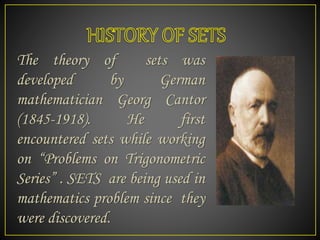
The theory of sets was
developed by German
mathematician Georg Cantor
(1845-1918). He first
encountered sets while working
on “Problems on Trigonometric
Series” . SETS are being used in
mathematics problem since they
were discovered.
Collection of object of a particular kind,
such as, a pack of cards, a crowed of
people, a cricket team etc. In mathematics
of natural number, prime numbers etc.
 Elements of a set are
synonymous terms.
 Sets are usually denoted
by capital letters.
 Elements of a set are
represented by small
letters.
There are two ways to
represent sets
 Roster or tabular
form.
In roster form, all the
elements of set are listed,
the elements are being
separated by commas and are
enclosed within braces { }.
e.g. : set of
1,2,3,4,5,6,7,8,9,10.
SET-BUILDER FORM
In set-builder form, all the elements of a set possess
a single common property which is not possessed
by an element outside the set.
e.g. : set of natural numbers k
k= {x : x is a natural number}
N : the set of all natural
numbers
Z : the set of all integers
Q : the set of all rational
numbers
R : the set of all real numbers
Z+ : the set of positive
Empty sets.
Finite &Infinite sets.
Equal sets.
Subset.
Power set.
Universal set.
THE EMPTY SET
A set which doesn't contains any element is called the
empty set or null set or void set, denoted by
symbol ϕ or { }.
e.g. : let R = {x : 1< x < 2, x is a natural
number}
A set which is empty or consist
of a definite numbers of
elements is called finite
otherwise, the set is called
infinite.
e.g. : let k be the set of the days
of the week. Then k is finite
let R be the set of points
Given two sets K & r are said
to be equal if they have
exactly the same element and
we write K=R. otherwise the
sets are said to be unequal and
we write K=R.
e.g. : let K = {1,2,3,4} & R=
{1,2,3,4}
A set R is said to be subset
of a set K if every element of
R is also an element K.
R ⊂ K
This mean all the elements of
R contained in K
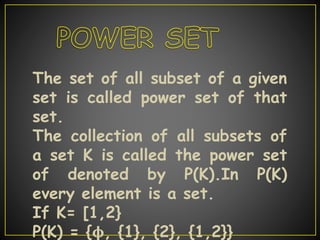
The set of all subset of a given
set is called power set of that
set.
The collection of all subsets of
a set K is called the power set
of denoted by P(K).In P(K)
every element is a set.
If K= [1,2}
P(K) = {ϕ, {1}, {2}, {1,2}}
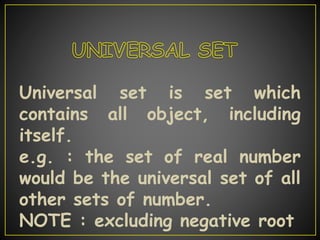
Universal set is set which
contains all object, including
itself.
e.g. : the set of real number
would be the universal set of all
other sets of number.
NOTE : excluding negative root
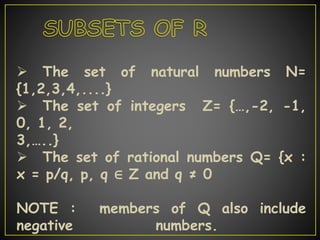
 The set of natural numbers N=
{1,2,3,4,....}
 The set of integers Z= {…,-2, -1,
0, 1, 2,
3,…..}
 The set of rational numbers Q= {x :
x = p/q, p, q ∈ Z and q ≠ 0
NOTE : members of Q also include
negative numbers.
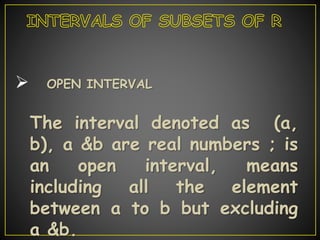
 OPEN INTERVAL
The interval denoted as (a,
b), a &b are real numbers ; is
an open interval, means
including all the element
between a to b but excluding
a &b.
The interval denoted as
[a, b], a &b are Real
numbers ; is an open
interval, means including
all the element between a
to b but including a &b.
 (a, b) = {x : a < x < b}
 [a, b] = {x : a ≤ x ≤ b}
 [a, b) = {x : a ≤ x < b}
 (a, b) = {x : a < x ≤ b}
 A Venn diagram or set diagram is
a diagram that shows all
possible logical relations between a
finite collection of sets. Venn
diagrams were conceived around 1880
by John Venn. They are used to teach
elementary set theory, as well as
illustrate simple set relationships
in probability, logic,
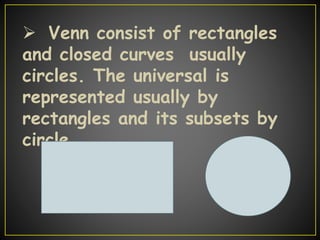
 Venn consist of rectangles
and closed curves usually
circles. The universal is
represented usually by
rectangles and its subsets by
circle.
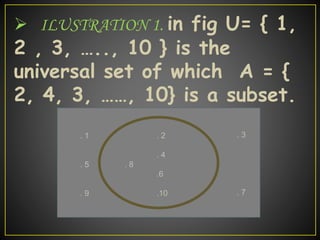
 ILUSTRATION 1. in fig U= { 1,
2 , 3, ….., 10 } is the
universal set of which A = {
2, 4, 3, ……, 10} is a subset.
. 2
. 4
. 8
.6
.10
. 3
. 7
. 1
. 5
. 9
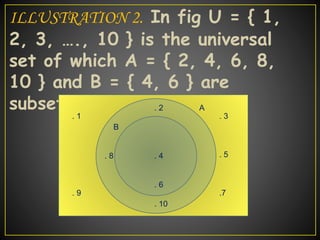
ILLUSTRATION 2. In fig U = { 1,
2, 3, …., 10 } is the universal
set of which A = { 2, 4, 6, 8,
10 } and B = { 4, 6 } are
subsets, and also B ⊂ A. 2 A
B
. 8 . 4
. 6
. 10
. 3
. 5
.7
. 1
. 9
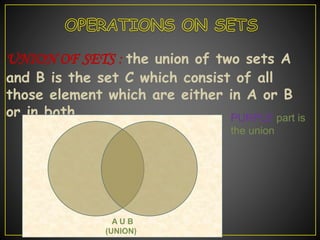
UNION OF SETS : the union of two sets A
and B is the set C which consist of all
those element which are either in A or B
or in both. PURPLE part is
the union
A U B
(UNION)
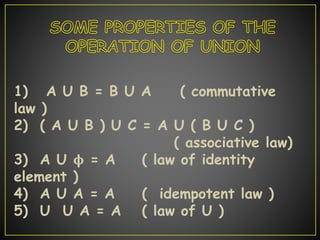
1) A U B = B U A ( commutative
law )
2) ( A U B ) U C = A U ( B U C )
( associative law)
3) A U ϕ = A ( law of identity
element )
4) A U A = A ( idempotent law )
5) U U A = A ( law of U )
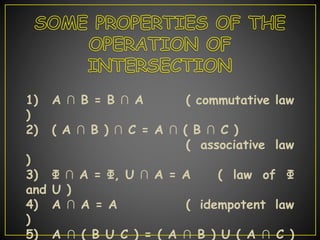
1) A ∩ B = B ∩ A ( commutative law
)
2) ( A ∩ B ) ∩ C = A ∩ ( B ∩ C )
( associative law
)
3) Φ ∩ A = Φ, U ∩ A = A ( law of Φ
and U )
4) A ∩ A = A ( idempotent law
)
5) A ∩ ( B U C ) = ( A ∩ B ) U ( A ∩ C )
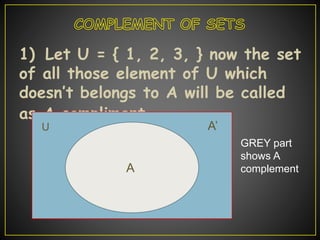
1) Let U = { 1, 2, 3, } now the set
of all those element of U which
doesn’t belongs to A will be called
as A compliment.
U
A
A’
GREY part
shows A
complement
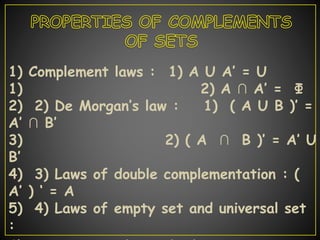
1) Complement laws : 1) A U A’ = U
1) 2) A ∩ A’ = Φ
2) 2) De Morgan’s law : 1) ( A U B )’ =
A’ ∩ B’
3) 2) ( A ∩ B )’ = A’ U
B’
4) 3) Laws of double complementation : (
A’ ) ‘ = A
5) 4) Laws of empty set and universal set
:
Sets PowerPoint Presentation

Sets PowerPoint Presentation

  • 2.
    The theory ofsets was developed by German mathematician Georg Cantor (1845-1918). He first encountered sets while working on “Problems on Trigonometric Series” . SETS are being used in mathematics problem since they were discovered.
  • 3.
    Collection of objectof a particular kind, such as, a pack of cards, a crowed of people, a cricket team etc. In mathematics of natural number, prime numbers etc.
  • 4.
     Elements ofa set are synonymous terms.  Sets are usually denoted by capital letters.  Elements of a set are represented by small letters.
  • 5.
    There are twoways to represent sets  Roster or tabular form.
  • 6.
    In roster form,all the elements of set are listed, the elements are being separated by commas and are enclosed within braces { }. e.g. : set of 1,2,3,4,5,6,7,8,9,10.
  • 7.
    SET-BUILDER FORM In set-builderform, all the elements of a set possess a single common property which is not possessed by an element outside the set. e.g. : set of natural numbers k k= {x : x is a natural number}
  • 8.
    N : theset of all natural numbers Z : the set of all integers Q : the set of all rational numbers R : the set of all real numbers Z+ : the set of positive
  • 9.
    Empty sets. Finite &Infinitesets. Equal sets. Subset. Power set. Universal set.
  • 10.
    THE EMPTY SET Aset which doesn't contains any element is called the empty set or null set or void set, denoted by symbol ϕ or { }. e.g. : let R = {x : 1< x < 2, x is a natural number}
  • 11.
    A set whichis empty or consist of a definite numbers of elements is called finite otherwise, the set is called infinite. e.g. : let k be the set of the days of the week. Then k is finite let R be the set of points
  • 12.
    Given two setsK & r are said to be equal if they have exactly the same element and we write K=R. otherwise the sets are said to be unequal and we write K=R. e.g. : let K = {1,2,3,4} & R= {1,2,3,4}
  • 13.
    A set Ris said to be subset of a set K if every element of R is also an element K. R ⊂ K This mean all the elements of R contained in K
  • 14.
    The set ofall subset of a given set is called power set of that set. The collection of all subsets of a set K is called the power set of denoted by P(K).In P(K) every element is a set. If K= [1,2} P(K) = {ϕ, {1}, {2}, {1,2}}
  • 15.
    Universal set isset which contains all object, including itself. e.g. : the set of real number would be the universal set of all other sets of number. NOTE : excluding negative root
  • 16.
     The setof natural numbers N= {1,2,3,4,....}  The set of integers Z= {…,-2, -1, 0, 1, 2, 3,…..}  The set of rational numbers Q= {x : x = p/q, p, q ∈ Z and q ≠ 0 NOTE : members of Q also include negative numbers.
  • 17.
     OPEN INTERVAL Theinterval denoted as (a, b), a &b are real numbers ; is an open interval, means including all the element between a to b but excluding a &b.
  • 18.
    The interval denotedas [a, b], a &b are Real numbers ; is an open interval, means including all the element between a to b but including a &b.
  • 19.
     (a, b)= {x : a < x < b}  [a, b] = {x : a ≤ x ≤ b}  [a, b) = {x : a ≤ x < b}  (a, b) = {x : a < x ≤ b}
  • 20.
     A Venndiagram or set diagram is a diagram that shows all possible logical relations between a finite collection of sets. Venn diagrams were conceived around 1880 by John Venn. They are used to teach elementary set theory, as well as illustrate simple set relationships in probability, logic,
  • 21.
     Venn consistof rectangles and closed curves usually circles. The universal is represented usually by rectangles and its subsets by circle.
  • 22.
     ILUSTRATION 1.in fig U= { 1, 2 , 3, ….., 10 } is the universal set of which A = { 2, 4, 3, ……, 10} is a subset. . 2 . 4 . 8 .6 .10 . 3 . 7 . 1 . 5 . 9
  • 23.
    ILLUSTRATION 2. Infig U = { 1, 2, 3, …., 10 } is the universal set of which A = { 2, 4, 6, 8, 10 } and B = { 4, 6 } are subsets, and also B ⊂ A. 2 A B . 8 . 4 . 6 . 10 . 3 . 5 .7 . 1 . 9
  • 24.
    UNION OF SETS: the union of two sets A and B is the set C which consist of all those element which are either in A or B or in both. PURPLE part is the union A U B (UNION)
  • 25.
    1) A UB = B U A ( commutative law ) 2) ( A U B ) U C = A U ( B U C ) ( associative law) 3) A U ϕ = A ( law of identity element ) 4) A U A = A ( idempotent law ) 5) U U A = A ( law of U )
  • 26.
    1) A ∩B = B ∩ A ( commutative law ) 2) ( A ∩ B ) ∩ C = A ∩ ( B ∩ C ) ( associative law ) 3) Φ ∩ A = Φ, U ∩ A = A ( law of Φ and U ) 4) A ∩ A = A ( idempotent law ) 5) A ∩ ( B U C ) = ( A ∩ B ) U ( A ∩ C )
  • 27.
    1) Let U= { 1, 2, 3, } now the set of all those element of U which doesn’t belongs to A will be called as A compliment. U A A’ GREY part shows A complement
  • 28.
    1) Complement laws: 1) A U A’ = U 1) 2) A ∩ A’ = Φ 2) 2) De Morgan’s law : 1) ( A U B )’ = A’ ∩ B’ 3) 2) ( A ∩ B )’ = A’ U B’ 4) 3) Laws of double complementation : ( A’ ) ‘ = A 5) 4) Laws of empty set and universal set :