Theory
of
Sets
Presenter
Md. Akter Nashid Rajin
Table of Contents
 A set
 Characteristics of a set
 Elements of Sets
 Method of set
 Types of set
 Operations on sets
 Some laws of set theory
 Let’s exercise
 Question & Answer
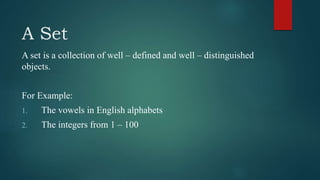
A Set
A set is a collection of well – defined and well – distinguished
objects.
For Example:
1. The vowels in English alphabets
2. The integers from 1 – 100
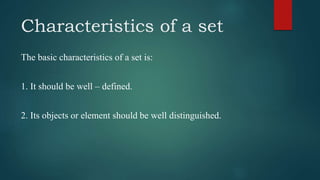
Characteristics of a set
The basic characteristics of a set is:
1. It should be well – defined.
2. Its objects or element should be well distinguished.
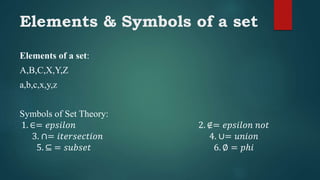
Elements & Symbols of a set
Elements of a set:
A,B,C,X,Y,Z
a,b,c,x,y,z
Symbols of Set Theory:
1. ∈= 𝑒𝑝𝑠𝑖𝑙𝑜𝑛 2. ∉= 𝑒𝑝𝑠𝑖𝑙𝑜𝑛 𝑛𝑜𝑡
3. ∩= 𝑖𝑡𝑒𝑟𝑠𝑒𝑐𝑡𝑖𝑜𝑛 4. ∪= 𝑢𝑛𝑖𝑜𝑛
5. ⊆ = 𝑠𝑢𝑏𝑠𝑒𝑡 6. ∅ = 𝑝ℎ𝑖
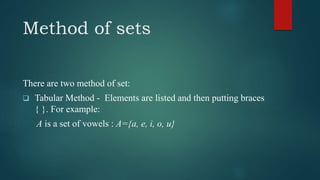
Method of sets
There are two method of set:
 Tabular Method - Elements are listed and then putting braces
{ }. For example:
A is a set of vowels : A={a, e, i, o, u}
Method of sets
 Selector Method - Elements are not listed but are indicate by
description of their characteristics. For example:
A = {x | x is a vowel in English alphabet}
Types of set
 Finite Set - A set can be counted by a finite number of elements.
A= {1, 2, 3, 4, 5, 6}
 Infinite Set- Aset cannot be counted in a finite number.
A = {1, 2, 3…. …}
 Singleton set– A set contain only one element.
A = {a}
 Empty, Null Set - Any set which has no element. This sets are denote by
{} / ∅ (𝑝ℎ𝑖).
Types of set
 Equal Set – The elements of both are equal.
 Equivalent Sets If the elements of one set can be, put into one to one
correspondence with the elements of another set, then the two sets are
called equivalent sets The symbol used to denote this set is [ ≡ ].
 Subsets– If every elements of set A is also an element of a set B then set A
is called subset of B “A is a subset of B” (A ⊆ B).
Here B is super set &A is Subset
Types of set
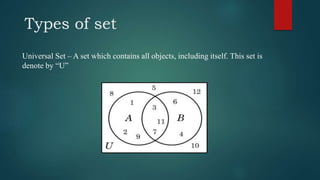
Universal Set – A set which contains all objects, including itself. This set is
denote by “U”
Operations on sets
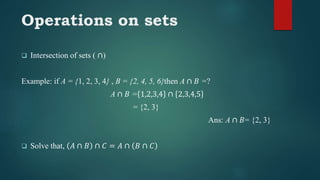
 Intersection of sets ( ∩)
The intersection of two sets A and B is the set that contains all elements
of A that also belong to B , but no other elements.
The intersection of two sets A and B is denoted as (A ∩ B) which is read a “A
cap B” or “A intersection B ”
In other words,
x ∈ A ∩ B
or, x ∈ A and x ∈ B
Operations on sets
 Intersection of sets ( ∩)
Example: if A = {1, 2, 3, 4} , B = {2, 4, 5, 6}then A ∩ 𝐵 =?
A ∩ 𝐵 = 1,2,3,4 ∩ 2,3,4,5
= {2, 3}
Ans: A ∩ 𝐵= {2, 3}
 Solve that, 𝐴 ∩ 𝐵 ∩ 𝐶 = 𝐴 ∩ 𝐵 ∩ 𝐶
Operations on sets
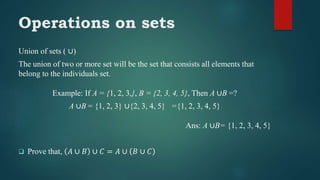
Union of sets ( ∪)
The union of two or more set will be the set that consists all elements that
belong to the individuals set.
Example: If A = {1, 2, 3,}, B = {2, 3, 4, 5}, Then A ∪B =?
A ∪B = {1, 2, 3} ∪{2, 3, 4, 5} ={1, 2, 3, 4, 5}
Ans: A ∪B= {1, 2, 3, 4, 5}
 Prove that, 𝐴 ∪ 𝐵 ∪ 𝐶 = 𝐴 ∪ 𝐵 ∪ 𝐶
Some Laws of set theory
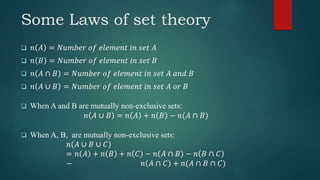
 𝑛 𝐴 = 𝑁𝑢𝑚𝑏𝑒𝑟 𝑜𝑓 𝑒𝑙𝑒𝑚𝑒𝑛𝑡 𝑖𝑛 𝑠𝑒𝑡 𝐴
 𝑛 𝐵 = 𝑁𝑢𝑚𝑏𝑒𝑟 𝑜𝑓 𝑒𝑙𝑒𝑚𝑒𝑛𝑡 𝑖𝑛 𝑠𝑒𝑡 𝐵
 𝑛 𝐴 ∩ 𝐵 = 𝑁𝑢𝑚𝑏𝑒𝑟 𝑜𝑓 𝑒𝑙𝑒𝑚𝑒𝑛𝑡 𝑖𝑛 𝑠𝑒𝑡 𝐴 𝑎𝑛𝑑 𝐵
 𝑛 𝐴 ∪ 𝐵 = 𝑁𝑢𝑚𝑏𝑒𝑟 𝑜𝑓 𝑒𝑙𝑒𝑚𝑒𝑛𝑡 𝑖𝑛 𝑠𝑒𝑡 𝐴 𝑜𝑟 𝐵
 When A and B are mutually non-exclusive sets:
𝑛 𝐴 ∪ 𝐵 = 𝑛 𝐴 + 𝑛 𝐵 − 𝑛(𝐴 ∩ 𝐵)
 When A, B, are mutually non-exclusive sets:
𝑛 𝐴 ∪ 𝐵 ∪ 𝐶
= 𝑛 𝐴 + 𝑛 𝐵 + 𝑛 𝐶 − 𝑛 𝐴 ∩ 𝐵 − 𝑛 𝐵 ∩ 𝐶
− 𝑛 𝐴 ∩ 𝐶 + 𝑛(𝐴 ∩ 𝐵 ∩ 𝐶)
Some Laws of set theory
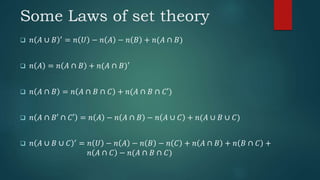
 𝑛 𝐴 ∪ 𝐵 ′ = 𝑛 𝑈 − 𝑛 𝐴 − 𝑛 𝐵 + 𝑛(𝐴 ∩ 𝐵)
 𝑛 𝐴 = 𝑛 𝐴 ∩ 𝐵 + 𝑛(𝐴 ∩ 𝐵)′
 𝑛 𝐴 ∩ 𝐵 = 𝑛 𝐴 ∩ 𝐵 ∩ 𝐶 + 𝑛(𝐴 ∩ 𝐵 ∩ 𝐶′)
 𝑛 𝐴 ∩ 𝐵′ ∩ 𝐶′ = 𝑛 𝐴 − 𝑛 𝐴 ∩ 𝐵 − 𝑛 𝐴 ∪ 𝐶 + 𝑛(𝐴 ∪ 𝐵 ∪ 𝐶)
 𝑛 𝐴 ∪ 𝐵 ∪ 𝐶 ′ = 𝑛 𝑈 − 𝑛 𝐴 − 𝑛 𝐵 − 𝑛 𝐶 + 𝑛 𝐴 ∩ 𝐵 + 𝑛 𝐵 ∩ 𝐶 +
𝑛 𝐴 ∩ 𝐶 − 𝑛(𝐴 ∩ 𝐵 ∩ 𝐶)
Let’s Exercise
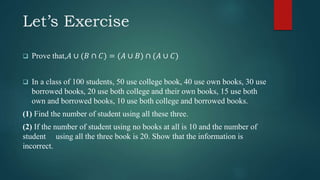
 Prove that,𝐴 ∪ (𝐵 ∩ 𝐶) = (𝐴 ∪ 𝐵) ∩ (𝐴 ∪ 𝐶)
 In a class of 100 students, 50 use college book, 40 use own books, 30 use
borrowed books, 20 use both college and their own books, 15 use both
own and borrowed books, 10 use both college and borrowed books.
(1) Find the number of student using all these three.
(2) If the number of student using no books at all is 10 and the number of
student using all the three book is 20. Show that the information is
incorrect.
Thank
You

Set theory

  • 1.
  • 2.
  • 3.
    Table of Contents A set  Characteristics of a set  Elements of Sets  Method of set  Types of set  Operations on sets  Some laws of set theory  Let’s exercise  Question & Answer
  • 4.
    A Set A setis a collection of well – defined and well – distinguished objects. For Example: 1. The vowels in English alphabets 2. The integers from 1 – 100
  • 5.
    Characteristics of aset The basic characteristics of a set is: 1. It should be well – defined. 2. Its objects or element should be well distinguished.
  • 6.
    Elements & Symbolsof a set Elements of a set: A,B,C,X,Y,Z a,b,c,x,y,z Symbols of Set Theory: 1. ∈= 𝑒𝑝𝑠𝑖𝑙𝑜𝑛 2. ∉= 𝑒𝑝𝑠𝑖𝑙𝑜𝑛 𝑛𝑜𝑡 3. ∩= 𝑖𝑡𝑒𝑟𝑠𝑒𝑐𝑡𝑖𝑜𝑛 4. ∪= 𝑢𝑛𝑖𝑜𝑛 5. ⊆ = 𝑠𝑢𝑏𝑠𝑒𝑡 6. ∅ = 𝑝ℎ𝑖
  • 7.
    Method of sets Thereare two method of set:  Tabular Method - Elements are listed and then putting braces { }. For example: A is a set of vowels : A={a, e, i, o, u}
  • 8.
    Method of sets Selector Method - Elements are not listed but are indicate by description of their characteristics. For example: A = {x | x is a vowel in English alphabet}
  • 9.
    Types of set Finite Set - A set can be counted by a finite number of elements. A= {1, 2, 3, 4, 5, 6}  Infinite Set- Aset cannot be counted in a finite number. A = {1, 2, 3…. …}  Singleton set– A set contain only one element. A = {a}  Empty, Null Set - Any set which has no element. This sets are denote by {} / ∅ (𝑝ℎ𝑖).
  • 10.
    Types of set Equal Set – The elements of both are equal.  Equivalent Sets If the elements of one set can be, put into one to one correspondence with the elements of another set, then the two sets are called equivalent sets The symbol used to denote this set is [ ≡ ].  Subsets– If every elements of set A is also an element of a set B then set A is called subset of B “A is a subset of B” (A ⊆ B). Here B is super set &A is Subset
  • 11.
    Types of set UniversalSet – A set which contains all objects, including itself. This set is denote by “U”
  • 12.
    Operations on sets Intersection of sets ( ∩) The intersection of two sets A and B is the set that contains all elements of A that also belong to B , but no other elements. The intersection of two sets A and B is denoted as (A ∩ B) which is read a “A cap B” or “A intersection B ” In other words, x ∈ A ∩ B or, x ∈ A and x ∈ B
  • 13.
    Operations on sets Intersection of sets ( ∩) Example: if A = {1, 2, 3, 4} , B = {2, 4, 5, 6}then A ∩ 𝐵 =? A ∩ 𝐵 = 1,2,3,4 ∩ 2,3,4,5 = {2, 3} Ans: A ∩ 𝐵= {2, 3}  Solve that, 𝐴 ∩ 𝐵 ∩ 𝐶 = 𝐴 ∩ 𝐵 ∩ 𝐶
  • 14.
    Operations on sets Unionof sets ( ∪) The union of two or more set will be the set that consists all elements that belong to the individuals set. Example: If A = {1, 2, 3,}, B = {2, 3, 4, 5}, Then A ∪B =? A ∪B = {1, 2, 3} ∪{2, 3, 4, 5} ={1, 2, 3, 4, 5} Ans: A ∪B= {1, 2, 3, 4, 5}  Prove that, 𝐴 ∪ 𝐵 ∪ 𝐶 = 𝐴 ∪ 𝐵 ∪ 𝐶
  • 15.
    Some Laws ofset theory  𝑛 𝐴 = 𝑁𝑢𝑚𝑏𝑒𝑟 𝑜𝑓 𝑒𝑙𝑒𝑚𝑒𝑛𝑡 𝑖𝑛 𝑠𝑒𝑡 𝐴  𝑛 𝐵 = 𝑁𝑢𝑚𝑏𝑒𝑟 𝑜𝑓 𝑒𝑙𝑒𝑚𝑒𝑛𝑡 𝑖𝑛 𝑠𝑒𝑡 𝐵  𝑛 𝐴 ∩ 𝐵 = 𝑁𝑢𝑚𝑏𝑒𝑟 𝑜𝑓 𝑒𝑙𝑒𝑚𝑒𝑛𝑡 𝑖𝑛 𝑠𝑒𝑡 𝐴 𝑎𝑛𝑑 𝐵  𝑛 𝐴 ∪ 𝐵 = 𝑁𝑢𝑚𝑏𝑒𝑟 𝑜𝑓 𝑒𝑙𝑒𝑚𝑒𝑛𝑡 𝑖𝑛 𝑠𝑒𝑡 𝐴 𝑜𝑟 𝐵  When A and B are mutually non-exclusive sets: 𝑛 𝐴 ∪ 𝐵 = 𝑛 𝐴 + 𝑛 𝐵 − 𝑛(𝐴 ∩ 𝐵)  When A, B, are mutually non-exclusive sets: 𝑛 𝐴 ∪ 𝐵 ∪ 𝐶 = 𝑛 𝐴 + 𝑛 𝐵 + 𝑛 𝐶 − 𝑛 𝐴 ∩ 𝐵 − 𝑛 𝐵 ∩ 𝐶 − 𝑛 𝐴 ∩ 𝐶 + 𝑛(𝐴 ∩ 𝐵 ∩ 𝐶)
  • 16.
    Some Laws ofset theory  𝑛 𝐴 ∪ 𝐵 ′ = 𝑛 𝑈 − 𝑛 𝐴 − 𝑛 𝐵 + 𝑛(𝐴 ∩ 𝐵)  𝑛 𝐴 = 𝑛 𝐴 ∩ 𝐵 + 𝑛(𝐴 ∩ 𝐵)′  𝑛 𝐴 ∩ 𝐵 = 𝑛 𝐴 ∩ 𝐵 ∩ 𝐶 + 𝑛(𝐴 ∩ 𝐵 ∩ 𝐶′)  𝑛 𝐴 ∩ 𝐵′ ∩ 𝐶′ = 𝑛 𝐴 − 𝑛 𝐴 ∩ 𝐵 − 𝑛 𝐴 ∪ 𝐶 + 𝑛(𝐴 ∪ 𝐵 ∪ 𝐶)  𝑛 𝐴 ∪ 𝐵 ∪ 𝐶 ′ = 𝑛 𝑈 − 𝑛 𝐴 − 𝑛 𝐵 − 𝑛 𝐶 + 𝑛 𝐴 ∩ 𝐵 + 𝑛 𝐵 ∩ 𝐶 + 𝑛 𝐴 ∩ 𝐶 − 𝑛(𝐴 ∩ 𝐵 ∩ 𝐶)
  • 17.
    Let’s Exercise  Provethat,𝐴 ∪ (𝐵 ∩ 𝐶) = (𝐴 ∪ 𝐵) ∩ (𝐴 ∪ 𝐶)  In a class of 100 students, 50 use college book, 40 use own books, 30 use borrowed books, 20 use both college and their own books, 15 use both own and borrowed books, 10 use both college and borrowed books. (1) Find the number of student using all these three. (2) If the number of student using no books at all is 10 and the number of student using all the three book is 20. Show that the information is incorrect.
  • 19.