MALPRESENTATIONS & MALPOSITIONS
General Considerations
◦ OSAMA MWARDA MD
1
2
MALPRESENTATIONS
ITEMS & TITLES
1.GENERAL CONSIDERATIONS (#1)
2.OCCIPUT POSTERIOR POSITION (#2)
3.FACE PRESENTATION & Brow presentation (#3)
4.BREECH PRESENTATION. (#4)
5.SHOULDER , COMPLEX,AND CORD (#5)
3
DEFINITION
The only normal presentations & positions are left
occiput anterior(LOA)& right occiput anterior ( ROA).
 Malposition: Normal presentation (vertex) but with
malposition of occiput which is directed posteriorly (OP).
 Malpresentation: Presentation other than normal
presentation (vertex).
4
CAUSES OF MALPRESENTATIONS
◦Causes of mal presentations in general
may be faults in powers (uterine
contractions), faults in the passenger
(fetus), or faults in the passages (birth
canal), or may be combined.
5
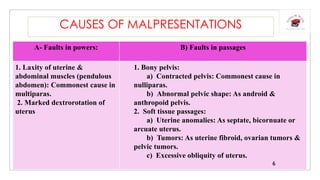
A- Faults in powers: B) Faults in passages
1. Laxity of uterine &
abdominal muscles (pendulous
abdomen): Commonest cause in
multiparas.
2. Marked dextrorotation of
uterus
1. Bony pelvis:
a)  Contracted pelvis: Commonest cause in
nulliparas.
b)  Abnormal pelvic shape: As android &
anthropoid pelvis.
2.  Soft tissue passages:
a)  Uterine anomalies: As septate, bicornuate or
arcuate uterus.
b)  Tumors: As uterine fibroid, ovarian tumors &
pelvic tumors.
c)  Excessive obliquity of uterus.
6
CAUSES OF MALPRESENTATIONS
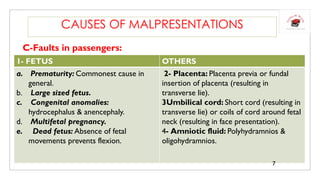
C-Faults in passengers:
CAUSES OF MALPRESENTATIONS
1- FETUS OTHERS
a. Prematurity: Commonest cause in
general.
b. Large sized fetus.
c. Congenital anomalies:
hydrocephalus & anencephaly.
d. Multifetal pregnancy.
e. Dead fetus: Absence of fetal
movements prevents flexion.
2- Placenta: Placenta previa or fundal
insertion of placenta (resulting in
transverse lie).
3Umbilical cord: Short cord (resulting in
transverse lie) or coils of cord around fetal
neck (resulting in face presentation).
4- Amniotic fluid: Polyhydramnios &
oligohydramnios.
7
General features:
A) History: ↑ fetal movements or lump in epigastrium.
B) Abdominal Examination:
1) Pendulous abdomen.
2) Unengaged head in last 3-4 weeks in primigravida.
3) FHS are heard above level of umbilicus.
4) Delay in descent of presenting part during labor.
DIAGNOSIS OF MALPRESENTATIONS
8
C) Vaginal Examination:
1) Feeling anything other than vertex.
2) PROM or membranes are bulging through non-dilated
cervix (membranes are felt as a sausage shaped
projection).
3) High presenting part.
D) Ultrasound & X-ray: Diagnosis of malpresentation &
fetopelvic disproportion.
DIAGNOSIS OF MALPRESENTATIONS
9
A) Maternal Complications
1) PROM: Leading to cord prolapse, dry labor & chorioamnionitis.
2) 1ry uterine inertia & delayed engagement.
3) Prolonged labor: Leading to maternal exhaustion.
4) Obstructed labor: Leading to rupture uterus.
5)  ↑ incidence of instrumental deliveries.
6)  ↑ incidence of maternal birth injuries.
7) PPH: Due to prolonged labor, anesthesia, maternal exhaustion & instrumental
deliveries.
8) Puerperal sepsis: Due to PROM & frequent vaginal examinations.
COMPLICATIONS OF MALPRESENTATIONS
10
B) Fetal Complications
1) Asphyxia: Due to prematurity, cord prolapse,
placental compression & ICH.
2) Fetal birth injuries.
COMPLICATIONS OF MALPRESENTATIONS
11
D.D. of irregular presenting part:
1) Face presentation.
2) Brow presentation.
3) In breech presentation: Complete breech, footling
presentation & knee presentation.
4) Shoulder presentation.
5) Complex presentation.
6) Cord presentation.
Differential Diagnosis in MALPRESENTATIONS
12
Head is delivered by flexion in:
1) Face to pubis.( direct OP)
2) Face direct MA.
3) After-coming head of breech.
The undeliverable presentations
1) Brow full term
2) Shoulder full term
3) Face mento-posterior
4) Deep transverse arrest of the head in macrosomic baby.
Differential Diagnosis in MALPRESENTATIONS
13
14

1 malpresentation (1)-

  • 1.
    MALPRESENTATIONS & MALPOSITIONS GeneralConsiderations ◦ OSAMA MWARDA MD 1
  • 2.
  • 3.
    MALPRESENTATIONS ITEMS & TITLES 1.GENERALCONSIDERATIONS (#1) 2.OCCIPUT POSTERIOR POSITION (#2) 3.FACE PRESENTATION & Brow presentation (#3) 4.BREECH PRESENTATION. (#4) 5.SHOULDER , COMPLEX,AND CORD (#5) 3
  • 4.
    DEFINITION The only normalpresentations & positions are left occiput anterior(LOA)& right occiput anterior ( ROA).  Malposition: Normal presentation (vertex) but with malposition of occiput which is directed posteriorly (OP).  Malpresentation: Presentation other than normal presentation (vertex). 4
  • 5.
    CAUSES OF MALPRESENTATIONS ◦Causesof mal presentations in general may be faults in powers (uterine contractions), faults in the passenger (fetus), or faults in the passages (birth canal), or may be combined. 5
  • 6.
    A- Faults in powers:B) Faults in passages 1. Laxity of uterine & abdominal muscles (pendulous abdomen): Commonest cause in multiparas. 2. Marked dextrorotation of uterus 1. Bony pelvis: a)  Contracted pelvis: Commonest cause in nulliparas. b)  Abnormal pelvic shape: As android & anthropoid pelvis. 2.  Soft tissue passages: a)  Uterine anomalies: As septate, bicornuate or arcuate uterus. b)  Tumors: As uterine fibroid, ovarian tumors & pelvic tumors. c)  Excessive obliquity of uterus. 6 CAUSES OF MALPRESENTATIONS
  • 7.
    C-Faults in passengers: CAUSESOF MALPRESENTATIONS 1- FETUS OTHERS a. Prematurity: Commonest cause in general. b. Large sized fetus. c. Congenital anomalies: hydrocephalus & anencephaly. d. Multifetal pregnancy. e. Dead fetus: Absence of fetal movements prevents flexion. 2- Placenta: Placenta previa or fundal insertion of placenta (resulting in transverse lie). 3Umbilical cord: Short cord (resulting in transverse lie) or coils of cord around fetal neck (resulting in face presentation). 4- Amniotic fluid: Polyhydramnios & oligohydramnios. 7
  • 8.
    General features: A) History:↑ fetal movements or lump in epigastrium. B) Abdominal Examination: 1) Pendulous abdomen. 2) Unengaged head in last 3-4 weeks in primigravida. 3) FHS are heard above level of umbilicus. 4) Delay in descent of presenting part during labor. DIAGNOSIS OF MALPRESENTATIONS 8
  • 9.
    C) Vaginal Examination: 1)Feeling anything other than vertex. 2) PROM or membranes are bulging through non-dilated cervix (membranes are felt as a sausage shaped projection). 3) High presenting part. D) Ultrasound & X-ray: Diagnosis of malpresentation & fetopelvic disproportion. DIAGNOSIS OF MALPRESENTATIONS 9
  • 10.
    A) Maternal Complications 1)PROM: Leading to cord prolapse, dry labor & chorioamnionitis. 2) 1ry uterine inertia & delayed engagement. 3) Prolonged labor: Leading to maternal exhaustion. 4) Obstructed labor: Leading to rupture uterus. 5)  ↑ incidence of instrumental deliveries. 6)  ↑ incidence of maternal birth injuries. 7) PPH: Due to prolonged labor, anesthesia, maternal exhaustion & instrumental deliveries. 8) Puerperal sepsis: Due to PROM & frequent vaginal examinations. COMPLICATIONS OF MALPRESENTATIONS 10
  • 11.
    B) Fetal Complications 1)Asphyxia: Due to prematurity, cord prolapse, placental compression & ICH. 2) Fetal birth injuries. COMPLICATIONS OF MALPRESENTATIONS 11
  • 12.
    D.D. of irregularpresenting part: 1) Face presentation. 2) Brow presentation. 3) In breech presentation: Complete breech, footling presentation & knee presentation. 4) Shoulder presentation. 5) Complex presentation. 6) Cord presentation. Differential Diagnosis in MALPRESENTATIONS 12
  • 13.
    Head is deliveredby flexion in: 1) Face to pubis.( direct OP) 2) Face direct MA. 3) After-coming head of breech. The undeliverable presentations 1) Brow full term 2) Shoulder full term 3) Face mento-posterior 4) Deep transverse arrest of the head in macrosomic baby. Differential Diagnosis in MALPRESENTATIONS 13
  • 14.