Prepared by:
Sangita shrestha
Manisha dhungana
Cardiopulmonary
Resuscitation(CPR)
Introduction
Life saving procedure given to those who develop
cardiopulmonary arrest.
Defined as chest compression and assisted
ventilation.
Time interval between collapse to initiation of CPR
and collapse to defibrillation is most important.
Consists of Basic life support and Advanced life
support.
Definition
 CPR is a basic emergency procedure for life
support consisting of artificial respiration and
manual external cardiac massage.
Purposes
To establish effective ventilation and circulation.
To prevent irreversible brain damage from anoxia.
To decrease immature mortality rate of patient in
hospital.
Indications
1.Respiratory arrest resulting from
 drowning
 stroke
 foreign body
 drug overdose
 smoke inhalation
 suffocation
 myocardial infraction
 coma; of any cause leading to airway
obstruction.
Cont..
2.Cardiac arrest
Sudden and complete loss of cardiac function.
Sudden collapse with loss of consciousness.
Pulse absent(femoral and carotid).
No respiration.
NOTE: If CPR is not given within 4-6 minutes, death
may occur.
Types of CPR
A. Basic life support(BLS)
B. Advance life support(ALS)
BASIC LIFE SUPPORT
 It is the sequences of procedures preformed to
restore the circulation of oxygenated blood after a
sudden pulmonary and/or cardiac arrest.
 Chest compressions and pulmonary ventilation
performed by anyone who knows How to do it,
anywhere, immediately, without any other
equipment.
Aim
To ensure open airway and adequate ventilation.
To maintain circulation until help comes and
definite treatment with advanced life support can
be administered.
ADVANCE LIFE SUPPORT
Airway secured with advanced technology,
Breathing is maintained with some means of
breathing apparatus, and
Circulation is maintained by BLS along with:
- IV access
- Defibrillator, and
- Appropriate drugs.
Procedure of CPR
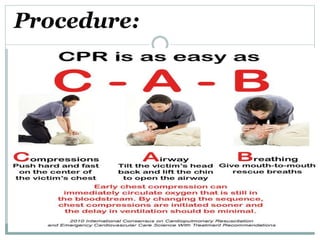
 Check for responsiveness of victim. If you suspect that victim
has sustained spinal or neck injury , do not shake or move him.
Otherwise shake victim gently and shout ‘Are you okay?’ to see
if there is any response. If there is no response no breathing
quickly call for emergency help and follow following steps:
 Circulation assessment
- Establish presence or absence of carotid pulse by placing two
fingertips on his carotid artery for 5 to 10 secs.
- Start chest compression immediately if the carotid pulse is
absent or questionable.
Procedure:
Cont…
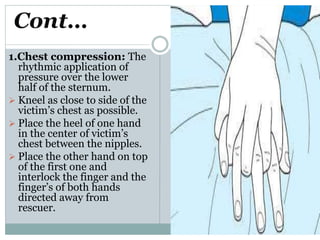
1.Chest compression: The
rhythmic application of
pressure over the lower
half of the sternum.
 Kneel as close to side of the
victim’s chest as possible.
 Place the heel of one hand
in the center of victim’s
chest between the nipples.
 Place the other hand on top
of the first one and
interlock the finger and the
finger’s of both hands
directed away from
rescuer.
Cont…
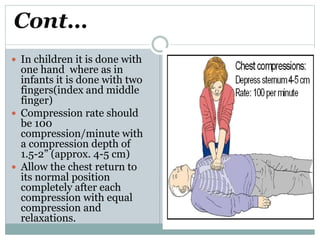
 In children it is done with
one hand where as in
infants it is done with two
fingers(index and middle
finger)
 Compression rate should
be 100
compression/minute with
a compression depth of
1.5-2” (approx. 4-5 cm)
 Allow the chest return to
its normal position
completely after each
compression with equal
compression and
relaxations.
Cont…
 Assess after 1 minute , if circulation present(heart
beat returns back) stop compressions immediately
but continue rescue breathing and check circulation
in each minute.
 If the victim remains unresponsive , check the
airway.
Cont…
2.Assess Airway:
 Assess for any visible
obstructions in the airway.
 Clear airway by removing
any loose obstruction,
(mucus, blood, foreign body)
from mouth and pharynx.
 In case of unconscious
victim, tongue is the most
common cause of airway
obstruction.
 If the victim is still not
breathing, then open airway
by head tilt and chin lift or
jaw thrust.
Cont…
 Note : The jaw thrust is a technique used on
patients with a suspected spinal injury and is used
on a supine patient.
 If the victim is still not breathing on in his own
after the airway has been you will have to assist
him breathing.
Cont…
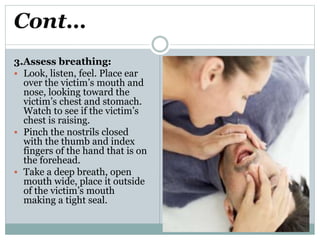
3.Assess breathing:
 Look, listen, feel. Place ear
over the victim’s mouth and
nose, looking toward the
victim’s chest and stomach.
Watch to see if the victim’s
chest is raising.
 Pinch the nostrils closed
with the thumb and index
fingers of the hand that is on
the forehead.
 Take a deep breath, open
mouth wide, place it outside
of the victim’s mouth
making a tight seal.
Cont…
 Inflate the victim’s lung by 2 full breaths each
breath over 1 sec allowing the victim’s lungs to relax.
 If resistance is experienced, then recheck airways.
 Note:
• Avoid rapid or forceful breath.
• Rate:10-12 breaths/min.
 Continue the cycle of 30 chest compressions and 2
rescue breaths until spontaneous circulation is
returned or until the arrival of medical help.
Guidelines for termination of
resuscitation:
Return of spontaneous circulation.
Arrival of arrest team or medical help.
If the rescuer becomes exhausted.
When death is confirmed.
Points to remember:
 Assess the victim (look, listen, feel) and if not
breathing call for help.
 Compression should be smooth, regular and
uninterrupted.
 The pressure on the chest should be completely
released after each compression, although the palm
of the hand remains in contact with the chest wall.
Cont…
 The xiphoid process should not compressed because
of the danger of lacerating the liver.
 Immediately start cardiopulmonary resuscitation.
 The victim should be stabilized before transportation
to a more convenient site.
 The presence of a palpable carotid pulse and
constriction of pupils are evidence of effective
circulation and oxygenated blood.
 All staff is to be skillful at CPR.
Cont…
 All CPR equipment is to be checked at the
beginning of each shift.
 Ratio of cardiac compression to ventilation:30:2
 Compression rate =100 compression/minute
 Compression depth
 Adult =5cm
 Child =4cm
 Neonate =3cm
References
1. Giri M, Sharma P, Essentials of Fundamentals of
Nursing, 1st edition, Pp:385-386.
2. Pathak S, Devkota R, A Text Book of
Fundamentals of Nursing, 2010 edition, Pp:333-
337.
3. Kozier and Erb’s, Fundamentals of Nursing, 8th
edition, Pp:1419-1420.
4. Brunner & suddharth’s Textbook of Medical-
Surgical Nursing, 12th edition, Pp: 843-845.
Cardiopulmonary resuscitation(cpr)

Cardiopulmonary resuscitation(cpr)

  • 1.
    Prepared by: Sangita shrestha Manishadhungana Cardiopulmonary Resuscitation(CPR)
  • 2.
    Introduction Life saving proceduregiven to those who develop cardiopulmonary arrest. Defined as chest compression and assisted ventilation. Time interval between collapse to initiation of CPR and collapse to defibrillation is most important. Consists of Basic life support and Advanced life support.
  • 3.
    Definition  CPR isa basic emergency procedure for life support consisting of artificial respiration and manual external cardiac massage.
  • 4.
    Purposes To establish effectiveventilation and circulation. To prevent irreversible brain damage from anoxia. To decrease immature mortality rate of patient in hospital.
  • 5.
    Indications 1.Respiratory arrest resultingfrom  drowning  stroke  foreign body  drug overdose  smoke inhalation  suffocation  myocardial infraction  coma; of any cause leading to airway obstruction.
  • 6.
    Cont.. 2.Cardiac arrest Sudden andcomplete loss of cardiac function. Sudden collapse with loss of consciousness. Pulse absent(femoral and carotid). No respiration. NOTE: If CPR is not given within 4-6 minutes, death may occur.
  • 7.
    Types of CPR A.Basic life support(BLS) B. Advance life support(ALS)
  • 8.
    BASIC LIFE SUPPORT It is the sequences of procedures preformed to restore the circulation of oxygenated blood after a sudden pulmonary and/or cardiac arrest.  Chest compressions and pulmonary ventilation performed by anyone who knows How to do it, anywhere, immediately, without any other equipment.
  • 9.
    Aim To ensure openairway and adequate ventilation. To maintain circulation until help comes and definite treatment with advanced life support can be administered.
  • 10.
    ADVANCE LIFE SUPPORT Airwaysecured with advanced technology, Breathing is maintained with some means of breathing apparatus, and Circulation is maintained by BLS along with: - IV access - Defibrillator, and - Appropriate drugs.
  • 11.
    Procedure of CPR Check for responsiveness of victim. If you suspect that victim has sustained spinal or neck injury , do not shake or move him. Otherwise shake victim gently and shout ‘Are you okay?’ to see if there is any response. If there is no response no breathing quickly call for emergency help and follow following steps:  Circulation assessment - Establish presence or absence of carotid pulse by placing two fingertips on his carotid artery for 5 to 10 secs. - Start chest compression immediately if the carotid pulse is absent or questionable.
  • 12.
  • 13.
    Cont… 1.Chest compression: The rhythmicapplication of pressure over the lower half of the sternum.  Kneel as close to side of the victim’s chest as possible.  Place the heel of one hand in the center of victim’s chest between the nipples.  Place the other hand on top of the first one and interlock the finger and the finger’s of both hands directed away from rescuer.
  • 14.
    Cont…  In childrenit is done with one hand where as in infants it is done with two fingers(index and middle finger)  Compression rate should be 100 compression/minute with a compression depth of 1.5-2” (approx. 4-5 cm)  Allow the chest return to its normal position completely after each compression with equal compression and relaxations.
  • 15.
    Cont…  Assess after1 minute , if circulation present(heart beat returns back) stop compressions immediately but continue rescue breathing and check circulation in each minute.  If the victim remains unresponsive , check the airway.
  • 16.
    Cont… 2.Assess Airway:  Assessfor any visible obstructions in the airway.  Clear airway by removing any loose obstruction, (mucus, blood, foreign body) from mouth and pharynx.  In case of unconscious victim, tongue is the most common cause of airway obstruction.  If the victim is still not breathing, then open airway by head tilt and chin lift or jaw thrust.
  • 17.
    Cont…  Note :The jaw thrust is a technique used on patients with a suspected spinal injury and is used on a supine patient.  If the victim is still not breathing on in his own after the airway has been you will have to assist him breathing.
  • 18.
    Cont… 3.Assess breathing:  Look,listen, feel. Place ear over the victim’s mouth and nose, looking toward the victim’s chest and stomach. Watch to see if the victim’s chest is raising.  Pinch the nostrils closed with the thumb and index fingers of the hand that is on the forehead.  Take a deep breath, open mouth wide, place it outside of the victim’s mouth making a tight seal.
  • 19.
    Cont…  Inflate thevictim’s lung by 2 full breaths each breath over 1 sec allowing the victim’s lungs to relax.  If resistance is experienced, then recheck airways.  Note: • Avoid rapid or forceful breath. • Rate:10-12 breaths/min.  Continue the cycle of 30 chest compressions and 2 rescue breaths until spontaneous circulation is returned or until the arrival of medical help.
  • 20.
    Guidelines for terminationof resuscitation: Return of spontaneous circulation. Arrival of arrest team or medical help. If the rescuer becomes exhausted. When death is confirmed.
  • 21.
    Points to remember: Assess the victim (look, listen, feel) and if not breathing call for help.  Compression should be smooth, regular and uninterrupted.  The pressure on the chest should be completely released after each compression, although the palm of the hand remains in contact with the chest wall.
  • 22.
    Cont…  The xiphoidprocess should not compressed because of the danger of lacerating the liver.  Immediately start cardiopulmonary resuscitation.  The victim should be stabilized before transportation to a more convenient site.  The presence of a palpable carotid pulse and constriction of pupils are evidence of effective circulation and oxygenated blood.  All staff is to be skillful at CPR.
  • 23.
    Cont…  All CPRequipment is to be checked at the beginning of each shift.  Ratio of cardiac compression to ventilation:30:2  Compression rate =100 compression/minute  Compression depth  Adult =5cm  Child =4cm  Neonate =3cm
  • 24.
    References 1. Giri M,Sharma P, Essentials of Fundamentals of Nursing, 1st edition, Pp:385-386. 2. Pathak S, Devkota R, A Text Book of Fundamentals of Nursing, 2010 edition, Pp:333- 337. 3. Kozier and Erb’s, Fundamentals of Nursing, 8th edition, Pp:1419-1420. 4. Brunner & suddharth’s Textbook of Medical- Surgical Nursing, 12th edition, Pp: 843-845.