DISAMPAIKAN OLEH;  GOODMAN BIN MOSITI PENOLONG PEGAWAI PERUBATAN U29 (BIUS) DEWAN BEDAH, HOSPITAL PITAS KURSUS  “ BASIC LIFE SUPPORT” (BLS)
PENGENALAN Sebahagian peralatan tambahan / bantuan yang digunakan  bagi pengendalian dan pengurusan salur pernafasan mangsa. Membantu membuka saluran pernafasan pesakit / mangsa semasa tidak sedarkan diri dan memudahkan dalam pemberian oksigen (ventilasi) kepada.
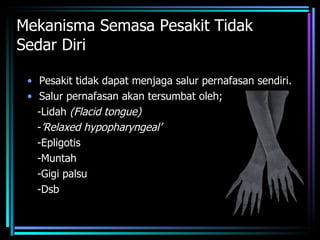
Mekanisma Semasa Pesakit Tidak Sedar Diri Pesakit tidak dapat menjaga salur pernafasan sendiri. Salur pernafasan akan tersumbat oleh; -Lidah  (Flacid tongue) - ’Relaxed hypopharyngeal’ -Epligotis -Muntah -Gigi palsu -Dsb
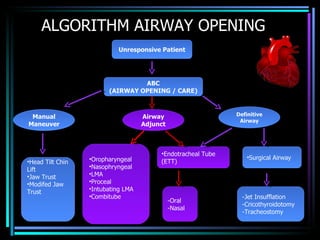
ALGORITHM AIRWAY OPENING Unresponsive Patient Manual Maneuver Definitive Airway ABC (AIRWAY OPENING / CARE) Airway Adjunct Oropharyngeal Nasophryngeal LMA Proceal Intubating LMA Combitube Surgical Airway Head Tilt Chin Lift Jaw Trust Modifed Jaw Trust Endotracheal Tube (ETT) -Oral -Nasal -Jet Insufflation -Cricothyroidotomy -Tracheostomy
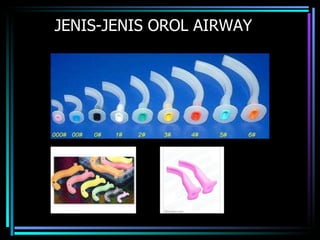
JENIS-JENIS OROL AIRWAY
OROPHARYNGEAL AIRWAY Oral Airway / OPA / Guedel Airway Dicipta oleh  Arthur E. Guedel  (1883-1956) Size: 000,00,0,1,2,3,4,5,6 /  C o l o u r  Code Kebaikan:- Mudah didapati / dikendali - Memudahkan  “Suction” -Bite Block  (mengelak pesakit  menggigit tiub ETT ) -Kurang Allergen
OROPHARYNGEAL AIRWAY INDIKASI; -Pesakit yang  tidak sedar diri -Pesakit  spontaneusly breathing - Total hilang  gag reflex - Digunakan sebagai  bite block KONTRAINDIKASI; -Pesakit sedar, ada gag reflex, susah buka mulut, masive oral trauma -Mandibulo-maxillary wiring KOMPLIKASI; -Terlalu panjang: Menekan epligotis -Terlalu pendek : Menolak lidah ke belakang -Menyebabkan batuk, muntah dan  laryngospasme -Aspiration
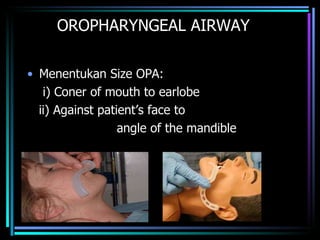
OROPHARYNGEAL AIRWAY Menentukan Size OPA: i) Coner of mouth to earlobe ii) Against patient’s face to  angle of the mandible
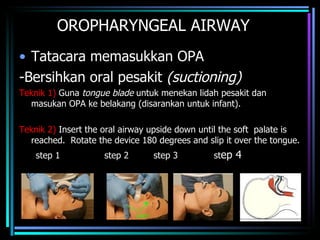
OROPHARYNGEAL AIRWAY Tatacara memasukkan OPA -Bersihkan oral pesakit  (suctioning) Teknik 1)  Guna  tongue blade  untuk menekan lidah pesakit dan masukan OPA ke belakang (disarankan untuk infant).   Teknik 2)  Insert the oral airway upside down until the soft  palate is reached.  Rotate the device 180 degrees and slip it over the tongue. step 1  step 2  step 3  st ep 4
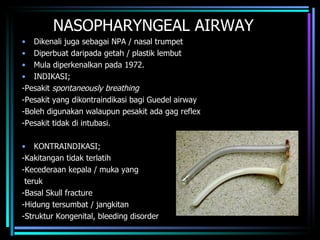
NASOPHARYNGEAL AIRWAY Dikenali juga sebagai NPA / nasal trumpet Diperbuat daripada getah / plastik lembut  Mula diperkenalkan pada 1972. INDIKASI; -Pesakit  spontaneously breathing -Pesakit yang dikontraindikasi bagi Guedel airway -Boleh digunakan walaupun pesakit ada gag reflex -Pesakit tidak di intubasi. KONTRAINDIKASI; -Kakitangan tidak terlatih -Kecederaan kepala / muka yang  teruk -Basal Skull fracture -Hidung tersumbat / jangkitan -Struktur Kongenital, bleeding disorder
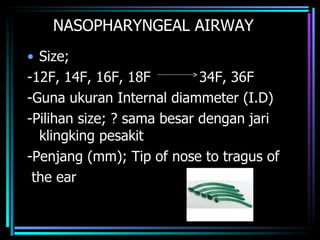
NASOPHARYNGEAL AIRWAY Size; -12F, 14F, 16F, 18F  34F, 36F -Guna ukuran Internal diammeter (I.D)  -Pilihan size; ? sama besar dengan jari klingking pesakit -Penjang (mm); Tip of nose to tragus of  the ear
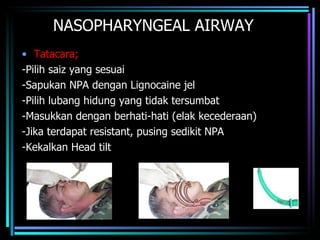
NASOPHARYNGEAL AIRWAY Tatacara; -Pilih saiz yang sesuai -Sapukan NPA dengan Lignocaine jel -Pilih lubang hidung yang tidak tersumbat -Masukkan dengan berhati-hati (elak kecederaan) -Jika terdapat resistant, pusing sedikit NPA -Kekalkan Head tilt
NASOPHARYNGEAL AIRWAY KOMPLIKASI; -Terlalu Panjang:- Kecederaan pada epligotis / vocal cord / vagal stimulation -Injured nasal mucosa; pendarahan -Alahan -Kurang Selesa
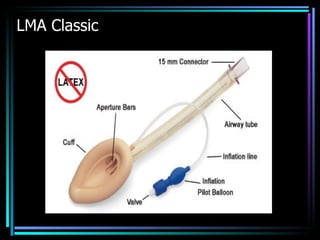
LARYNGEAL MASK AIRWAY Supraglottic airway management device.  Also called LMA Designed between  1981 and 1988 by Dr. Archie I. J. Brain. Cuff device that provides sufficient seal to allow for positive pressure ventilation to be delivered Tiga komponen utama:  airway tube, mask, and inflation line Alternative airway device used for anesthesia and airway support in emergency (difficult intubation).  It is inserted blindly into the pharynx, forming a low-pressure seal around the laryngeal inlet and permitting gentle positive pressure ventilation.  All parts are latex-free.
LARYNGEAL MASK AIRWAY Indications: -The Laryngeal Mask Airway is an appropriate airway choice when mask ventilation can be used but endotracheal intubation is not necessary. -Guide for endotracheal intubation (Fastrach) -Unanticipated difficult intubations  -Failed intubation  -Intubation of patients with limited head/neck movement
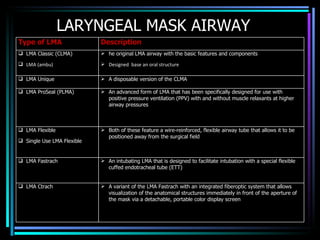
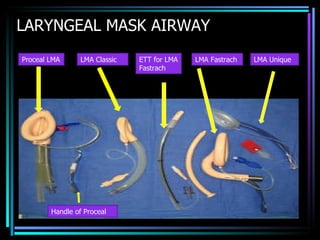
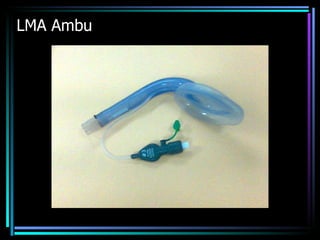
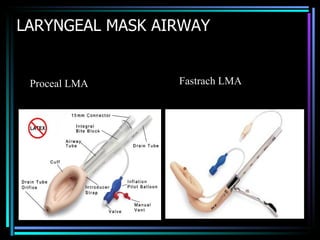
LARYNGEAL MASK AIRWAY Type of LMA Description LMA Classic (CLMA) LMA (ambu) he original LMA airway with the basic features and components  Designed  base an oral structure LMA Unique A disposable version of the CLMA LMA ProSeal (PLMA) An advanced form of LMA that has been specifically designed for use with positive pressure ventilation (PPV) with and without muscle relaxants at higher airway pressures  LMA Flexible Single Use LMA Flexible Both of these feature a wire-reinforced, flexible airway tube that allows it to be positioned away from the surgical field LMA Fastrach An intubating LMA that is designed to facilitate intubation with a special flexible cuffed endotracheal tube (ETT)  LMA Ctrach A variant of the LMA Fastrach with an integrated fiberoptic system that allows visualization of the anatomical structures immediately in front of the aperture of the mask via a detachable, portable color display screen
LARYNGEAL MASK AIRWAY Proceal LMA LMA Classic LMA Fastrach LMA Unique ETT for LMA Fastrach Handle of Proceal
LMA Classic
LMA Ambu
LARYNGEAL MASK AIRWAY Proceal LMA Fastrach LMA
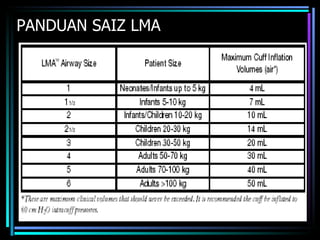
PANDUAN SAIZ LMA
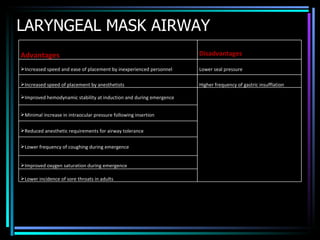
LARYNGEAL MASK AIRWAY Advantages Disadvantages Increased speed and ease of placement by inexperienced personnel Lower seal pressure Increased speed of placement by anesthetists Higher frequency of gastric insufflation Improved hemodynamic stability at induction and during emergence Minimal increase in intraocular pressure following insertion Reduced anesthetic requirements for airway tolerance Lower frequency of coughing during emergence Improved oxygen saturation during emergence Lower incidence of sore throats in adults
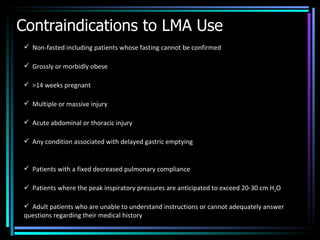
Contraindications to LMA Use Non-fasted including patients whose fasting cannot be confirmed Grossly or morbidly obese >14 weeks pregnant Multiple or massive injury Acute abdominal or thoracic injury Any condition associated with delayed gastric emptying Patients with a fixed decreased pulmonary compliance Patients where the peak inspiratory pressures are anticipated to exceed 20-30 cm H 2 O Adult patients who are unable to understand instructions or cannot adequately answer questions regarding their medical history
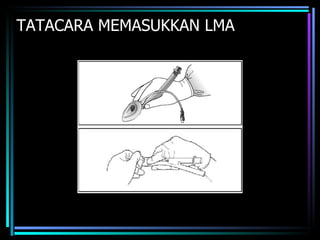
TATACARA MEMASUKKAN LMA
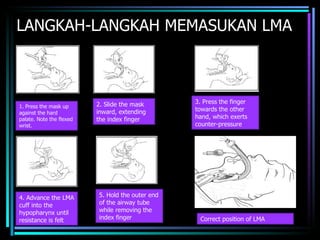
LANGKAH-LANGKAH MEMASUKAN LMA 1. Press the mask up against the hard palate. Note the flexed wrist. 2. Slide the mask inward, extending the index finger 3. Press the finger towards the other hand, which exerts counter-pressure 4. Advance the LMA cuff into the hypopharynx until resistance is felt 5. Hold the outer end of the airway tube while removing the index finger Correct position of LMA
COMPLICATION USE LMA Oral trauma Laryngo-spasm Aspiration  Incorrect position; hypoxia Dislodge
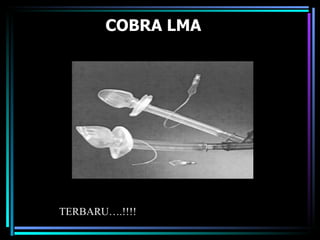
COBRA LMA TERBARU….!!!!
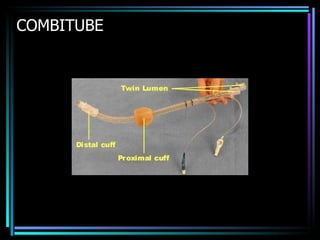
COMBETUBE The Combitube is a twin lumen device designed for use in emergency situations and difficult airways. It can be inserted without the need for visualization into the oropharynx, and usually enters the esophagus. It has a low volume inflatable distal cuff and a much larger proximal cuff designed to occlude the oro- and nasopharynx If the tube has entered the trachea, ventilation is achieved through the distal lumen as with a standard ETT. More commonly the device enters the esophagus and ventilation is achieved through multiple proximal apertures situated above the distal cuff. In the latter case the proximal and distal cuffs have to be inflated to prevent air from escaping through the esophagus or back out of the oro- and nasopharynx.
COMBITUBE
COMBITUBE Used effectively in cardiopulmonary resuscitation and  patient with difficult airways secondary to severe facial burns, trauma, upper airway bleeding and vomiting where there was an inability to visualize the vocal cords.  It can be used in patients whose cervical spine has been immobilized with a rigid cervical collar.  The Combitube can only be used in the adult population as no pediatric sizes are available. Complications of the Combitube include an increased incidence of sore throat, dysphagia and upper airway hematoma when compared to endotracheal intubation and LMA.  Esophageal rupture is a rare complication but has been described.
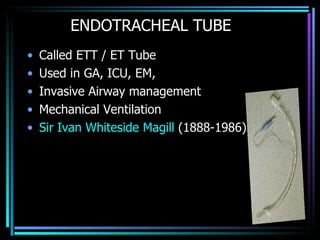
ENDOTRACHEAL TUBE  Called ETT / ET Tube Used in GA, ICU, EM,  Invasive Airway management Mechanical Ventilation Sir Ivan Whiteside Magill  (1888-1986)
TRACHEAL INTUBATION Oral Nasal Fiberoptic  endoscopy
INDICATIONS Provide patent airway Prevent aspiration Facilitate IPPV Operative positions Difficult  airway maintenance Suction  of respiratory  tract Thoracic  operations Disease involving upper airway
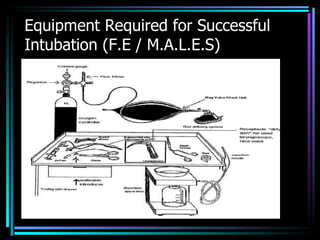
PERALATAN UNTUK INTUBASI Laryngoscope  and  spare ET tubes/  connector Stilette Magill  forceps 20 ml  syringe Securing  tapes /  bandage LA 4 % lignocane  spray Cocaine  gel -  nasal Lubricant Throat packs GA machine, face  mask,  airways
PREPARATION Assess patients Oral  versus  nasal  intubation? Check  equipment Assistant  required Check Ventilator / BVM check  suction pump Correct  sizes  of  scopes and  blades Correct sizes  of ET tubes
Equipment Required for Successful Intubation (F.E / M.A.L.E.S)
TYPE OF INDUCTION  Rapid  sequence  induction 2. Normal sequence  induction
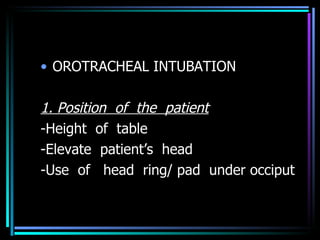
OROTRACHEAL INTUBATION 1. Position  of  the  patient -Height  of  table -Elevate  patient’s  head -Use  of  head  ring/ pad  under occiput
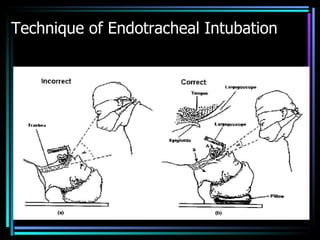
Technique of Endotracheal Intubation
-Sniffing  position -Align oral,  pharyngeal  and  laryngeal axis -Lips  to  glottic opening  - straight line -Open patient’s  mouth  with  right  thumb 2.Direct laryngoscope -Hold laryngoscope  in Lt  hand -Insert  blade  into  Rt  side  of mouth -Deflect  the  tongue  to the left
3. VISUALIZE  THE EPIGLOTTIS -Advance  blade  in  the  midline -Until  epiglottis  visualized -Advance  tip  of  blade  into vallecula -Or  beneath  epiglottis -  straight  blade -Forward  & upward  movement -Elevate  epiglottis -Expose  glottic  opening -Depression of  thyroid  cartilage -Exposure  of  glottic  opening
4.  PLACEMENT  OF ET  TUBE -Introduce  tube  with Rt  hand -Through  Rt  side  of  mouth -Advance  tube  through  glottic opening -Until calf  just  passes  vocal  cord -Remove  scope  blade -Inflate  the  cuff -IPPV – absence  of  air leak
5.CONFIRMATION OF  ET  TUBE PLACEMENT -Co2 in exhaled  gases -Bilateral  breath  sounds -Epigastric auscultation -Fogging  of  water  vapour in  tube -Maintenance  of  O2  saturation
6. Secure tube with  tape/  bandage 7.Continue  IPPPV NASAL INTUBATION -Dental / ENT operations -Long  term  intubation -Pre- formed  nasal  tube -Smaller  in  size
-Choose  nostril  that breath more  easily -Lubricate  tube -Insert  tube  through  nostril -Advance  tube  until tip visualized in  the orophargynx -Advance  distil  end  of  ET tube into  tracheal through  visualizes glottic  opening
-Used  of  magill  forceps -Avoid  damage  to cuff -Confirm  tube placement -Cuff  tube -Insertion  of  moist  gauze  pack -Secure  tube
FIBREOPTIC INTUBATION Difficult  airway/ intubation Glottic opening  cannot  be  visualised Awake intubation  Oral  or  nasal
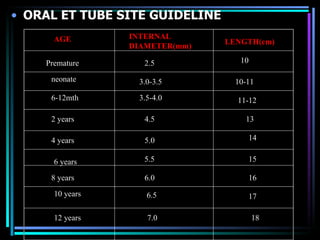
ORAL ET TUBE SITE GUIDELINE AGE INTERNAL DIAMETER(mm) LENGTH(cm) Premature 2.5 10 neonate 3.0-3.5 10-11 6-12mth 11-12 3.5-4.0 2 years 4.5 13 4 years 5.0 14 6 years 5.5 15 8 years 6.0 16 10 years 6.5 17 12 years 7.0 18
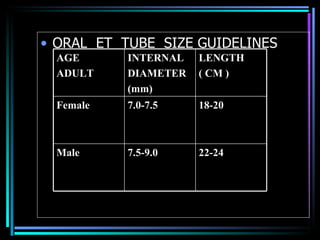
ORAL  ET  TUBE  SIZE GUIDELINES AGE ADULT INTERNAL  DIAMETER (mm) LENGTH ( CM ) Female 7.0-7.5 18-20 Male  7.5-9.0 22-24
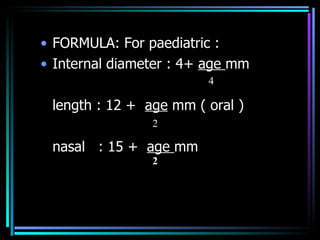
FORMULA : For paediatric :  Internal diameter : 4+  age  mm length : 12 +  age  mm ( oral )    nasal  : 15 +  age  mm   4 2 2
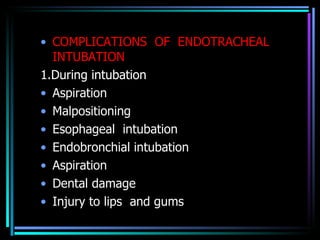
COMPLICATIONS  OF  ENDOTRACHEAL INTUBATION 1.During intubation Aspiration  Malpositioning Esophageal  intubation Endobronchial intubation Aspiration Dental damage Injury to lips  and gums
Activation  of sympathetic nervous  system Bronchospasm Sore throat Dislocated mandible 2. AFTER EXTUBATION Aspiration Laryngospasm Transient  vocal  cord  incompetence Glottic  or subglottic oedema Pharyngitis or  tracheitis
DIFFICULT INTUBATION 1 in  65 patients Difficulty  with laryngoscopy Cause  of mobidity & mortality sequelae - dental  &  airway  trauma - pulmonary  aspiration -hypoxaemia
CAUSES  OF  DIFFICULT  INTUBATION Inadequate  assessment Inadequate  equipment  preparation Inexperience Poor technique Equipment -Malfunction -Unavailability -No  trained  assistant
PATIENT Congenital -syndromes (  Down’s, Pierre – Robin) Achondroplasia Cystic  hygroma Encephalocele  Acquired -Reduced  jaw  movement i)  Trismus ii) Fibrosis
- tumours - Jaw  wiring Reduced  neck  movement - Rheumatoid / osteoarthritis - ankylosing  spondylitis - cervical # /  fusion Airway -  oedema - compression - scarring
- tumours/  polyps - Foreign  body - Nerve  palsy Others - mobid  obesity - pregnancy - acromegaly
ANATOMICAL  FACTOR : DIFFICULT  LARYNGOSCOPY Short  neck Protuding  incisions Long  high  arched  palate Receding  lower  jaw Poor  mobility  of mandible    anterior  depth  of  mandible Reduced  jaw  opening Reduced  neck  extension
DIFFICULT INTUBATION KIT Airway adjuncts  Gum  elastic bougies/ ET  tubes Cricothyrotomy  needle Jet  ventilation Maccoy Blade
Extreme Clinical Situations Tracheostomy LA
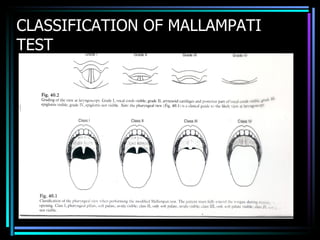
CLASSIFICATION OF MALLAMPATI TEST
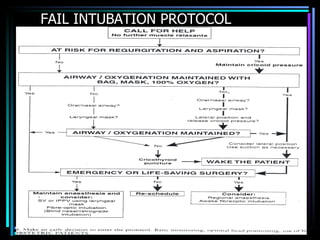
FAIL INTUBATION PROTOCOL Kong Thau Chin
 
THANK YOU

AIRWAY ADJUNCT

  • 1.
    DISAMPAIKAN OLEH; GOODMAN BIN MOSITI PENOLONG PEGAWAI PERUBATAN U29 (BIUS) DEWAN BEDAH, HOSPITAL PITAS KURSUS “ BASIC LIFE SUPPORT” (BLS)
  • 2.
    PENGENALAN Sebahagian peralatantambahan / bantuan yang digunakan bagi pengendalian dan pengurusan salur pernafasan mangsa. Membantu membuka saluran pernafasan pesakit / mangsa semasa tidak sedarkan diri dan memudahkan dalam pemberian oksigen (ventilasi) kepada.
  • 3.
    Mekanisma Semasa PesakitTidak Sedar Diri Pesakit tidak dapat menjaga salur pernafasan sendiri. Salur pernafasan akan tersumbat oleh; -Lidah (Flacid tongue) - ’Relaxed hypopharyngeal’ -Epligotis -Muntah -Gigi palsu -Dsb
  • 4.
    ALGORITHM AIRWAY OPENINGUnresponsive Patient Manual Maneuver Definitive Airway ABC (AIRWAY OPENING / CARE) Airway Adjunct Oropharyngeal Nasophryngeal LMA Proceal Intubating LMA Combitube Surgical Airway Head Tilt Chin Lift Jaw Trust Modifed Jaw Trust Endotracheal Tube (ETT) -Oral -Nasal -Jet Insufflation -Cricothyroidotomy -Tracheostomy
  • 5.
  • 6.
    OROPHARYNGEAL AIRWAY OralAirway / OPA / Guedel Airway Dicipta oleh Arthur E. Guedel (1883-1956) Size: 000,00,0,1,2,3,4,5,6 / C o l o u r Code Kebaikan:- Mudah didapati / dikendali - Memudahkan “Suction” -Bite Block (mengelak pesakit menggigit tiub ETT ) -Kurang Allergen
  • 7.
    OROPHARYNGEAL AIRWAY INDIKASI;-Pesakit yang tidak sedar diri -Pesakit spontaneusly breathing - Total hilang gag reflex - Digunakan sebagai bite block KONTRAINDIKASI; -Pesakit sedar, ada gag reflex, susah buka mulut, masive oral trauma -Mandibulo-maxillary wiring KOMPLIKASI; -Terlalu panjang: Menekan epligotis -Terlalu pendek : Menolak lidah ke belakang -Menyebabkan batuk, muntah dan laryngospasme -Aspiration
  • 8.
    OROPHARYNGEAL AIRWAY MenentukanSize OPA: i) Coner of mouth to earlobe ii) Against patient’s face to angle of the mandible
  • 9.
    OROPHARYNGEAL AIRWAY Tatacaramemasukkan OPA -Bersihkan oral pesakit (suctioning) Teknik 1) Guna tongue blade untuk menekan lidah pesakit dan masukan OPA ke belakang (disarankan untuk infant).  Teknik 2) Insert the oral airway upside down until the soft palate is reached.  Rotate the device 180 degrees and slip it over the tongue. step 1 step 2 step 3 st ep 4
  • 10.
    NASOPHARYNGEAL AIRWAY Dikenalijuga sebagai NPA / nasal trumpet Diperbuat daripada getah / plastik lembut Mula diperkenalkan pada 1972. INDIKASI; -Pesakit spontaneously breathing -Pesakit yang dikontraindikasi bagi Guedel airway -Boleh digunakan walaupun pesakit ada gag reflex -Pesakit tidak di intubasi. KONTRAINDIKASI; -Kakitangan tidak terlatih -Kecederaan kepala / muka yang teruk -Basal Skull fracture -Hidung tersumbat / jangkitan -Struktur Kongenital, bleeding disorder
  • 11.
    NASOPHARYNGEAL AIRWAY Size;-12F, 14F, 16F, 18F 34F, 36F -Guna ukuran Internal diammeter (I.D) -Pilihan size; ? sama besar dengan jari klingking pesakit -Penjang (mm); Tip of nose to tragus of the ear
  • 12.
    NASOPHARYNGEAL AIRWAY Tatacara;-Pilih saiz yang sesuai -Sapukan NPA dengan Lignocaine jel -Pilih lubang hidung yang tidak tersumbat -Masukkan dengan berhati-hati (elak kecederaan) -Jika terdapat resistant, pusing sedikit NPA -Kekalkan Head tilt
  • 13.
    NASOPHARYNGEAL AIRWAY KOMPLIKASI;-Terlalu Panjang:- Kecederaan pada epligotis / vocal cord / vagal stimulation -Injured nasal mucosa; pendarahan -Alahan -Kurang Selesa
  • 14.
    LARYNGEAL MASK AIRWAYSupraglottic airway management device. Also called LMA Designed between 1981 and 1988 by Dr. Archie I. J. Brain. Cuff device that provides sufficient seal to allow for positive pressure ventilation to be delivered Tiga komponen utama: airway tube, mask, and inflation line Alternative airway device used for anesthesia and airway support in emergency (difficult intubation). It is inserted blindly into the pharynx, forming a low-pressure seal around the laryngeal inlet and permitting gentle positive pressure ventilation. All parts are latex-free.
  • 15.
    LARYNGEAL MASK AIRWAYIndications: -The Laryngeal Mask Airway is an appropriate airway choice when mask ventilation can be used but endotracheal intubation is not necessary. -Guide for endotracheal intubation (Fastrach) -Unanticipated difficult intubations -Failed intubation -Intubation of patients with limited head/neck movement
  • 16.
    LARYNGEAL MASK AIRWAYType of LMA Description LMA Classic (CLMA) LMA (ambu) he original LMA airway with the basic features and components Designed base an oral structure LMA Unique A disposable version of the CLMA LMA ProSeal (PLMA) An advanced form of LMA that has been specifically designed for use with positive pressure ventilation (PPV) with and without muscle relaxants at higher airway pressures LMA Flexible Single Use LMA Flexible Both of these feature a wire-reinforced, flexible airway tube that allows it to be positioned away from the surgical field LMA Fastrach An intubating LMA that is designed to facilitate intubation with a special flexible cuffed endotracheal tube (ETT) LMA Ctrach A variant of the LMA Fastrach with an integrated fiberoptic system that allows visualization of the anatomical structures immediately in front of the aperture of the mask via a detachable, portable color display screen
  • 17.
    LARYNGEAL MASK AIRWAYProceal LMA LMA Classic LMA Fastrach LMA Unique ETT for LMA Fastrach Handle of Proceal
  • 18.
  • 19.
  • 20.
    LARYNGEAL MASK AIRWAYProceal LMA Fastrach LMA
  • 21.
  • 22.
    LARYNGEAL MASK AIRWAYAdvantages Disadvantages Increased speed and ease of placement by inexperienced personnel Lower seal pressure Increased speed of placement by anesthetists Higher frequency of gastric insufflation Improved hemodynamic stability at induction and during emergence Minimal increase in intraocular pressure following insertion Reduced anesthetic requirements for airway tolerance Lower frequency of coughing during emergence Improved oxygen saturation during emergence Lower incidence of sore throats in adults
  • 23.
    Contraindications to LMAUse Non-fasted including patients whose fasting cannot be confirmed Grossly or morbidly obese >14 weeks pregnant Multiple or massive injury Acute abdominal or thoracic injury Any condition associated with delayed gastric emptying Patients with a fixed decreased pulmonary compliance Patients where the peak inspiratory pressures are anticipated to exceed 20-30 cm H 2 O Adult patients who are unable to understand instructions or cannot adequately answer questions regarding their medical history
  • 24.
  • 25.
    LANGKAH-LANGKAH MEMASUKAN LMA1. Press the mask up against the hard palate. Note the flexed wrist. 2. Slide the mask inward, extending the index finger 3. Press the finger towards the other hand, which exerts counter-pressure 4. Advance the LMA cuff into the hypopharynx until resistance is felt 5. Hold the outer end of the airway tube while removing the index finger Correct position of LMA
  • 26.
    COMPLICATION USE LMAOral trauma Laryngo-spasm Aspiration Incorrect position; hypoxia Dislodge
  • 27.
  • 28.
    COMBETUBE The Combitubeis a twin lumen device designed for use in emergency situations and difficult airways. It can be inserted without the need for visualization into the oropharynx, and usually enters the esophagus. It has a low volume inflatable distal cuff and a much larger proximal cuff designed to occlude the oro- and nasopharynx If the tube has entered the trachea, ventilation is achieved through the distal lumen as with a standard ETT. More commonly the device enters the esophagus and ventilation is achieved through multiple proximal apertures situated above the distal cuff. In the latter case the proximal and distal cuffs have to be inflated to prevent air from escaping through the esophagus or back out of the oro- and nasopharynx.
  • 29.
  • 30.
    COMBITUBE Used effectivelyin cardiopulmonary resuscitation and patient with difficult airways secondary to severe facial burns, trauma, upper airway bleeding and vomiting where there was an inability to visualize the vocal cords. It can be used in patients whose cervical spine has been immobilized with a rigid cervical collar. The Combitube can only be used in the adult population as no pediatric sizes are available. Complications of the Combitube include an increased incidence of sore throat, dysphagia and upper airway hematoma when compared to endotracheal intubation and LMA. Esophageal rupture is a rare complication but has been described.
  • 31.
    ENDOTRACHEAL TUBE Called ETT / ET Tube Used in GA, ICU, EM, Invasive Airway management Mechanical Ventilation Sir Ivan Whiteside Magill (1888-1986)
  • 32.
    TRACHEAL INTUBATION OralNasal Fiberoptic endoscopy
  • 33.
    INDICATIONS Provide patentairway Prevent aspiration Facilitate IPPV Operative positions Difficult airway maintenance Suction of respiratory tract Thoracic operations Disease involving upper airway
  • 34.
    PERALATAN UNTUK INTUBASILaryngoscope and spare ET tubes/ connector Stilette Magill forceps 20 ml syringe Securing tapes / bandage LA 4 % lignocane spray Cocaine gel - nasal Lubricant Throat packs GA machine, face mask, airways
  • 35.
    PREPARATION Assess patientsOral versus nasal intubation? Check equipment Assistant required Check Ventilator / BVM check suction pump Correct sizes of scopes and blades Correct sizes of ET tubes
  • 36.
    Equipment Required forSuccessful Intubation (F.E / M.A.L.E.S)
  • 37.
    TYPE OF INDUCTION Rapid sequence induction 2. Normal sequence induction
  • 38.
    OROTRACHEAL INTUBATION 1.Position of the patient -Height of table -Elevate patient’s head -Use of head ring/ pad under occiput
  • 39.
  • 40.
    -Sniffing position-Align oral, pharyngeal and laryngeal axis -Lips to glottic opening - straight line -Open patient’s mouth with right thumb 2.Direct laryngoscope -Hold laryngoscope in Lt hand -Insert blade into Rt side of mouth -Deflect the tongue to the left
  • 41.
    3. VISUALIZE THE EPIGLOTTIS -Advance blade in the midline -Until epiglottis visualized -Advance tip of blade into vallecula -Or beneath epiglottis - straight blade -Forward & upward movement -Elevate epiglottis -Expose glottic opening -Depression of thyroid cartilage -Exposure of glottic opening
  • 42.
    4. PLACEMENT OF ET TUBE -Introduce tube with Rt hand -Through Rt side of mouth -Advance tube through glottic opening -Until calf just passes vocal cord -Remove scope blade -Inflate the cuff -IPPV – absence of air leak
  • 43.
    5.CONFIRMATION OF ET TUBE PLACEMENT -Co2 in exhaled gases -Bilateral breath sounds -Epigastric auscultation -Fogging of water vapour in tube -Maintenance of O2 saturation
  • 44.
    6. Secure tubewith tape/ bandage 7.Continue IPPPV NASAL INTUBATION -Dental / ENT operations -Long term intubation -Pre- formed nasal tube -Smaller in size
  • 45.
    -Choose nostril that breath more easily -Lubricate tube -Insert tube through nostril -Advance tube until tip visualized in the orophargynx -Advance distil end of ET tube into tracheal through visualizes glottic opening
  • 46.
    -Used of magill forceps -Avoid damage to cuff -Confirm tube placement -Cuff tube -Insertion of moist gauze pack -Secure tube
  • 47.
    FIBREOPTIC INTUBATION Difficult airway/ intubation Glottic opening cannot be visualised Awake intubation Oral or nasal
  • 48.
    ORAL ET TUBESITE GUIDELINE AGE INTERNAL DIAMETER(mm) LENGTH(cm) Premature 2.5 10 neonate 3.0-3.5 10-11 6-12mth 11-12 3.5-4.0 2 years 4.5 13 4 years 5.0 14 6 years 5.5 15 8 years 6.0 16 10 years 6.5 17 12 years 7.0 18
  • 49.
    ORAL ET TUBE SIZE GUIDELINES AGE ADULT INTERNAL DIAMETER (mm) LENGTH ( CM ) Female 7.0-7.5 18-20 Male 7.5-9.0 22-24
  • 50.
    FORMULA : Forpaediatric : Internal diameter : 4+ age mm length : 12 + age mm ( oral ) nasal : 15 + age mm 4 2 2
  • 51.
    COMPLICATIONS OF ENDOTRACHEAL INTUBATION 1.During intubation Aspiration Malpositioning Esophageal intubation Endobronchial intubation Aspiration Dental damage Injury to lips and gums
  • 52.
    Activation ofsympathetic nervous system Bronchospasm Sore throat Dislocated mandible 2. AFTER EXTUBATION Aspiration Laryngospasm Transient vocal cord incompetence Glottic or subglottic oedema Pharyngitis or tracheitis
  • 53.
    DIFFICULT INTUBATION 1in 65 patients Difficulty with laryngoscopy Cause of mobidity & mortality sequelae - dental & airway trauma - pulmonary aspiration -hypoxaemia
  • 54.
    CAUSES OF DIFFICULT INTUBATION Inadequate assessment Inadequate equipment preparation Inexperience Poor technique Equipment -Malfunction -Unavailability -No trained assistant
  • 55.
    PATIENT Congenital -syndromes( Down’s, Pierre – Robin) Achondroplasia Cystic hygroma Encephalocele Acquired -Reduced jaw movement i) Trismus ii) Fibrosis
  • 56.
    - tumours -Jaw wiring Reduced neck movement - Rheumatoid / osteoarthritis - ankylosing spondylitis - cervical # / fusion Airway - oedema - compression - scarring
  • 57.
    - tumours/ polyps - Foreign body - Nerve palsy Others - mobid obesity - pregnancy - acromegaly
  • 58.
    ANATOMICAL FACTOR: DIFFICULT LARYNGOSCOPY Short neck Protuding incisions Long high arched palate Receding lower jaw Poor mobility of mandible  anterior depth of mandible Reduced jaw opening Reduced neck extension
  • 59.
    DIFFICULT INTUBATION KITAirway adjuncts Gum elastic bougies/ ET tubes Cricothyrotomy needle Jet ventilation Maccoy Blade
  • 60.
  • 61.
  • 62.
  • 63.
  • 64.