CARDIAC
TAMPONADE
PANKAJ SINGH RANA
NURSE PRACTITIONER IN CRITICAL CARE
SWAMI RAMA HIMALAYAN UNIVERSITY
ANOTOMY OF PERICARDIUM
Fibro-serous sac
The inner visceral layer-- thin layer of mesothelial cells.
Parietal pericardium- collagenous fibrous tissue and elastic
fibrils.
Between the 2 layers lies the pericardial space- 10-50ml of
fluid- ultrafiltrate of plasma.
Drainage of pericardial fluid is via right lymphatic duct and
thoracic duct.
PERICARDIAL LAYERS
 Visceral layer
 Parietal layer
 Fibrous pericardium
PHYSIOLOGY OF
PERICARDIUM
• Limits distension of the cardiac chambers
• Facilitates interaction and coupling of the ventricles
and atria.
• Changes in pressure and volume on one side of the
heart can influence pressure and volume on the
other side
• Magnitude & importance of pericardial restraint of
vent filling at physiologic cardiac volumes-
controversial
• Pericardial reserve volume - diff between
unstressed pericardial volume and cardiac volume.
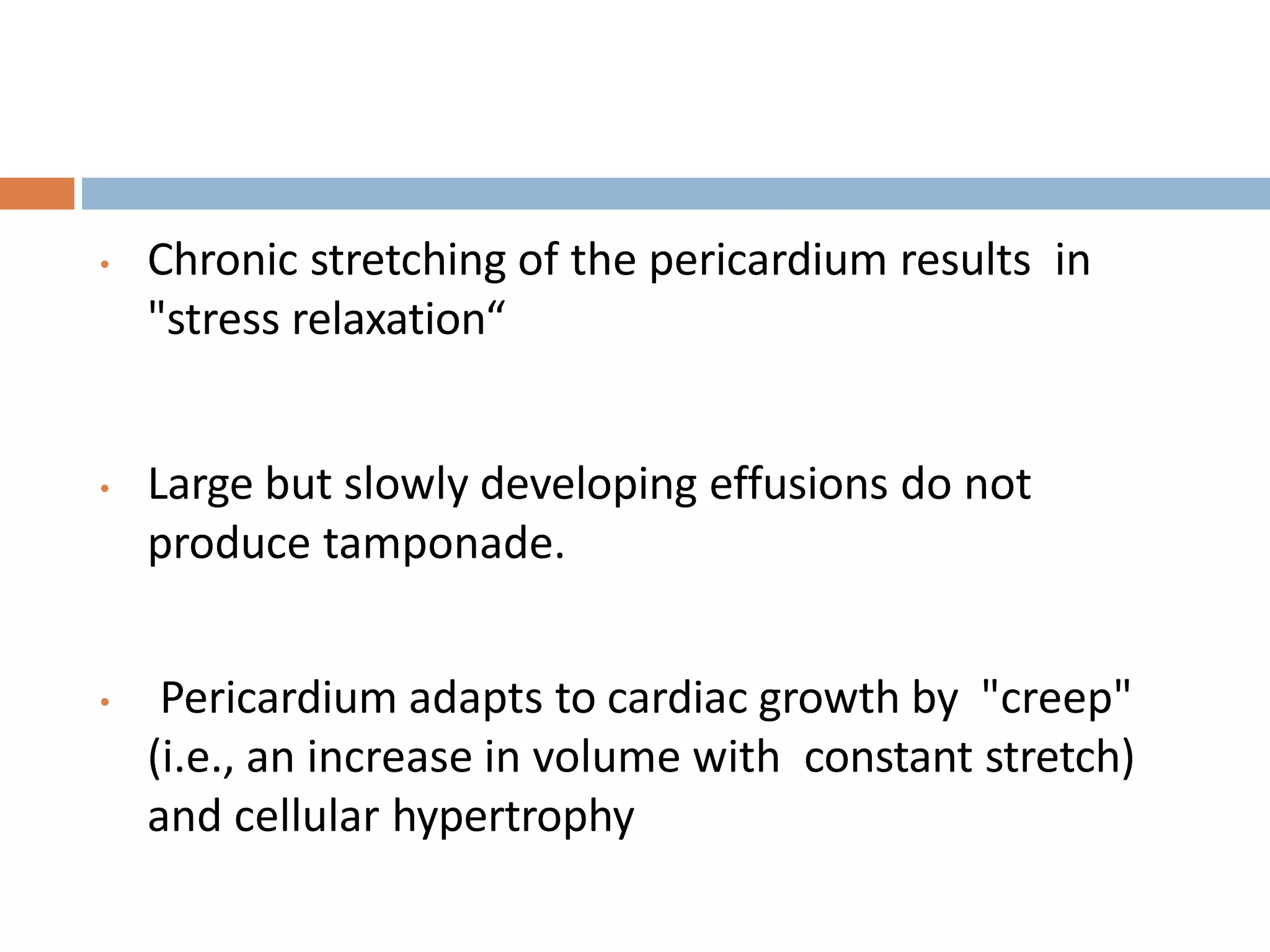
• Chronic stretching of the pericardium results in
"stress relaxation“
• Large but slowly developing effusions do not
produce tamponade.
• Pericardium adapts to cardiac growth by "creep"
(i.e., an increase in volume with constant stretch)
and cellular hypertrophy
FUNCTIONS
1) Effects on chambers
 Limits short-term cardiac distention
 Facilitate chamber coupling and disastrous interaction
 Maintain P-V relation of chambers and output
 Maintain geometry of left ventricle
2) Effects on whole heart
 Lubricates, min friction
3) Mechanical barrier to infection
4) Immunologic
5) Vasomotor
6) Fibrinolytic
7) Modulation of myocardial structure and function and gene expression
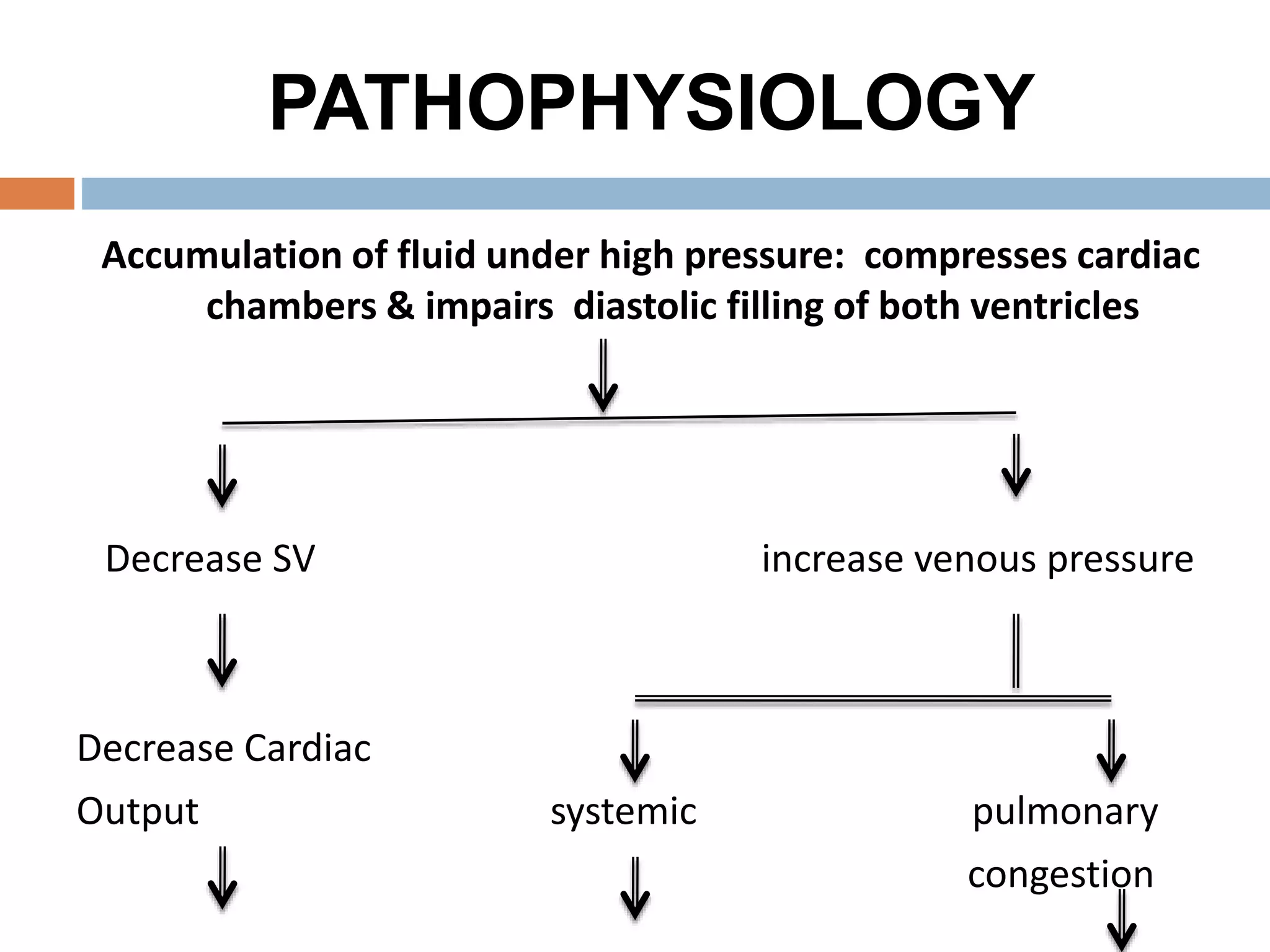
PATHOPHYSIOLOGY
Accumulation of fluid under high pressure: compresses cardiac
chambers & impairs diastolic filling of both ventricles
Decrease SV increase venous pressure
Decrease Cardiac
Output systemic pulmonary
congestion
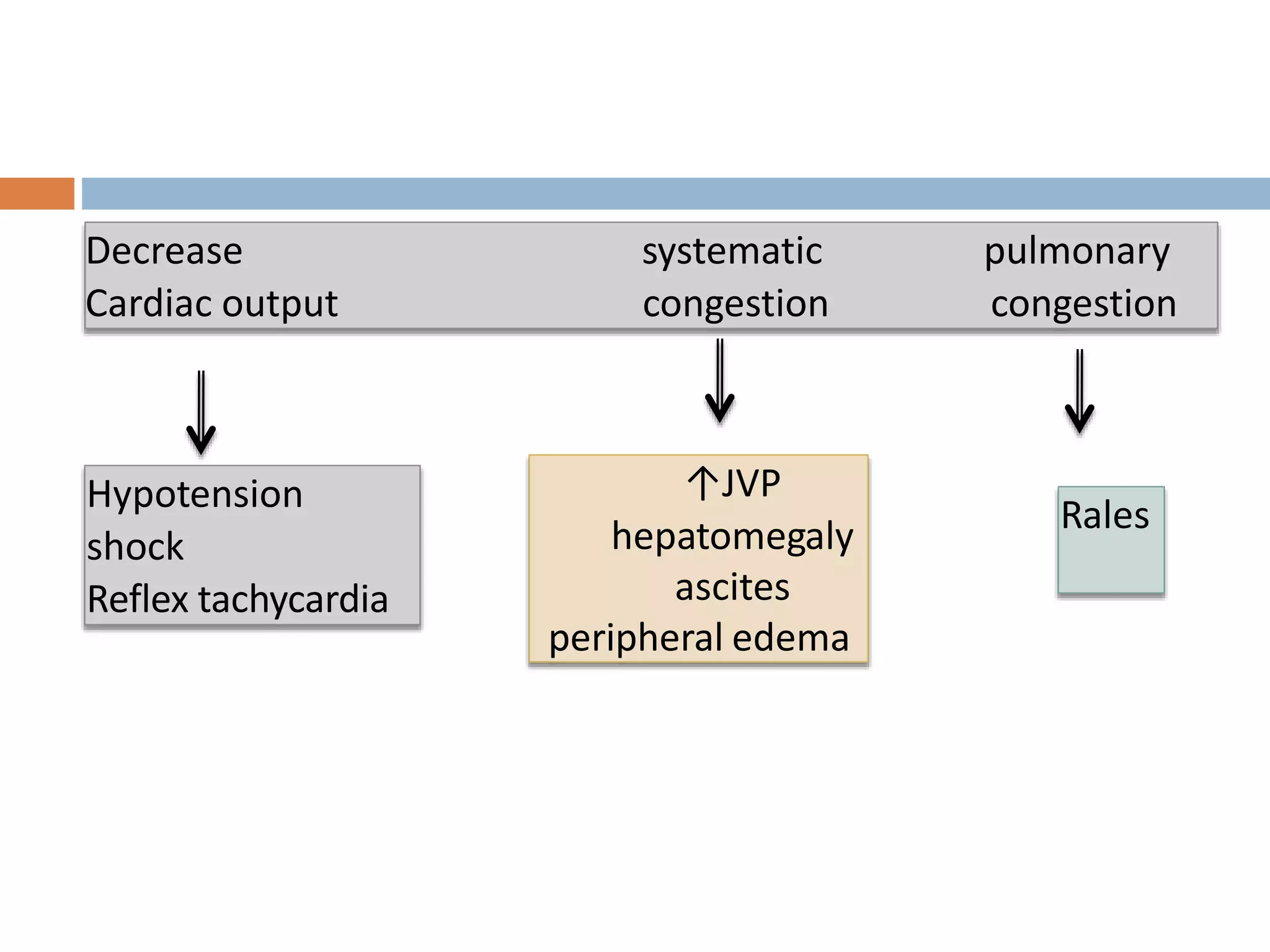
Decrease systematic pulmonary
Cardiac output congestion congestion
Hypotension
shock
Reflex tachycardia
↑JVP
hepatomegaly
ascites
peripheral edema
Rales
CAUSES
 Idiopathic
 Infectious- Viral/Bacterial/Mycobacterial/Fungal/Protozoal
 Immune-inflammatory Connective tissue disease, Early
post–myocardial infarction, Post-cardiotomy/thoracotomy,
Late post- trauma.
 Early post–cardiac surgery and post–orthotopic heart
transplantation
 Hemopericardium - Trauma, Post–myocardial infarction free
wall rupture, Device and procedure related (percutaneous
coronary procedures, implantable defibrillators,
pacemakers, post–arrhythmia ablation, post–atrial septal
defect closure, post–valve repair or replacement),
Dissecting aortic aneurysm.
 Trauma - Blunt and penetrating, Post–cardiopulmonary
resuscitation
 Congenital - Cysts, congenital absence
 Miscellaneous - Chronic renal failure, dialysis related,
Chylopericardium,
 Hypothyroidism and hyperthyroidism, Amyloidosis,
Neoplastic, Radiation
 Idiopathic pericarditis and any infection, neoplasm, and
autoimmune or inflammatory process that can cause
pericarditis can cause an effusion
Bacterial /
Mycobacterial /
 Fungal
Hemopericardium
 Traumatic
Iatrogenic
 Aortic Dissection
HIV
Uremia / Dialysis
associated
Malignancy
Common Viral
Post-MI pericarditis
Post cardiotomy, Post
cardiac transplant
Autoimmune
Drug-induced
MOST COMMON CAUSE UNCOMMON CAUSE
CLINICAL SYMPTOMS
NOT SPECIFIC
 Apprehension
 Chest pain
 Oppressive precordial
 Positional
 Dyspnea
 Dry Cough
 Hoarseness
 Dysphasia
SPECIFIC
 General
 Anxious
 Apprehensive
 Ashen gray facies
 Cool perspiration
 Tachypnea
 Tachycardia - Exceptions include patients with bradycardia
during uremia and patients with hypothyroidism
 Tachypnea
 Jugular venous distension
 Quiet precordium with both inspection and palpation, Impure muffled
heart sounds
 Rub
 Peripheral Cyanosis
PULSUS PARADOXUS
 Pulsus paradoxus, also paradoxic
pulse or paradoxical pulse, is an abnormally large
decrease in stroke volume, systolic blood
pressure and pulse wave amplitude during inspiration.
The normal fall in pressure is less than 10 mmHg. When
the drop is more than 10 mmHg, it is referred to as
pulsus paradoxus.
OTHER CAUSES OF PULSE
PARADOXUS
 Large pulmonary embolus
 Severe COPD exacerbation
 Labored respiration
 Constrictive pericarditis
 Restrictive cardiomyopathy
 Right ventricular infarction
 Circulatory shock
 Large pleural effusions
 Tense ascites
 Extreme obesity
How to Check Pulsus
Paradoxus
 Place the patient in a position of comfort and conduct manometric
 studies during baseline respiration.
 Raise sphygmomanometer pressure until Korotkoff sounds
disappear.
 Lower pressure slowly (2 mmHg per sec) until first Korotkoff sounds are
heard during early expiration with their disappearance during inspiration.
 Record this pressure.
 Lower pressure until Korotkoff sounds are heard throughout the
respiratory cycle with even intensity.
 Record this pressure.
 The difference between the two recorded pressures is the Pulsus
Paradoxus.
 Conventionally difference >10 mmHg considered significant.
 Other definition: Pulsus paradox is greater than or equal to 10% of the
pressure at which all Korotkoff sounds are heard with even intensity.
PHYSICAL EXAMINATION
PHYSICAL FINDING PERCENTAGE PRESENT
ELEVATED JVP 100
PULSE PARADOX 98
TACHYPNEA 80
TACHYCARDIA 77
SBP< 100 36
DECREASE HEART SOUND 34
RUB 29
RAPID FALLING BP 25
Physical findings in 56 patients diagnosed with Cardiac Tamponade at the
bedside.Circulation. 1981: 64, 633-9
BECK TRAID
ECG CHANGES
DISTENDED JVP
CHEST X RAY
2D ECHO
CT THORAX
MEDICAL MANAGEMENT
 Oxygenation
 Increasing the volume may help only in patients with
Hypovolemic, since in patients with normovolemia and
hypervolemia, volume infusion may increase intracardiac
pressures as well as heart size, which in turn increases
pericardial pressure, further reducing or eliminating the low
transmural myocardial pressures supporting the circulation
 Bed rest and leg elevation
 Inotropic drugs ( Dobutamine)
 Mechanical ventilation with positive airway pressure should be
avoided in patients with tamponade, because this further
decreases cardiac output
SURGICAL MANAGMENT
 The treatment of cardiac tamponade is drainage of the
pericardial contents, preferably by needle paracentesis,
with the use of echocardiography or another type of
imaging, such as fluoroscopy or CT.
CONCLUSION
 Acute cardiac tamponade is a life-threatening,
slow or rapid compression of the heart due to the
pericardial accumulation of fluid, pus, blood, clots,
or gas, as a result of effusion, trauma, or rupture
of the heart.
 The gold standard for the diagnosis of pericardial
effusion is echocardiography.
 The diagnosis of Cardiac Tamponade is based
solely on physical exam.
 In most circumstances, closed pericardiocentesis
is the treatment of choice, and is life-saving
when performed with adequate precautions.
THANK
YOU

Cardiac tamponade BY PANKAJ

  • 1.
    CARDIAC TAMPONADE PANKAJ SINGH RANA NURSEPRACTITIONER IN CRITICAL CARE SWAMI RAMA HIMALAYAN UNIVERSITY
  • 2.
    ANOTOMY OF PERICARDIUM Fibro-seroussac The inner visceral layer-- thin layer of mesothelial cells. Parietal pericardium- collagenous fibrous tissue and elastic fibrils. Between the 2 layers lies the pericardial space- 10-50ml of fluid- ultrafiltrate of plasma. Drainage of pericardial fluid is via right lymphatic duct and thoracic duct.
  • 3.
    PERICARDIAL LAYERS  Viscerallayer  Parietal layer  Fibrous pericardium
  • 4.
    PHYSIOLOGY OF PERICARDIUM • Limitsdistension of the cardiac chambers • Facilitates interaction and coupling of the ventricles and atria. • Changes in pressure and volume on one side of the heart can influence pressure and volume on the other side
  • 5.
    • Magnitude &importance of pericardial restraint of vent filling at physiologic cardiac volumes- controversial • Pericardial reserve volume - diff between unstressed pericardial volume and cardiac volume.
  • 7.
    • Chronic stretchingof the pericardium results in "stress relaxation“ • Large but slowly developing effusions do not produce tamponade. • Pericardium adapts to cardiac growth by "creep" (i.e., an increase in volume with constant stretch) and cellular hypertrophy
  • 9.
    FUNCTIONS 1) Effects onchambers  Limits short-term cardiac distention  Facilitate chamber coupling and disastrous interaction  Maintain P-V relation of chambers and output  Maintain geometry of left ventricle 2) Effects on whole heart  Lubricates, min friction 3) Mechanical barrier to infection 4) Immunologic 5) Vasomotor 6) Fibrinolytic 7) Modulation of myocardial structure and function and gene expression
  • 10.
    PATHOPHYSIOLOGY Accumulation of fluidunder high pressure: compresses cardiac chambers & impairs diastolic filling of both ventricles Decrease SV increase venous pressure Decrease Cardiac Output systemic pulmonary congestion
  • 11.
    Decrease systematic pulmonary Cardiacoutput congestion congestion Hypotension shock Reflex tachycardia ↑JVP hepatomegaly ascites peripheral edema Rales
  • 13.
    CAUSES  Idiopathic  Infectious-Viral/Bacterial/Mycobacterial/Fungal/Protozoal  Immune-inflammatory Connective tissue disease, Early post–myocardial infarction, Post-cardiotomy/thoracotomy, Late post- trauma.  Early post–cardiac surgery and post–orthotopic heart transplantation  Hemopericardium - Trauma, Post–myocardial infarction free wall rupture, Device and procedure related (percutaneous coronary procedures, implantable defibrillators, pacemakers, post–arrhythmia ablation, post–atrial septal defect closure, post–valve repair or replacement), Dissecting aortic aneurysm.
  • 14.
     Trauma -Blunt and penetrating, Post–cardiopulmonary resuscitation  Congenital - Cysts, congenital absence  Miscellaneous - Chronic renal failure, dialysis related, Chylopericardium,  Hypothyroidism and hyperthyroidism, Amyloidosis, Neoplastic, Radiation  Idiopathic pericarditis and any infection, neoplasm, and autoimmune or inflammatory process that can cause pericarditis can cause an effusion
  • 15.
    Bacterial / Mycobacterial / Fungal Hemopericardium  Traumatic Iatrogenic  Aortic Dissection HIV Uremia / Dialysis associated Malignancy Common Viral Post-MI pericarditis Post cardiotomy, Post cardiac transplant Autoimmune Drug-induced MOST COMMON CAUSE UNCOMMON CAUSE
  • 16.
    CLINICAL SYMPTOMS NOT SPECIFIC Apprehension  Chest pain  Oppressive precordial  Positional  Dyspnea  Dry Cough  Hoarseness  Dysphasia
  • 17.
    SPECIFIC  General  Anxious Apprehensive  Ashen gray facies  Cool perspiration  Tachypnea  Tachycardia - Exceptions include patients with bradycardia during uremia and patients with hypothyroidism  Tachypnea  Jugular venous distension  Quiet precordium with both inspection and palpation, Impure muffled heart sounds  Rub  Peripheral Cyanosis
  • 19.
    PULSUS PARADOXUS  Pulsusparadoxus, also paradoxic pulse or paradoxical pulse, is an abnormally large decrease in stroke volume, systolic blood pressure and pulse wave amplitude during inspiration. The normal fall in pressure is less than 10 mmHg. When the drop is more than 10 mmHg, it is referred to as pulsus paradoxus.
  • 20.
    OTHER CAUSES OFPULSE PARADOXUS  Large pulmonary embolus  Severe COPD exacerbation  Labored respiration  Constrictive pericarditis  Restrictive cardiomyopathy  Right ventricular infarction  Circulatory shock  Large pleural effusions  Tense ascites  Extreme obesity
  • 21.
    How to CheckPulsus Paradoxus  Place the patient in a position of comfort and conduct manometric  studies during baseline respiration.  Raise sphygmomanometer pressure until Korotkoff sounds disappear.  Lower pressure slowly (2 mmHg per sec) until first Korotkoff sounds are heard during early expiration with their disappearance during inspiration.  Record this pressure.  Lower pressure until Korotkoff sounds are heard throughout the respiratory cycle with even intensity.  Record this pressure.  The difference between the two recorded pressures is the Pulsus Paradoxus.  Conventionally difference >10 mmHg considered significant.  Other definition: Pulsus paradox is greater than or equal to 10% of the pressure at which all Korotkoff sounds are heard with even intensity.
  • 22.
    PHYSICAL EXAMINATION PHYSICAL FINDINGPERCENTAGE PRESENT ELEVATED JVP 100 PULSE PARADOX 98 TACHYPNEA 80 TACHYCARDIA 77 SBP< 100 36 DECREASE HEART SOUND 34 RUB 29 RAPID FALLING BP 25 Physical findings in 56 patients diagnosed with Cardiac Tamponade at the bedside.Circulation. 1981: 64, 633-9
  • 23.
  • 24.
  • 25.
  • 26.
  • 27.
  • 29.
  • 30.
    MEDICAL MANAGEMENT  Oxygenation Increasing the volume may help only in patients with Hypovolemic, since in patients with normovolemia and hypervolemia, volume infusion may increase intracardiac pressures as well as heart size, which in turn increases pericardial pressure, further reducing or eliminating the low transmural myocardial pressures supporting the circulation  Bed rest and leg elevation  Inotropic drugs ( Dobutamine)  Mechanical ventilation with positive airway pressure should be avoided in patients with tamponade, because this further decreases cardiac output
  • 31.
    SURGICAL MANAGMENT  Thetreatment of cardiac tamponade is drainage of the pericardial contents, preferably by needle paracentesis, with the use of echocardiography or another type of imaging, such as fluoroscopy or CT.
  • 34.
    CONCLUSION  Acute cardiactamponade is a life-threatening, slow or rapid compression of the heart due to the pericardial accumulation of fluid, pus, blood, clots, or gas, as a result of effusion, trauma, or rupture of the heart.  The gold standard for the diagnosis of pericardial effusion is echocardiography.  The diagnosis of Cardiac Tamponade is based solely on physical exam.  In most circumstances, closed pericardiocentesis is the treatment of choice, and is life-saving when performed with adequate precautions.
  • 35.