DR NILESH KATE
MBBS,MD
ASSOCIATE PROF
ESIC MEDICAL COLLEGE, GULBARGA.
DEPT. OF PHYSIOLOGY
CONDUCTION
SYSTEM OF
HEART
OBJECTIVES.
 Introduction.
 Anatomic consideration.
 Mechanism of origin of rhythmic cardiac
impulse.
 Spread of cardiac impulse.
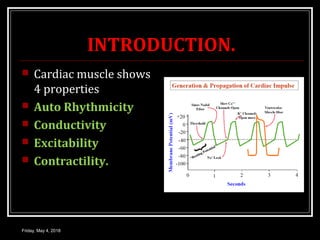
INTRODUCTION.
 Cardiac muscle shows
4 properties
 Auto Rhythmicity
 Conductivity
 Excitability
 Contractility.
Friday, May 4, 2018
INTRODUCTION.
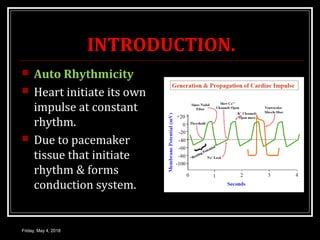
 Auto Rhythmicity
 Heart initiate its own
impulse at constant
rhythm.
 Due to pacemaker
tissue that initiate
rhythm & forms
conduction system.
Friday, May 4, 2018
ANATOMIC CONSIDERATION.
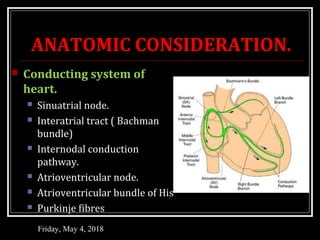
 Conducting system of
heart.
 Sinuatrial node.
 Interatrial tract ( Bachman
bundle)
 Internodal conduction
pathway.
 Atrioventricular node.
 Atrioventricular bundle of His
 Purkinje fibres
Friday, May 4, 2018
SINUATRIAL NODE.
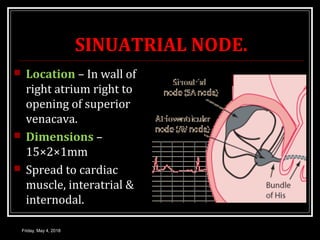
 Location – In wall of
right atrium right to
opening of superior
venacava.
 Dimensions –
15×2×1mm
 Spread to cardiac
muscle, interatrial &
internodal.
Friday, May 4, 2018
INTERATRIAL TRACT
(BACHMAN BUNDLE)
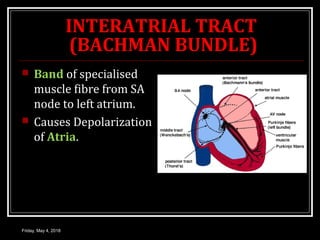
 Band of specialised
muscle fibre from SA
node to left atrium.
 Causes Depolarization
of Atria.
Friday, May 4, 2018
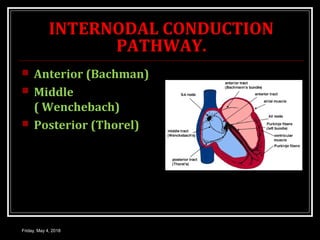
INTERNODAL CONDUCTION
PATHWAY.
 Anterior (Bachman)
 Middle
( Wenchebach)
 Posterior (Thorel)
Friday, May 4, 2018
ATRIOVENTRICULAR NODE.
 Location – just
beneath the
endocardium on right
side of lower part of
atrial septum.
 Convey impulses from
internodal tracts to
ventricles.
Friday, May 4, 2018
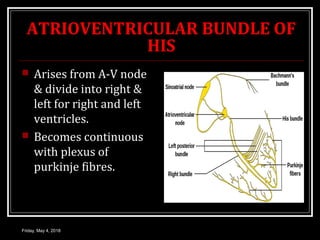
ATRIOVENTRICULAR BUNDLE OF
HIS
 Arises from A-V node
& divide into right &
left for right and left
ventricles.
 Becomes continuous
with plexus of
purkinje fibres.
Friday, May 4, 2018
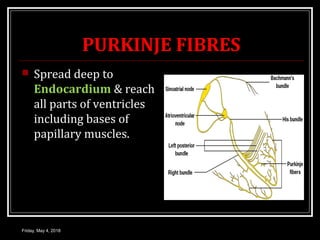
PURKINJE FIBRES
 Spread deep to
Endocardium & reach
all parts of ventricles
including bases of
papillary muscles.
Friday, May 4, 2018
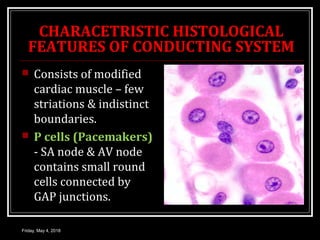
CHARACETRISTIC HISTOLOGICAL
FEATURES OF CONDUCTING SYSTEM
 Consists of modified
cardiac muscle – few
striations & indistinct
boundaries.
 P cells (Pacemakers)
- SA node & AV node
contains small round
cells connected by
GAP junctions.
Friday, May 4, 2018
INNERVATIONAL
CHARACTERISTIC OF HEART
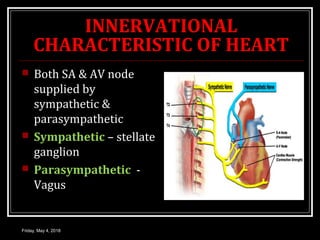
 Both SA & AV node
supplied by
sympathetic &
parasympathetic
 Sympathetic – stellate
ganglion
 Parasympathetic -
Vagus
Friday, May 4, 2018
INNERVATIONAL
CHARACTERISTIC OF HEART
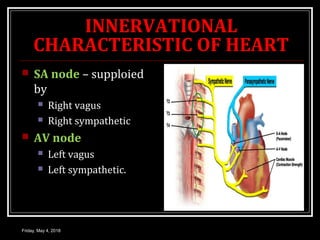
 SA node – supploied
by
 Right vagus
 Right sympathetic
 AV node
 Left vagus
 Left sympathetic.
Friday, May 4, 2018
MECHANISM OF ORIGIN OF
RHYTHMIC CARDIAC IMPULSE.
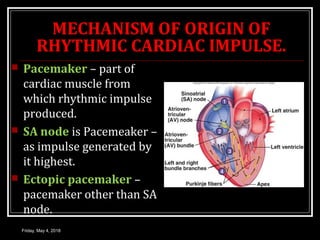
 Pacemaker – part of
cardiac muscle from
which rhythmic impulse
produced.
 SA node is Pacemeaker –
as impulse generated by
it highest.
 Ectopic pacemaker –
pacemaker other than SA
node.
Friday, May 4, 2018
MECHANISM OF ORIGIN OF
RHYTHMIC CARDIAC IMPULSE.
 Rate of production of rhythmic impulses
 SA node – 70-80/min
 AV node – 40-60/min
 Atrial Muscle - 40-60/min
 Ventricular muscle -20-40/min
Friday, May 4, 2018
ELECTRICAL POTENTIAL IN
PACEMAKER TISSUE.
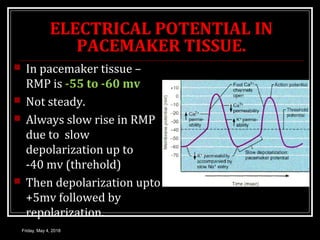
 In pacemaker tissue –
RMP is -55 to -60 mv
 Not steady.
 Always slow rise in RMP
due to slow
depolarization up to
-40 mv (threhold)
 Then depolarization upto
+5mv followed by
repolarization.
Friday, May 4, 2018
ELECTRICAL POTENTIAL IN
PACEMAKER TISSUE.
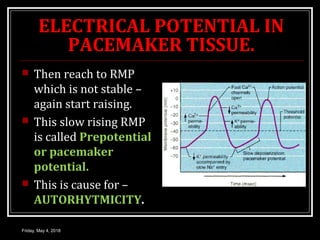
 Then reach to RMP
which is not stable –
again start raising.
 This slow rising RMP
is called Prepotential
or pacemaker
potential.
 This is cause for –
AUTORHYTMICITY.
Friday, May 4, 2018
IONIC BASIS OF PACEMAKER POTENTIAL
AND ACTION POTENTIAL IN SA NODE
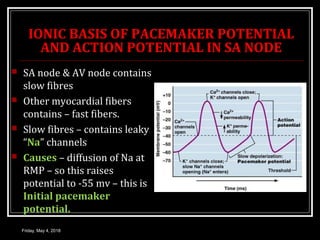
 SA node & AV node contains
slow fibres
 Other myocardial fibers
contains – fast fibers.
 Slow fibres – contains leaky
“Na” channels
 Causes – diffusion of Na at
RMP – so this raises
potential to -55 mv – this is
Initial pacemaker
potential.
Friday, May 4, 2018
IONIC BASIS OF PACEMAKER POTENTIAL
AND ACTION POTENTIAL IN SA NODE
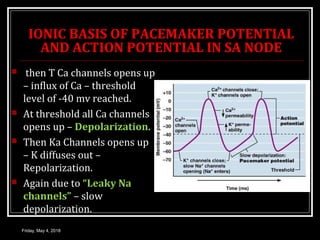
 then T Ca channels opens up
– influx of Ca – threshold
level of -40 mv reached.
 At threshold all Ca channels
opens up – Depolarization.
 Then Ka Channels opens up
– K diffuses out –
Repolarization.
 Again due to “Leaky Na
channels” – slow
depolarization.
Friday, May 4, 2018
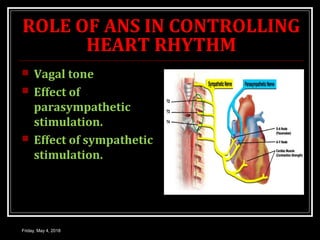
ROLE OF ANS IN CONTROLLING
HEART RHYTHM
 Vagal tone
 Effect of
parasympathetic
stimulation.
 Effect of sympathetic
stimulation.
Friday, May 4, 2018
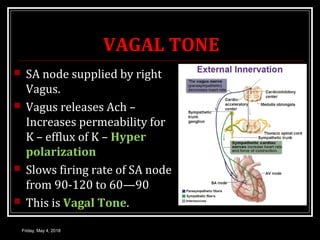
VAGAL TONE
 SA node supplied by right
Vagus.
 Vagus releases Ach –
Increases permeability for
K – efflux of K – Hyper
polarization
 Slows firing rate of SA node
from 90-120 to 60—90
 This is Vagal Tone.
Friday, May 4, 2018
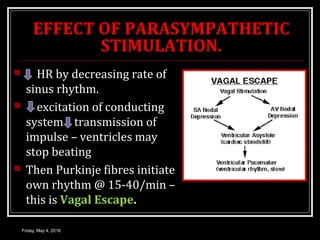
EFFECT OF PARASYMPATHETIC
STIMULATION.
 HR by decreasing rate of
sinus rhythm.
 excitation of conducting
system transmission of
impulse – ventricles may
stop beating
 Then Purkinje fibres initiate
own rhythm @ 15-40/min –
this is Vagal Escape.
Friday, May 4, 2018
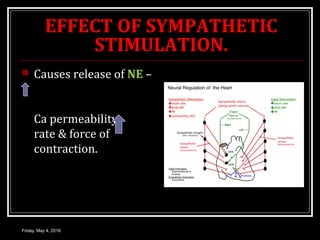
EFFECT OF SYMPATHETIC
STIMULATION.
 Causes release of NE –
Ca permeability -
rate & force of
contraction.
Friday, May 4, 2018
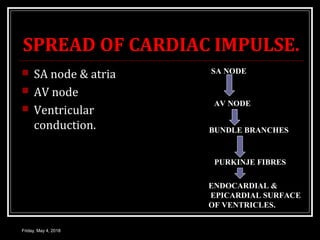
SPREAD OF CARDIAC IMPULSE.
 SA node & atria
 AV node
 Ventricular
conduction.
Friday, May 4, 2018
SA NODE
AV NODE
BUNDLE BRANCHES
PURKINJE FIBRES
ENDOCARDIAL &
EPICARDIAL SURFACE
OF VENTRICLES.
Conduction system of heart

Conduction system of heart

  • 1.
    DR NILESH KATE MBBS,MD ASSOCIATEPROF ESIC MEDICAL COLLEGE, GULBARGA. DEPT. OF PHYSIOLOGY CONDUCTION SYSTEM OF HEART
  • 2.
    OBJECTIVES.  Introduction.  Anatomicconsideration.  Mechanism of origin of rhythmic cardiac impulse.  Spread of cardiac impulse.
  • 3.
    INTRODUCTION.  Cardiac muscleshows 4 properties  Auto Rhythmicity  Conductivity  Excitability  Contractility. Friday, May 4, 2018
  • 4.
    INTRODUCTION.  Auto Rhythmicity Heart initiate its own impulse at constant rhythm.  Due to pacemaker tissue that initiate rhythm & forms conduction system. Friday, May 4, 2018
  • 5.
    ANATOMIC CONSIDERATION.  Conductingsystem of heart.  Sinuatrial node.  Interatrial tract ( Bachman bundle)  Internodal conduction pathway.  Atrioventricular node.  Atrioventricular bundle of His  Purkinje fibres Friday, May 4, 2018
  • 6.
    SINUATRIAL NODE.  Location– In wall of right atrium right to opening of superior venacava.  Dimensions – 15×2×1mm  Spread to cardiac muscle, interatrial & internodal. Friday, May 4, 2018
  • 7.
    INTERATRIAL TRACT (BACHMAN BUNDLE) Band of specialised muscle fibre from SA node to left atrium.  Causes Depolarization of Atria. Friday, May 4, 2018
  • 8.
    INTERNODAL CONDUCTION PATHWAY.  Anterior(Bachman)  Middle ( Wenchebach)  Posterior (Thorel) Friday, May 4, 2018
  • 9.
    ATRIOVENTRICULAR NODE.  Location– just beneath the endocardium on right side of lower part of atrial septum.  Convey impulses from internodal tracts to ventricles. Friday, May 4, 2018
  • 10.
    ATRIOVENTRICULAR BUNDLE OF HIS Arises from A-V node & divide into right & left for right and left ventricles.  Becomes continuous with plexus of purkinje fibres. Friday, May 4, 2018
  • 11.
    PURKINJE FIBRES  Spreaddeep to Endocardium & reach all parts of ventricles including bases of papillary muscles. Friday, May 4, 2018
  • 12.
    CHARACETRISTIC HISTOLOGICAL FEATURES OFCONDUCTING SYSTEM  Consists of modified cardiac muscle – few striations & indistinct boundaries.  P cells (Pacemakers) - SA node & AV node contains small round cells connected by GAP junctions. Friday, May 4, 2018
  • 13.
    INNERVATIONAL CHARACTERISTIC OF HEART Both SA & AV node supplied by sympathetic & parasympathetic  Sympathetic – stellate ganglion  Parasympathetic - Vagus Friday, May 4, 2018
  • 14.
    INNERVATIONAL CHARACTERISTIC OF HEART SA node – supploied by  Right vagus  Right sympathetic  AV node  Left vagus  Left sympathetic. Friday, May 4, 2018
  • 15.
    MECHANISM OF ORIGINOF RHYTHMIC CARDIAC IMPULSE.  Pacemaker – part of cardiac muscle from which rhythmic impulse produced.  SA node is Pacemeaker – as impulse generated by it highest.  Ectopic pacemaker – pacemaker other than SA node. Friday, May 4, 2018
  • 16.
    MECHANISM OF ORIGINOF RHYTHMIC CARDIAC IMPULSE.  Rate of production of rhythmic impulses  SA node – 70-80/min  AV node – 40-60/min  Atrial Muscle - 40-60/min  Ventricular muscle -20-40/min Friday, May 4, 2018
  • 17.
    ELECTRICAL POTENTIAL IN PACEMAKERTISSUE.  In pacemaker tissue – RMP is -55 to -60 mv  Not steady.  Always slow rise in RMP due to slow depolarization up to -40 mv (threhold)  Then depolarization upto +5mv followed by repolarization. Friday, May 4, 2018
  • 18.
    ELECTRICAL POTENTIAL IN PACEMAKERTISSUE.  Then reach to RMP which is not stable – again start raising.  This slow rising RMP is called Prepotential or pacemaker potential.  This is cause for – AUTORHYTMICITY. Friday, May 4, 2018
  • 19.
    IONIC BASIS OFPACEMAKER POTENTIAL AND ACTION POTENTIAL IN SA NODE  SA node & AV node contains slow fibres  Other myocardial fibers contains – fast fibers.  Slow fibres – contains leaky “Na” channels  Causes – diffusion of Na at RMP – so this raises potential to -55 mv – this is Initial pacemaker potential. Friday, May 4, 2018
  • 20.
    IONIC BASIS OFPACEMAKER POTENTIAL AND ACTION POTENTIAL IN SA NODE  then T Ca channels opens up – influx of Ca – threshold level of -40 mv reached.  At threshold all Ca channels opens up – Depolarization.  Then Ka Channels opens up – K diffuses out – Repolarization.  Again due to “Leaky Na channels” – slow depolarization. Friday, May 4, 2018
  • 21.
    ROLE OF ANSIN CONTROLLING HEART RHYTHM  Vagal tone  Effect of parasympathetic stimulation.  Effect of sympathetic stimulation. Friday, May 4, 2018
  • 22.
    VAGAL TONE  SAnode supplied by right Vagus.  Vagus releases Ach – Increases permeability for K – efflux of K – Hyper polarization  Slows firing rate of SA node from 90-120 to 60—90  This is Vagal Tone. Friday, May 4, 2018
  • 23.
    EFFECT OF PARASYMPATHETIC STIMULATION. HR by decreasing rate of sinus rhythm.  excitation of conducting system transmission of impulse – ventricles may stop beating  Then Purkinje fibres initiate own rhythm @ 15-40/min – this is Vagal Escape. Friday, May 4, 2018
  • 24.
    EFFECT OF SYMPATHETIC STIMULATION. Causes release of NE – Ca permeability - rate & force of contraction. Friday, May 4, 2018
  • 25.
    SPREAD OF CARDIACIMPULSE.  SA node & atria  AV node  Ventricular conduction. Friday, May 4, 2018 SA NODE AV NODE BUNDLE BRANCHES PURKINJE FIBRES ENDOCARDIAL & EPICARDIAL SURFACE OF VENTRICLES.