Cardiovascular Drugs
DEPARTMENT
OF
MEDICAL SURGICAL NURSING
1
LEARNING OBJECTIVES
At the end of the class the group will be able to
• Describe the cardiovascular drugs,
• List down the cardiovascular drugs,
• Enlist the types cardiovascular drugs, ,
• Explain the dosage mode of actions, uses, side
effects.
2
INOTROPES
TYPES:
• Catecholamines: e.g. epinephrine,
norepinephrine, dobutamine, dopamine
• Phosphodiesterase (PDE) inhibi tors: e.g. mi
lrinone, enoximone Dopexamine
• Calcium sensitisers: e.g. levosimendan
• Cardiac glycosides: e.g. digoxin (weak)
3
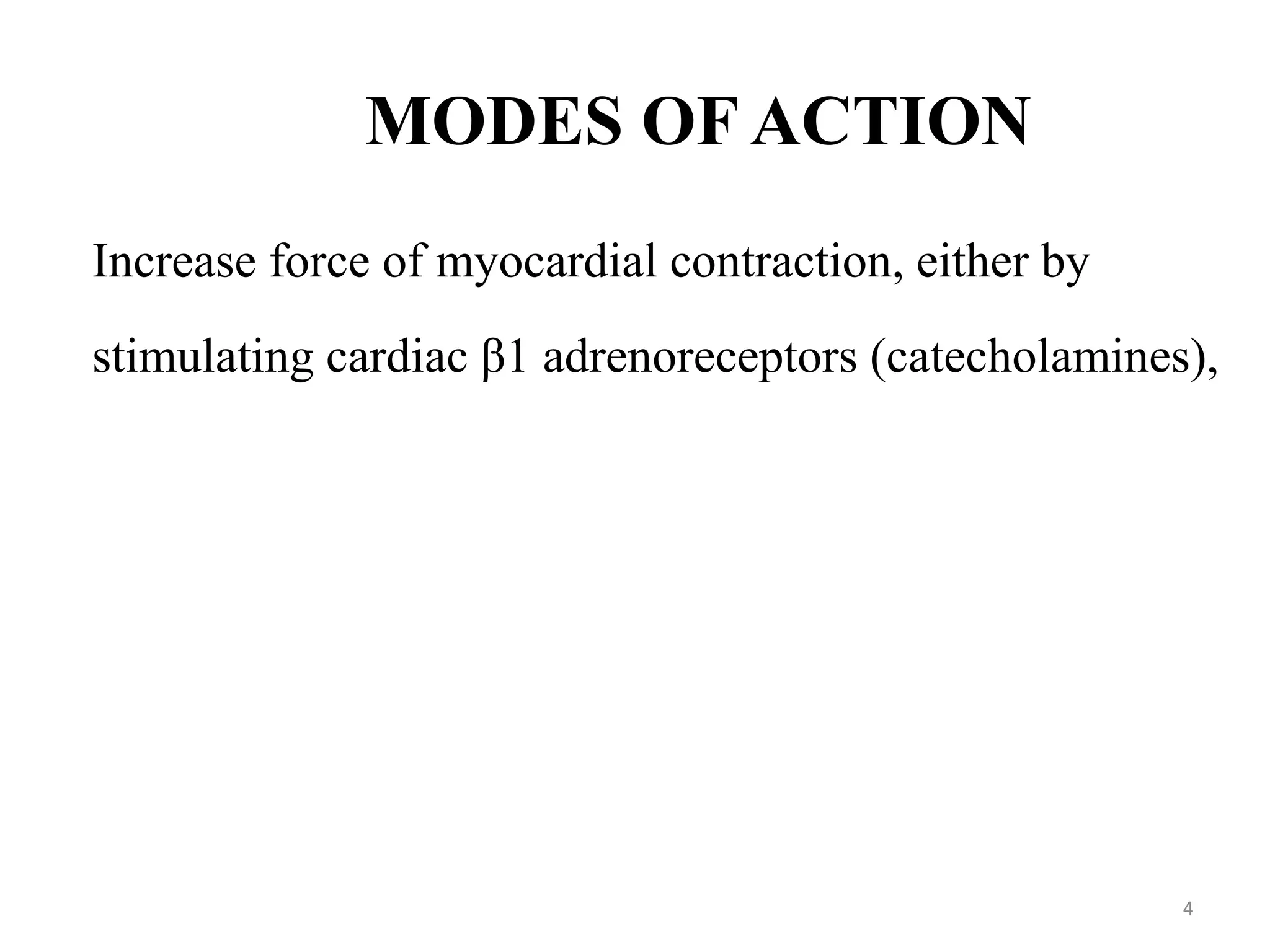
MODES OF ACTION
Increase force of myocardial contraction, either by
stimulating cardiac β1 adrenoreceptors (catecholamines),
4
USES
• Myocardial failure, e.g. post-myocardial
infarction, cardiomyopathy.
• Myocardial depression, e.g. sepsis
• Augmentation of oxygen delivery in high-risk
surgical patients.
5
SIDE-EFFECTS
• Arrhythmias
• Tachycardia
• Hypotension
• Hypertension
• Anginal chest pain, or ST-segment and T-wave
changes on ECG.
6
DRUG DOSAGES
• Epinephrine: Infusion starting from
0.05μg/kg/min
• Norepinephrine: Infusion starting from
0.05μg/kg/min
• Dobutamine: Infusion from 2.5–5μg/kg/min
• Dopamine: Infusion from 2.5–50μg/kg/min
• Dopexamine: Infusion from 0.5–6μg/kg/min
7
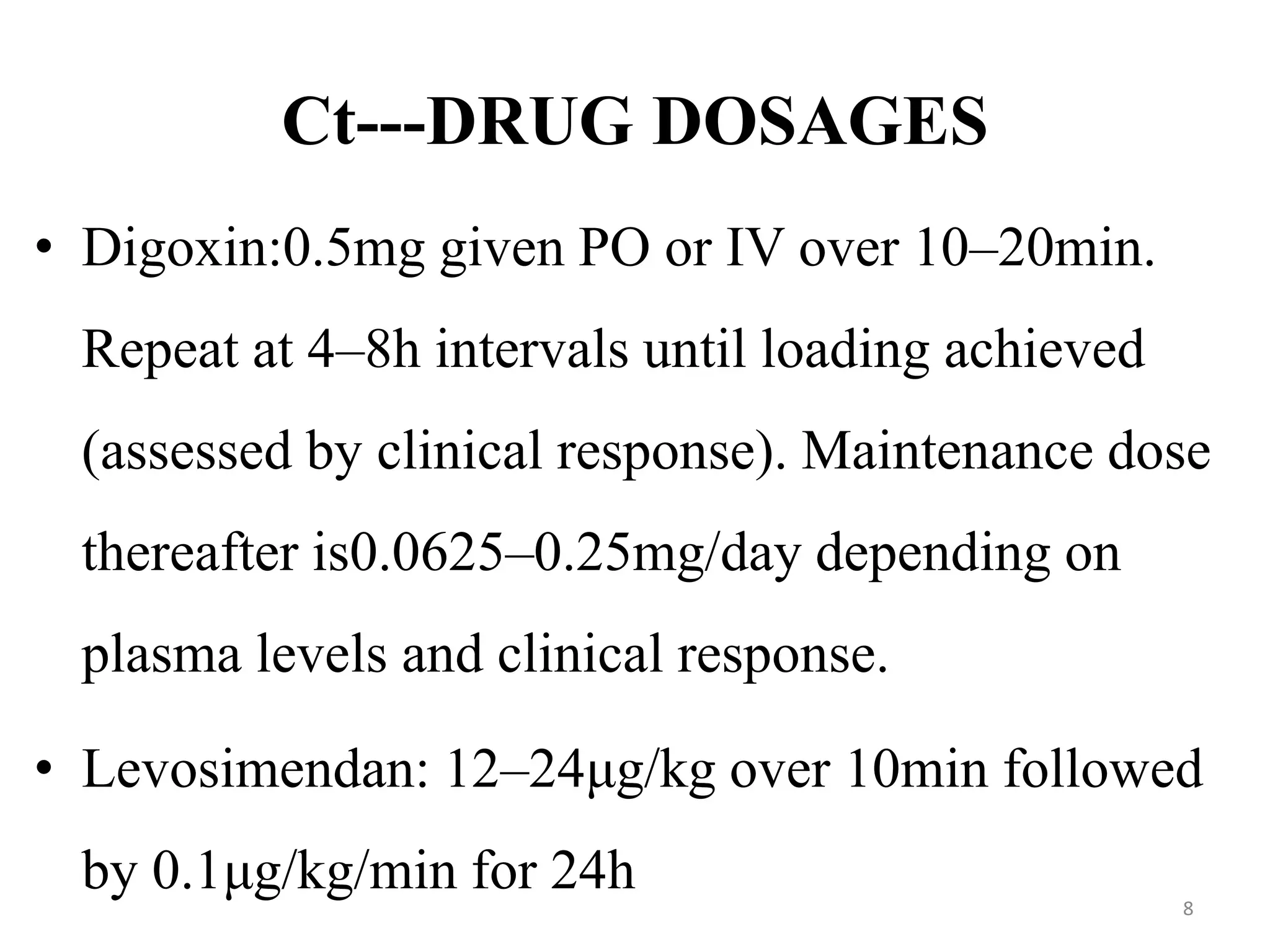
Ct---DRUG DOSAGES
• Digoxin:0.5mg given PO or IV over 10–20min.
Repeat at 4–8h intervals until loading achieved
(assessed by clinical response). Maintenance dose
thereafter is0.0625–0.25mg/day depending on
plasma levels and clinical response.
• Levosimendan: 12–24μg/kg over 10min followed
by 0.1μg/kg/min for 24h 8
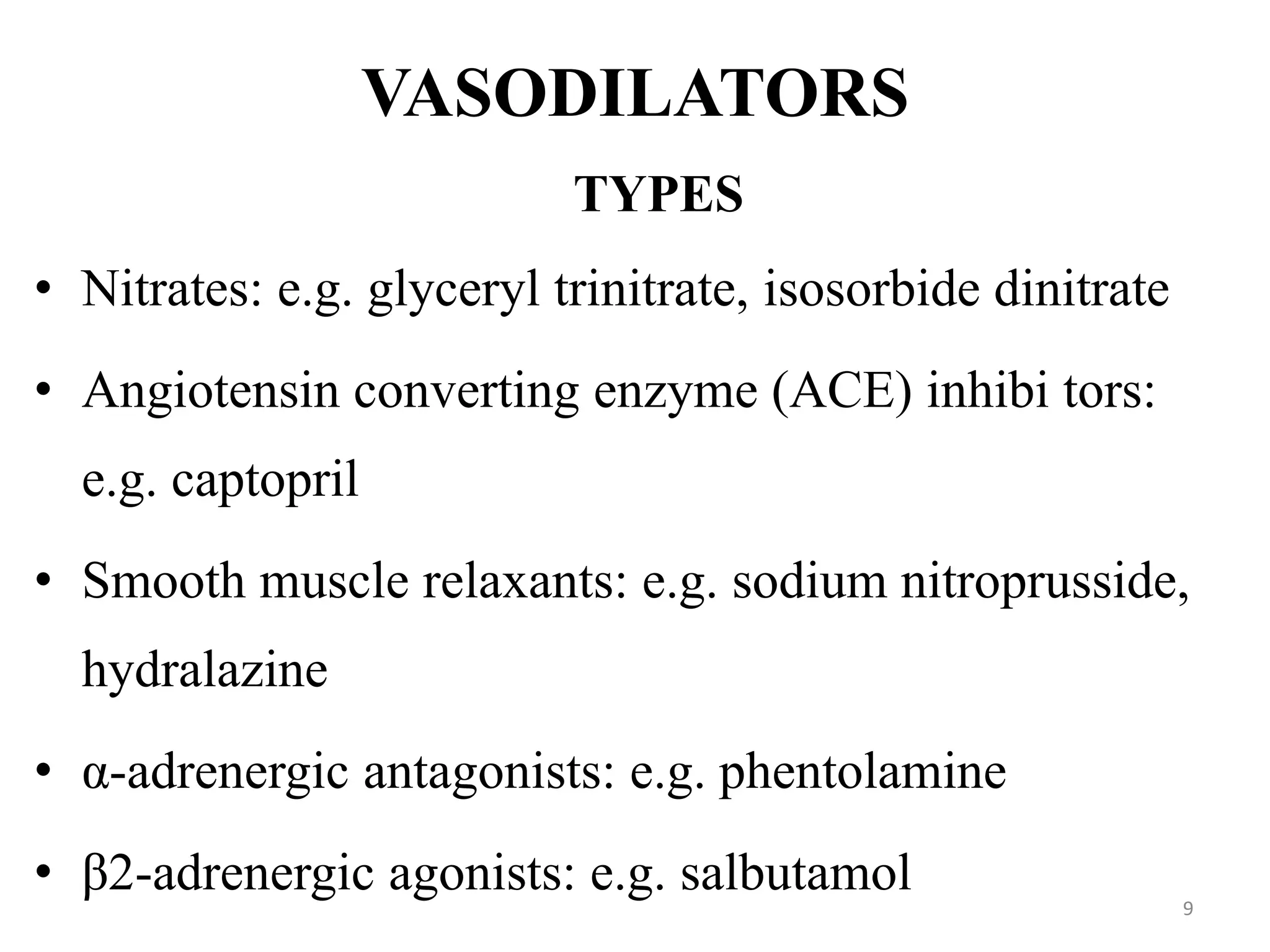
VASODILATORS
TYPES
• Nitrates: e.g. glyceryl trinitrate, isosorbide dinitrate
• Angiotensin converting enzyme (ACE) inhibi tors:
e.g. captopril
• Smooth muscle relaxants: e.g. sodium nitroprusside,
hydralazine
• α-adrenergic antagonists: e.g. phentolamine
• β2-adrenergic agonists: e.g. salbutamol 9
Ct---VASODILATORS
• Calcium antagonists: e.g. nifedipine, diltiazem
• Dopaminergic agonists: e.g. dopexamine
• Phosphodiesterase inhibitors: e.g. enoximone,
milrinone, sildenafil
• Prostaglandins: e.g. epoprostenol (PGI2),
alprostadi l (PGE1)
• B-type natriuretic peptide analogues, e.g. nesiritide
10
MODES OF ACTION
• Increase cyclic GMP concentration (by nitric
oxide donation or by inhibiting cGMP
breakdown), or acts directly on
• dopaminergic receptors leading to vasodilatation
• Reduce (to varying degrees) ventricular preload
and/or afterload.
• Reduce cardiac work.
11
USES
• Myocardial failure, e.g. post-myocardial
infarction, cardiomyopathy.
• Angina/ischaemic heart disease.
• Systemic hypertension
• Vasoconstriction
• Peripheral vascular disease/hypoperfusion
• Pulmonary hypertension
12
SIDE-EFFECTS
• Hypotension
• Tachycardia
• Symptoms include headache, flushing, postural
hypotension
• Renal failure (ACE inhibitors)—especially with
renal artery stenosis, hypovolaemia, non-
steroidals.
13
DRUG DOSAGES
• Nitrates Glyceryl trinitrate: 2–40mg/h
• Isosorbide dinitrate: 2–40mg/h
• Sodium nitroprusside: 20–400μg/min
• Hydralazine: 5–10mg by slow IV bolus, repeat
after 20–30min. Alternatively, by infusion starting
at 200–300μg/min and reducing to 50–150μg/min
14
Ct---DRUG DOSAGES
• ACE inhibitors Captopril: 6.25mg test dose
increasing to 25mg tds
• Enalapril: 2.5mg test dose increasing to 40mg od
• Nifedipine: 5–20mg PO. Capsule fluid can be
injected down nasogastric tube or given
sublingually
• Dopexamine Infusion from 0.5–6μg/kg/min
15
VASOPRESSORS
• α-adrenergic: e.g. norepinephrine, epinephrine,
dopamine, ephedrine, phenylephrine,
methoxamine.
• Drugs reducing production of cycl ic GMP (in
septic shock): e.g. methylthioninium chloride
• Vasopressin or synthetic analogues, e.g.
terlipressin
16
MODES OF ACTION
• Acting on peripheral α-adrenergic or vasopressin
V1 receptors
• Blocking cGMP production (methylene blue)
• Increase after load, mainly by arteriolar
vasoconstriction and restoration of vascular
reactivity Venoconstriction
17
USES
• To increase organ perfusion pressures,
particularly in high output, low peripheral
resistance states, e.g. sepsis, anaphylaxis
• To raise coronary perfusion pressures in
cardiopulmonary resuscitation (epinephrine,
vasopressin)
18
SIDE-EFFECTS
• Increased cardiac work
• Decreased cardiac output,
• Myocardial and splanchnic ischaemia
• Increased myocardial irritability,, leading to
arrhythmias and tachycardia
• Decreased peripheral perfusion and distal
ischaemia/necrosis
19
DRUG DOSAGES
• Norepinephine Infusion starting from
0.05μg/kg/min
• Epinephrine Infusion starting from 0.05μg/kg/min
• Dopamine Infusion from 5–50μg/kg/min
• Methoxamine 3–10mg by slow IV bolus (rate of
1mg/min)
• Vasopressin 0.01–0.04U/min
20
SUMMARY
In this class we discussed the
• List of the cardiovascular drugs,
• Types cardiovascular drugs, ,
• Dosage, mode of actions, uses, side effects of the
cardiovascular drugs
21
BIBLIOGRAPHY
• Lewis et al, Medical Surgical Nursing, Mosby
Elsevier,7th edition.
• Joyce.M.Black et al, Medical Surgical
Nursing, Saunders publication.
• Brunner and Siddhartha, Medical Surgical
Nursing, Lippincott Williams and Wilkins
22
23

Cardiac drugs

  • 1.
  • 2.
    LEARNING OBJECTIVES At theend of the class the group will be able to • Describe the cardiovascular drugs, • List down the cardiovascular drugs, • Enlist the types cardiovascular drugs, , • Explain the dosage mode of actions, uses, side effects. 2
  • 3.
    INOTROPES TYPES: • Catecholamines: e.g.epinephrine, norepinephrine, dobutamine, dopamine • Phosphodiesterase (PDE) inhibi tors: e.g. mi lrinone, enoximone Dopexamine • Calcium sensitisers: e.g. levosimendan • Cardiac glycosides: e.g. digoxin (weak) 3
  • 4.
    MODES OF ACTION Increaseforce of myocardial contraction, either by stimulating cardiac β1 adrenoreceptors (catecholamines), 4
  • 5.
    USES • Myocardial failure,e.g. post-myocardial infarction, cardiomyopathy. • Myocardial depression, e.g. sepsis • Augmentation of oxygen delivery in high-risk surgical patients. 5
  • 6.
    SIDE-EFFECTS • Arrhythmias • Tachycardia •Hypotension • Hypertension • Anginal chest pain, or ST-segment and T-wave changes on ECG. 6
  • 7.
    DRUG DOSAGES • Epinephrine:Infusion starting from 0.05μg/kg/min • Norepinephrine: Infusion starting from 0.05μg/kg/min • Dobutamine: Infusion from 2.5–5μg/kg/min • Dopamine: Infusion from 2.5–50μg/kg/min • Dopexamine: Infusion from 0.5–6μg/kg/min 7
  • 8.
    Ct---DRUG DOSAGES • Digoxin:0.5mggiven PO or IV over 10–20min. Repeat at 4–8h intervals until loading achieved (assessed by clinical response). Maintenance dose thereafter is0.0625–0.25mg/day depending on plasma levels and clinical response. • Levosimendan: 12–24μg/kg over 10min followed by 0.1μg/kg/min for 24h 8
  • 9.
    VASODILATORS TYPES • Nitrates: e.g.glyceryl trinitrate, isosorbide dinitrate • Angiotensin converting enzyme (ACE) inhibi tors: e.g. captopril • Smooth muscle relaxants: e.g. sodium nitroprusside, hydralazine • α-adrenergic antagonists: e.g. phentolamine • β2-adrenergic agonists: e.g. salbutamol 9
  • 10.
    Ct---VASODILATORS • Calcium antagonists:e.g. nifedipine, diltiazem • Dopaminergic agonists: e.g. dopexamine • Phosphodiesterase inhibitors: e.g. enoximone, milrinone, sildenafil • Prostaglandins: e.g. epoprostenol (PGI2), alprostadi l (PGE1) • B-type natriuretic peptide analogues, e.g. nesiritide 10
  • 11.
    MODES OF ACTION •Increase cyclic GMP concentration (by nitric oxide donation or by inhibiting cGMP breakdown), or acts directly on • dopaminergic receptors leading to vasodilatation • Reduce (to varying degrees) ventricular preload and/or afterload. • Reduce cardiac work. 11
  • 12.
    USES • Myocardial failure,e.g. post-myocardial infarction, cardiomyopathy. • Angina/ischaemic heart disease. • Systemic hypertension • Vasoconstriction • Peripheral vascular disease/hypoperfusion • Pulmonary hypertension 12
  • 13.
    SIDE-EFFECTS • Hypotension • Tachycardia •Symptoms include headache, flushing, postural hypotension • Renal failure (ACE inhibitors)—especially with renal artery stenosis, hypovolaemia, non- steroidals. 13
  • 14.
    DRUG DOSAGES • NitratesGlyceryl trinitrate: 2–40mg/h • Isosorbide dinitrate: 2–40mg/h • Sodium nitroprusside: 20–400μg/min • Hydralazine: 5–10mg by slow IV bolus, repeat after 20–30min. Alternatively, by infusion starting at 200–300μg/min and reducing to 50–150μg/min 14
  • 15.
    Ct---DRUG DOSAGES • ACEinhibitors Captopril: 6.25mg test dose increasing to 25mg tds • Enalapril: 2.5mg test dose increasing to 40mg od • Nifedipine: 5–20mg PO. Capsule fluid can be injected down nasogastric tube or given sublingually • Dopexamine Infusion from 0.5–6μg/kg/min 15
  • 16.
    VASOPRESSORS • α-adrenergic: e.g.norepinephrine, epinephrine, dopamine, ephedrine, phenylephrine, methoxamine. • Drugs reducing production of cycl ic GMP (in septic shock): e.g. methylthioninium chloride • Vasopressin or synthetic analogues, e.g. terlipressin 16
  • 17.
    MODES OF ACTION •Acting on peripheral α-adrenergic or vasopressin V1 receptors • Blocking cGMP production (methylene blue) • Increase after load, mainly by arteriolar vasoconstriction and restoration of vascular reactivity Venoconstriction 17
  • 18.
    USES • To increaseorgan perfusion pressures, particularly in high output, low peripheral resistance states, e.g. sepsis, anaphylaxis • To raise coronary perfusion pressures in cardiopulmonary resuscitation (epinephrine, vasopressin) 18
  • 19.
    SIDE-EFFECTS • Increased cardiacwork • Decreased cardiac output, • Myocardial and splanchnic ischaemia • Increased myocardial irritability,, leading to arrhythmias and tachycardia • Decreased peripheral perfusion and distal ischaemia/necrosis 19
  • 20.
    DRUG DOSAGES • NorepinephineInfusion starting from 0.05μg/kg/min • Epinephrine Infusion starting from 0.05μg/kg/min • Dopamine Infusion from 5–50μg/kg/min • Methoxamine 3–10mg by slow IV bolus (rate of 1mg/min) • Vasopressin 0.01–0.04U/min 20
  • 21.
    SUMMARY In this classwe discussed the • List of the cardiovascular drugs, • Types cardiovascular drugs, , • Dosage, mode of actions, uses, side effects of the cardiovascular drugs 21
  • 22.
    BIBLIOGRAPHY • Lewis etal, Medical Surgical Nursing, Mosby Elsevier,7th edition. • Joyce.M.Black et al, Medical Surgical Nursing, Saunders publication. • Brunner and Siddhartha, Medical Surgical Nursing, Lippincott Williams and Wilkins 22
  • 23.