Cardiovascular Medications
CV CORE CURRICULUM
11/25/2016 1
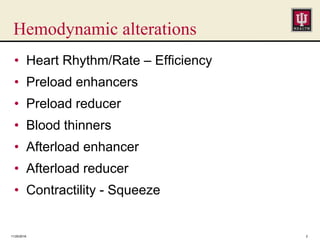
Hemodynamic alterations
• Heart Rhythm/Rate – Efficiency
• Preload enhancers
• Preload reducer
• Blood thinners
• Afterload enhancer
• Afterload reducer
• Contractility - Squeeze
11/25/2016 2
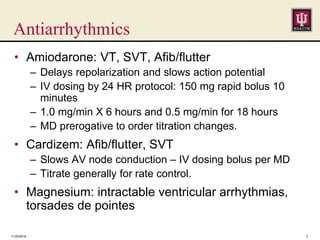
Antiarrhythmics
• Amiodarone: VT, SVT, Afib/flutter
– Delays repolarization and slows action potential
– IV dosing by 24 HR protocol: 150 mg rapid bolus 10
minutes
– 1.0 mg/min X 6 hours and 0.5 mg/min for 18 hours
– MD prerogative to order titration changes.
• Cardizem: Afib/flutter, SVT
– Slows AV node conduction – IV dosing bolus per MD
– Titrate generally for rate control.
• Magnesium: intractable ventricular arrhythmias,
torsades de pointes
11/25/2016 3
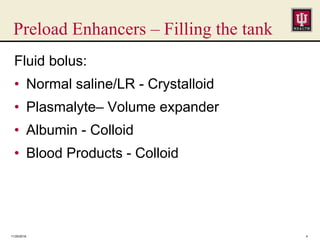
Preload Enhancers – Filling the tank
Fluid bolus:
• Normal saline/LR - Crystalloid
• Plasmalyte– Volume expander
• Albumin - Colloid
• Blood Products - Colloid
11/25/2016 4
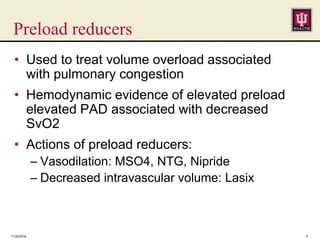
Preload reducers
• Used to treat volume overload associated
with pulmonary congestion
• Hemodynamic evidence of elevated preload
elevated PAD associated with decreased
SvO2
• Actions of preload reducers:
– Vasodilation: MSO4, NTG, Nipride
– Decreased intravascular volume: Lasix
11/25/2016 5
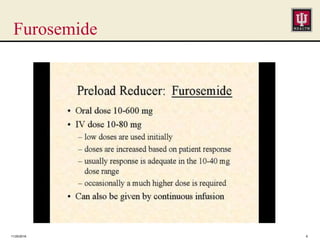
Furosemide
11/25/2016 6
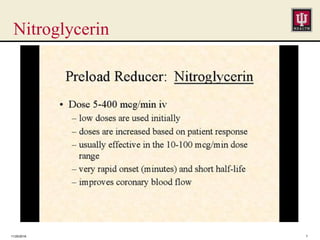
Nitroglycerin
11/25/2016 7
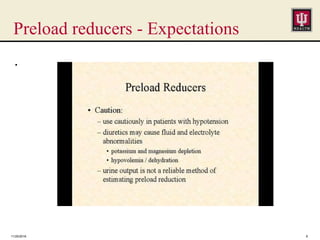
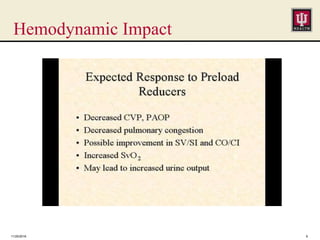
Preload reducers - Expectations
.
11/25/2016 8
Hemodynamic Impact
11/25/2016 9
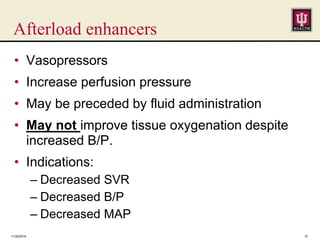
Afterload enhancers
11/25/2016 10
• Vasopressors
• Increase perfusion pressure
• May be preceded by fluid administration
• May not improve tissue oxygenation despite
increased B/P.
• Indications:
– Decreased SVR
– Decreased B/P
– Decreased MAP
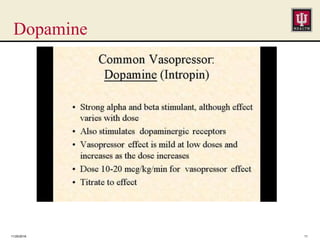
Dopamine
11/25/2016 11
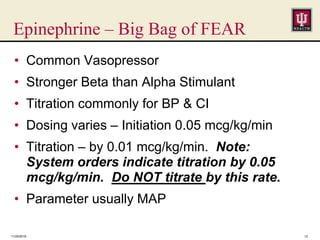
Epinephrine – Big Bag of FEAR
11/25/2016 12
• Common Vasopressor
• Stronger Beta than Alpha Stimulant
• Titration commonly for BP & CI
• Dosing varies – Initiation 0.05 mcg/kg/min
• Titration – by 0.01 mcg/kg/min. Note:
System orders indicate titration by 0.05
mcg/kg/min. Do NOT titrate by this rate.
• Parameter usually MAP
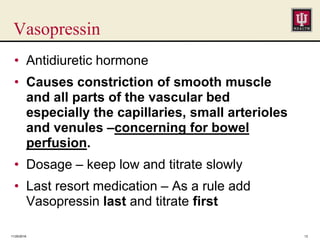
Vasopressin
• Antidiuretic hormone
• Causes constriction of smooth muscle
and all parts of the vascular bed
especially the capillaries, small arterioles
and venules –concerning for bowel
perfusion.
• Dosage – keep low and titrate slowly
• Last resort medication – As a rule add
Vasopressin last and titrate first
11/25/2016 13
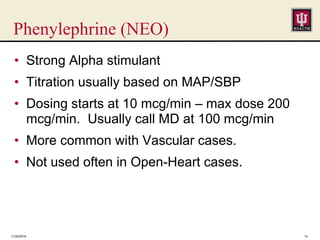
Phenylephrine (NEO)
• Strong Alpha stimulant
• Titration usually based on MAP/SBP
• Dosing starts at 10 mcg/min – max dose 200
mcg/min. Usually call MD at 100 mcg/min
• More common with Vascular cases.
• Not used often in Open-Heart cases.
11/25/2016 14
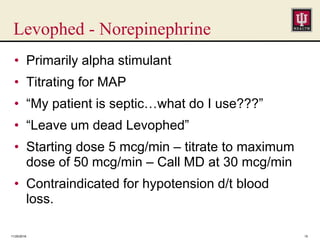
Levophed - Norepinephrine
• Primarily alpha stimulant
• Titrating for MAP
• “My patient is septic…what do I use???”
• “Leave um dead Levophed”
• Starting dose 5 mcg/min – titrate to maximum
dose of 50 mcg/min – Call MD at 30 mcg/min
• Contraindicated for hypotension d/t blood
loss.
11/25/2016 15
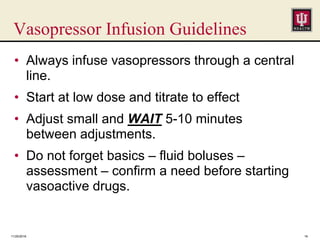
Vasopressor Infusion Guidelines
• Always infuse vasopressors through a central
line.
• Start at low dose and titrate to effect
• Adjust small and WAIT 5-10 minutes
between adjustments.
• Do not forget basics – fluid boluses –
assessment – confirm a need before starting
vasoactive drugs.
11/25/2016 16
Vasopressors – Key Concepts
• Vasopressors work by stimulating alpha
receptors – sympathetic nervous system
• Normal response is a rapid rise in BP
• Failure to raise BP is an indication of acuity of
patient condition.
• Remember! No medication is benign!
Increased stress on the heart/body occurs
with these drugs. Be mindful of costs vs.
benefits.
11/25/2016 17
Afterload reduction
• Used to lower the resistance to ventricular
ejection to improve CO/CI
• Indicated for decreased CO/CI and SvO2
associated with elevated SVR and hypertension
• Categories:
– Direct arterial dilation: Nipride or high dose of
NTG
– Angiotensin converting enzyme inhibitors
– Calcium channel blockers
11/25/2016 18
Nipride
• Powerful direct arterial dilator and mild
venodilator. Effects much more profound
than NTG.
• Dosing –0.5 mcg/kg/min initiation and titrate
by 0.5 mcg/kg/min Q5 minutes to keep MAP
below 80mmHG. Call MD at 5 mcg/kg/min –
Max dose 8 mcg/kg/min.
• Consider Renal and Liver issues – cyanide
toxicity.
11/25/2016 19
Cardene - Nicardipine
• Calcium channel blocker – inhibits
contraction of smooth muscle. Think
Cardizem/Norvasc
• Benefits: reduces cardiac work through
vasodilation.
• Negatives: Can cause bradycardia, heart
block, decreased contractility.
• Dosing: Start at 5 mg/hr – titrate by 2.5 mg/hr
Q 10 minutes. Max rate 15 mg/hr
11/25/2016 20
Contractility Enhancers
• Positive inotropes – stimulate beta receptors
to increase inotropic state of the heart.
“Improve Squeeze”
• Indicated for decreased CO/CI with adequate
preload and normal/low afterload. “Is your
tank full?”
• “What’s the malfunction of your dysfunction?”
Know WHY a drug is hanging and WHAT to
look for by way of effect.
11/25/2016 21
Dobutamine
• Beta receptor stimulant – used to improve
CO/CI and SvO2. May lower SVR and BP
• Dosing: 1-20 mcg/kg/min – as a rule, not the
first drug class you titrate. Often a set rate.
• Titration parameters usually CO/CI
• Side effects: Tachycardia, increased
myocardial O2 consumption and potential for
hypotension.
• Think: Who needs Dobutamine?
11/25/2016 22
Dopamine
• Remember: Stimulates alpha & beta
receptors
• Dosing determines function!!!
• Low Dose – 1-5 mcg/kg/min = improves renal
and mesenteric blood flow.
• Mid Dose – 5-10 mcg/kg/min = positive
inotrope – improved contractility
• High Dose - > 10 mcg/kg/min = increased
SVR, HR and BP.
11/25/2016 23
Phosphodiesterase Inhibitors
• Milrinone (Primacor)
• Dosing: Loading dose 0.05 mg/kg over 10
minutes. Continuous infusion 0.375-0.75
mcg/kg/min. Max rate 0.75
• Milrinone is a bipyridine inotropic/vasodilator.
Increases intracellular ionized calcium and
contractile force of the heart muscles
11/25/2016 24
Contractility Reducers
• Beta Blockers/Negative inotropes/Calcium
Channel Blockers
• Common side effects – Lower HR and B/P
• Brevibloc Infusion – BB with rapid onset
and short half-life. Indications: HTN,
Tachycardia, SVT. Contraindications:
Cardiogenic shock, Overt cardiac failure, 2nd
and 3rd degree HB
• Dosing: Loading doses (see drug guide) – 50
mcg/kg/min – max rate of 200 mcg/kg/min
11/25/2016 25
AntiCoagulants
• Heparin - Glycosaminoglycan – inhibits
formation of thrombin through inactivation of
Factor X of the clotting cascade. Protamine
Sulfate.
• Argatroban - Direct thrombin inhibitor –
inhibits thrombin catalyzed or induced
reactions, inhibits fibrin formation and factors
V,VIII, XIII.
• Alteplase – Recombinant t-PA is clot specific
and activates fibrin bound plasminogen.
Lyses clots – Everywhere.
11/25/2016 26
Anticoagulant Concerns
• Heparin – Platelet Count and PTT
• Argatroban – PTT and Scheduled labs
• Warfarin – PT/INR
• ALL – Bleeding – GI – Surgical Site etc.
11/25/2016 27
Questions
Questions?
11/25/2016 28

Cardiac Medications

  • 1.
    Cardiovascular Medications CV CORECURRICULUM 11/25/2016 1
  • 2.
    Hemodynamic alterations • HeartRhythm/Rate – Efficiency • Preload enhancers • Preload reducer • Blood thinners • Afterload enhancer • Afterload reducer • Contractility - Squeeze 11/25/2016 2
  • 3.
    Antiarrhythmics • Amiodarone: VT,SVT, Afib/flutter – Delays repolarization and slows action potential – IV dosing by 24 HR protocol: 150 mg rapid bolus 10 minutes – 1.0 mg/min X 6 hours and 0.5 mg/min for 18 hours – MD prerogative to order titration changes. • Cardizem: Afib/flutter, SVT – Slows AV node conduction – IV dosing bolus per MD – Titrate generally for rate control. • Magnesium: intractable ventricular arrhythmias, torsades de pointes 11/25/2016 3
  • 4.
    Preload Enhancers –Filling the tank Fluid bolus: • Normal saline/LR - Crystalloid • Plasmalyte– Volume expander • Albumin - Colloid • Blood Products - Colloid 11/25/2016 4
  • 5.
    Preload reducers • Usedto treat volume overload associated with pulmonary congestion • Hemodynamic evidence of elevated preload elevated PAD associated with decreased SvO2 • Actions of preload reducers: – Vasodilation: MSO4, NTG, Nipride – Decreased intravascular volume: Lasix 11/25/2016 5
  • 6.
  • 7.
  • 8.
    Preload reducers -Expectations . 11/25/2016 8
  • 9.
  • 10.
    Afterload enhancers 11/25/2016 10 •Vasopressors • Increase perfusion pressure • May be preceded by fluid administration • May not improve tissue oxygenation despite increased B/P. • Indications: – Decreased SVR – Decreased B/P – Decreased MAP
  • 11.
  • 12.
    Epinephrine – BigBag of FEAR 11/25/2016 12 • Common Vasopressor • Stronger Beta than Alpha Stimulant • Titration commonly for BP & CI • Dosing varies – Initiation 0.05 mcg/kg/min • Titration – by 0.01 mcg/kg/min. Note: System orders indicate titration by 0.05 mcg/kg/min. Do NOT titrate by this rate. • Parameter usually MAP
  • 13.
    Vasopressin • Antidiuretic hormone •Causes constriction of smooth muscle and all parts of the vascular bed especially the capillaries, small arterioles and venules –concerning for bowel perfusion. • Dosage – keep low and titrate slowly • Last resort medication – As a rule add Vasopressin last and titrate first 11/25/2016 13
  • 14.
    Phenylephrine (NEO) • StrongAlpha stimulant • Titration usually based on MAP/SBP • Dosing starts at 10 mcg/min – max dose 200 mcg/min. Usually call MD at 100 mcg/min • More common with Vascular cases. • Not used often in Open-Heart cases. 11/25/2016 14
  • 15.
    Levophed - Norepinephrine •Primarily alpha stimulant • Titrating for MAP • “My patient is septic…what do I use???” • “Leave um dead Levophed” • Starting dose 5 mcg/min – titrate to maximum dose of 50 mcg/min – Call MD at 30 mcg/min • Contraindicated for hypotension d/t blood loss. 11/25/2016 15
  • 16.
    Vasopressor Infusion Guidelines •Always infuse vasopressors through a central line. • Start at low dose and titrate to effect • Adjust small and WAIT 5-10 minutes between adjustments. • Do not forget basics – fluid boluses – assessment – confirm a need before starting vasoactive drugs. 11/25/2016 16
  • 17.
    Vasopressors – KeyConcepts • Vasopressors work by stimulating alpha receptors – sympathetic nervous system • Normal response is a rapid rise in BP • Failure to raise BP is an indication of acuity of patient condition. • Remember! No medication is benign! Increased stress on the heart/body occurs with these drugs. Be mindful of costs vs. benefits. 11/25/2016 17
  • 18.
    Afterload reduction • Usedto lower the resistance to ventricular ejection to improve CO/CI • Indicated for decreased CO/CI and SvO2 associated with elevated SVR and hypertension • Categories: – Direct arterial dilation: Nipride or high dose of NTG – Angiotensin converting enzyme inhibitors – Calcium channel blockers 11/25/2016 18
  • 19.
    Nipride • Powerful directarterial dilator and mild venodilator. Effects much more profound than NTG. • Dosing –0.5 mcg/kg/min initiation and titrate by 0.5 mcg/kg/min Q5 minutes to keep MAP below 80mmHG. Call MD at 5 mcg/kg/min – Max dose 8 mcg/kg/min. • Consider Renal and Liver issues – cyanide toxicity. 11/25/2016 19
  • 20.
    Cardene - Nicardipine •Calcium channel blocker – inhibits contraction of smooth muscle. Think Cardizem/Norvasc • Benefits: reduces cardiac work through vasodilation. • Negatives: Can cause bradycardia, heart block, decreased contractility. • Dosing: Start at 5 mg/hr – titrate by 2.5 mg/hr Q 10 minutes. Max rate 15 mg/hr 11/25/2016 20
  • 21.
    Contractility Enhancers • Positiveinotropes – stimulate beta receptors to increase inotropic state of the heart. “Improve Squeeze” • Indicated for decreased CO/CI with adequate preload and normal/low afterload. “Is your tank full?” • “What’s the malfunction of your dysfunction?” Know WHY a drug is hanging and WHAT to look for by way of effect. 11/25/2016 21
  • 22.
    Dobutamine • Beta receptorstimulant – used to improve CO/CI and SvO2. May lower SVR and BP • Dosing: 1-20 mcg/kg/min – as a rule, not the first drug class you titrate. Often a set rate. • Titration parameters usually CO/CI • Side effects: Tachycardia, increased myocardial O2 consumption and potential for hypotension. • Think: Who needs Dobutamine? 11/25/2016 22
  • 23.
    Dopamine • Remember: Stimulatesalpha & beta receptors • Dosing determines function!!! • Low Dose – 1-5 mcg/kg/min = improves renal and mesenteric blood flow. • Mid Dose – 5-10 mcg/kg/min = positive inotrope – improved contractility • High Dose - > 10 mcg/kg/min = increased SVR, HR and BP. 11/25/2016 23
  • 24.
    Phosphodiesterase Inhibitors • Milrinone(Primacor) • Dosing: Loading dose 0.05 mg/kg over 10 minutes. Continuous infusion 0.375-0.75 mcg/kg/min. Max rate 0.75 • Milrinone is a bipyridine inotropic/vasodilator. Increases intracellular ionized calcium and contractile force of the heart muscles 11/25/2016 24
  • 25.
    Contractility Reducers • BetaBlockers/Negative inotropes/Calcium Channel Blockers • Common side effects – Lower HR and B/P • Brevibloc Infusion – BB with rapid onset and short half-life. Indications: HTN, Tachycardia, SVT. Contraindications: Cardiogenic shock, Overt cardiac failure, 2nd and 3rd degree HB • Dosing: Loading doses (see drug guide) – 50 mcg/kg/min – max rate of 200 mcg/kg/min 11/25/2016 25
  • 26.
    AntiCoagulants • Heparin -Glycosaminoglycan – inhibits formation of thrombin through inactivation of Factor X of the clotting cascade. Protamine Sulfate. • Argatroban - Direct thrombin inhibitor – inhibits thrombin catalyzed or induced reactions, inhibits fibrin formation and factors V,VIII, XIII. • Alteplase – Recombinant t-PA is clot specific and activates fibrin bound plasminogen. Lyses clots – Everywhere. 11/25/2016 26
  • 27.
    Anticoagulant Concerns • Heparin– Platelet Count and PTT • Argatroban – PTT and Scheduled labs • Warfarin – PT/INR • ALL – Bleeding – GI – Surgical Site etc. 11/25/2016 27
  • 28.