Vision
Shama Praveen
Lecturer
Department of Physiology
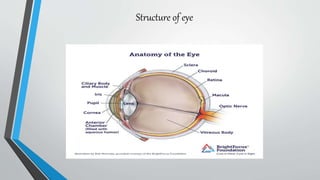
Structure of eye
Physiological Anatomy Of Eye
• Special Organ to sense the sight
• 1/6th of eyeball is visible outside
• It has three principal layers:- Outer Fibrous Layer, middleVascular layer and
inner nervous layer.
• Outer Fibrous layer:-
Sclera- tough, fibrous opaque coat made up of dense connective tissue. It
provides shape to eyeball
It gets modified in central portion of eye called Cornea.
• Middle layer:- (Uveal layer)
Choroid (bluish colour) contains numerous blood vessels.
In front it thickens to form the ciliary body.
help to absorb the extra amount of light that enters eyes.
It is attached to suspensory ligaments (or zonule).
The ciliary body continues forward to form Iris.
It contains two types of smooth muscle layer- circular and longitudinal layer.
Iris- pigmented and muscular structure. It contains Sphincter Pupillae(circular
muscle fibers) and dilator pupillae (radial muscle fiber)
Regulates intensity of light.
• Inner layer-
Retina- it contains Photoreceptors (rods and cones).
Crystalline lens:-
• Circular biconvex lens
• The central core of lens possesses a higher refractive index than does the
remainder.
• Lens has no blood supply.
• Optic nerves leaves the eyes is called optic disc.
• Vision is not possible over this area called as blind spot.
• At posterior pole of eye(yellowish pigmented spot) called Macula lutea which
marks the location of fovea centralis .
• It is the point of greatest visual acuity (sharpness of vision).
Eyes have two chambers:-
Aqueous chamber that contains aqueous humour
Vitreous chamber that contains vitreous humour which maintains
intraocular pressure and prevents the walls of eyeball from collapsing.
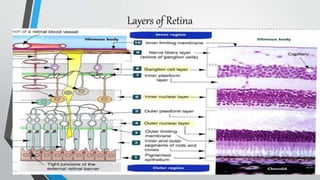
Layers of Retina
Functions of layers of Retina
• Pigmented epithelium:- contains Melanin pigment that absorbs extra amount
of light.
• Photoreceptors layer:- Each rods and Cones divided into outer segment, inner
segment and synaptic zone.
Rods contain rhodopsin pigment (scotopic vision) and cones contain iodopsin
pigment (photopic vision).
• External limiting layer is formed by the glial tissues and it is pierced by rods
and cones.
• Outer Nuclear Layer is formed by the nucleus of rods and cones.
• Outer Synaptic Layer is formed by synapse between the ends of rods and cones
with dendrites of bipolar and horizontal cell processes.
• Inner nuclear Layer – It contains different cells like bipolar cells, amacrine cells
and horizontal cells.
o horizontal cells are horizonally placed in retina and connect different receptor
cells each other.
oAmacrine cells is to make synapse contacts with dendrites of both ganglion and
bipolar cells .
• Inner Synaptic layer- synapse between the axons of bipolar cells with the
dendrites of ganglion cells. It is the site of major processing of the visual image.
• Ganglion cell layer- contain round cells.
• Optic Nerve- formed by joining the axons of ganglion cells. All axons run
parallel.
• Internal Limiting Membrane- separates the retina fromVitreous humour.
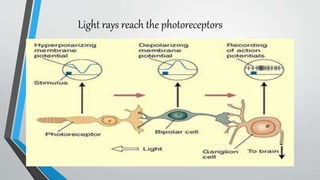
Light rays reach the photoreceptors
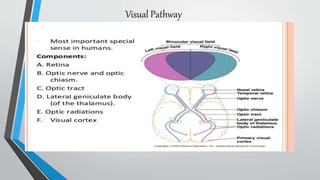
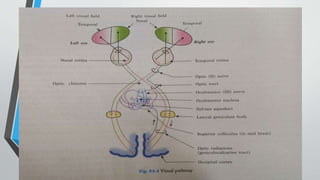
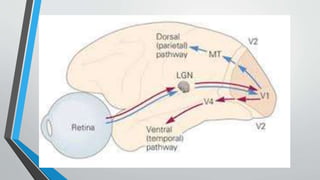
Visual Pathway
• PrimaryVisual Area also called visuo sensory area (V-1)
• Each half of the retina receives light rays from opposite half of the field of
vision. Each visual cortex is called half visual cortex.
• Visual association areas-
Area- 18 visuo psychic area (V-2) (depth perception)
Area- 19 occipital eye field (deviation and movement of eyeball)
Area- 8 Frontal eye field (conjugate deviation of eyes to the opposite side)
• Field ofVision:- the visual field of each eye is the area visualized on the
screen when the gaze is fixed at an object.
• Binocular vision- the central parts of the visual fields of two eyes coincides.
Therefore, anything in this portion of the field is seen with both the eyes
called binocular vision.
Visual acuity
• It is the degree to which the details and contours of objects are perceived. It
is expressed in terms of visual angle.
• Visual acuity is usually defined in terms of minimum separable i.e. shortest
distance by which two lines can be separated and still be perceived as two
lines or power determining the shape, outline etc. of the surroundings.l
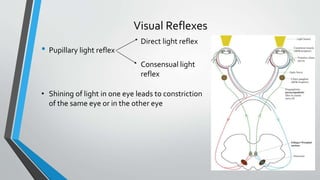
Visual Reflexes
• Pupillary light reflex
Direct light reflex
Consensual light
reflex
• Shining of light in one eye leads to constriction
of the same eye or in the other eye
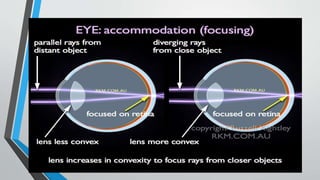
Accommodation
• The ability of the eye to focus an object at varying distances ia called
accommodation.
• It is due to a mechanism which brings about the change of curvature of the
anterior surface of the lens.
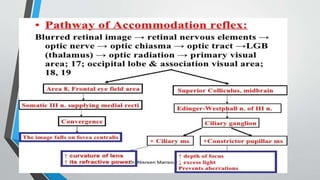
• Accommodation Reflex or near response- (looks at a near object)
• It consists of: Contraction of Ciliary muscle, Constriction of pupil and
convergence of visual axes.
• Contraction of ciliary muscle via III nerve. As a result, anterior curvature of
lens increases.
• Constriction of pupil due to contraction of sphincter pupillae.
• Convergence of visual axes due to contraction of medial rectus muscle.
Accommodation Pathway
Amplitude of Accommodation
• The amplitude of accommodation is the difference in refractive power of
the eye between the two states, complete relaxation and maximal
accommodation.
• Far point ofVision- when the eye is adapted for distant vision, the parallel
light rays from distant object are brought to a focus on the retina. In this
state the resting power of eye is 59D which is taken as zero and the position
of the object is referred as the far point of vision.
• Near point of vision- the nearest point to the eye at which an object can be
clearly seen with maximum accommodation.
Defects of image forming mechanism
• Presbyopia- (means loss of accommodation)- due to increasing sclerosis
(hardening) of the lens.
• It can be corrected by wearing glasses with convex lens.
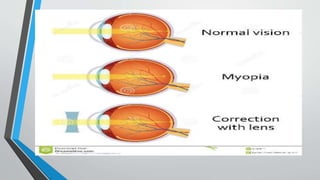
• Myopia- cannot see the distant object called near sightedness.
• It is due to long length of eyeball or increased refractive power of lens and
range of accommodation decreases in this condition.
• It is corrected by concave glasses.
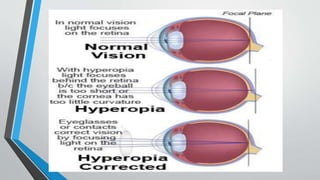
• HYPERMETROPIA:- long sightedness
• Parallel light rays from distant object are focused behind the retina due to
short length of eyeball and decreased refractive power of lens.
• Hypertrophy of ciliary muscles occurs because individuals use the
accommodation all the time for seeing far objects.
• Sustained accommodation is tiring and may cause severe headache and
blurring of vision.
• The prolonged convergence of the visual axes associated with the
accommodation finally leads to squint (strabismus).
ColorVision
• Vision is of two types:- Achromatic and Chromatic
• Achromatic is the sensation of white vision and no color has been assigned
to it.
• Chromatic is the sensation of colors eg. Spectral colors vision (VIBGYOR),
Extra spectral color vision (mixing of two colors)
• Primary colors:- Red, Green and Blue. A spectral or extra spectral sensation
of which can be produced by mixing varying proportions of these three
primary colors.
Theories of ColorVision
• ThomasYoung andVon Helmholtz’sTheory:- According to this theory, 3
primary colors are 3 types of cone receptors, each containing a different
photosensitive pigment and maximum sensitivity to one type of primary
color. By mixing 3 primary colors in different proportions, any type of color
sensation can be produced.
when 3 receptors are stimulated equally, a sensation of white is produced.
• Muller’s Doctrine of Specific Nerve EnergyTheory:- According to this theory,
there are specific nerve fibers with specific ganglion cells responding to 3
primary colors.
THANK YOU

eye.pptx

  • 1.
  • 2.
  • 3.
    Physiological Anatomy OfEye • Special Organ to sense the sight • 1/6th of eyeball is visible outside • It has three principal layers:- Outer Fibrous Layer, middleVascular layer and inner nervous layer. • Outer Fibrous layer:- Sclera- tough, fibrous opaque coat made up of dense connective tissue. It provides shape to eyeball It gets modified in central portion of eye called Cornea.
  • 4.
    • Middle layer:-(Uveal layer) Choroid (bluish colour) contains numerous blood vessels. In front it thickens to form the ciliary body. help to absorb the extra amount of light that enters eyes. It is attached to suspensory ligaments (or zonule). The ciliary body continues forward to form Iris. It contains two types of smooth muscle layer- circular and longitudinal layer. Iris- pigmented and muscular structure. It contains Sphincter Pupillae(circular muscle fibers) and dilator pupillae (radial muscle fiber) Regulates intensity of light.
  • 5.
    • Inner layer- Retina-it contains Photoreceptors (rods and cones). Crystalline lens:- • Circular biconvex lens • The central core of lens possesses a higher refractive index than does the remainder. • Lens has no blood supply.
  • 6.
    • Optic nervesleaves the eyes is called optic disc. • Vision is not possible over this area called as blind spot. • At posterior pole of eye(yellowish pigmented spot) called Macula lutea which marks the location of fovea centralis . • It is the point of greatest visual acuity (sharpness of vision). Eyes have two chambers:- Aqueous chamber that contains aqueous humour Vitreous chamber that contains vitreous humour which maintains intraocular pressure and prevents the walls of eyeball from collapsing.
  • 7.
  • 8.
    Functions of layersof Retina • Pigmented epithelium:- contains Melanin pigment that absorbs extra amount of light. • Photoreceptors layer:- Each rods and Cones divided into outer segment, inner segment and synaptic zone. Rods contain rhodopsin pigment (scotopic vision) and cones contain iodopsin pigment (photopic vision). • External limiting layer is formed by the glial tissues and it is pierced by rods and cones. • Outer Nuclear Layer is formed by the nucleus of rods and cones. • Outer Synaptic Layer is formed by synapse between the ends of rods and cones with dendrites of bipolar and horizontal cell processes.
  • 9.
    • Inner nuclearLayer – It contains different cells like bipolar cells, amacrine cells and horizontal cells. o horizontal cells are horizonally placed in retina and connect different receptor cells each other. oAmacrine cells is to make synapse contacts with dendrites of both ganglion and bipolar cells . • Inner Synaptic layer- synapse between the axons of bipolar cells with the dendrites of ganglion cells. It is the site of major processing of the visual image. • Ganglion cell layer- contain round cells. • Optic Nerve- formed by joining the axons of ganglion cells. All axons run parallel. • Internal Limiting Membrane- separates the retina fromVitreous humour.
  • 10.
    Light rays reachthe photoreceptors
  • 11.
  • 13.
    • PrimaryVisual Areaalso called visuo sensory area (V-1) • Each half of the retina receives light rays from opposite half of the field of vision. Each visual cortex is called half visual cortex. • Visual association areas- Area- 18 visuo psychic area (V-2) (depth perception) Area- 19 occipital eye field (deviation and movement of eyeball) Area- 8 Frontal eye field (conjugate deviation of eyes to the opposite side) • Field ofVision:- the visual field of each eye is the area visualized on the screen when the gaze is fixed at an object. • Binocular vision- the central parts of the visual fields of two eyes coincides. Therefore, anything in this portion of the field is seen with both the eyes called binocular vision.
  • 15.
    Visual acuity • Itis the degree to which the details and contours of objects are perceived. It is expressed in terms of visual angle. • Visual acuity is usually defined in terms of minimum separable i.e. shortest distance by which two lines can be separated and still be perceived as two lines or power determining the shape, outline etc. of the surroundings.l
  • 16.
    Visual Reflexes • Pupillarylight reflex Direct light reflex Consensual light reflex • Shining of light in one eye leads to constriction of the same eye or in the other eye
  • 17.
    Accommodation • The abilityof the eye to focus an object at varying distances ia called accommodation. • It is due to a mechanism which brings about the change of curvature of the anterior surface of the lens. • Accommodation Reflex or near response- (looks at a near object) • It consists of: Contraction of Ciliary muscle, Constriction of pupil and convergence of visual axes. • Contraction of ciliary muscle via III nerve. As a result, anterior curvature of lens increases. • Constriction of pupil due to contraction of sphincter pupillae. • Convergence of visual axes due to contraction of medial rectus muscle.
  • 18.
  • 20.
    Amplitude of Accommodation •The amplitude of accommodation is the difference in refractive power of the eye between the two states, complete relaxation and maximal accommodation. • Far point ofVision- when the eye is adapted for distant vision, the parallel light rays from distant object are brought to a focus on the retina. In this state the resting power of eye is 59D which is taken as zero and the position of the object is referred as the far point of vision. • Near point of vision- the nearest point to the eye at which an object can be clearly seen with maximum accommodation.
  • 21.
    Defects of imageforming mechanism • Presbyopia- (means loss of accommodation)- due to increasing sclerosis (hardening) of the lens. • It can be corrected by wearing glasses with convex lens. • Myopia- cannot see the distant object called near sightedness. • It is due to long length of eyeball or increased refractive power of lens and range of accommodation decreases in this condition. • It is corrected by concave glasses.
  • 23.
    • HYPERMETROPIA:- longsightedness • Parallel light rays from distant object are focused behind the retina due to short length of eyeball and decreased refractive power of lens. • Hypertrophy of ciliary muscles occurs because individuals use the accommodation all the time for seeing far objects. • Sustained accommodation is tiring and may cause severe headache and blurring of vision. • The prolonged convergence of the visual axes associated with the accommodation finally leads to squint (strabismus).
  • 25.
    ColorVision • Vision isof two types:- Achromatic and Chromatic • Achromatic is the sensation of white vision and no color has been assigned to it. • Chromatic is the sensation of colors eg. Spectral colors vision (VIBGYOR), Extra spectral color vision (mixing of two colors) • Primary colors:- Red, Green and Blue. A spectral or extra spectral sensation of which can be produced by mixing varying proportions of these three primary colors.
  • 26.
    Theories of ColorVision •ThomasYoung andVon Helmholtz’sTheory:- According to this theory, 3 primary colors are 3 types of cone receptors, each containing a different photosensitive pigment and maximum sensitivity to one type of primary color. By mixing 3 primary colors in different proportions, any type of color sensation can be produced. when 3 receptors are stimulated equally, a sensation of white is produced. • Muller’s Doctrine of Specific Nerve EnergyTheory:- According to this theory, there are specific nerve fibers with specific ganglion cells responding to 3 primary colors.
  • 27.