EVALUATION OF
SYNCOPE IN ADULTS

     Dr.Venkat Narayana Goutham.V
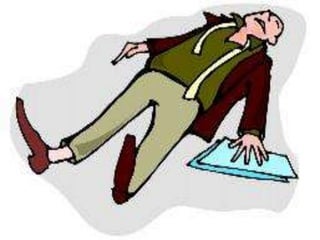
• Syncope(SING-kə-pee) is a transient,
  self-limited loss of consciousness
  with loss of postural tone due to
  acute global impairment of cerebral
  blood flow.

• The onset is rapid, duration brief,
 and recovery spontaneous and
 complete without medical or
 surgical intervention.
• Other causes of transient loss of
  consciousness need to be
  distinguished from syncope.

• These include
  seizures, vertebrobasilar
  ischemia, hypoxemia, and
  hypoglycemia
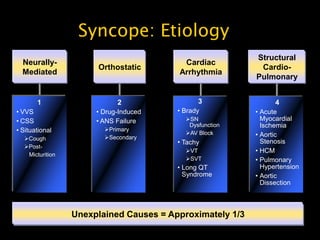
Syncope: Etiology
                                                          Structural
  Neurally-                              Cardiac
                      Orthostatic                          Cardio-
  Mediated                              Arrhythmia
                                                          Pulmonary


       1                    2                 3                 4
• VVS                 • Drug-Induced    • Brady           • Acute
• CSS                 • ANS Failure       SN               Myocardial
                                           Dysfunction      Ischemia
• Situational           Primary
                                          AV Block       • Aortic
  Cough                Secondary
                                        • Tachy             Stenosis
  Post-
                                          VT             • HCM
   Micturition
                                          SVT            • Pulmonary
                                        • Long QT           Hypertension
                                          Syndrome        • Aortic
                                                            Dissection


                 Unexplained Causes = Approximately 1/3
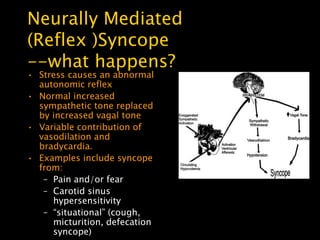
Neurally Mediated
(Reflex )Syncope
--what happens?
• Stress causes an abnormal
  autonomic reflex
• Normal increased
  sympathetic tone replaced
  by increased vagal tone
• Variable contribution of
  vasodilation and
  bradycardia.
• Examples include syncope
  from:
   – Pain and/or fear
   – Carotid sinus
     hypersensitivity
   – ―situational‖ (cough,
     micturition, defecation
     syncope)
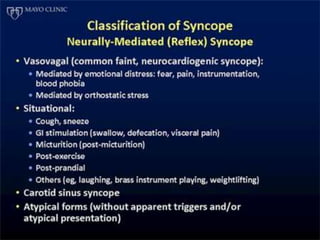
Neurally Mediated Syncope
Features of Neurally Mediated
Syncope
• dizziness, lightheadedness, and
  fatigue, premonitory features of
  autonomic activation may be
  present. These include diaphoresis,
  pallor, palpitations, nausea,
  hyperventilation, and yawning.
• During the event proximal and
  distal myoclonus (typically
  arrhythmic and multifocal) may
  occur, raising the possibility of
  epilepsy.
• The eyes typically remain open and
  usually deviate upward. Urinary but
  not fecal incontinence may occur.
Treatment: Neurally
Mediated Syncope
• Reassurance
• avoidance of provocative stimuli
• plasma volume expansion with fluid
  and salt are the cornerstones of the
  management of neurally mediated
  syncope.
• Isometric counterpressure
  maneuvers of the limbs (leg
  crossing or handgrip and arm
  tensing).
• Fludrocortisone, vasoconstricting
  agents, and beta-adrenoreceptor
  antagonists are widely used by
  experts to treat .
Orthostatic Hypotension

• Orthostatic hypotension, defined as
  a reduction in systolic blood
  pressure of at least 20 mmHg or
  diastolic blood pressure of at least
  10 mmHg within 3 minutes of
  standing or head-up tilt on a tilt
  table.
Features

• It is a manifestation of sympathetic
  vasoconstrictor (autonomic) failure .
• light-headedness, dizziness, and
  presyncope (near-faintness)
• Visual blurring may occur, likely due
  to retinal or occipital lobe ischemia.
• Patients may report orthostatic
  dyspnea
• Neck pain—typically in the
  suboccipital, posterior cervical, and
  shoulder region (the "coat-hanger
  headache") most likely due to neck
  muscle ischemia, may be the only
  symptom.
• Symptoms may be exacerbated by
  exertion, prolonged standing,
  increased ambient temperature, or
  meals
Treatment: Orthostatic
Hypotension

• The first step is to remove
  reversible causes—usually
  vasoactive medications .
• Nonpharmacologic interventions
  should be introduced.
Nonpharmacologic interventions
• patient education regarding staged
  moves from supine to upright
• warnings about the hypotensive
  effects of meal ingestion
• instructions about the isometric
  counterpressure maneuvers that
  increase intravascular pressure (see
  above).
• Intravascular volume should be
  expanded by increasing dietary fluid
  and salt.
• If these nonpharmacologic
  measures fail, pharmacologic
  intervention with fludrocortisone
  acetate and vasoconstricting agents
  such as midodrine and
  pseudoephedrine should be
  introduced.
Cardiac Syncope

• Cardiac (or cardiovascular) syncope
  is caused by arrhythmias and
  structural heart disease.
• Both cause the heart to be unable to
  sufficiently increase cardiac output
  to meet demand.
• Cardiac arrythymias especially in the
  elderly have high mortality.
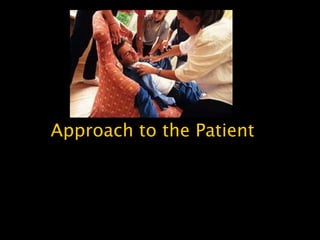
Approach to the Patient
Diagnostic Objectives

• Distinguish true syncope from
  syncope mimics
• Determine presence of heart disease
• Establish the cause of syncope with
  sufficient certainty to:
  – Assess prognosis confidently
  – Initiate effective preventive treatment.
• Generalized and partial seizures
  may be confused with syncope.
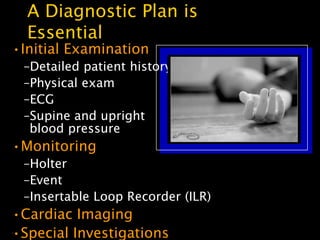
A Diagnostic Plan is
    Essential
•Initial Examination
    –Detailed patient history
    –Physical exam
    –ECG
    –Supine and upright
     blood pressure
•Monitoring
    –Holter
    –Event
    –Insertable Loop Recorder (ILR)
•Cardiac Imaging
•Special Investigations
.
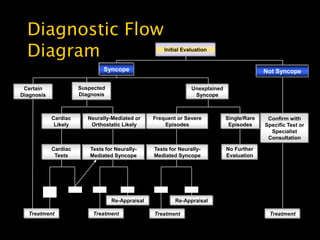
Diagnostic Flow
  Diagram                                                       Initial Evaluation


                                         Syncope                                                       Not Syncope

 Certain                      Suspected                                    Unexplained
Diagnosis                     Diagnosis                                     Syncope


                Cardiac          Neurally-Mediated or     Frequent or Severe             Single/Rare    Confirm with
                 Likely           Orthostatic Likely          Episodes                    Episodes     Specific Test or
                                                                                                         Specialist
                                                                                                        Consultation

                Cardiac           Tests for Neurally-     Tests for Neurally-            No Further
                 Tests            Mediated Syncope        Mediated Syncope               Evaluation


            +             -          +          -           +              -

                                           Re-Appraisal             Re-Appraisal

  Treatment                        Treatment              Treatment                                     Treatment
HISTORY

• HISTORY alone identifies the cause
  up to 85% of the time
• POINTS
  –   Previous episodes
  –   Character of the events, witnesses
  –   Events preceding the syncope
  –   Events during and after the episode
HISTORY
• Events preceding the          • Events during and
  syncope                         after the episode
  – Prolonged standing            – Trauma (implication
    (vasovagal)                     important)
  – Immediately upon              – Chest pain (CAD, PE)
    standing (orthostatic)        – Seizure (incontinence,
  – With exertion (cardiac)         confusion, tongue
  – Sudden without warning          laceration, postictal
    or palpitations (cardiac)       behavior)
  – Aggressive dieting            – Cerebrovascular
  – Heat exposure                   syndrome (diplopia,
                                    dysarthia, hemiparesis)
  – Emotional stress
                                  – Associated with
                                    n/v/sweating
                                    (vasovagal)
HISTORY
• Associated symptoms              • Medications
   – Chest pain, SOB,                 – Antihypertensives,
     lightheadedness,                   diuretics (orthostatic)
     incontinence
                                      – Antiarrthymics (cardiac
• Past medical history                  syncope)
   – Identifying risk factors         – TCA, Amiodarone
   – Morbidity and mortality            (cardiac/prolonged QT)
     increases with organic
     causes                        • Family history
      • Parkinsons (orthostatic)      – Sudden death (cardiac
      • Epilepsy (seizure)              syncope/prolonged QT
      • DM (cardiac, autonomic          or Brugada)
        dysfunction, glucose)
      • Cardiac disease
PHYSICAL EXAM
• Vital signs
   – Orthostatics—most             – Heart rate
     important                        • Tachy/brady,
      • Drop in BP and fixed            dysrhythmia
        HR ->dysautonomia          – Respiratory rate
      • Drop in BP and                • Tachypnea (pe,
        increase HR -> volume           hypoxia, anxiety)
        depletion/                    • Bradypnea (cns,
        vasodilatation                  toxicmetabolic)
      • Insignificant drop in BP   – Blood pressure
        and marked increase in
        HR -> POTS                    • High (cns,
                                        toxic/metabolic)
   – Temperature                      • Low (hypovolemia,
      • Hypo/hyperthermia               cardiogenic shock,
        (sepsis, toxic-                 sepsis)
        metabolic, exposure)
PHYSICAL EXAM
• HEENT                      • HEART
  – Tenderness/deformity       – Murmur (valves,
    (trauma)                     dissection)
  – Papilledema (increased     – Rub (pericarditis,
    icp, head injury)            tamponade)
  – Breath (alcohol, dka)
                             • LUNGS
• NECK                         – Sounds may help
  – Bruits                       distinguish chf,
  – JVD (chf, mi, pe,            infection,
    tampnade)                    pneumothorax
PHYSICAL EXAM
• ABDOMEN                       • SKIN
  – Pulsatile mass; AAA           – Signs of trauma,
  – Tenderness                      hypoperfusion
  – Occult blood loss
                                • EXTREMITES
• PELVIS                          – Paralysis (CNS)
  – Bleeding, hypovolemia
                                  – Pulses unequal
  – Tenderness (PID,
    ectopic, torsion, sepsis)       (dissection,
                                    embolus, steal)
PHYSICAL EXAM
• NEUROLOGIC
  – Mental status; toxic     – Cranial nerves
    metabolic; organic
    disease; seizure;        – Cerebellar testing
    hypoxia.
  – Focal findings
    (hemorrhagic/ischemic
    stroke, trauma, tumor,
    or other primary
    neurologic disease
• EKG---Cornerstone of workup
  – Arrhythmia, long qt, WPW, conduction abn.
• Routine Blood work—limited value
• Radiology---limited value except if
  abnormal exam
• Other tests—depending of history and
  exam
  – Glucose      --hemoglobin     --troponin
    --CK (syncope vs seizure)
Starting the ―Workup‖

• If young adult and No comorbid
  conditions or symptoms

Most likely VASOMOTOR or ORTHOSTATIC .

*Clinicians may forego the ECG in young,
  healthy patients with an obvious cause of
  syncope.
Young adult, no
comorbidity, normal
ECG, absent orthostatics
• Vasomotor                • Neurologic
  – Try carotid massage      – CT head (tia, cva, sah)
     • (+) carotid sinus     – EEG (if suspect Sz)
       sensitivity
     • (-) reflex or
                           • Cardiovascular
       neurocardiogenic      – If Outflow obstruction,
                               check CT chest, Echo
• Metabolic                    (PE, valvular, HOCM)
  – Check chemistry.         – If venous return, check
    R/O hypoglycemia,          HCG, Echo (pregnancy,
    adrenal                    tamponade)
    insufficiency
The ECG
Key Points
• Guidelines recommend EKG in the
  evaluation of all patients with syncope.
• Exception: young healthy patients with
  an obvious cause of syncope
• Abnormal ECG in 90% of patient with
  cardiac syncope
• Only 6% of patients with reflex mediated
  syncope have abnormal ECG.
• Syncopal patient with negative cardiac
  history and normal ECG—unlikely to have
  a cardiac cause
The ECG
 patient older, +comorbid
signs/symptoms
• If Abnormal ECG
  – Ischemia/injury
  – Dysrhythmia
    • Sinus brady, BBB, AV block, prolonged
      QT, WPW, HOCM, Brugada
• If Normal ECG
  – Consider holter or event recorder if
    dysrhythmia suspected
Carotid Sinus Massage
(CSM)
• Method1                      • Absolute
  – Massage, 5-10 seconds        contraindications2
  – Don’t occlude                 – Carotid bruit, known
  – Supine and upright              significant carotid
    posture                         arterial
    (on tilt table)                 disease, previous
                                    CVA, MI last 3 months
• Outcome
                               • Complications
  – 3 second asystole
    and/or       50 mmHg          – Primarily neurological
    fall in systolic BP with      – Less than 0.2%
    reproduction of               – Usually transient
    symptoms = Carotid
    Sinus Syndrome
Holter Monitoring
• 24-48 hour monitor—limited value
  because of intermittent nature of
  arrhythmias
• Event recorder—more helpful. Patient
  must be conscious in order to activate
  unit.
• Establishes diagnosis in only 2-3% of
  patients with syncope if ECG is normal.
• Indicated in patients at highest risk for
  arrhythmia ie, abnormal ecg,
  palpitations, cad history, syncope when
  supine or with exertion.
Loop Event Recorders
• Provides longer monitoring—weeks to
  months
• Can activate the monitor after symptoms
  occur, thereby freezing in its memory the
  readings from the previous 2-5 minutes
  and the subsequent 1 minute
• In patients with recurrent
  syncope, arrhythmias were found during
  symptoms in 8-20%.
• Limitations: compliance, use of
  device, transmission
ECHOCARDIOGRAM

• Access structural causes of cardiac
  syncope
  – AS, MS, HOCM, atrial myoxoma
• Unlikely to be helpful in the absence of
  known cardiac disease or an abnormal
  ekg.
• INDICATIONS
  – Abnormal ECG     ---history of heart
    disease
  – Murmur                 ---exercise assoc.
    syncope
Structural Heart Disease

• Aortic Stenosis
  – Most common structural lesion
    associated with syncope in the elderly
• Hypertrophic Obstructive
  Cardiomyopathy
  – Vasodilatation (drugs/hot bath) can
    induce syncope
• Obstruction to Right Ventricular
  Outflow
  – PE, pulmonary stenosis, pulmonary htn
EXERCISE STRESS TEST
• Syncope during exercise is more likely to
  be related to an arrhythmia
• Post-exertional syncope is usually
  neurally mediated.
• Echocardiogram should be done prior to
  EST to r/o structural abnormality.
• INDICATION
  – Syncope during or shortly after exercise
    (exertional syncope)
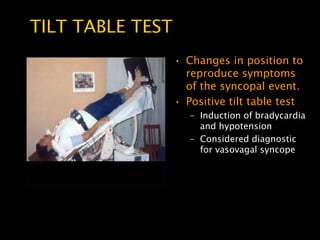
TILT TABLE TEST
                  • Changes in position to
                    reproduce symptoms
                    of the syncopal event.
                  • Positive tilt table test
                     – Induction of bradycardia
                       and hypotension
                     – Considered diagnostic
                       for vasovagal syncope
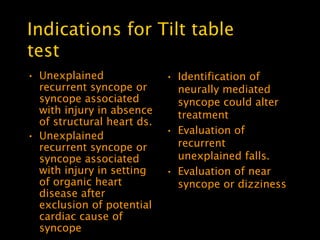
Indications for Tilt table
test
• Unexplained               • Identification of
  recurrent syncope or        neurally mediated
  syncope associated          syncope could alter
  with injury in absence      treatment
  of structural heart ds.
                            • Evaluation of
• Unexplained
  recurrent syncope or        recurrent
  syncope associated          unexplained falls.
  with injury in setting    • Evaluation of near
  of organic heart            syncope or dizziness
  disease after
  exclusion of potential
  cardiac cause of
  syncope
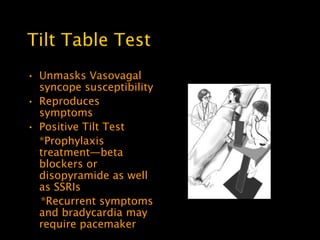
Tilt Table Test
• Unmasks Vasovagal
  syncope susceptibility
• Reproduces
  symptoms
• Positive Tilt Test
  *Prophylaxis
  treatment—beta
  blockers or
  disopyramide as well
  as SSRIs
  *Recurrent symptoms
  and bradycardia may
  require pacemaker
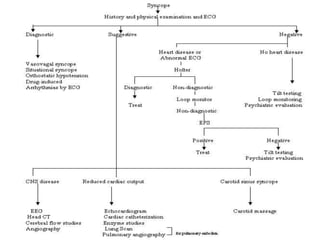
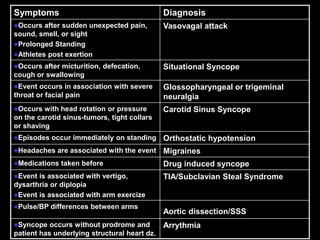
Syncope Evaluation Flow
Chart
--CLUES
Symptoms                                      Diagnosis
Occurs  after sudden unexpected pain,        Vasovagal attack
sound, smell, or sight
Prolonged Standing
Athletes post exertion

Occurs after micturition, defecation,        Situational Syncope
cough or swallowing
Event  occurs in association with severe     Glossopharyngeal or trigeminal
throat or facial pain                         neuralgia
Occurs  with head rotation or pressure       Carotid Sinus Syncope
on the carotid sinus-tumors, tight collars
or shaving
Episodes   occur immediately on standing Orthostatic hypotension
Headaches   are associated with the event Migraines
Medications   taken before                   Drug induced syncope
Event is associated with vertigo,            TIA/Subclavian Steal Syndrome
dysarthria or diplopia
Event is associated with arm exercize

Pulse/BP   differences between arms
                                              Aortic dissection/SSS
Syncope   occurs without prodrome and        Arrythmia
patient has underlying structural heart dz.
San Francisco Syncope
Rule

• Risk Factors
  – C History of CHF
  – H Hematocrit less than 30
  – E Non-sinus rhythm or new changes in EKG
  – S Systolic BP less than 90
  – S Shortness of breath
  ------------- is a simple rule for evaluating
    the risk of adverse outcomes in patient who
    present with syncope.
SUMMARY
• Shotgun approach is Not helpful.
• EKG should be considered in all patients.
• Tilt table test can diagnosis vasovagal
  syncope.
• Neurologic testing is low yield and often
  overused.
• Holter monitoring, Echo, EST, EP
  considered in patients at high risk for
  cardiac syncope.
• Patients remain undiagnosed in 34% of
  cases.
THANK YOU

Evaluation of syncope in adults

  • 1.
    EVALUATION OF SYNCOPE INADULTS Dr.Venkat Narayana Goutham.V
  • 3.
    • Syncope(SING-kə-pee) isa transient, self-limited loss of consciousness with loss of postural tone due to acute global impairment of cerebral blood flow. • The onset is rapid, duration brief, and recovery spontaneous and complete without medical or surgical intervention.
  • 4.
    • Other causesof transient loss of consciousness need to be distinguished from syncope. • These include seizures, vertebrobasilar ischemia, hypoxemia, and hypoglycemia
  • 5.
    Syncope: Etiology Structural Neurally- Cardiac Orthostatic Cardio- Mediated Arrhythmia Pulmonary 1 2 3 4 • VVS • Drug-Induced • Brady • Acute • CSS • ANS Failure SN Myocardial Dysfunction Ischemia • Situational Primary AV Block • Aortic Cough Secondary • Tachy Stenosis Post- VT • HCM Micturition SVT • Pulmonary • Long QT Hypertension Syndrome • Aortic Dissection Unexplained Causes = Approximately 1/3
  • 6.
    Neurally Mediated (Reflex )Syncope --whathappens? • Stress causes an abnormal autonomic reflex • Normal increased sympathetic tone replaced by increased vagal tone • Variable contribution of vasodilation and bradycardia. • Examples include syncope from: – Pain and/or fear – Carotid sinus hypersensitivity – ―situational‖ (cough, micturition, defecation syncope)
  • 7.
  • 8.
    Features of NeurallyMediated Syncope • dizziness, lightheadedness, and fatigue, premonitory features of autonomic activation may be present. These include diaphoresis, pallor, palpitations, nausea, hyperventilation, and yawning.
  • 9.
    • During theevent proximal and distal myoclonus (typically arrhythmic and multifocal) may occur, raising the possibility of epilepsy. • The eyes typically remain open and usually deviate upward. Urinary but not fecal incontinence may occur.
  • 10.
    Treatment: Neurally Mediated Syncope •Reassurance • avoidance of provocative stimuli • plasma volume expansion with fluid and salt are the cornerstones of the management of neurally mediated syncope.
  • 11.
    • Isometric counterpressure maneuvers of the limbs (leg crossing or handgrip and arm tensing). • Fludrocortisone, vasoconstricting agents, and beta-adrenoreceptor antagonists are widely used by experts to treat .
  • 12.
    Orthostatic Hypotension • Orthostatichypotension, defined as a reduction in systolic blood pressure of at least 20 mmHg or diastolic blood pressure of at least 10 mmHg within 3 minutes of standing or head-up tilt on a tilt table.
  • 13.
    Features • It isa manifestation of sympathetic vasoconstrictor (autonomic) failure . • light-headedness, dizziness, and presyncope (near-faintness) • Visual blurring may occur, likely due to retinal or occipital lobe ischemia. • Patients may report orthostatic dyspnea
  • 14.
    • Neck pain—typicallyin the suboccipital, posterior cervical, and shoulder region (the "coat-hanger headache") most likely due to neck muscle ischemia, may be the only symptom. • Symptoms may be exacerbated by exertion, prolonged standing, increased ambient temperature, or meals
  • 15.
    Treatment: Orthostatic Hypotension • Thefirst step is to remove reversible causes—usually vasoactive medications . • Nonpharmacologic interventions should be introduced.
  • 16.
    Nonpharmacologic interventions • patienteducation regarding staged moves from supine to upright • warnings about the hypotensive effects of meal ingestion • instructions about the isometric counterpressure maneuvers that increase intravascular pressure (see above). • Intravascular volume should be expanded by increasing dietary fluid and salt.
  • 17.
    • If thesenonpharmacologic measures fail, pharmacologic intervention with fludrocortisone acetate and vasoconstricting agents such as midodrine and pseudoephedrine should be introduced.
  • 18.
    Cardiac Syncope • Cardiac(or cardiovascular) syncope is caused by arrhythmias and structural heart disease. • Both cause the heart to be unable to sufficiently increase cardiac output to meet demand. • Cardiac arrythymias especially in the elderly have high mortality.
  • 19.
  • 20.
    Diagnostic Objectives • Distinguishtrue syncope from syncope mimics • Determine presence of heart disease • Establish the cause of syncope with sufficient certainty to: – Assess prognosis confidently – Initiate effective preventive treatment.
  • 21.
    • Generalized andpartial seizures may be confused with syncope.
  • 22.
    A Diagnostic Planis Essential •Initial Examination –Detailed patient history –Physical exam –ECG –Supine and upright blood pressure •Monitoring –Holter –Event –Insertable Loop Recorder (ILR) •Cardiac Imaging •Special Investigations .
  • 23.
    Diagnostic Flow Diagram Initial Evaluation Syncope Not Syncope Certain Suspected Unexplained Diagnosis Diagnosis Syncope Cardiac Neurally-Mediated or Frequent or Severe Single/Rare Confirm with Likely Orthostatic Likely Episodes Episodes Specific Test or Specialist Consultation Cardiac Tests for Neurally- Tests for Neurally- No Further Tests Mediated Syncope Mediated Syncope Evaluation + - + - + - Re-Appraisal Re-Appraisal Treatment Treatment Treatment Treatment
  • 24.
    HISTORY • HISTORY aloneidentifies the cause up to 85% of the time • POINTS – Previous episodes – Character of the events, witnesses – Events preceding the syncope – Events during and after the episode
  • 25.
    HISTORY • Events precedingthe • Events during and syncope after the episode – Prolonged standing – Trauma (implication (vasovagal) important) – Immediately upon – Chest pain (CAD, PE) standing (orthostatic) – Seizure (incontinence, – With exertion (cardiac) confusion, tongue – Sudden without warning laceration, postictal or palpitations (cardiac) behavior) – Aggressive dieting – Cerebrovascular – Heat exposure syndrome (diplopia, dysarthia, hemiparesis) – Emotional stress – Associated with n/v/sweating (vasovagal)
  • 26.
    HISTORY • Associated symptoms • Medications – Chest pain, SOB, – Antihypertensives, lightheadedness, diuretics (orthostatic) incontinence – Antiarrthymics (cardiac • Past medical history syncope) – Identifying risk factors – TCA, Amiodarone – Morbidity and mortality (cardiac/prolonged QT) increases with organic causes • Family history • Parkinsons (orthostatic) – Sudden death (cardiac • Epilepsy (seizure) syncope/prolonged QT • DM (cardiac, autonomic or Brugada) dysfunction, glucose) • Cardiac disease
  • 27.
    PHYSICAL EXAM • Vitalsigns – Orthostatics—most – Heart rate important • Tachy/brady, • Drop in BP and fixed dysrhythmia HR ->dysautonomia – Respiratory rate • Drop in BP and • Tachypnea (pe, increase HR -> volume hypoxia, anxiety) depletion/ • Bradypnea (cns, vasodilatation toxicmetabolic) • Insignificant drop in BP – Blood pressure and marked increase in HR -> POTS • High (cns, toxic/metabolic) – Temperature • Low (hypovolemia, • Hypo/hyperthermia cardiogenic shock, (sepsis, toxic- sepsis) metabolic, exposure)
  • 28.
    PHYSICAL EXAM • HEENT • HEART – Tenderness/deformity – Murmur (valves, (trauma) dissection) – Papilledema (increased – Rub (pericarditis, icp, head injury) tamponade) – Breath (alcohol, dka) • LUNGS • NECK – Sounds may help – Bruits distinguish chf, – JVD (chf, mi, pe, infection, tampnade) pneumothorax
  • 29.
    PHYSICAL EXAM • ABDOMEN • SKIN – Pulsatile mass; AAA – Signs of trauma, – Tenderness hypoperfusion – Occult blood loss • EXTREMITES • PELVIS – Paralysis (CNS) – Bleeding, hypovolemia – Pulses unequal – Tenderness (PID, ectopic, torsion, sepsis) (dissection, embolus, steal)
  • 30.
    PHYSICAL EXAM • NEUROLOGIC – Mental status; toxic – Cranial nerves metabolic; organic disease; seizure; – Cerebellar testing hypoxia. – Focal findings (hemorrhagic/ischemic stroke, trauma, tumor, or other primary neurologic disease
  • 31.
    • EKG---Cornerstone ofworkup – Arrhythmia, long qt, WPW, conduction abn. • Routine Blood work—limited value • Radiology---limited value except if abnormal exam • Other tests—depending of history and exam – Glucose --hemoglobin --troponin --CK (syncope vs seizure)
  • 32.
    Starting the ―Workup‖ •If young adult and No comorbid conditions or symptoms Most likely VASOMOTOR or ORTHOSTATIC . *Clinicians may forego the ECG in young, healthy patients with an obvious cause of syncope.
  • 33.
    Young adult, no comorbidity,normal ECG, absent orthostatics • Vasomotor • Neurologic – Try carotid massage – CT head (tia, cva, sah) • (+) carotid sinus – EEG (if suspect Sz) sensitivity • (-) reflex or • Cardiovascular neurocardiogenic – If Outflow obstruction, check CT chest, Echo • Metabolic (PE, valvular, HOCM) – Check chemistry. – If venous return, check R/O hypoglycemia, HCG, Echo (pregnancy, adrenal tamponade) insufficiency
  • 34.
    The ECG Key Points •Guidelines recommend EKG in the evaluation of all patients with syncope. • Exception: young healthy patients with an obvious cause of syncope • Abnormal ECG in 90% of patient with cardiac syncope • Only 6% of patients with reflex mediated syncope have abnormal ECG. • Syncopal patient with negative cardiac history and normal ECG—unlikely to have a cardiac cause
  • 35.
    The ECG patientolder, +comorbid signs/symptoms • If Abnormal ECG – Ischemia/injury – Dysrhythmia • Sinus brady, BBB, AV block, prolonged QT, WPW, HOCM, Brugada • If Normal ECG – Consider holter or event recorder if dysrhythmia suspected
  • 36.
    Carotid Sinus Massage (CSM) •Method1 • Absolute – Massage, 5-10 seconds contraindications2 – Don’t occlude – Carotid bruit, known – Supine and upright significant carotid posture arterial (on tilt table) disease, previous CVA, MI last 3 months • Outcome • Complications – 3 second asystole and/or 50 mmHg – Primarily neurological fall in systolic BP with – Less than 0.2% reproduction of – Usually transient symptoms = Carotid Sinus Syndrome
  • 37.
    Holter Monitoring • 24-48hour monitor—limited value because of intermittent nature of arrhythmias • Event recorder—more helpful. Patient must be conscious in order to activate unit. • Establishes diagnosis in only 2-3% of patients with syncope if ECG is normal. • Indicated in patients at highest risk for arrhythmia ie, abnormal ecg, palpitations, cad history, syncope when supine or with exertion.
  • 38.
    Loop Event Recorders •Provides longer monitoring—weeks to months • Can activate the monitor after symptoms occur, thereby freezing in its memory the readings from the previous 2-5 minutes and the subsequent 1 minute • In patients with recurrent syncope, arrhythmias were found during symptoms in 8-20%. • Limitations: compliance, use of device, transmission
  • 39.
    ECHOCARDIOGRAM • Access structuralcauses of cardiac syncope – AS, MS, HOCM, atrial myoxoma • Unlikely to be helpful in the absence of known cardiac disease or an abnormal ekg. • INDICATIONS – Abnormal ECG ---history of heart disease – Murmur ---exercise assoc. syncope
  • 40.
    Structural Heart Disease •Aortic Stenosis – Most common structural lesion associated with syncope in the elderly • Hypertrophic Obstructive Cardiomyopathy – Vasodilatation (drugs/hot bath) can induce syncope • Obstruction to Right Ventricular Outflow – PE, pulmonary stenosis, pulmonary htn
  • 41.
    EXERCISE STRESS TEST •Syncope during exercise is more likely to be related to an arrhythmia • Post-exertional syncope is usually neurally mediated. • Echocardiogram should be done prior to EST to r/o structural abnormality. • INDICATION – Syncope during or shortly after exercise (exertional syncope)
  • 42.
    TILT TABLE TEST • Changes in position to reproduce symptoms of the syncopal event. • Positive tilt table test – Induction of bradycardia and hypotension – Considered diagnostic for vasovagal syncope
  • 43.
    Indications for Tilttable test • Unexplained • Identification of recurrent syncope or neurally mediated syncope associated syncope could alter with injury in absence treatment of structural heart ds. • Evaluation of • Unexplained recurrent syncope or recurrent syncope associated unexplained falls. with injury in setting • Evaluation of near of organic heart syncope or dizziness disease after exclusion of potential cardiac cause of syncope
  • 44.
    Tilt Table Test •Unmasks Vasovagal syncope susceptibility • Reproduces symptoms • Positive Tilt Test *Prophylaxis treatment—beta blockers or disopyramide as well as SSRIs *Recurrent symptoms and bradycardia may require pacemaker
  • 45.
  • 46.
  • 47.
    Symptoms Diagnosis Occurs after sudden unexpected pain, Vasovagal attack sound, smell, or sight Prolonged Standing Athletes post exertion Occurs after micturition, defecation, Situational Syncope cough or swallowing Event occurs in association with severe Glossopharyngeal or trigeminal throat or facial pain neuralgia Occurs with head rotation or pressure Carotid Sinus Syncope on the carotid sinus-tumors, tight collars or shaving Episodes occur immediately on standing Orthostatic hypotension Headaches are associated with the event Migraines Medications taken before Drug induced syncope Event is associated with vertigo, TIA/Subclavian Steal Syndrome dysarthria or diplopia Event is associated with arm exercize Pulse/BP differences between arms Aortic dissection/SSS Syncope occurs without prodrome and Arrythmia patient has underlying structural heart dz.
  • 48.
    San Francisco Syncope Rule •Risk Factors – C History of CHF – H Hematocrit less than 30 – E Non-sinus rhythm or new changes in EKG – S Systolic BP less than 90 – S Shortness of breath ------------- is a simple rule for evaluating the risk of adverse outcomes in patient who present with syncope.
  • 49.
    SUMMARY • Shotgun approachis Not helpful. • EKG should be considered in all patients. • Tilt table test can diagnosis vasovagal syncope. • Neurologic testing is low yield and often overused. • Holter monitoring, Echo, EST, EP considered in patients at high risk for cardiac syncope. • Patients remain undiagnosed in 34% of cases.
  • 50.