
Geriatric nutritional
Tips
Dr Doha Rasheedy
Professor of Geriatrics and Gerontology
Ain Shams University
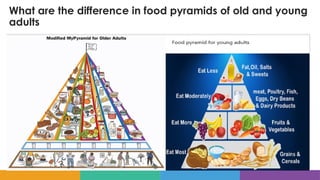
What are the difference in food pyramids of old and young
adults
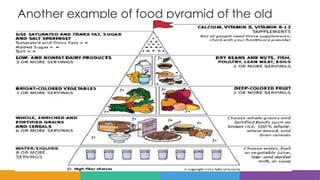
Another example of food pyramid of the old
Anthropometric measurement
challenges in older adults
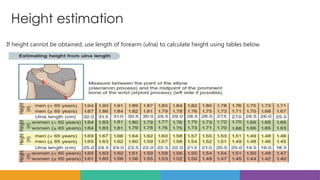
Height estimation
If height cannot be obtained, use length of forearm (ulna) to calculate height using tables below.
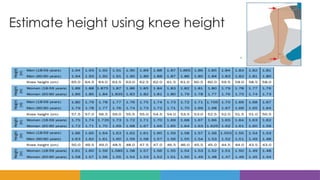
Estimate height using knee height
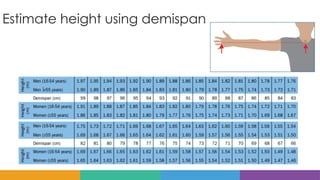
Estimate height using demispan
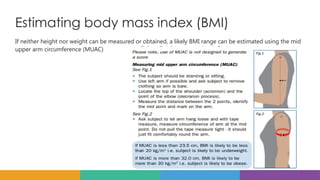
Estimating body mass index (BMI)
If neither height nor weight can be measured or obtained, a likely BMI range can be estimated using the mid
upper arm circumference (MUAC)
Body weight
Don’t use self reported values: patient forgets or unfamiliar with scales.
Immobile patients: use bed scales.
Body weight in volume overload and amputation
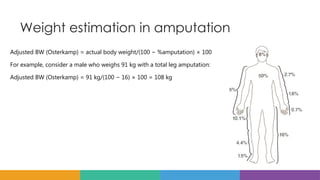
Weight estimation in amputation
Adjusted BW (Osterkamp) = actual body weight/(100 − %amputation) × 100
For example, consider a male who weighs 91 kg with a total leg amputation:
Adjusted BW (Osterkamp) = 91 kg/(100 − 16) × 100 = 108 kg
Body weight change over time
MUAC can also be used to estimate weight change over a period of time and can be useful in subjects in long term
care.
• MUAC needs to be measured repeatedly over a period of time, preferably taking 2 measurements on each
occasion and using the average of the 2 figures.
If MUAC changes by at least 10% then it is likely that weight and BMI have changed by approximately 10% or more.
Challenges in symptoms
interpretation in the elderly
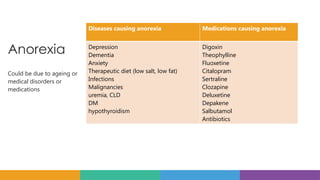
Anorexia
Could be due to ageing or
medical disorders or
medications
Diseases causing anorexia Medications causing anorexia
Depression
Dementia
Anxiety
Therapeutic diet (low salt, low fat)
Infections
Malignancies
uremia, CLD
DM
hypothyroidism
Digoxin
Theophylline
Fluoxetine
Citalopram
Sertraline
Clozapine
Deluxetine
Depakene
Salbutamol
Antibiotics
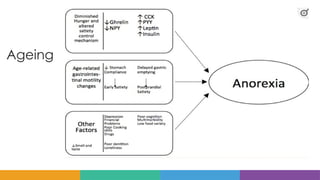
Ageing
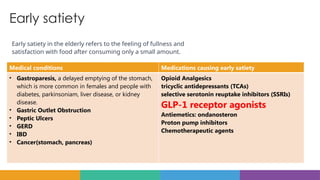
Early satiety
Early satiety in the elderly refers to the feeling of fullness and
satisfaction with food after consuming only a small amount.
Medical conditions Medications causing early satiety
• Gastroparesis, a delayed emptying of the stomach,
which is more common in females and people with
diabetes, parkinsoniam, liver disease, or kidney
disease.
• Gastric Outlet Obstruction
• Peptic Ulcers
• GERD
• IBD
• Cancer(stomach, pancreas)
Opioid Analgesics
tricyclic antidepressants (TCAs)
selective serotonin reuptake inhibitors (SSRIs)
GLP-1 receptor agonists
Antiemetics: ondanosteron
Proton pump inhibitors
Chemotherapeutic agents
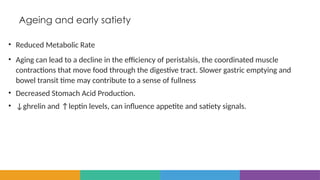
Ageing and early satiety
• Reduced Metabolic Rate
• Aging can lead to a decline in the efficiency of peristalsis, the coordinated muscle
contractions that move food through the digestive tract. Slower gastric emptying and
bowel transit time may contribute to a sense of fullness
• Decreased Stomach Acid Production.
• ↓ghrelin and ↑leptin levels, can influence appetite and satiety signals.
Challenges in clinical
examination of the elderly
What are the clinical signs of dehydration?
Thirst
Dark urine
Decreased urine output
Dry mouth and dry skin
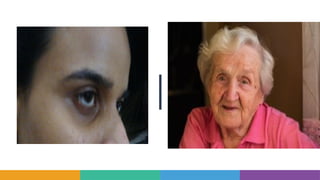
Sunken eyes (enophthalmos)
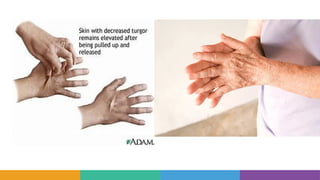
Inelastic skin
Late:
Dizziness
Confusion
How it is difficult to detect signs of dehydration
early in elderly?
• Elderly have impaired thirst sensation
• They may have cognitive decline (can’t remember
amount of water they had or amount of urine
they passed}
• They may have visual impairment can’t detect the
change of urine colour.
• Dry mouth, dry skin is normal physiology with
ageing and can be due to diseases or medications.
• Ageing is associated with loss of orbital fat leading
to enophthalmos not due to dehydration.
• Ageing is associated with decreased collagen,
elastin in skin leading to loss of skin elasticity even
without dehydration.
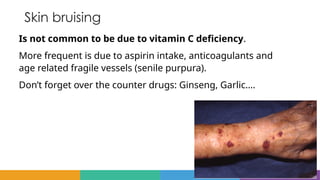
Skin bruising
Is not common to be due to vitamin C deficiency.
More frequent is due to aspirin intake, anticoagulants and
age related fragile vessels (senile purpura).
Don’t forget over the counter drugs: Ginseng, Garlic….
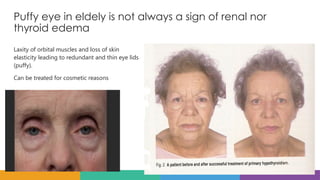
Puffy eye in eldely is not always a sign of renal nor
thyroid edema
Laxity of orbital muscles and loss of skin
elasticity leading to redundant and thin eye lids
(puffy).
Can be treated for cosmetic reasons
Loss of night vision
Not merely due to vitamin A deficiency.
Ageing simply cause decreased night vision (Scotopic vision)or macular
degeneration
Age related changes include:
• Reduced Pupil Size
• Reduced sensitivity to light(due to changes in rods)
• The lens of the eye becomes less transparent and more yellow with age. lead to a
reduction in the amount of light that reaches the retina.
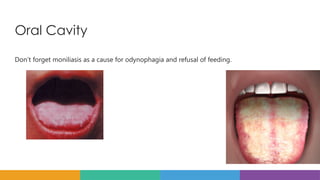
Oral Cavity
Don’t forget moniliasis as a cause for odynophagia and refusal of feeding.
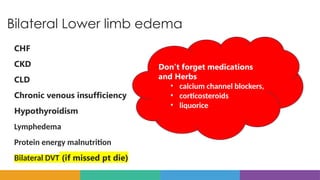
Bilateral Lower limb edema
CHF
CKD
CLD
Chronic venous insufficiency
Hypothyroidism
Lymphedema
Protein energy malnutrition
Bilateral DVT (if missed pt die)
Don’t forget medications
and Herbs
• calcium channel blockers,
• corticosteroids
• liquorice
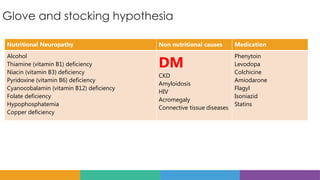
Glove and stocking hypothesia
Nutritional Neuropathy Non nutritional causes Medication
Alcohol
Thiamine (vitamin B1) deficiency
Niacin (vitamin B3) deficiency
Pyridoxine (vitamin B6) deficiency
Cyanocobalamin (vitamin B12) deficiency
Folate deficiency
Hypophosphatemia
Copper deficiency
DM
CKD
Amyloidosis
HIV
Acromegaly
Connective tissue diseases
Phenytoin
Levodopa
Colchicine
Amiodarone
Flagyl
Isoniazid
Statins
Dehydration
Risk factors
Prevention
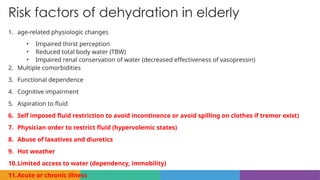
Risk factors of dehydration in elderly
1. age-related physiologic changes
• Impaired thirst perception
• Reduced total body water (TBW)
• Impaired renal conservation of water (decreased effectiveness of vasopressin)
2. Multiple comorbidities
3. Functional dependence
4. Cognitive impairment
5. Aspiration to fluid
6. Self imposed fluid restriction to avoid incontinence or avoid spilling on clothes if tremor exist)
7. Physician order to restrict fluid (hypervolemic states)
8. Abuse of laxatives and diuretics
9. Hot weather
10.Limited access to water (dependency, immobility)
11.Acute or chronic illness
How to avoid dehydration in elderly
1. Take 8 glasses(2 L) of fluid wheter or not thirsty.
2. Never to restrict water to avoid incontinence but just reschedule.
3. Include foods with high water content in their diet, such as fruits (watermelon, oranges, berries),
vegetables (cucumber, celery, lettuce), and soups.
4. Use laxative and diuretics according to physician advice.
5. Monitor fluid loss (don’t forget sweating, fever)
6. Ensure that water is easily accessible. Keep water bottles within reach
7. use a spill-proof cup if tremor or mobility is an issue.
8. During hot weather, encourage increased fluid intake, as the risk of dehydration rises in high
temperatures. Offer cool drinks and try to keep the living environment comfortably cool.
9. Water thickner formulas or starch, gelatin,guar gum
Case presentation
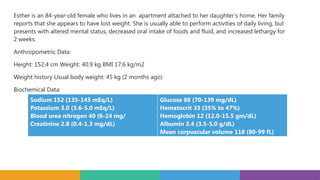
Esther is an 84-year-old female who lives in an apartment attached to her daughter’s home. Her family
reports that she appears to have lost weight. She is usually able to perform activities of daily living, but
presents with altered mental status, decreased oral intake of foods and fluid, and increased lethargy for
2 weeks.
Anthropometric Data:
Height: 152.4 cm Weight: 40.9 kg BMI 17.6 kg/m2
Weight history Usual body weight: 45 kg (2 months ago)
Biochemical Data:
Sodium 152 (135-145 mEq/L)
Potassium 3.0 (3.6-5.0 mEq/L)
Blood urea nitrogen 40 (6-24 mg/
Creatinine 2.8 (0.4-1.3 mg/dL)
Glucose 88 (70-139 mg/dL)
Hematocrit 33 (35% to 47%)
Hemoglobin 12 (12.0-15.5 gm/dL)
Albumin 3.4 (3.5-5.0 g/dL)
Mean corpuscular volume 118 (80-99 fL)
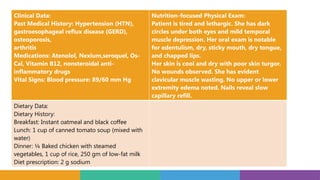
Clinical Data:
Past Medical History: Hypertension (HTN),
gastroesophageal reflux disease (GERD),
osteoporosis,
arthritis
Medications: Atenolol, Nexium,seroquel, Os-
Cal, Vitamin B12, nonsteroidal anti-
inflammatory drugs
Vital Signs: Blood pressure: 89/60 mm Hg
Nutrition-focused Physical Exam:
Patient is tired and lethargic. She has dark
circles under both eyes and mild temporal
muscle depression. Her oral exam is notable
for edentulism, dry, sticky mouth, dry tongue,
and chapped lips.
Her skin is cool and dry with poor skin turgor.
No wounds observed. She has evident
clavicular muscle wasting. No upper or lower
extremity edema noted. Nails reveal slow
capillary refill.
Dietary Data:
Dietary History:
Breakfast: Instant oatmeal and black coffee
Lunch: 1 cup of canned tomato soup (mixed with
water)
Dinner: ¼ Baked chicken with steamed
vegetables, 1 cup of rice, 250 gm of low-fat milk
Diet prescription: 2 g sodium
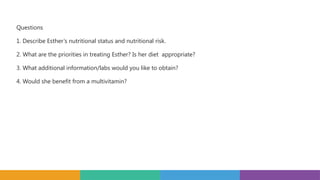
Questions
1. Describe Esther’s nutritional status and nutritional risk.
2. What are the priorities in treating Esther? Is her diet appropriate?
3. What additional information/labs would you like to obtain?
4. Would she benefit from a multivitamin?
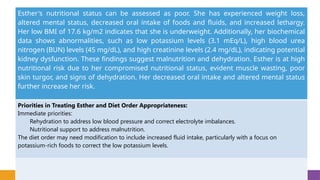
Esther's nutritional status can be assessed as poor. She has experienced weight loss,
altered mental status, decreased oral intake of foods and fluids, and increased lethargy.
Her low BMI of 17.6 kg/m2 indicates that she is underweight. Additionally, her biochemical
data shows abnormalities, such as low potassium levels (3.1 mEq/L), high blood urea
nitrogen (BUN) levels (45 mg/dL), and high creatinine levels (2.4 mg/dL), indicating potential
kidney dysfunction. These findings suggest malnutrition and dehydration. Esther is at high
nutritional risk due to her compromised nutritional status, evident muscle wasting, poor
skin turgor, and signs of dehydration. Her decreased oral intake and altered mental status
further increase her risk.
Priorities in Treating Esther and Diet Order Appropriateness:
Immediate priorities:
Rehydration to address low blood pressure and correct electrolyte imbalances.
Nutritional support to address malnutrition.
The diet order may need modification to include increased fluid intake, particularly with a focus on
potassium-rich foods to correct the low potassium levels.
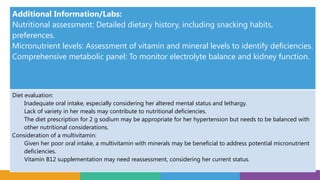
Additional Information/Labs:
Nutritional assessment: Detailed dietary history, including snacking habits,
preferences.
Micronutrient levels: Assessment of vitamin and mineral levels to identify deficiencies.
Comprehensive metabolic panel: To monitor electrolyte balance and kidney function.
Diet evaluation:
Inadequate oral intake, especially considering her altered mental status and lethargy.
Lack of variety in her meals may contribute to nutritional deficiencies.
The diet prescription for 2 g sodium may be appropriate for her hypertension but needs to be balanced with
other nutritional considerations.
Consideration of a multivitamin:
Given her poor oral intake, a multivitamin with minerals may be beneficial to address potential micronutrient
deficiencies.
Vitamin B12 supplementation may need reassessment, considering her current status.
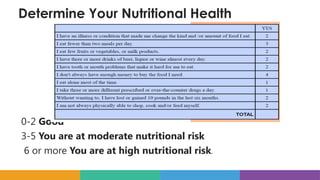
Determine Your Nutritional Health
0-2 Good
3-5 You are at moderate nutritional risk
6 or more You are at high nutritional risk.
Diagnose
What are the risk factors
Results of nutritional assessment (anthropometric, biochemical,clinical,
diet)
Plan of management
• Manage acute condition
• Eliminate risk factors
• Diet plan
• Follow up plan

geriatric nutritional tips (Assessment).pptx

  • 1.
    Geriatric nutritional Tips Dr DohaRasheedy Professor of Geriatrics and Gerontology Ain Shams University
  • 2.
    What are thedifference in food pyramids of old and young adults
  • 3.
    Another example offood pyramid of the old
  • 4.
  • 5.
    Height estimation If heightcannot be obtained, use length of forearm (ulna) to calculate height using tables below.
  • 6.
  • 7.
  • 8.
    Estimating body massindex (BMI) If neither height nor weight can be measured or obtained, a likely BMI range can be estimated using the mid upper arm circumference (MUAC)
  • 9.
    Body weight Don’t useself reported values: patient forgets or unfamiliar with scales. Immobile patients: use bed scales. Body weight in volume overload and amputation
  • 10.
    Weight estimation inamputation Adjusted BW (Osterkamp) = actual body weight/(100 − %amputation) × 100 For example, consider a male who weighs 91 kg with a total leg amputation: Adjusted BW (Osterkamp) = 91 kg/(100 − 16) × 100 = 108 kg
  • 11.
    Body weight changeover time MUAC can also be used to estimate weight change over a period of time and can be useful in subjects in long term care. • MUAC needs to be measured repeatedly over a period of time, preferably taking 2 measurements on each occasion and using the average of the 2 figures. If MUAC changes by at least 10% then it is likely that weight and BMI have changed by approximately 10% or more.
  • 12.
  • 13.
    Anorexia Could be dueto ageing or medical disorders or medications Diseases causing anorexia Medications causing anorexia Depression Dementia Anxiety Therapeutic diet (low salt, low fat) Infections Malignancies uremia, CLD DM hypothyroidism Digoxin Theophylline Fluoxetine Citalopram Sertraline Clozapine Deluxetine Depakene Salbutamol Antibiotics
  • 14.
  • 15.
    Early satiety Early satietyin the elderly refers to the feeling of fullness and satisfaction with food after consuming only a small amount. Medical conditions Medications causing early satiety • Gastroparesis, a delayed emptying of the stomach, which is more common in females and people with diabetes, parkinsoniam, liver disease, or kidney disease. • Gastric Outlet Obstruction • Peptic Ulcers • GERD • IBD • Cancer(stomach, pancreas) Opioid Analgesics tricyclic antidepressants (TCAs) selective serotonin reuptake inhibitors (SSRIs) GLP-1 receptor agonists Antiemetics: ondanosteron Proton pump inhibitors Chemotherapeutic agents
  • 16.
    Ageing and earlysatiety • Reduced Metabolic Rate • Aging can lead to a decline in the efficiency of peristalsis, the coordinated muscle contractions that move food through the digestive tract. Slower gastric emptying and bowel transit time may contribute to a sense of fullness • Decreased Stomach Acid Production. • ↓ghrelin and ↑leptin levels, can influence appetite and satiety signals.
  • 17.
  • 18.
    What are theclinical signs of dehydration? Thirst Dark urine Decreased urine output Dry mouth and dry skin Sunken eyes (enophthalmos) Inelastic skin Late: Dizziness Confusion How it is difficult to detect signs of dehydration early in elderly? • Elderly have impaired thirst sensation • They may have cognitive decline (can’t remember amount of water they had or amount of urine they passed} • They may have visual impairment can’t detect the change of urine colour. • Dry mouth, dry skin is normal physiology with ageing and can be due to diseases or medications. • Ageing is associated with loss of orbital fat leading to enophthalmos not due to dehydration. • Ageing is associated with decreased collagen, elastin in skin leading to loss of skin elasticity even without dehydration.
  • 21.
    Skin bruising Is notcommon to be due to vitamin C deficiency. More frequent is due to aspirin intake, anticoagulants and age related fragile vessels (senile purpura). Don’t forget over the counter drugs: Ginseng, Garlic….
  • 22.
    Puffy eye ineldely is not always a sign of renal nor thyroid edema Laxity of orbital muscles and loss of skin elasticity leading to redundant and thin eye lids (puffy). Can be treated for cosmetic reasons
  • 23.
    Loss of nightvision Not merely due to vitamin A deficiency. Ageing simply cause decreased night vision (Scotopic vision)or macular degeneration Age related changes include: • Reduced Pupil Size • Reduced sensitivity to light(due to changes in rods) • The lens of the eye becomes less transparent and more yellow with age. lead to a reduction in the amount of light that reaches the retina.
  • 24.
    Oral Cavity Don’t forgetmoniliasis as a cause for odynophagia and refusal of feeding.
  • 25.
    Bilateral Lower limbedema CHF CKD CLD Chronic venous insufficiency Hypothyroidism Lymphedema Protein energy malnutrition Bilateral DVT (if missed pt die) Don’t forget medications and Herbs • calcium channel blockers, • corticosteroids • liquorice
  • 26.
    Glove and stockinghypothesia Nutritional Neuropathy Non nutritional causes Medication Alcohol Thiamine (vitamin B1) deficiency Niacin (vitamin B3) deficiency Pyridoxine (vitamin B6) deficiency Cyanocobalamin (vitamin B12) deficiency Folate deficiency Hypophosphatemia Copper deficiency DM CKD Amyloidosis HIV Acromegaly Connective tissue diseases Phenytoin Levodopa Colchicine Amiodarone Flagyl Isoniazid Statins
  • 27.
  • 28.
    Risk factors ofdehydration in elderly 1. age-related physiologic changes • Impaired thirst perception • Reduced total body water (TBW) • Impaired renal conservation of water (decreased effectiveness of vasopressin) 2. Multiple comorbidities 3. Functional dependence 4. Cognitive impairment 5. Aspiration to fluid 6. Self imposed fluid restriction to avoid incontinence or avoid spilling on clothes if tremor exist) 7. Physician order to restrict fluid (hypervolemic states) 8. Abuse of laxatives and diuretics 9. Hot weather 10.Limited access to water (dependency, immobility) 11.Acute or chronic illness
  • 29.
    How to avoiddehydration in elderly 1. Take 8 glasses(2 L) of fluid wheter or not thirsty. 2. Never to restrict water to avoid incontinence but just reschedule. 3. Include foods with high water content in their diet, such as fruits (watermelon, oranges, berries), vegetables (cucumber, celery, lettuce), and soups. 4. Use laxative and diuretics according to physician advice. 5. Monitor fluid loss (don’t forget sweating, fever) 6. Ensure that water is easily accessible. Keep water bottles within reach 7. use a spill-proof cup if tremor or mobility is an issue. 8. During hot weather, encourage increased fluid intake, as the risk of dehydration rises in high temperatures. Offer cool drinks and try to keep the living environment comfortably cool. 9. Water thickner formulas or starch, gelatin,guar gum
  • 30.
  • 31.
    Esther is an84-year-old female who lives in an apartment attached to her daughter’s home. Her family reports that she appears to have lost weight. She is usually able to perform activities of daily living, but presents with altered mental status, decreased oral intake of foods and fluid, and increased lethargy for 2 weeks. Anthropometric Data: Height: 152.4 cm Weight: 40.9 kg BMI 17.6 kg/m2 Weight history Usual body weight: 45 kg (2 months ago) Biochemical Data: Sodium 152 (135-145 mEq/L) Potassium 3.0 (3.6-5.0 mEq/L) Blood urea nitrogen 40 (6-24 mg/ Creatinine 2.8 (0.4-1.3 mg/dL) Glucose 88 (70-139 mg/dL) Hematocrit 33 (35% to 47%) Hemoglobin 12 (12.0-15.5 gm/dL) Albumin 3.4 (3.5-5.0 g/dL) Mean corpuscular volume 118 (80-99 fL)
  • 32.
    Clinical Data: Past MedicalHistory: Hypertension (HTN), gastroesophageal reflux disease (GERD), osteoporosis, arthritis Medications: Atenolol, Nexium,seroquel, Os- Cal, Vitamin B12, nonsteroidal anti- inflammatory drugs Vital Signs: Blood pressure: 89/60 mm Hg Nutrition-focused Physical Exam: Patient is tired and lethargic. She has dark circles under both eyes and mild temporal muscle depression. Her oral exam is notable for edentulism, dry, sticky mouth, dry tongue, and chapped lips. Her skin is cool and dry with poor skin turgor. No wounds observed. She has evident clavicular muscle wasting. No upper or lower extremity edema noted. Nails reveal slow capillary refill. Dietary Data: Dietary History: Breakfast: Instant oatmeal and black coffee Lunch: 1 cup of canned tomato soup (mixed with water) Dinner: ¼ Baked chicken with steamed vegetables, 1 cup of rice, 250 gm of low-fat milk Diet prescription: 2 g sodium
  • 33.
    Questions 1. Describe Esther’snutritional status and nutritional risk. 2. What are the priorities in treating Esther? Is her diet appropriate? 3. What additional information/labs would you like to obtain? 4. Would she benefit from a multivitamin?
  • 34.
    Esther's nutritional statuscan be assessed as poor. She has experienced weight loss, altered mental status, decreased oral intake of foods and fluids, and increased lethargy. Her low BMI of 17.6 kg/m2 indicates that she is underweight. Additionally, her biochemical data shows abnormalities, such as low potassium levels (3.1 mEq/L), high blood urea nitrogen (BUN) levels (45 mg/dL), and high creatinine levels (2.4 mg/dL), indicating potential kidney dysfunction. These findings suggest malnutrition and dehydration. Esther is at high nutritional risk due to her compromised nutritional status, evident muscle wasting, poor skin turgor, and signs of dehydration. Her decreased oral intake and altered mental status further increase her risk. Priorities in Treating Esther and Diet Order Appropriateness: Immediate priorities: Rehydration to address low blood pressure and correct electrolyte imbalances. Nutritional support to address malnutrition. The diet order may need modification to include increased fluid intake, particularly with a focus on potassium-rich foods to correct the low potassium levels.
  • 35.
    Additional Information/Labs: Nutritional assessment:Detailed dietary history, including snacking habits, preferences. Micronutrient levels: Assessment of vitamin and mineral levels to identify deficiencies. Comprehensive metabolic panel: To monitor electrolyte balance and kidney function. Diet evaluation: Inadequate oral intake, especially considering her altered mental status and lethargy. Lack of variety in her meals may contribute to nutritional deficiencies. The diet prescription for 2 g sodium may be appropriate for her hypertension but needs to be balanced with other nutritional considerations. Consideration of a multivitamin: Given her poor oral intake, a multivitamin with minerals may be beneficial to address potential micronutrient deficiencies. Vitamin B12 supplementation may need reassessment, considering her current status.
  • 37.
    Determine Your NutritionalHealth 0-2 Good 3-5 You are at moderate nutritional risk 6 or more You are at high nutritional risk.
  • 38.
    Diagnose What are therisk factors Results of nutritional assessment (anthropometric, biochemical,clinical, diet) Plan of management • Manage acute condition • Eliminate risk factors • Diet plan • Follow up plan