Malignant tumors
• Malignant tumors are
cancerous. They can
invade and damage nearby
tissues and organs, and
they can break away and
enter the blood stream to
form new tumors in other
parts of the body. The
spread of cancer is called
metastasis.
Benign tumors
• Benign tumors are not
cancerous. They do not
invade nearby tissues nor
spread to other parts of
the body. They can be
removed and are not a
threat to life.
Normal cells major characters
1. It needs a structure to determine the size of bones and
shape of the body, tail and whiskers. This is
determined by the DNA in genes and chromosomes.
2. It needs energy to play and prowl and sustain life. This
is derived from the chemicals in food.
3. It needs a system to deliver chemicals (food nutrients
like amino acids, carbohydrates, fats, vitamins and
minerals) to all parts of the body. These are the blood
vessels.
4. It needs growth factors to take it from being a kitty into
a lazy old cat.
5. It needs to function normally.
Characteristics of Cancer Cells
1. Cancer cells have sustained proliferative signaling
resulting in the stimulation of cells’ own growth.
2. They show a clear escape from growth suppressors
or growth-inhibiting signals.
3. They resist cell death or apoptosis.
4. They have a better copying ability from the parent
cells (replication) that is helpful in expanding their
numbers.
5. They affect other cells to make new blood vessels
(angiogenesis) for a blood supply.
6. They are actively involved in the spread of the
disease i.e. metastasis
Transformation of normal cell to
malignant cells
– Hyperplasia: the enlargement of a cell
– Metaplasia: abnormal change in the nature of a
cell
– Dysplasia: abnormality in the cell development
– Anaplasia: structural differentiation loss within a
cell or group of cells
– Neoplasia: an abnormal growth of cell or tissue
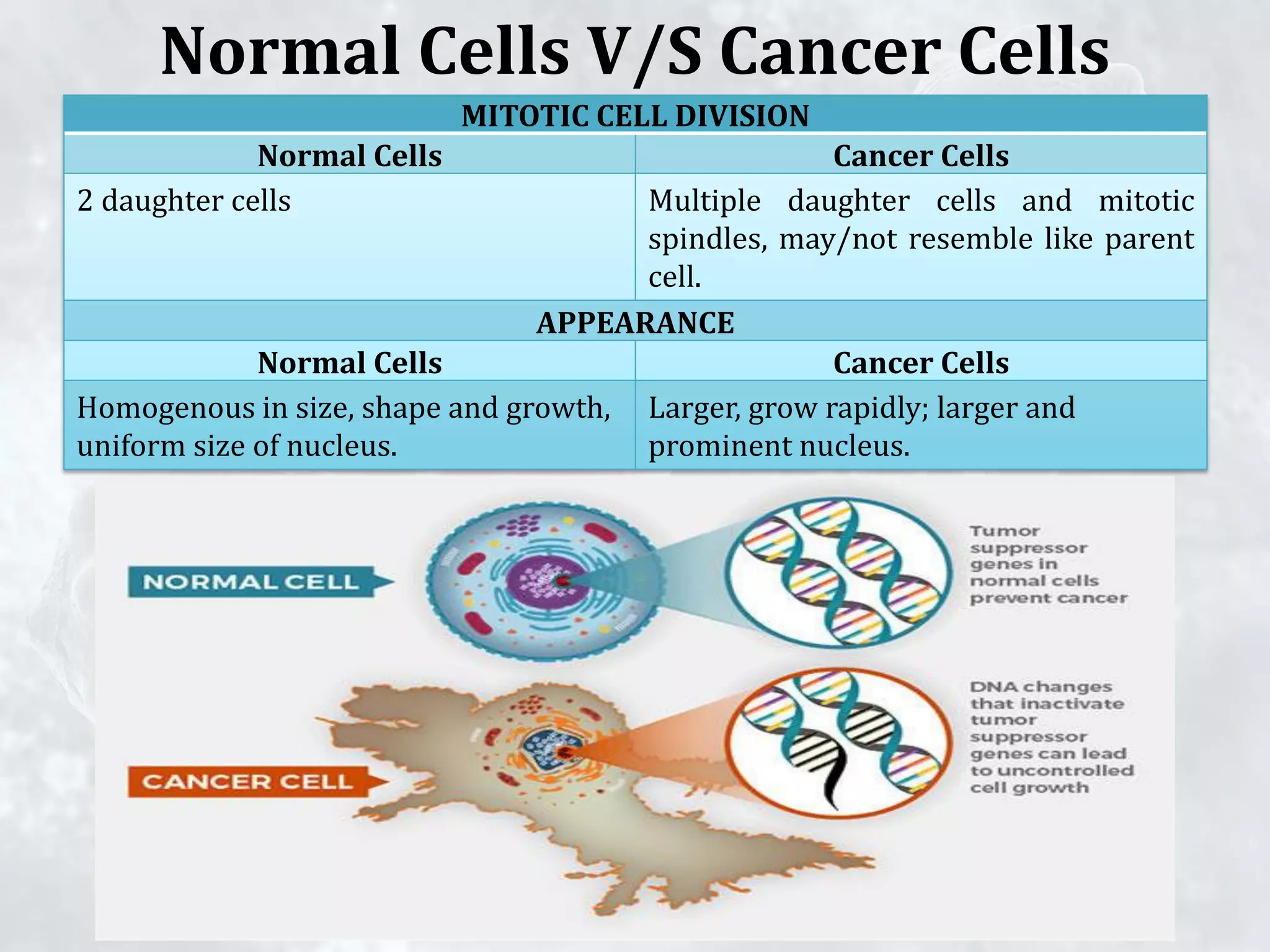
Normal Cells V/S Cancer Cells
STRUCTURE
Normal Cells Cancer Cells
DNA in genes and chromosomes go about
their business in a normal way.
Cancer cells develop a different DNA or gene
structure or acquire abnormal numbers of
chromosomes
Cells divide in an orderly way to produce
more cells only when the body needs them,
Cells continue to be created without control
or order. If not needed, a mass of tissue is
formed. which is called a tumor
ENERGY
Normal Cells Cancer Cells
Cells derive 70% of their energy from a
system called the Krebs Cycle.
Cells have a defective "Krebs Cycle' and derive
little or no energy from it
Cells derive only 20% of their energy from
a system called Glycolysis."
Cancer cells derive almost all their energy
from Glycolysis
Cells derive most of their energy with the
use of oxygen
Cells derive most of their energy in the
absence of oxygen
Normal Cells V/S Cancer Cells
BLOOD VESSELS
Normal Cells Cancer Cells
Cells have a built-in blood vessel
system.
Cells don t have a built-in blood vessel
system. They require more amino
acids to build one.
GROWTH FACTORS
Normal Cells Cancer Cells
While similar to cancer cells, the
amount of them are more in balance
to produce a more normal level of
activity.
These cells have over produced,
require more chemicals (food) and
are over active
Do not invade adjacent tissue invade
Grow in ideal conditions Adverse conditions
Cell birth=/< than cell death Cell birth exceeds death
Cannot grow outside Able to break off cells & grow
outside.
Normal Cells V/S Cancer Cells
MITOTIC CELL DIVISION
Normal Cells Cancer Cells
2 daughter cells Multiple daughter cells and mitotic
spindles, may/not resemble like parent
cell.
APPEARANCE
Normal Cells Cancer Cells
Homogenous in size, shape and growth,
uniform size of nucleus.
Larger, grow rapidly; larger and
prominent nucleus.
Genetics in Cancer
Genes are found in the DNA in each cell that makes up your body. They
control all the cell functions
• Genetic mutations
There are two basic types of genetic mutations:
• Acquired mutations
These are the most common cause of cancer. These occur from damage
to genes during a person’s life. They are not passed from parent to
child. Factors such as tobacco, ultraviolet (UV) radiation, viruses, and
age cause these mutations. Cancer that occurs because of acquired
mutations is called sporadic cancer.
• Germline mutations
These are passed directly from a parent to a child. The mutation can be
found in every cell of a person’s body, including the reproductive sperm
cells in a male body and egg cells in a female body. Because the
mutation affects reproductive cells, it passes from generation to
generation. Cancer caused by germline mutations is called inherited
cancer.
APOPTOSIS AND CANCER
• Apoptosis often referred to as programmed
cell death or cell suicide – a gene directed
method of cell destruction.
• Can be triggered by environmental factors ,
cellular receptor activation and internal
factors related gene expression.
• Essential for normal development, orderly
cell turnover and remolding.
• Pathways:
– Extrinsic pathway: involves activation of cell
surface receptors.
– Intrinsic (mitochondrial) pathway: responsive
to internal cues such as DNA damage which
increase p53 protein.
• Faulty apoptotic mechanisms are important
factor in tumor development and survival, in
anticancer therapy.
SIGNALLING PATHWAY
Characteristics of cell undergoing
apoptosis
Structural changes:
• Blebbing of the plasma membrane & breakage
of the cell into apoptotic bodies.
• AB- helps apoptotic cell become phagocytized
by cells.
• The way phagocytes and other healthy cells
recognize apoptotic bodies-specific changes in
the composition of plasma membrane (
phosphatidylserine translocate from the
cytoplasmic leaflet to the extracellular leaflet of
the membrane lipid bilayer).
• Cardinal feature of the cell is minimal leakage of cellular
constituents into the extracellular phase - minimize
inflammatory response – distinguishes apoptosis from
necrosis.
• Apoptotic cells lose H2O – shrinking of the cytoplasm.
• Large vacuoles form in the cytoplasm.
• In nucleus- margins of chromatin become concentrated
at the inside of the nuclear membrane.
• The nucleus condenses into multiple fragments by an
intact membrane.
• The chromatin cleavage is associated with DNA
degradation into small fragments.
Mutation
Mutation is an alteration in DNA molecule sequence - the order of
the 4 bases ACTG.
TYPES:
• DNA Mutations - changes to the sequence of nucleotides in DNA
• Translocations - alterations of large amounts of DNA, often at the
level of the chromosome.
• Gene Amplification - production of many copies of a gene or set
of genes at one location on a chromosome
• Inversions - segments of DNA are released from
a chromosome and then re-inserted in the opposite orientation
• Duplications/Deletions - a gene or group of genes may be copied
more than one time within a chromosome or lost entirely
• Aneuploidy - the loss or gain of entire chromosomes
• Epigenetic Changes - changes to the DNA and chromatin that do
not change the sequence
16
Oncogenes and Tumor-
Suppressor Genes
• Oncogenes
– Mutant genes that in their non - mutant state direct
protein synthesis and cellular growth
• Tumor-suppressor genes
– Encode proteins that in their normal state negatively
regulate proliferation
– Also referred to as anti-oncogenes
• Proto-oncogene
– A normal, nonmutant gene that codes for cellular
growth
Genes Associated with Cancer
NAME FUNCTION EXAMPLES of Cancer/Diseases TYPE of Cancer Gene
APC regulates transcription of target genes Familial Adenomatous Polyposis tumor suppressor
BCL2
involved in apoptosis; stimulates
angiogenesis
Leukemia; Lymphoma oncogene
BLM DNA repair Bloom Syndrome DNA repair
BRCA1 may be involved in cell cycle control
Breast, Ovarian, Prostatic, & Colonic
Neoplasms
tumor suppressor
BRCA2 DNA repair
Breast & Pancreatic Neoplasms;
Leukemia
tumor suppressor
HER2
tyrosine kinase; growth factor
receptor
Breast, Ovarian Neoplasms oncogene
MYC
involved in protein-protein
interactions with various cellular
factors
Burkitt's Lymphoma oncogene
p16 cyclin-dependent kinase inhibitor
Leukemia; Melanoma; Multiple
Myeloma; Pancreatic Neoplasms
tumor suppressor
p21 cyclin-dependent kinase inhibitor tumor suppressor
p53 apoptosis; transcription factor
Colorectal Neoplasms; Li-Fraumeni
Syndrome
tumor suppressor
RAS
GTP-binding protein; important in
signal transduction cascade
Pancreatic, Colorectal, Bladder Breast,
Kidney & Lung Neoplasms; Leukemia;
Melanoma
oncogene
RB regulation of cell cycle Retinoblastoma tumor suppressor
SIS growth factor
Dermatofibrosarcoma; Meningioma;
Skin Neoplasms
oncogene
XP DNA repair Xeroderma pigmentosum DNA repair
18
Mutation of Normal Genes
• Point mutations
– Changes in one or a few nucleotide base pairs
• Chromosome translocation
– A piece on one chromosome is transferred to
another
• Gene amplification
– Duplication of a small piece of chromosome
over and over
– Results in an increased expression of an
oncogene
19
Mutation of Normal Genes
• Mutation of tumor-suppressor genes
– Allows unregulated cellular growth
• Loss of heterozygosity
– Both chromosome copies of a gene are
inactivated
• Gene silencing
– Whole regions of chromosomes are shut off
while the same regions in other cells remain
active
20
Mutation of Normal Genes
• Caretaker genes
– Encode for proteins that are involved in
repairing damaged DNA
• Chromosome instability
– Increased in malignant cells
– Results in chromosome loss, loss of
heterozygosity, and chromosome amplification
REPRIR OF DNA DAMAGE
FOUR MECHANISM OF REPAIRING DNA
• Mismatch repair(MMR)
• Base excision repair(BER)
• Nucleotide excision repair(NER)
• Double strand break repair.
CARCINOGENISIS
STAGES OF CARCINOGENESIS
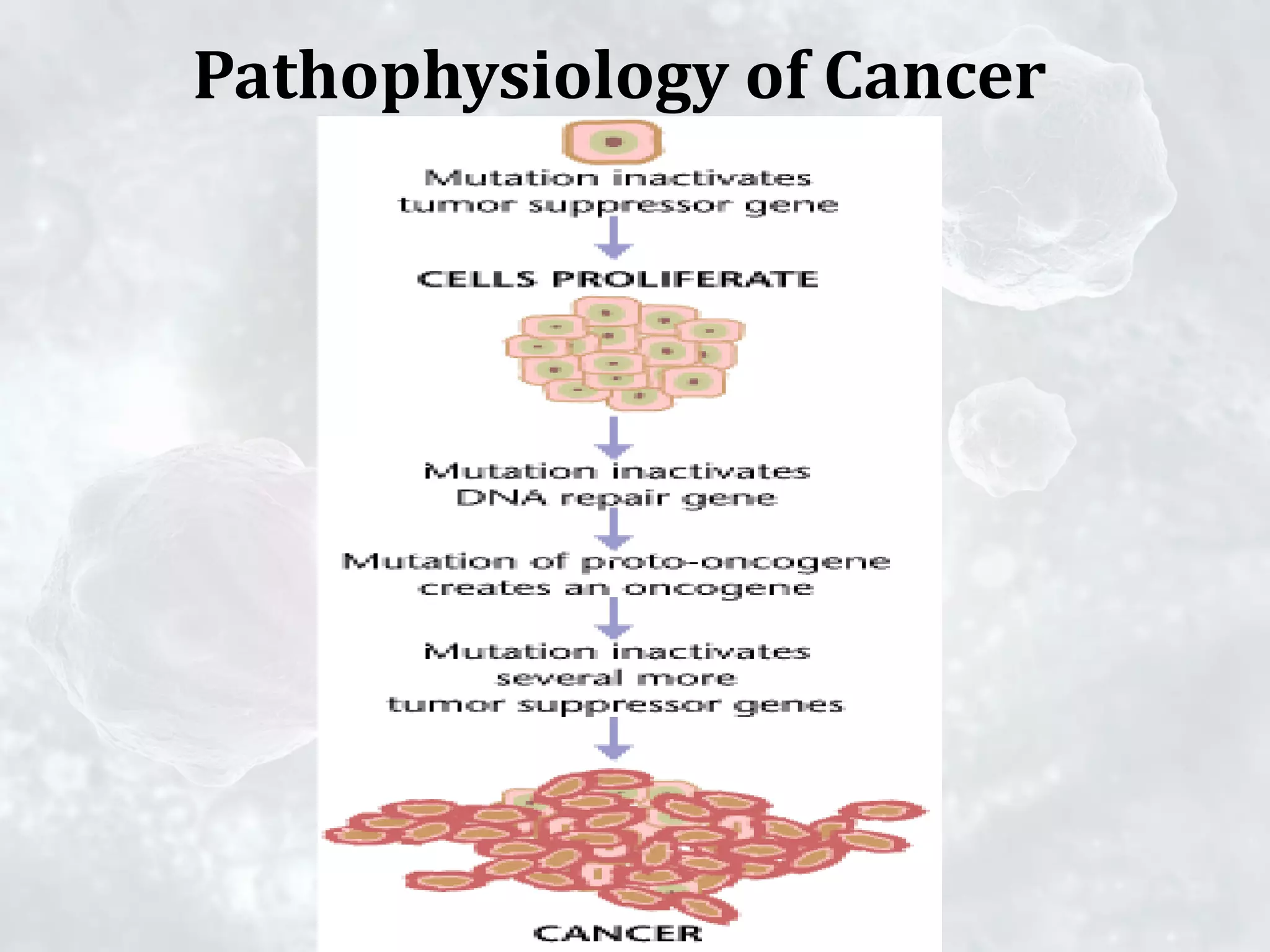
1. Initiation: - activation of oncogenes and
protooncogens, irreversible changes
2. Promotion: stimulation and proliferation cells
3. Progression: bad to worse
Types of Cancer
Benign and malignant growths are classified and named by tissue of
origin.
• Carcinomas
• Result from altered epithelial cells, which cover the surface of our skin
and internal organs. Most cancers are carcinomas.
• Sarcomas
• Result from changes in muscle, bone, fat, or connective tissue.
• Leukemia
• Results from malignant white blood cells.
• Lymphoma
• It is a cancer of the lymphatic system cells that derive from bone
marrow.
• Myelomas
• These are cancers of specialized white blood cells that make
antibodies.
CLASSIFICATION OF NEOPLASM
TISSUE OF ORIGIN BENIGN MALIGNANT
CONNECTIVE TISSUE SARCOMA
Embryonic fibrous tissue Myxoma Myxosarcoma
Fibrous tissue Fibroma Fibrosarcoma
Adipose tissue Lipoma Liposarcoma
Cartilage Chondroma Chondrosarcoma
Bone Osteoma Osteogenic sarcoma
EPITHELIUM CARCINOMA
Skin and mucous
membrane
Papilloma Squmous cell carcinoma
Glands Polyp Basel cell carcinoma
Transitional cell carcinoma
Adenoma Adenocarcinoma
Cystadenoma
Pigmented
cells(melanoblasts)
Nevus Malignant melanoma
24
CLASSIFICATION OF NEOPLASM
ENDOTHELIUM ENDOTHELIOMA
Blood vessels Hemangioma Hemangioendothelioma
Hemangiosarcoma.
Lymph vessels Lymphangioma Lymphangiosarcoma
Lymphangioendothelioma
Bone marrow Multiple myeloma
Ewing’s sarcoma
Leukemia
Lymphoid tissue Malignant lymphoma
Lymphosarcoma
Reticulum cell sarcoma
Lymphatic leukemia
25
CLASSIFICATION OF NEOPLASM
MUSCLE TISSUE
Smooth muscle Leiomyoma Leiomyosarcoma
Striated muscle Rhabdomyoma Rhabdomyosarcoma
NERVE TISSUE
Nerve fibers and
sheaths
Neuroma
Neurinoma (Neurilemoma)
Neurofibroma
Neurofibrosarcoma
Ganglion cell Ganglioneuroma Neuroblastoma
Glia cell Glioma Glioblastoma
Spongioblastoma
Meninges Meningioma Malignant meningioma
GONADS Dermoid cyst
Embryonal carcinoma
Embryonal sarcoma
Teratocarcinoma
Pathophysiology of Cancer
REFERENCES
• Hodgson, S. V. (2016). Practical guide to human
cancer genetics. Springer London Ltd.
• Connie Henke Yarbro, Wujcik, D., & Barbara
Holmes Gobel. (2018). Cancer nursing : principles
and practice. Jones & Bartlett Learning.
• Cahoon, M. C. (1982). Cancer nursing. Churchill
Livingstone.
• Bozzone, D. M. (2007). Biology of cancer : cancer
genetics. Chelsea House.
Cancer cell biology

Cancer cell biology

  • 2.
    Malignant tumors • Malignanttumors are cancerous. They can invade and damage nearby tissues and organs, and they can break away and enter the blood stream to form new tumors in other parts of the body. The spread of cancer is called metastasis. Benign tumors • Benign tumors are not cancerous. They do not invade nearby tissues nor spread to other parts of the body. They can be removed and are not a threat to life.
  • 3.
    Normal cells majorcharacters 1. It needs a structure to determine the size of bones and shape of the body, tail and whiskers. This is determined by the DNA in genes and chromosomes. 2. It needs energy to play and prowl and sustain life. This is derived from the chemicals in food. 3. It needs a system to deliver chemicals (food nutrients like amino acids, carbohydrates, fats, vitamins and minerals) to all parts of the body. These are the blood vessels. 4. It needs growth factors to take it from being a kitty into a lazy old cat. 5. It needs to function normally.
  • 4.
    Characteristics of CancerCells 1. Cancer cells have sustained proliferative signaling resulting in the stimulation of cells’ own growth. 2. They show a clear escape from growth suppressors or growth-inhibiting signals. 3. They resist cell death or apoptosis. 4. They have a better copying ability from the parent cells (replication) that is helpful in expanding their numbers. 5. They affect other cells to make new blood vessels (angiogenesis) for a blood supply. 6. They are actively involved in the spread of the disease i.e. metastasis
  • 5.
    Transformation of normalcell to malignant cells – Hyperplasia: the enlargement of a cell – Metaplasia: abnormal change in the nature of a cell – Dysplasia: abnormality in the cell development – Anaplasia: structural differentiation loss within a cell or group of cells – Neoplasia: an abnormal growth of cell or tissue
  • 7.
    Normal Cells V/SCancer Cells STRUCTURE Normal Cells Cancer Cells DNA in genes and chromosomes go about their business in a normal way. Cancer cells develop a different DNA or gene structure or acquire abnormal numbers of chromosomes Cells divide in an orderly way to produce more cells only when the body needs them, Cells continue to be created without control or order. If not needed, a mass of tissue is formed. which is called a tumor ENERGY Normal Cells Cancer Cells Cells derive 70% of their energy from a system called the Krebs Cycle. Cells have a defective "Krebs Cycle' and derive little or no energy from it Cells derive only 20% of their energy from a system called Glycolysis." Cancer cells derive almost all their energy from Glycolysis Cells derive most of their energy with the use of oxygen Cells derive most of their energy in the absence of oxygen
  • 8.
    Normal Cells V/SCancer Cells BLOOD VESSELS Normal Cells Cancer Cells Cells have a built-in blood vessel system. Cells don t have a built-in blood vessel system. They require more amino acids to build one. GROWTH FACTORS Normal Cells Cancer Cells While similar to cancer cells, the amount of them are more in balance to produce a more normal level of activity. These cells have over produced, require more chemicals (food) and are over active Do not invade adjacent tissue invade Grow in ideal conditions Adverse conditions Cell birth=/< than cell death Cell birth exceeds death Cannot grow outside Able to break off cells & grow outside.
  • 9.
    Normal Cells V/SCancer Cells MITOTIC CELL DIVISION Normal Cells Cancer Cells 2 daughter cells Multiple daughter cells and mitotic spindles, may/not resemble like parent cell. APPEARANCE Normal Cells Cancer Cells Homogenous in size, shape and growth, uniform size of nucleus. Larger, grow rapidly; larger and prominent nucleus.
  • 10.
    Genetics in Cancer Genesare found in the DNA in each cell that makes up your body. They control all the cell functions • Genetic mutations There are two basic types of genetic mutations: • Acquired mutations These are the most common cause of cancer. These occur from damage to genes during a person’s life. They are not passed from parent to child. Factors such as tobacco, ultraviolet (UV) radiation, viruses, and age cause these mutations. Cancer that occurs because of acquired mutations is called sporadic cancer. • Germline mutations These are passed directly from a parent to a child. The mutation can be found in every cell of a person’s body, including the reproductive sperm cells in a male body and egg cells in a female body. Because the mutation affects reproductive cells, it passes from generation to generation. Cancer caused by germline mutations is called inherited cancer.
  • 11.
    APOPTOSIS AND CANCER •Apoptosis often referred to as programmed cell death or cell suicide – a gene directed method of cell destruction. • Can be triggered by environmental factors , cellular receptor activation and internal factors related gene expression. • Essential for normal development, orderly cell turnover and remolding.
  • 12.
    • Pathways: – Extrinsicpathway: involves activation of cell surface receptors. – Intrinsic (mitochondrial) pathway: responsive to internal cues such as DNA damage which increase p53 protein. • Faulty apoptotic mechanisms are important factor in tumor development and survival, in anticancer therapy. SIGNALLING PATHWAY
  • 13.
    Characteristics of cellundergoing apoptosis Structural changes: • Blebbing of the plasma membrane & breakage of the cell into apoptotic bodies. • AB- helps apoptotic cell become phagocytized by cells. • The way phagocytes and other healthy cells recognize apoptotic bodies-specific changes in the composition of plasma membrane ( phosphatidylserine translocate from the cytoplasmic leaflet to the extracellular leaflet of the membrane lipid bilayer).
  • 14.
    • Cardinal featureof the cell is minimal leakage of cellular constituents into the extracellular phase - minimize inflammatory response – distinguishes apoptosis from necrosis. • Apoptotic cells lose H2O – shrinking of the cytoplasm. • Large vacuoles form in the cytoplasm. • In nucleus- margins of chromatin become concentrated at the inside of the nuclear membrane. • The nucleus condenses into multiple fragments by an intact membrane. • The chromatin cleavage is associated with DNA degradation into small fragments.
  • 15.
    Mutation Mutation is analteration in DNA molecule sequence - the order of the 4 bases ACTG. TYPES: • DNA Mutations - changes to the sequence of nucleotides in DNA • Translocations - alterations of large amounts of DNA, often at the level of the chromosome. • Gene Amplification - production of many copies of a gene or set of genes at one location on a chromosome • Inversions - segments of DNA are released from a chromosome and then re-inserted in the opposite orientation • Duplications/Deletions - a gene or group of genes may be copied more than one time within a chromosome or lost entirely • Aneuploidy - the loss or gain of entire chromosomes • Epigenetic Changes - changes to the DNA and chromatin that do not change the sequence
  • 16.
    16 Oncogenes and Tumor- SuppressorGenes • Oncogenes – Mutant genes that in their non - mutant state direct protein synthesis and cellular growth • Tumor-suppressor genes – Encode proteins that in their normal state negatively regulate proliferation – Also referred to as anti-oncogenes • Proto-oncogene – A normal, nonmutant gene that codes for cellular growth
  • 17.
    Genes Associated withCancer NAME FUNCTION EXAMPLES of Cancer/Diseases TYPE of Cancer Gene APC regulates transcription of target genes Familial Adenomatous Polyposis tumor suppressor BCL2 involved in apoptosis; stimulates angiogenesis Leukemia; Lymphoma oncogene BLM DNA repair Bloom Syndrome DNA repair BRCA1 may be involved in cell cycle control Breast, Ovarian, Prostatic, & Colonic Neoplasms tumor suppressor BRCA2 DNA repair Breast & Pancreatic Neoplasms; Leukemia tumor suppressor HER2 tyrosine kinase; growth factor receptor Breast, Ovarian Neoplasms oncogene MYC involved in protein-protein interactions with various cellular factors Burkitt's Lymphoma oncogene p16 cyclin-dependent kinase inhibitor Leukemia; Melanoma; Multiple Myeloma; Pancreatic Neoplasms tumor suppressor p21 cyclin-dependent kinase inhibitor tumor suppressor p53 apoptosis; transcription factor Colorectal Neoplasms; Li-Fraumeni Syndrome tumor suppressor RAS GTP-binding protein; important in signal transduction cascade Pancreatic, Colorectal, Bladder Breast, Kidney & Lung Neoplasms; Leukemia; Melanoma oncogene RB regulation of cell cycle Retinoblastoma tumor suppressor SIS growth factor Dermatofibrosarcoma; Meningioma; Skin Neoplasms oncogene XP DNA repair Xeroderma pigmentosum DNA repair
  • 18.
    18 Mutation of NormalGenes • Point mutations – Changes in one or a few nucleotide base pairs • Chromosome translocation – A piece on one chromosome is transferred to another • Gene amplification – Duplication of a small piece of chromosome over and over – Results in an increased expression of an oncogene
  • 19.
    19 Mutation of NormalGenes • Mutation of tumor-suppressor genes – Allows unregulated cellular growth • Loss of heterozygosity – Both chromosome copies of a gene are inactivated • Gene silencing – Whole regions of chromosomes are shut off while the same regions in other cells remain active
  • 20.
    20 Mutation of NormalGenes • Caretaker genes – Encode for proteins that are involved in repairing damaged DNA • Chromosome instability – Increased in malignant cells – Results in chromosome loss, loss of heterozygosity, and chromosome amplification
  • 21.
    REPRIR OF DNADAMAGE FOUR MECHANISM OF REPAIRING DNA • Mismatch repair(MMR) • Base excision repair(BER) • Nucleotide excision repair(NER) • Double strand break repair.
  • 22.
    CARCINOGENISIS STAGES OF CARCINOGENESIS 1.Initiation: - activation of oncogenes and protooncogens, irreversible changes 2. Promotion: stimulation and proliferation cells 3. Progression: bad to worse
  • 23.
    Types of Cancer Benignand malignant growths are classified and named by tissue of origin. • Carcinomas • Result from altered epithelial cells, which cover the surface of our skin and internal organs. Most cancers are carcinomas. • Sarcomas • Result from changes in muscle, bone, fat, or connective tissue. • Leukemia • Results from malignant white blood cells. • Lymphoma • It is a cancer of the lymphatic system cells that derive from bone marrow. • Myelomas • These are cancers of specialized white blood cells that make antibodies.
  • 24.
    CLASSIFICATION OF NEOPLASM TISSUEOF ORIGIN BENIGN MALIGNANT CONNECTIVE TISSUE SARCOMA Embryonic fibrous tissue Myxoma Myxosarcoma Fibrous tissue Fibroma Fibrosarcoma Adipose tissue Lipoma Liposarcoma Cartilage Chondroma Chondrosarcoma Bone Osteoma Osteogenic sarcoma EPITHELIUM CARCINOMA Skin and mucous membrane Papilloma Squmous cell carcinoma Glands Polyp Basel cell carcinoma Transitional cell carcinoma Adenoma Adenocarcinoma Cystadenoma Pigmented cells(melanoblasts) Nevus Malignant melanoma 24
  • 25.
    CLASSIFICATION OF NEOPLASM ENDOTHELIUMENDOTHELIOMA Blood vessels Hemangioma Hemangioendothelioma Hemangiosarcoma. Lymph vessels Lymphangioma Lymphangiosarcoma Lymphangioendothelioma Bone marrow Multiple myeloma Ewing’s sarcoma Leukemia Lymphoid tissue Malignant lymphoma Lymphosarcoma Reticulum cell sarcoma Lymphatic leukemia 25
  • 26.
    CLASSIFICATION OF NEOPLASM MUSCLETISSUE Smooth muscle Leiomyoma Leiomyosarcoma Striated muscle Rhabdomyoma Rhabdomyosarcoma NERVE TISSUE Nerve fibers and sheaths Neuroma Neurinoma (Neurilemoma) Neurofibroma Neurofibrosarcoma Ganglion cell Ganglioneuroma Neuroblastoma Glia cell Glioma Glioblastoma Spongioblastoma Meninges Meningioma Malignant meningioma GONADS Dermoid cyst Embryonal carcinoma Embryonal sarcoma Teratocarcinoma
  • 27.
  • 29.
    REFERENCES • Hodgson, S.V. (2016). Practical guide to human cancer genetics. Springer London Ltd. • Connie Henke Yarbro, Wujcik, D., & Barbara Holmes Gobel. (2018). Cancer nursing : principles and practice. Jones & Bartlett Learning. • Cahoon, M. C. (1982). Cancer nursing. Churchill Livingstone. • Bozzone, D. M. (2007). Biology of cancer : cancer genetics. Chelsea House.