Carcinogen
Characteristics of a Cancer
• Uncontrolled growth
– beyond normal hyperplasia in vivo
– loss of cell-cell inhibition in vitro
– anaplasia (highly variable)
– apoptosis (normal cell death) defective
• Tendency to invade surrounding tissue
• Tendency to travel beyond site of origin
– metastasis may occur late
Early Theories of Carcinogenesis
• Surfeit of black bile (Hippocrates)
• Omnis cellula ex cellula (Bichat,
Pasteur)
• Irritation hypothesis (Virchow)
– medicolegal issues
– persists as lay theory
• Embryonic hypothesis (teratomas, etc.)
• Parasitic hypothesis
Recent Theories of
Carcinogenesis
• Chemical carcinogenesis
– derived from observations by Pott, 1775
– major line of mechanistic oncology every
since
• Viral theory of carcinogenesis
• Two-stage mechanism of Ca.genesis
– two processes: initiation, promotion
– followed by progression
Steps in Chemical
Carcinogenesis
1. Biotransformation
2. Initiation: Covalent binding to DNA
3. Fixation: Mutation stabilized by mitosis
4. Gene expression, transformation
5. Neoplastic growth, proliferation
6. Progression, local effects
7. Metastasis
Initiation - 1
• Biotransformation:
– procarcinogenultimate carcinogen
• Interaction with macromolecules
– silent binding to other receptors
• covalent binding to critical DNA sites
– repairnormal cell + DNA adducts
– cytotoxicity
– fixationinitiation
Initiation - 2
• Induced transcription errors
• DNA polymerase
• Binding to oncogenes
– regions of genome that code for cell
growth and differentiation
– may result in cell transformation
• Binding to tumour suppressor genes
– apoptosis
Oncogenes - 1
• Oncogenes are activated, unregulated
versions of protooncogenes
• Protooncogenes normal genes encoding
for protein kinase and other growth
signals
• Their gene products stimulate cell
growth
• Viral oncogenes are altered copies of
protooncogenes
• 20% of human tumours show oncogenes
Oncogenes - 2
• Single copies of oncogenes are
sufficient to result in malignant
transformation
• Oncogene products are convenient
biomarkers of effect
• Thought by some to be underlying
mechanism (distinct from cause) of
all Ca
Tumour Suppressor Genes
• Genes that block neoplastic growth,
e.g. p53
• Functional opposites of oncogenes, hence
originally named anti-oncogenes
• Very difficult to identify and characterize
• Characteristic double allelic activity:
– both alleles must be damaged for malignant
activity
– retinoblastoma follows “two hit” model
InitiationPromotion - 1
• Cell affected by Ca.gen must replicate
for Ca to occur
• Cell division fixes the mutation in
daughter cells
• Promoters induce rapid tissue growth
– irritation or necrosis
– hyperplasia and stimulate growth
• Fixation occurs when mutation is
passed on
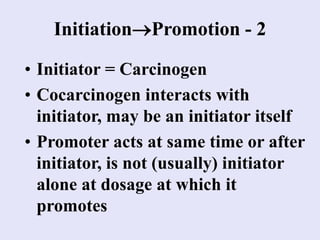
InitiationPromotion - 2
• Initiator = Carcinogen
• Cocarcinogen interacts with
initiator, may be an initiator itself
• Promoter acts at same time or after
initiator, is not (usually) initiator
alone at dosage at which it
promotes
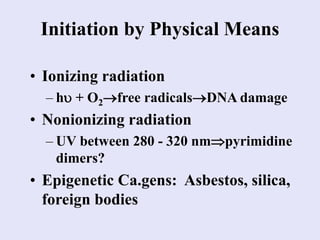
Initiation by Physical Means
• Ionizing radiation
– h + O2free radicalsDNA damage
• Nonionizing radiation
– UV between 280 - 320 nmpyrimidine
dimers?
• Epigenetic Ca.gens: Asbestos, silica,
foreign bodies
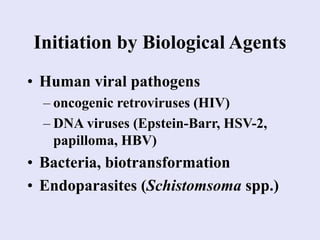
Initiation by Biological Agents
• Human viral pathogens
– oncogenic retroviruses (HIV)
– DNA viruses (Epstein-Barr, HSV-2,
papilloma, HBV)
• Bacteria, biotransformation
• Endoparasites (Schistomsoma spp.)
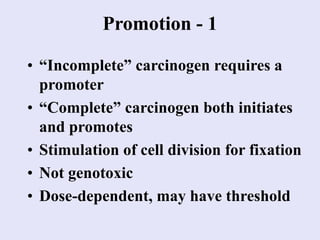
Promotion - 1
• “Incomplete” carcinogen requires a
promoter
• “Complete” carcinogen both initiates
and promotes
• Stimulation of cell division for fixation
• Not genotoxic
• Dose-dependent, may have threshold
Promotion - 2
• Promoters induce small foci of
“preneoplastic” proliferation where
transformed cells reside in tissues
• Selection pressure favours more
rapidly proliferating foci
• At high concentrations, cytotoxic
promoters may inhibit
carcinogenesis by negative selection
pressure on susceptible cells
Promoters - 3
• Promoters are mitogens, may be
endogenous as well as exogenous
– hormones (estrogen, prolactin, thyroxin)
• Exogenous promoters
– phorbol esters (experimental)
– phenobarbital
– foreign bodies
– aromatic hydrocarbons (also initiators)
– dioxin (most potent in animal studies)
Progression
• Proliferation of successful clone
• Adaptive growth
• Dormancy period in many cases,
ends for many reasons (hormonal,
nutritional, lymphokines,
immunodeficiency etc.)
• Tumour vascularization,
angiogenesis
• Develops into detectable tumour
Predisposing Factors - Genetic
• Metabolism, biotransformation
• Rare AuD cancers
– familial polyposis straight AuD)
– retinoblastoma (two hit model)
• Predisposition to initiation
• Inaccurate repair mechanisms
• Immunodeficiency
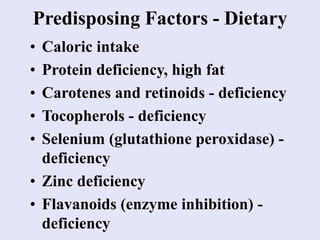
Predisposing Factors - Dietary
• Caloric intake
• Protein deficiency, high fat
• Carotenes and retinoids - deficiency
• Tocopherols - deficiency
• Selenium (glutathione peroxidase) -
deficiency
• Zinc deficiency
• Flavanoids (enzyme inhibition) -
deficiency

Noc.ppt

  • 1.
  • 2.
    Characteristics of aCancer • Uncontrolled growth – beyond normal hyperplasia in vivo – loss of cell-cell inhibition in vitro – anaplasia (highly variable) – apoptosis (normal cell death) defective • Tendency to invade surrounding tissue • Tendency to travel beyond site of origin – metastasis may occur late
  • 3.
    Early Theories ofCarcinogenesis • Surfeit of black bile (Hippocrates) • Omnis cellula ex cellula (Bichat, Pasteur) • Irritation hypothesis (Virchow) – medicolegal issues – persists as lay theory • Embryonic hypothesis (teratomas, etc.) • Parasitic hypothesis
  • 4.
    Recent Theories of Carcinogenesis •Chemical carcinogenesis – derived from observations by Pott, 1775 – major line of mechanistic oncology every since • Viral theory of carcinogenesis • Two-stage mechanism of Ca.genesis – two processes: initiation, promotion – followed by progression
  • 5.
    Steps in Chemical Carcinogenesis 1.Biotransformation 2. Initiation: Covalent binding to DNA 3. Fixation: Mutation stabilized by mitosis 4. Gene expression, transformation 5. Neoplastic growth, proliferation 6. Progression, local effects 7. Metastasis
  • 6.
    Initiation - 1 •Biotransformation: – procarcinogenultimate carcinogen • Interaction with macromolecules – silent binding to other receptors • covalent binding to critical DNA sites – repairnormal cell + DNA adducts – cytotoxicity – fixationinitiation
  • 7.
    Initiation - 2 •Induced transcription errors • DNA polymerase • Binding to oncogenes – regions of genome that code for cell growth and differentiation – may result in cell transformation • Binding to tumour suppressor genes – apoptosis
  • 8.
    Oncogenes - 1 •Oncogenes are activated, unregulated versions of protooncogenes • Protooncogenes normal genes encoding for protein kinase and other growth signals • Their gene products stimulate cell growth • Viral oncogenes are altered copies of protooncogenes • 20% of human tumours show oncogenes
  • 9.
    Oncogenes - 2 •Single copies of oncogenes are sufficient to result in malignant transformation • Oncogene products are convenient biomarkers of effect • Thought by some to be underlying mechanism (distinct from cause) of all Ca
  • 10.
    Tumour Suppressor Genes •Genes that block neoplastic growth, e.g. p53 • Functional opposites of oncogenes, hence originally named anti-oncogenes • Very difficult to identify and characterize • Characteristic double allelic activity: – both alleles must be damaged for malignant activity – retinoblastoma follows “two hit” model
  • 11.
    InitiationPromotion - 1 •Cell affected by Ca.gen must replicate for Ca to occur • Cell division fixes the mutation in daughter cells • Promoters induce rapid tissue growth – irritation or necrosis – hyperplasia and stimulate growth • Fixation occurs when mutation is passed on
  • 12.
    InitiationPromotion - 2 •Initiator = Carcinogen • Cocarcinogen interacts with initiator, may be an initiator itself • Promoter acts at same time or after initiator, is not (usually) initiator alone at dosage at which it promotes
  • 13.
    Initiation by PhysicalMeans • Ionizing radiation – h + O2free radicalsDNA damage • Nonionizing radiation – UV between 280 - 320 nmpyrimidine dimers? • Epigenetic Ca.gens: Asbestos, silica, foreign bodies
  • 14.
    Initiation by BiologicalAgents • Human viral pathogens – oncogenic retroviruses (HIV) – DNA viruses (Epstein-Barr, HSV-2, papilloma, HBV) • Bacteria, biotransformation • Endoparasites (Schistomsoma spp.)
  • 15.
    Promotion - 1 •“Incomplete” carcinogen requires a promoter • “Complete” carcinogen both initiates and promotes • Stimulation of cell division for fixation • Not genotoxic • Dose-dependent, may have threshold
  • 16.
    Promotion - 2 •Promoters induce small foci of “preneoplastic” proliferation where transformed cells reside in tissues • Selection pressure favours more rapidly proliferating foci • At high concentrations, cytotoxic promoters may inhibit carcinogenesis by negative selection pressure on susceptible cells
  • 17.
    Promoters - 3 •Promoters are mitogens, may be endogenous as well as exogenous – hormones (estrogen, prolactin, thyroxin) • Exogenous promoters – phorbol esters (experimental) – phenobarbital – foreign bodies – aromatic hydrocarbons (also initiators) – dioxin (most potent in animal studies)
  • 18.
    Progression • Proliferation ofsuccessful clone • Adaptive growth • Dormancy period in many cases, ends for many reasons (hormonal, nutritional, lymphokines, immunodeficiency etc.) • Tumour vascularization, angiogenesis • Develops into detectable tumour
  • 19.
    Predisposing Factors -Genetic • Metabolism, biotransformation • Rare AuD cancers – familial polyposis straight AuD) – retinoblastoma (two hit model) • Predisposition to initiation • Inaccurate repair mechanisms • Immunodeficiency
  • 20.
    Predisposing Factors -Dietary • Caloric intake • Protein deficiency, high fat • Carotenes and retinoids - deficiency • Tocopherols - deficiency • Selenium (glutathione peroxidase) - deficiency • Zinc deficiency • Flavanoids (enzyme inhibition) - deficiency