GEOL 325:  Stratigraphy & Sedimentary Basins University of South Carolina Spring 2005 Professor Chris Kendall EWS 304  kendall@sc.edu  777.2410 An Overview of Carbonates
Precipitated Sediments & Sedimentary Rocks An Epitaph to Limestones & Dolomites
Lecture Series Overview sediment production types of sediment and sedimentary rocks sediment transport and deposition depositional systems stratigraphic architecture and basins chrono-, bio-, chemo-, and sequence stratigraphy Earth history
Sedimentary rocks are the product of the creation, transport, deposition, and diagenesis of detritus and solutes derived from pre-existing rocks.
Sedimentary rocks are the product of the creation, transport, deposition, and diagenesis of detritus and  solutes  derived from pre-existing rocks.
Sedimentary Rocks Detrital/Siliciclastic Sedimentary Rocks conglomerates & breccias sandstones mudstones Carbonate Sedimentary Rocks carbonates Other Sedimentary Rocks evaporites phosphates organic-rich sedimentary rocks cherts volcaniclastic rocks
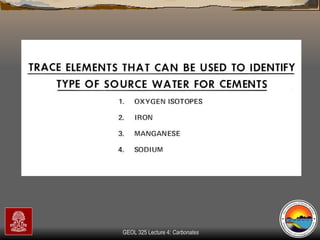
Lecture Outline How photosynthesis, warm temperatures & low pressures in shallow water control carbonate distribution  How carbonate sediment types is tied to depositional setting How most mud lime mud has a bio-physico-chemical origin Origins of bio-physico-chemical grains:- ooids, intraclasts, pellets, pisoids Separation of bioclastic grains:- foram’s, brach’s, bryozoan, echinoids, red calc’ algae, corals, green calc’ algae, and molluscs by mineralogy & fabric How CCD controls deepwater carbonate ooze distribution How Folk & Dunham’s classifications are used for carbonate sediments How most diagenesis, dolomitization, & cementation of carbonates takes place in near surface & trace elements are used in this determination  How Stylolites develop through burial & solution/compaction
 
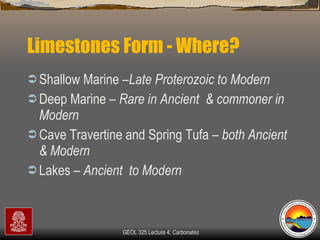
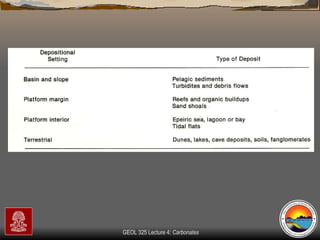
Limestones Form - Where? Shallow Marine – Late Proterozoic to Modern Deep Marine –  Rare in Ancient  & commoner in Modern Cave Travertine and Spring Tufa –  both Ancient  & Modern Lakes –  Ancient  to Modern
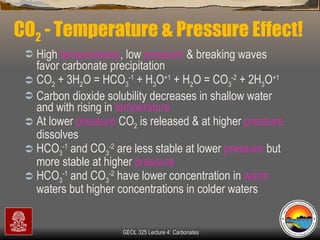
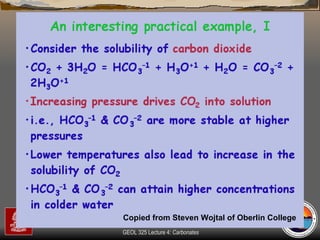
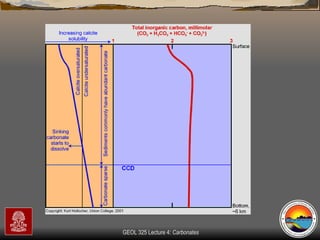
CO 2  - Temperature & Pressure Effect! High  temperatures , low  pressure  & breaking waves favor carbonate precipitation  CO 2  + 3H 2 O = HCO 3 -1  + H 3 O +1  + H 2 O = CO 3 -2  + 2H 3 O +1 Carbon dioxide solubility decreases in shallow water and with rising in  temperature At lower  pressure  CO 2  is released & at higher  pressure  dissolves  HCO 3 -1  and CO 3 -2  are less stable at lower  pressure  but more stable at higher  pressure   HCO 3 -1  and CO 3 -2  have lower concentration in  warm  waters but higher concentrations in colder waters
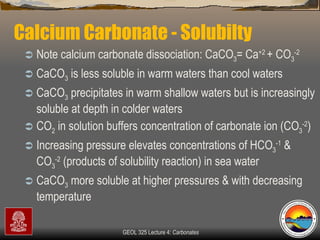
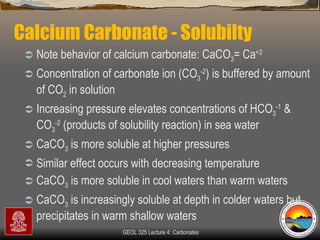
Calcium Carbonate - Solubilty  Note calcium carbonate dissociation: CaCO 3 = Ca +2  + CO 3 -2   CaCO 3  is less soluble in warm waters than cool waters CaCO 3  precipitates in warm shallow waters but is increasingly soluble at depth in colder waters CO 2  in solution buffers concentration of carbonate ion (CO 3 -2 )  Increasing pressure elevates concentrations of HCO 3 -1  & CO 3 -2  (products of solubility reaction) in sea water CaCO 3  more soluble at higher pressures & with decreasing temperature
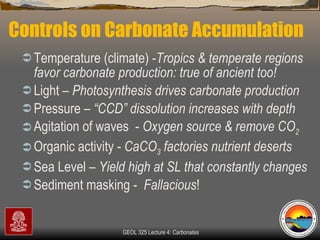
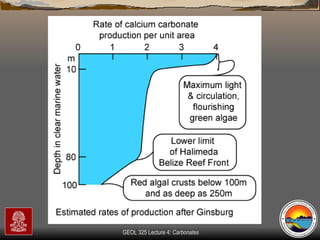
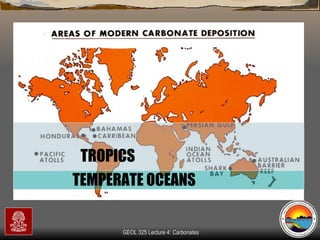
Controls on Carbonate Accumulation Temperature (climate) - Tropics & temperate regions favor carbonate production: true of ancient too! Light –  Photosynthesis drives carbonate production Pressure –  “CCD” dissolution increases with depth Agitation of waves  -  Oxygen source & remove CO 2 Organic activity -  CaCO 3  factories nutrient deserts Sea Level –  Yield high at SL that constantly changes Sediment masking -  Fallacious !
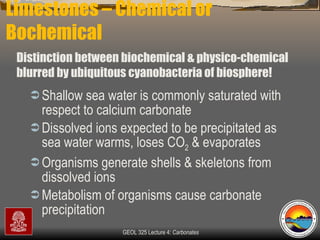
Limestones – Chemical or Bochemical Shallow sea water is commonly saturated with respect to calcium carbonate Dissolved ions expected to be precipitated as sea water warms, loses CO 2  & evaporates Organisms generate shells & skeletons from dissolved ions Metabolism of organisms cause carbonate precipitation  Distinction between biochemical & physico-chemical blurred by ubiquitous cyanobacteria of biosphere!


Biological Carbon Pump  Carbon from CO 2  incorporated in organisms through photosynthesis, heterotrophy & secretion of shells  > 99% of atmospheric CO 2  from volcanism removed by biological pump is deposited as calcium carbonate & organic matter  5.3 gigatons of CO 2  added to atmosphere a year but only 2.1 gigatons/year remains; the rest is believed sequestered as aragonite & calcite
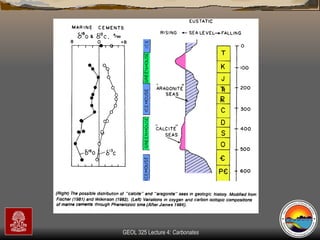
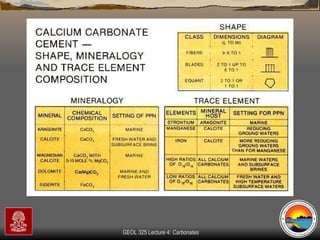
Carbonate Mineralogy Aragonite – high temperature mineral Calcite – stable in sea water & near surface crust Low Magnesium Calcite High Magnesium Calcite  Imperforate foraminifera Echinoidea  Dolomite – stable in sea water & near surface Carbonate mineralogy of oceans changes with time!
 
TROPICS TEMPERATE OCEANS
 
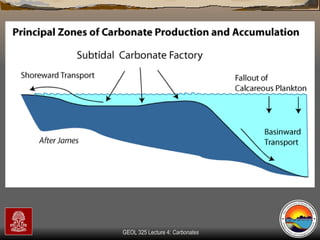
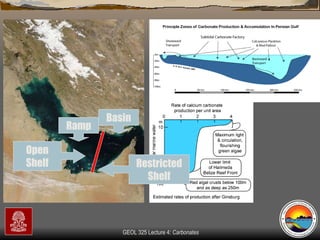
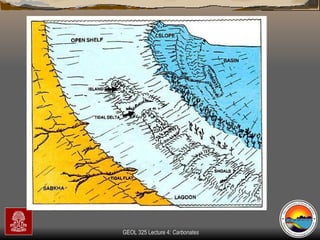
Basin Ramp Restricted Shelf Open Shelf
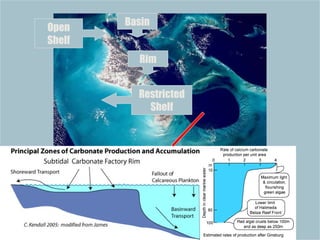
Basin Rim Restricted Shelf Open Shelf
Carbonate Components – The Key Interpretation of depositional setting of carbonates is based on  Grain types Grain packing or fabric Sedimentary structures Early diagenetic changes  Identification of grain types commonly used in subsurface studies of depositional setting because, unlike particles in siliciclastic rocks, carbonate grains generally formed within basin of deposition NB : This rule of thumb doesn’t always apply
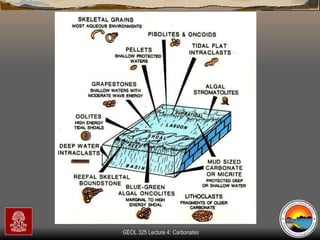
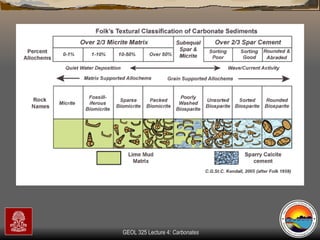
Carbonate Particles Subdivided into micrite (lime mud) & sand-sized grains These grains are separated on basis of shape & internal structure  They are subdivided into: skeletal & non-skeletal (bio-physico-chemical grains)
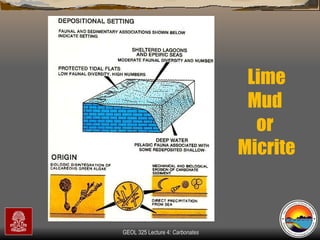
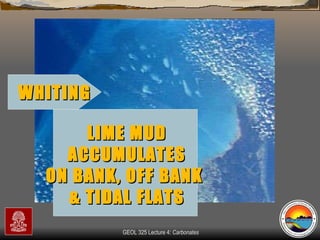
Lime Mud or Micrite
Lime Mud  or  Micrite
WHITING LIME MUD ACCUMULATES ON BANK, OFF BANK  & TIDAL FLATS
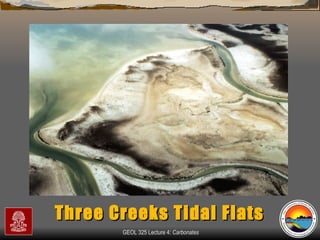
Three Creeks Tidal Flats
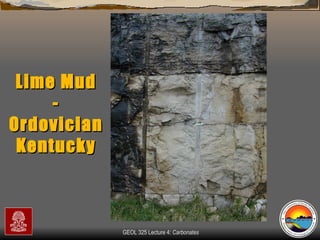
Lime Mud - Ordovician Kentucky
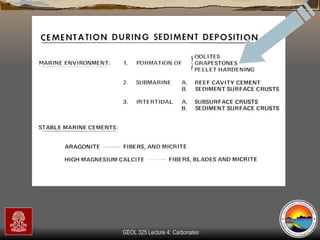
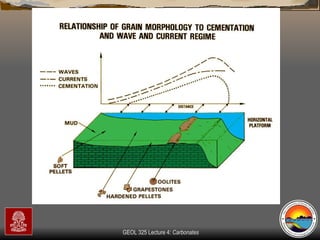
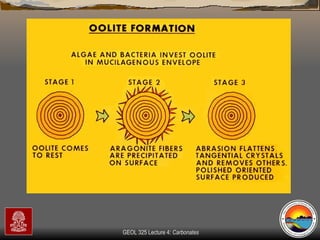
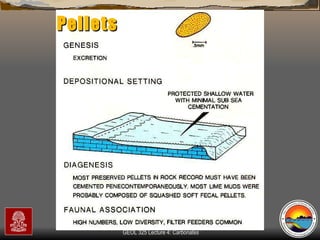
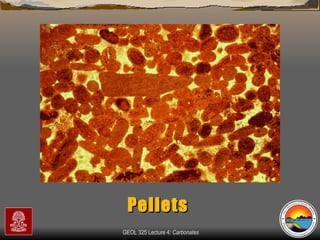
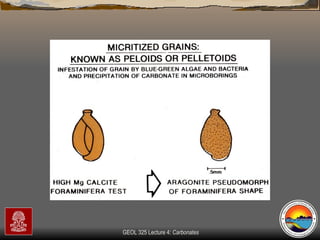
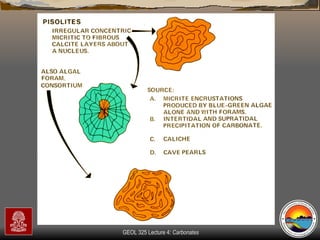
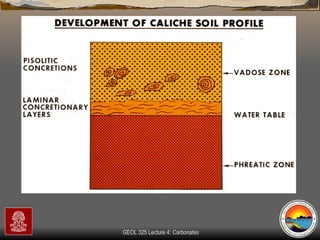
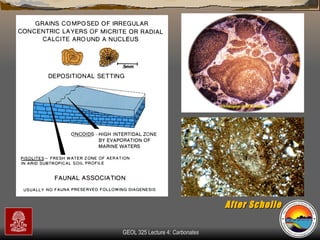
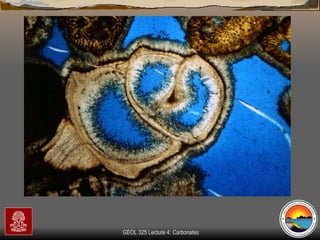
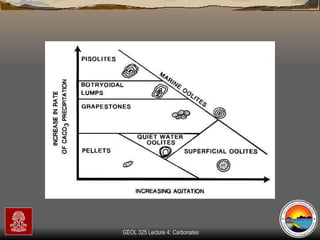
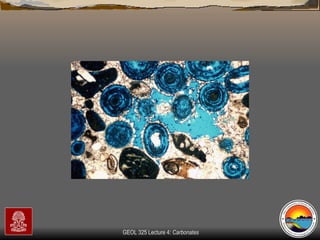
Carbonate Bio-physico-chemical Grains Ooids Grapestones and other intraclasts Pellets Pisolites and Oncolites


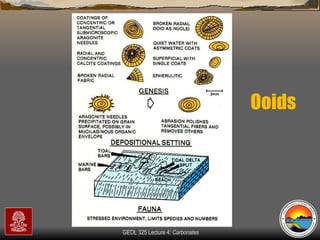
Ooids
 
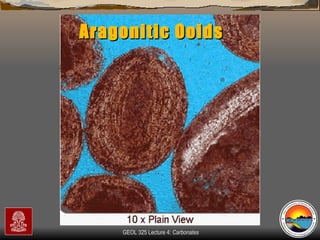
Aragonitic Ooids
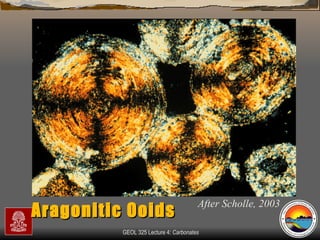
After Scholle, 2003 Aragonitic Ooids
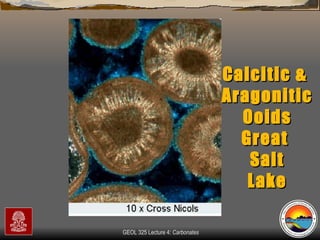
Calcitic &  Aragonitic Ooids Great  Salt Lake
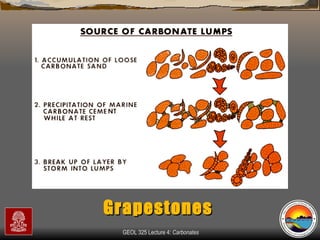
Grapestones
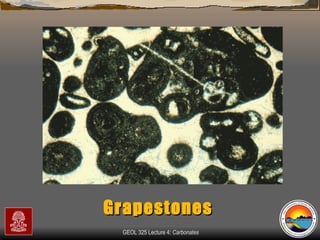
Grapestones
Pellets
Pellets


After Scholle
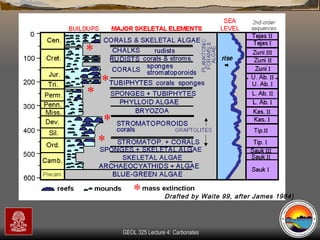
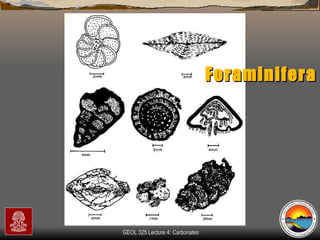
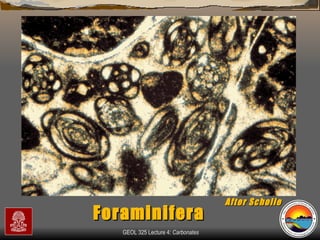
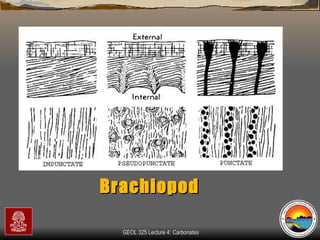
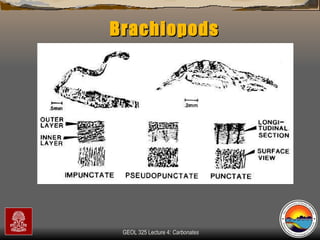
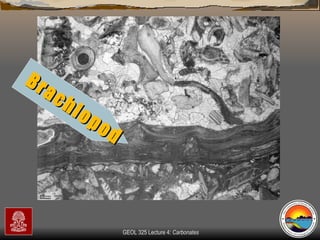
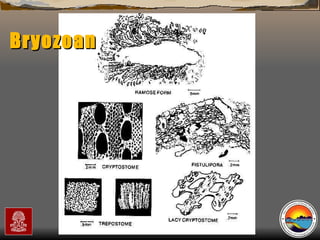
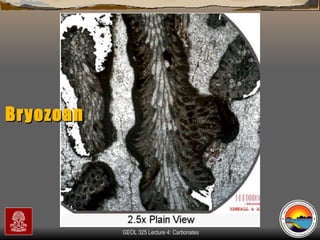
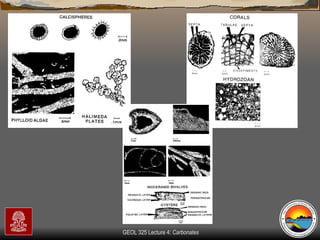
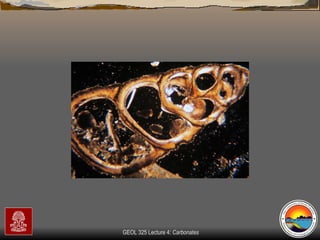
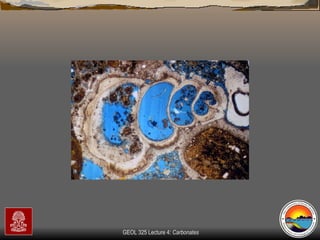
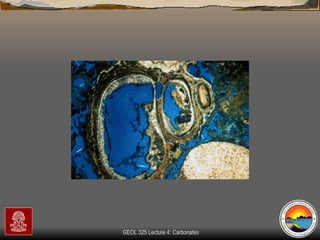
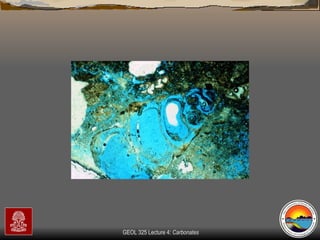
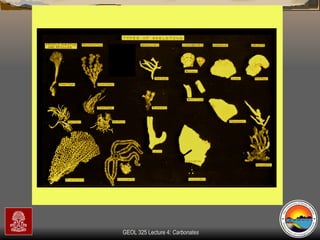
Skeletal Particles - Mineralogy Calcite commonly containing less than 4 mole % magnesium  Some foraminifera, brachiopods, bryozoans, trilobites, ostracodes, calcareous nannoplankton, & tintinnids  Magnesian calcite, with 4-20 mole % magnesium Echinoderms, most foraminifera, & red algae Aragonite tests Corals, stromatoporoids, most molluscs, green algae, & blue-green algae. Opaline silica  sponge spicules & radiolarians
Drafted by Waite 99, after James 1984)
Foraminifera
After Scholle Foraminifera
Brachiopod
Brachiopods
Brachiopod
Bryozoan
Bryozoan
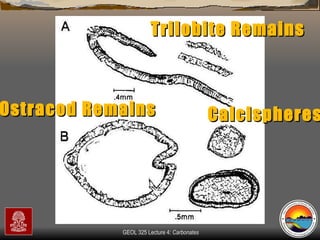
Trilobite Remains Ostracod Remains Calcispheres
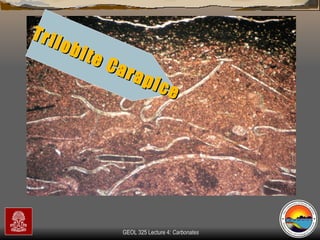
Trilobite Carapice
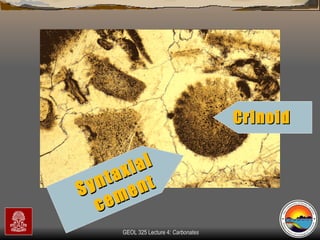
Syntaxial  cement Crinoid
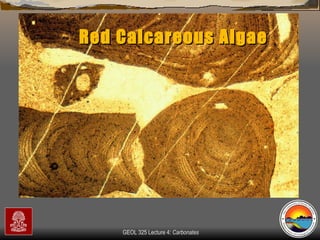
Red Calcareous Algae
 
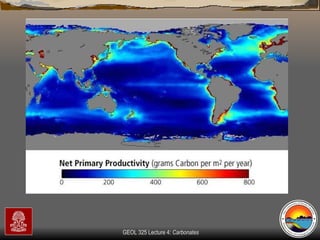
Surface Water Organic Productivity  Marine algae & cyanobacteria base of marine food chain  Fed by available nitrogen and phosphorus Supplied in surface waters by deep water upwelling Vertical upwelling drives high biological productivity at: Equator Western continental margins  Southern Ocean around Antarctica Produce biogenous oozes
 
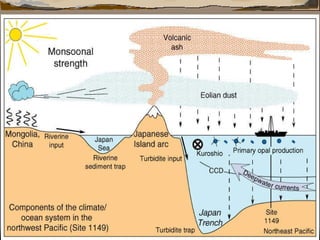
Deep Water Carbonate Deposits Deep water pelagic sediments accumulate slowly (0.1-1 cm per thousand years) far from land, and include:  abyssal clay from continents cover most of deeper ocean floor carried by winds  ocean currents  Oozes from organisms' bodies; not present on continental margins where rate of supply of terriginous sediment too high & organically derived material less than 30% of sediment
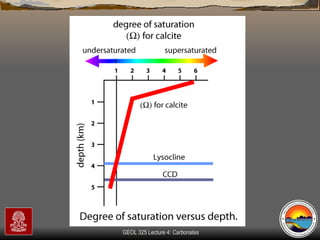
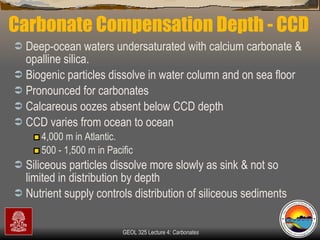
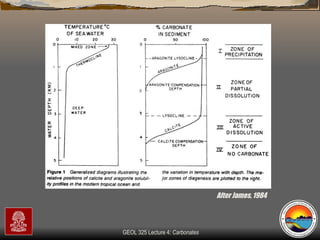
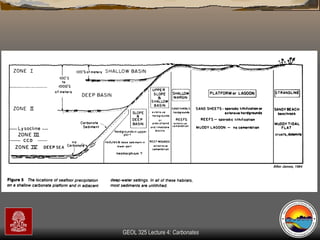
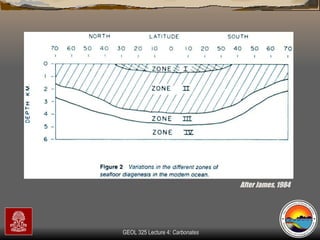
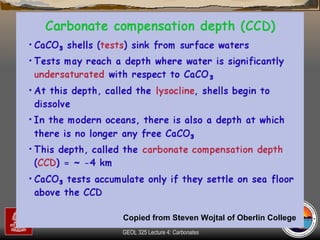
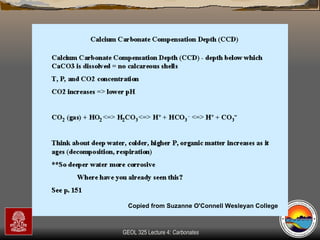
Carbonate Compensation Depth - CCD Deep-ocean waters undersaturated with calcium carbonate & opalline silica.  Biogenic particles dissolve in water column and on sea floor Pronounced for carbonates  Calcareous oozes absent below CCD depth CCD varies from ocean to ocean 4,000 m in Atlantic.  500 - 1,500 m in Pacific Siliceous particles dissolve more slowly as sink & not so limited in distribution by depth Nutrient supply controls distribution of siliceous sediments
After James, 1984
 
After James, 1984


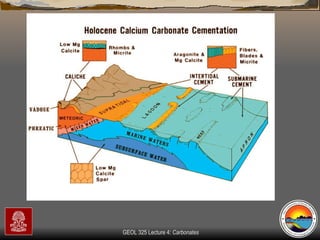
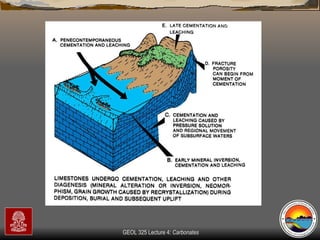
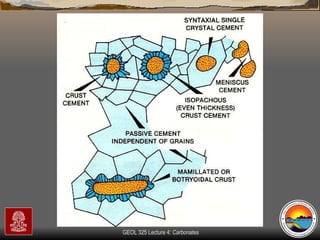
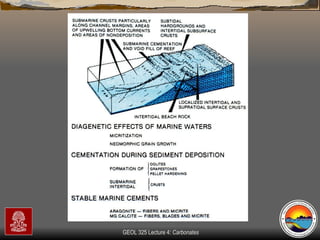
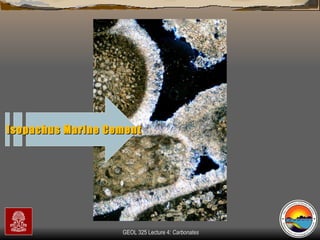
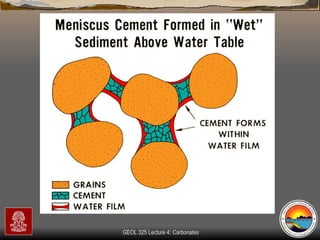
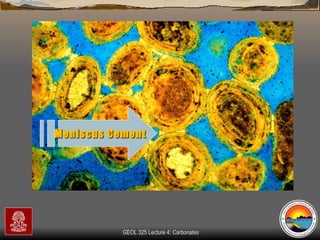
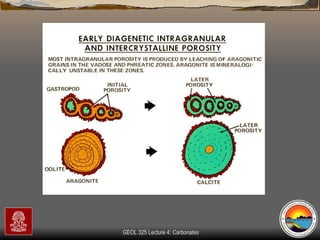
Carbonate Cement Fabrics  Crust or rims coat grains  Syntaxial overgrowth – optical continuity with skeletal fabric Echinoid single crystals Brachiopod multiple crystals Blocky equant - final void fill


Isopachus Marine Cement
 
Meniscus Cement


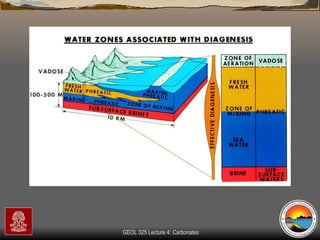
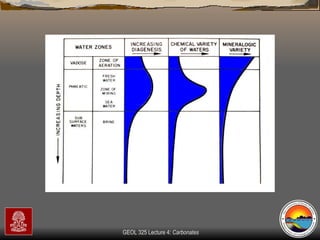
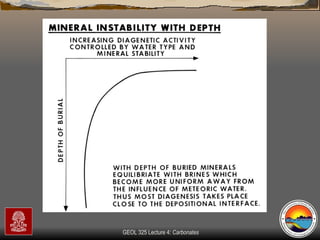
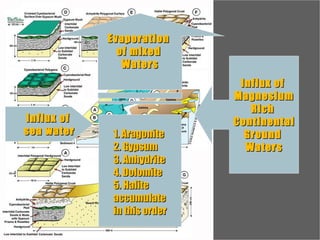
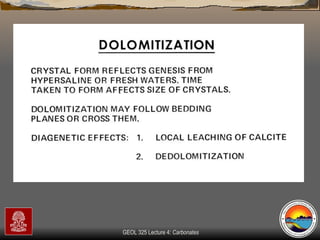
Influx of  Magnesium Rich  Continental Ground  Waters Influx of  sea water Evaporation  of mixed  Waters 1. Aragonite 2. Gypsum 3. Anhydrite 4. Dolomite 5. Halite accumulate in this order


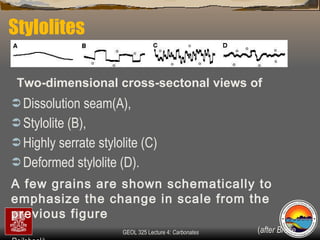
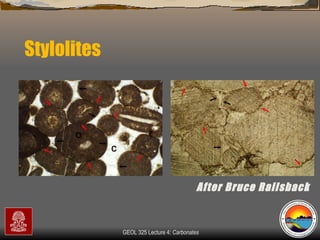
Stylolites Dissolution seam(A), Stylolite (B),  Highly serrate stylolite (C) Deformed stylolite (D).  A few grains are shown schematically to emphasize the change in scale from the previous figure ( after Bruce Railsback ) Two-dimensional cross-sectonal views of
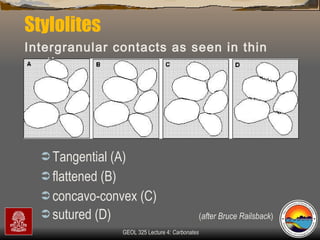
Stylolites Tangential (A) flattened (B) concavo-convex (C) sutured (D)  ( after Bruce Railsback ) Intergranular contacts as seen in thin section
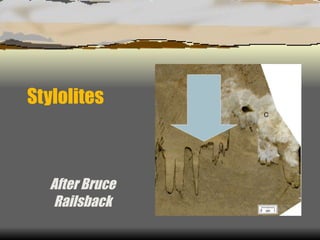
Stylolites After Bruce Railsback
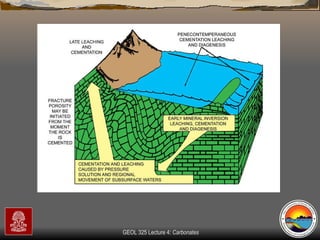
Lecture Conclusions Photosynthesis, warm temperatures & low pressures in shallow water control carbonate distribution  Carbonate sediment types indicate depositional setting Most mud lime mud has a bio-physico-chemical origin Ooid, intraclast, pellet, and pisoid grains have bio-physico-chemical origin Mineralogy & fabric separate foram’s, brach’s, bryozoan, echinoids, red calc’ algae, corals, green calc’ algae, and molluscan skeleletal grains CCD controls deepwater ooze distribution Folk & Dunham are best way to classify carbonates Most diagenesis, dolomitization, & cementation of carbonates takes place in near surface crust  & trace elements can be used in this determination  Stylolites develop through burial & solution/compaction
End of the Lecture Lets go for lunch!!!
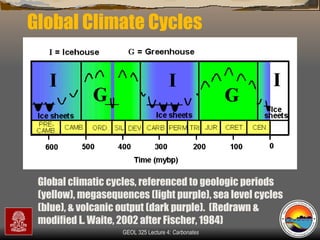
Global Climate Cycles Global climatic cycles, referenced to geologic periods (yellow), megasequences (light purple), sea level cycles (blue), & volcanic output (dark purple).  (Redrawn & modified L. Waite, 2002 after Fischer, 1984)
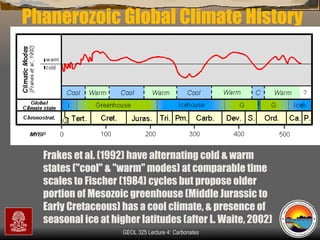
Frakes et al. (1992) have alternating cold & warm states ("cool" & "warm" modes) at comparable time scales to Fischer (1984) cycles but propose older portion of Mesozoic greenhouse (Middle Jurassic to Early Cretaceous) has a cool climate, & presence of seasonal ice at higher latitudes (after L. Waite, 2002) Phanerozoic Global Climate History
Copied from Steven Wojtal of Oberlin College
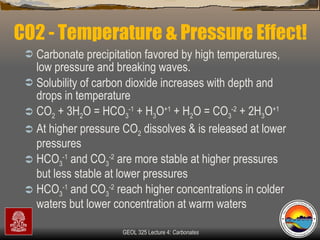
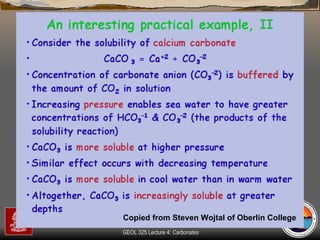
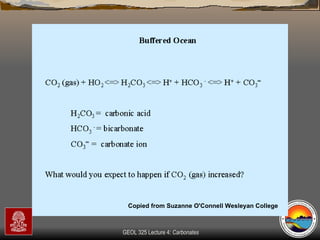
CO2 - Temperature & Pressure Effect! Carbonate precipitation favored by high temperatures, low pressure and breaking waves. Solubility of carbon dioxide increases with depth and drops in temperature CO 2  + 3H 2 O = HCO 3 -1  + H 3 O +1  + H 2 O = CO 3 -2  + 2H 3 O +1 At higher pressure CO 2  dissolves & is released at lower pressures HCO 3 -1  and CO 3 -2  are more stable at higher pressures but less stable at lower pressures HCO 3 -1  and CO 3 -2  reach higher concentrations in colder waters but lower concentration at warm waters
Copied from Steven Wojtal of Oberlin College
Calcium Carbonate - Solubilty  Note behavior of calcium carbonate: CaCO 3 = Ca +2 Concentration of carbonate ion (CO 3 -2 ) is buffered by amount of CO 2  in solution  Increasing pressure elevates concentrations of HCO 3 -1  & CO 3 -2  (products of solubility reaction) in sea water CaCO 3  is more soluble at higher pressures Similar effect occurs with decreasing temperature CaCO 3  is more soluble in cool waters than warm waters CaCO 3  is increasingly soluble at depth in colder waters but precipitates in warm shallow waters
Copied from Steven Wojtal of Oberlin College
Copied from Suzanne O'Connell   Wesleyan College


Carbonates overview

  • 1.
    GEOL 325: Stratigraphy & Sedimentary Basins University of South Carolina Spring 2005 Professor Chris Kendall EWS 304 kendall@sc.edu 777.2410 An Overview of Carbonates
  • 2.
    Precipitated Sediments &Sedimentary Rocks An Epitaph to Limestones & Dolomites
  • 3.
    Lecture Series Overviewsediment production types of sediment and sedimentary rocks sediment transport and deposition depositional systems stratigraphic architecture and basins chrono-, bio-, chemo-, and sequence stratigraphy Earth history
  • 4.
    Sedimentary rocks arethe product of the creation, transport, deposition, and diagenesis of detritus and solutes derived from pre-existing rocks.
  • 5.
    Sedimentary rocks arethe product of the creation, transport, deposition, and diagenesis of detritus and solutes derived from pre-existing rocks.
  • 6.
    Sedimentary Rocks Detrital/SiliciclasticSedimentary Rocks conglomerates & breccias sandstones mudstones Carbonate Sedimentary Rocks carbonates Other Sedimentary Rocks evaporites phosphates organic-rich sedimentary rocks cherts volcaniclastic rocks
  • 7.
    Lecture Outline Howphotosynthesis, warm temperatures & low pressures in shallow water control carbonate distribution How carbonate sediment types is tied to depositional setting How most mud lime mud has a bio-physico-chemical origin Origins of bio-physico-chemical grains:- ooids, intraclasts, pellets, pisoids Separation of bioclastic grains:- foram’s, brach’s, bryozoan, echinoids, red calc’ algae, corals, green calc’ algae, and molluscs by mineralogy & fabric How CCD controls deepwater carbonate ooze distribution How Folk & Dunham’s classifications are used for carbonate sediments How most diagenesis, dolomitization, & cementation of carbonates takes place in near surface & trace elements are used in this determination How Stylolites develop through burial & solution/compaction
  • 8.
  • 9.
    Limestones Form -Where? Shallow Marine – Late Proterozoic to Modern Deep Marine – Rare in Ancient & commoner in Modern Cave Travertine and Spring Tufa – both Ancient & Modern Lakes – Ancient to Modern
  • 10.
    CO 2 - Temperature & Pressure Effect! High temperatures , low pressure & breaking waves favor carbonate precipitation CO 2 + 3H 2 O = HCO 3 -1 + H 3 O +1 + H 2 O = CO 3 -2 + 2H 3 O +1 Carbon dioxide solubility decreases in shallow water and with rising in temperature At lower pressure CO 2 is released & at higher pressure dissolves HCO 3 -1 and CO 3 -2 are less stable at lower pressure but more stable at higher pressure HCO 3 -1 and CO 3 -2 have lower concentration in warm waters but higher concentrations in colder waters
  • 11.
    Calcium Carbonate -Solubilty Note calcium carbonate dissociation: CaCO 3 = Ca +2 + CO 3 -2 CaCO 3 is less soluble in warm waters than cool waters CaCO 3 precipitates in warm shallow waters but is increasingly soluble at depth in colder waters CO 2 in solution buffers concentration of carbonate ion (CO 3 -2 ) Increasing pressure elevates concentrations of HCO 3 -1 & CO 3 -2 (products of solubility reaction) in sea water CaCO 3 more soluble at higher pressures & with decreasing temperature
  • 12.
    Controls on CarbonateAccumulation Temperature (climate) - Tropics & temperate regions favor carbonate production: true of ancient too! Light – Photosynthesis drives carbonate production Pressure – “CCD” dissolution increases with depth Agitation of waves - Oxygen source & remove CO 2 Organic activity - CaCO 3 factories nutrient deserts Sea Level – Yield high at SL that constantly changes Sediment masking - Fallacious !
  • 13.
    Limestones – Chemicalor Bochemical Shallow sea water is commonly saturated with respect to calcium carbonate Dissolved ions expected to be precipitated as sea water warms, loses CO 2 & evaporates Organisms generate shells & skeletons from dissolved ions Metabolism of organisms cause carbonate precipitation Distinction between biochemical & physico-chemical blurred by ubiquitous cyanobacteria of biosphere!
  • 14.
  • 15.
  • 16.
  • 17.
    Biological Carbon Pump Carbon from CO 2 incorporated in organisms through photosynthesis, heterotrophy & secretion of shells > 99% of atmospheric CO 2 from volcanism removed by biological pump is deposited as calcium carbonate & organic matter 5.3 gigatons of CO 2 added to atmosphere a year but only 2.1 gigatons/year remains; the rest is believed sequestered as aragonite & calcite
  • 18.
    Carbonate Mineralogy Aragonite– high temperature mineral Calcite – stable in sea water & near surface crust Low Magnesium Calcite High Magnesium Calcite Imperforate foraminifera Echinoidea Dolomite – stable in sea water & near surface Carbonate mineralogy of oceans changes with time!
  • 19.
  • 20.
  • 21.
  • 22.
    Basin Ramp RestrictedShelf Open Shelf
  • 23.
    Basin Rim RestrictedShelf Open Shelf
  • 24.
    Carbonate Components –The Key Interpretation of depositional setting of carbonates is based on Grain types Grain packing or fabric Sedimentary structures Early diagenetic changes Identification of grain types commonly used in subsurface studies of depositional setting because, unlike particles in siliciclastic rocks, carbonate grains generally formed within basin of deposition NB : This rule of thumb doesn’t always apply
  • 25.
    Carbonate Particles Subdividedinto micrite (lime mud) & sand-sized grains These grains are separated on basis of shape & internal structure They are subdivided into: skeletal & non-skeletal (bio-physico-chemical grains)
  • 26.
    Lime Mud orMicrite
  • 27.
    Lime Mud or Micrite
  • 28.
    WHITING LIME MUDACCUMULATES ON BANK, OFF BANK & TIDAL FLATS
  • 29.
  • 30.
    Lime Mud -Ordovician Kentucky
  • 31.
    Carbonate Bio-physico-chemical GrainsOoids Grapestones and other intraclasts Pellets Pisolites and Oncolites
  • 32.
  • 33.
  • 34.
  • 35.
  • 36.
  • 37.
  • 38.
    After Scholle, 2003Aragonitic Ooids
  • 39.
    Calcitic & Aragonitic Ooids Great Salt Lake
  • 40.
  • 41.
  • 42.
  • 43.
  • 44.
  • 45.
  • 46.
  • 47.
  • 48.
  • 49.
    Skeletal Particles -Mineralogy Calcite commonly containing less than 4 mole % magnesium Some foraminifera, brachiopods, bryozoans, trilobites, ostracodes, calcareous nannoplankton, & tintinnids Magnesian calcite, with 4-20 mole % magnesium Echinoderms, most foraminifera, & red algae Aragonite tests Corals, stromatoporoids, most molluscs, green algae, & blue-green algae. Opaline silica sponge spicules & radiolarians
  • 50.
    Drafted by Waite99, after James 1984)
  • 51.
  • 52.
  • 53.
  • 54.
  • 55.
  • 56.
  • 57.
  • 58.
    Trilobite Remains OstracodRemains Calcispheres
  • 59.
  • 60.
  • 61.
  • 62.
  • 63.
    Surface Water OrganicProductivity Marine algae & cyanobacteria base of marine food chain Fed by available nitrogen and phosphorus Supplied in surface waters by deep water upwelling Vertical upwelling drives high biological productivity at: Equator Western continental margins Southern Ocean around Antarctica Produce biogenous oozes
  • 64.
  • 65.
    Deep Water CarbonateDeposits Deep water pelagic sediments accumulate slowly (0.1-1 cm per thousand years) far from land, and include: abyssal clay from continents cover most of deeper ocean floor carried by winds ocean currents Oozes from organisms' bodies; not present on continental margins where rate of supply of terriginous sediment too high & organically derived material less than 30% of sediment
  • 66.
    Carbonate Compensation Depth- CCD Deep-ocean waters undersaturated with calcium carbonate & opalline silica. Biogenic particles dissolve in water column and on sea floor Pronounced for carbonates Calcareous oozes absent below CCD depth CCD varies from ocean to ocean 4,000 m in Atlantic. 500 - 1,500 m in Pacific Siliceous particles dissolve more slowly as sink & not so limited in distribution by depth Nutrient supply controls distribution of siliceous sediments
  • 67.
  • 68.
  • 69.
  • 70.
  • 71.
  • 72.
  • 73.
  • 74.
  • 75.
  • 76.
  • 77.
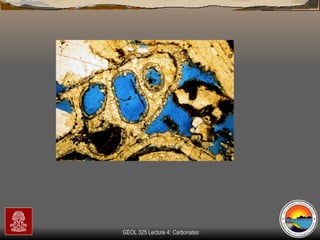
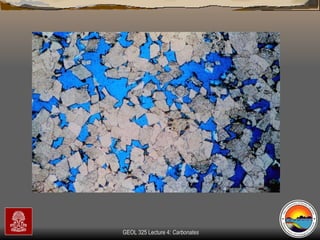
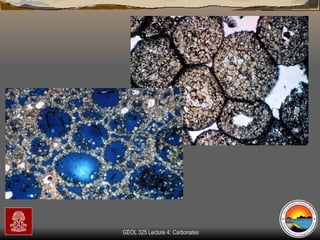
    Carbonate Cement Fabrics Crust or rims coat grains Syntaxial overgrowth – optical continuity with skeletal fabric Echinoid single crystals Brachiopod multiple crystals Blocky equant - final void fill
  • 78.
  • 79.
  • 80.
  • 81.
  • 82.
  • 83.
  • 84.
  • 85.
  • 86.
  • 87.
  • 88.
  • 89.
  • 90.
  • 91.
  • 92.
  • 93.
  • 94.
  • 95.
  • 96.
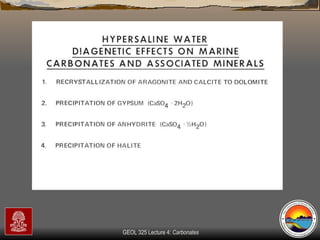
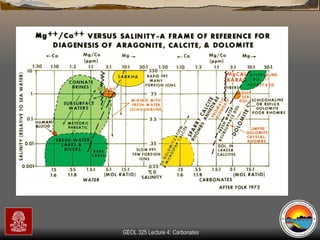
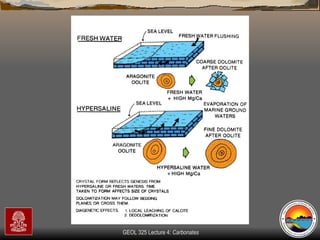
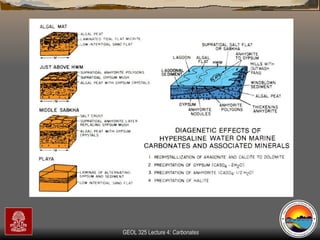
    Influx of Magnesium Rich Continental Ground Waters Influx of sea water Evaporation of mixed Waters 1. Aragonite 2. Gypsum 3. Anhydrite 4. Dolomite 5. Halite accumulate in this order
  • 97.
  • 98.
  • 99.
  • 100.
  • 101.
  • 102.
  • 103.
  • 104.
  • 105.
  • 106.
  • 107.
    Stylolites Dissolution seam(A),Stylolite (B), Highly serrate stylolite (C) Deformed stylolite (D). A few grains are shown schematically to emphasize the change in scale from the previous figure ( after Bruce Railsback ) Two-dimensional cross-sectonal views of
  • 108.
    Stylolites Tangential (A)flattened (B) concavo-convex (C) sutured (D) ( after Bruce Railsback ) Intergranular contacts as seen in thin section
  • 109.
  • 110.
  • 111.
    Lecture Conclusions Photosynthesis,warm temperatures & low pressures in shallow water control carbonate distribution Carbonate sediment types indicate depositional setting Most mud lime mud has a bio-physico-chemical origin Ooid, intraclast, pellet, and pisoid grains have bio-physico-chemical origin Mineralogy & fabric separate foram’s, brach’s, bryozoan, echinoids, red calc’ algae, corals, green calc’ algae, and molluscan skeleletal grains CCD controls deepwater ooze distribution Folk & Dunham are best way to classify carbonates Most diagenesis, dolomitization, & cementation of carbonates takes place in near surface crust & trace elements can be used in this determination Stylolites develop through burial & solution/compaction
  • 112.
    End of theLecture Lets go for lunch!!!
  • 113.
    Global Climate CyclesGlobal climatic cycles, referenced to geologic periods (yellow), megasequences (light purple), sea level cycles (blue), & volcanic output (dark purple).  (Redrawn & modified L. Waite, 2002 after Fischer, 1984)
  • 114.
    Frakes et al.(1992) have alternating cold & warm states ("cool" & "warm" modes) at comparable time scales to Fischer (1984) cycles but propose older portion of Mesozoic greenhouse (Middle Jurassic to Early Cretaceous) has a cool climate, & presence of seasonal ice at higher latitudes (after L. Waite, 2002) Phanerozoic Global Climate History
  • 115.
    Copied from StevenWojtal of Oberlin College
  • 116.
    CO2 - Temperature& Pressure Effect! Carbonate precipitation favored by high temperatures, low pressure and breaking waves. Solubility of carbon dioxide increases with depth and drops in temperature CO 2 + 3H 2 O = HCO 3 -1 + H 3 O +1 + H 2 O = CO 3 -2 + 2H 3 O +1 At higher pressure CO 2 dissolves & is released at lower pressures HCO 3 -1 and CO 3 -2 are more stable at higher pressures but less stable at lower pressures HCO 3 -1 and CO 3 -2 reach higher concentrations in colder waters but lower concentration at warm waters
  • 117.
    Copied from StevenWojtal of Oberlin College
  • 118.
    Calcium Carbonate -Solubilty Note behavior of calcium carbonate: CaCO 3 = Ca +2 Concentration of carbonate ion (CO 3 -2 ) is buffered by amount of CO 2 in solution Increasing pressure elevates concentrations of HCO 3 -1 & CO 3 -2 (products of solubility reaction) in sea water CaCO 3 is more soluble at higher pressures Similar effect occurs with decreasing temperature CaCO 3 is more soluble in cool waters than warm waters CaCO 3 is increasingly soluble at depth in colder waters but precipitates in warm shallow waters
  • 119.
    Copied from StevenWojtal of Oberlin College
  • 120.
    Copied from SuzanneO'Connell Wesleyan College
  • 121.
    Copied from SuzanneO'Connell Wesleyan College
  • 122.
  • 123.
  • 124.
  • 125.
  • 126.
  • 127.
  • 128.