CHAPTER 5: MarineCHAPTER 5: Marine
SedimentsSediments
Marine sedimentsMarine sediments
 Eroded rock particles and fragmentsEroded rock particles and fragments
 Transported to or produced in the oceanTransported to or produced in the ocean
 Deposit by settling through water columnDeposit by settling through water column
 Oceanographers decipher Earth historyOceanographers decipher Earth history
through studying sedimentsthrough studying sediments
S
Classification of marineClassification of marine
sedimentssediments
 Classified by originClassified by origin
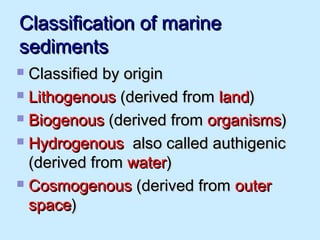
 LithogenousLithogenous (derived from(derived from landland))
 BiogenousBiogenous (derived from(derived from organismsorganisms))
 HydrogenousHydrogenous also called authigenicalso called authigenic
(derived from(derived from waterwater))
 CosmogenousCosmogenous (derived from(derived from outerouter
spacespace))
Lithogenous sedimentsLithogenous sediments
 Eroded rock fragments from land (Eroded rock fragments from land (originorigin))
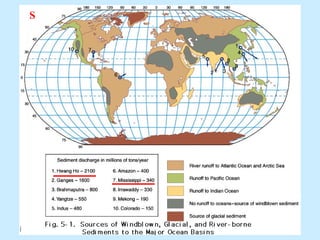
 TransportedTransported from landfrom land byby
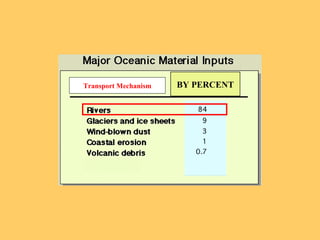
 Water (e.g.,Water (e.g., riverriver transported sediment)transported sediment)
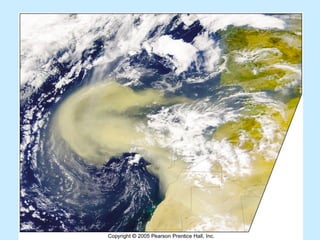
 WindWind (e.g., windblown dust)(e.g., windblown dust)
 IceIce (e.g., ice-rafted rocks)(e.g., ice-rafted rocks)
 Gravity (e.g.,Gravity (e.g., turbidity currentsturbidity currents))
BY PERCENTTransport Mechanism
S
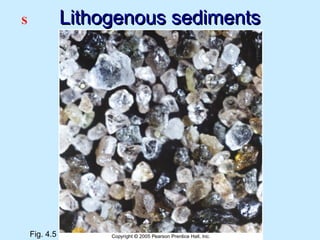
Lithogenous sedimentsLithogenous sediments
Fig. 4.5
S
Lithogenous sedimentsLithogenous sediments
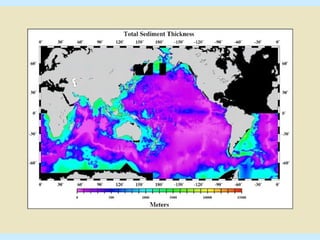
 Most lithogenous sediments at continentalMost lithogenous sediments at continental
marginsmargins
 Coarser sediments closer to shoreCoarser sediments closer to shore
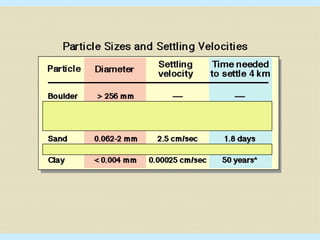
 Finer sediments farther from shoreFiner sediments farther from shore WHY?WHY?
 Mainly mineral quartz (SiOMainly mineral quartz (SiO22))
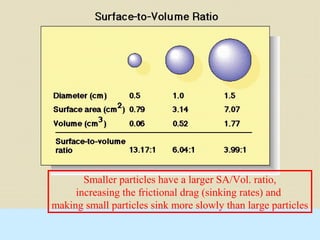
Smaller particles have a larger SA/Vol. ratio,
increasing the frictional drag (sinking rates) and
making small particles sink more slowly than large particles
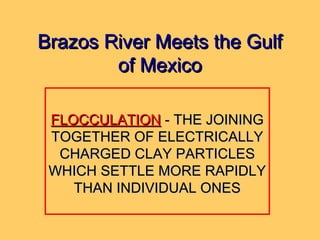
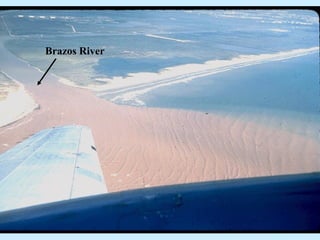
Brazos River Meets the GulfBrazos River Meets the Gulf
of Mexicoof Mexico
FLOCCULATIONFLOCCULATION - THE JOINING- THE JOINING
TOGETHER OF ELECTRICALLYTOGETHER OF ELECTRICALLY
CHARGED CLAY PARTICLESCHARGED CLAY PARTICLES
WHICH SETTLE MORE RAPIDLYWHICH SETTLE MORE RAPIDLY
THAN INDIVIDUAL ONESTHAN INDIVIDUAL ONES
Brazos River
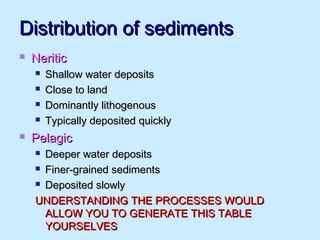
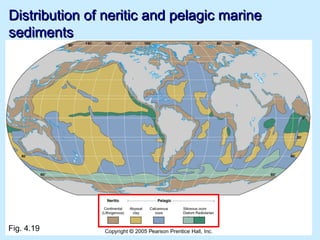
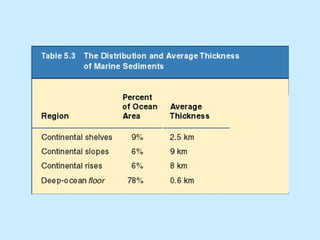
Distribution of sedimentsDistribution of sediments
 NeriticNeritic
 Shallow water depositsShallow water deposits
 Close to landClose to land
 Dominantly lithogenousDominantly lithogenous
 Typically deposited quicklyTypically deposited quickly
 PelagicPelagic
 Deeper water depositsDeeper water deposits
 Finer-grained sedimentsFiner-grained sediments
 Deposited slowlyDeposited slowly
UNDERSTANDING THE PROCESSES WOULDUNDERSTANDING THE PROCESSES WOULD
ALLOW YOU TO GENERATE THIS TABLEALLOW YOU TO GENERATE THIS TABLE
YOURSELVESYOURSELVES
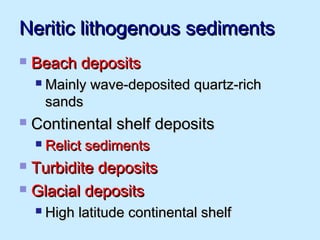
Neritic lithogenous sedimentsNeritic lithogenous sediments
 Beach depositsBeach deposits
 Mainly wave-deposited quartz-richMainly wave-deposited quartz-rich
sandssands
 Continental shelf depositsContinental shelf deposits
 Relict sedimentsRelict sediments
 Turbidite depositsTurbidite deposits
 Glacial depositsGlacial deposits
 High latitude continental shelfHigh latitude continental shelf
Pelagic lithogenous sedimentsPelagic lithogenous sediments
 Sources of fine material:Sources of fine material:
 Volcanic ashVolcanic ash (volcanic eruptions)(volcanic eruptions)
 Wind-blown dustWind-blown dust
 Fine grained material transported byFine grained material transported by
deep ocean currentsdeep ocean currents
 Abyssal clay (red clay)Abyssal clay (red clay)
 Oxidized ironOxidized iron
 Abundant if other sediments absentAbundant if other sediments absent
BiogenousBiogenous marine sedimentsmarine sediments
 Hard remains of once-livingHard remains of once-living
organismsorganisms
 Shells, bones, teethShells, bones, teeth
 Macroscopic (large remains)Macroscopic (large remains)
 Microscopic (small remains)Microscopic (small remains)
 Tiny shells or testsTiny shells or tests settle throughsettle through
water columnwater column
 Biogenic ooze (30% or more tests)Biogenic ooze (30% or more tests)
 Mainly algae and protozoansMainly algae and protozoans
Biogenous marine sedimentsBiogenous marine sediments
 Commonly eitherCommonly either calcium carbonatecalcium carbonate
(CaCO(CaCO33)) oror silicasilica (SiO(SiO22 or SiOor SiO22.nH.nH22O)O)
 UsuallyUsually planktonicplanktonic (free-floating)(free-floating)
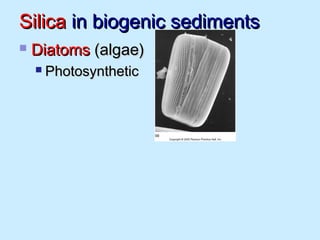
SilicaSilica in biogenic sedimentsin biogenic sediments
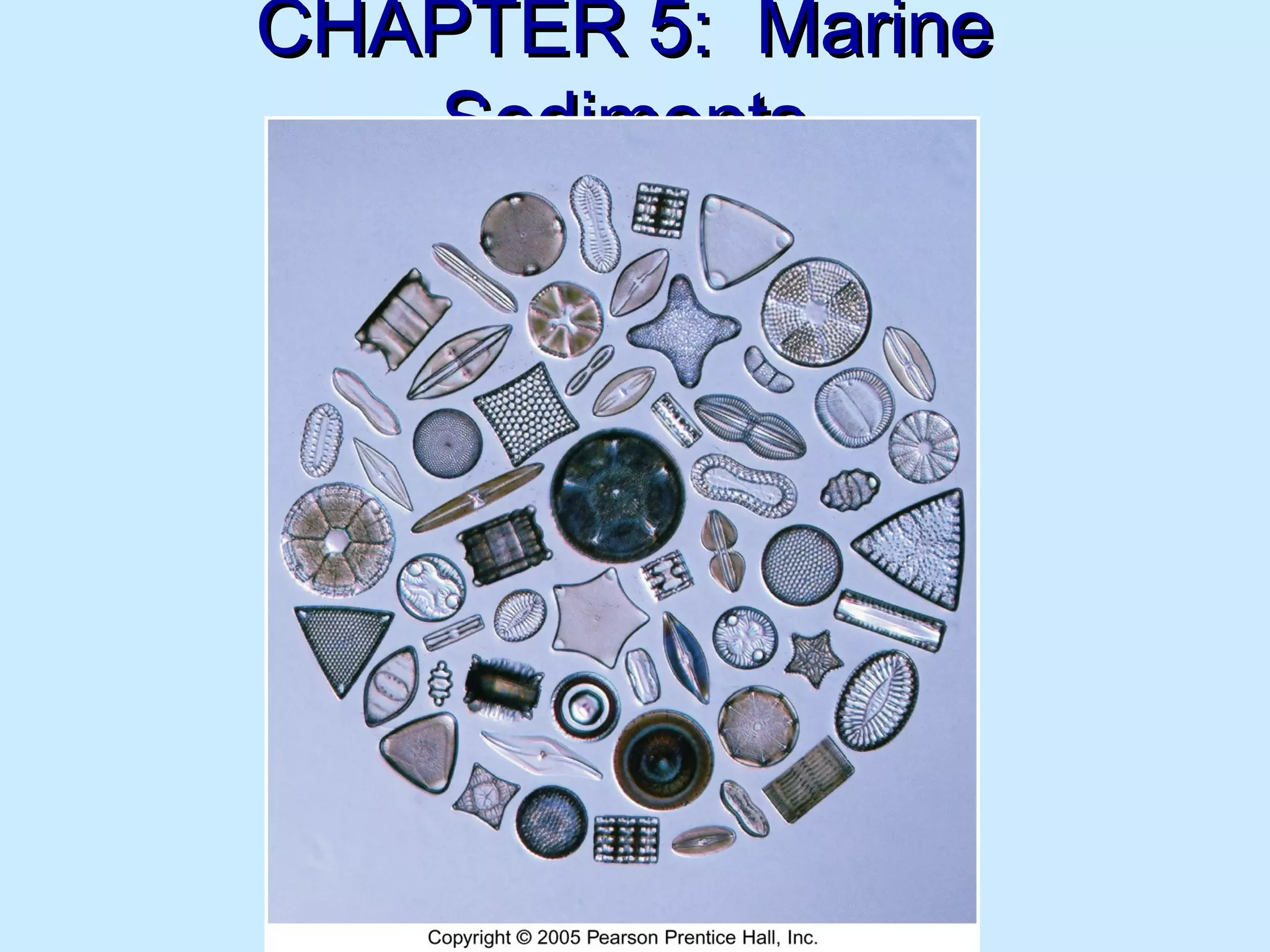
 DiatomsDiatoms (algae)(algae)
 PhotosyntheticPhotosynthetic
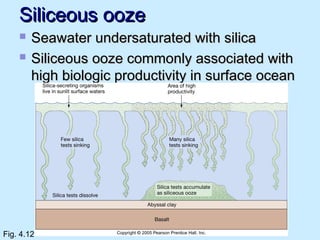
Siliceous oozeSiliceous ooze
 Seawater undersaturated with silicaSeawater undersaturated with silica
 Siliceous ooze commonly associated withSiliceous ooze commonly associated with
high biologic productivity in surface oceanhigh biologic productivity in surface ocean
Fig. 4.12
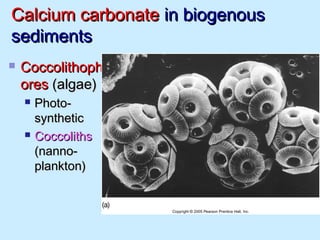
Calcium carbonateCalcium carbonate in biogenousin biogenous
sedimentssediments
 CoccolithophCoccolithoph
oresores (algae)(algae)
 Photo-Photo-
syntheticsynthetic
 CoccolithsCoccoliths
(nanno-(nanno-
plankton)plankton)
S
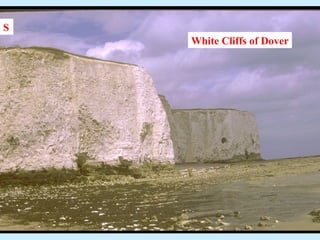
White Cliffs of Dover
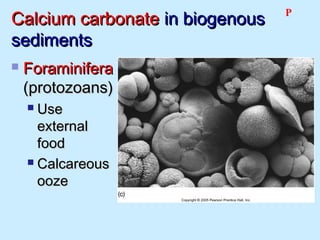
Calcium carbonateCalcium carbonate in biogenousin biogenous
sedimentssediments
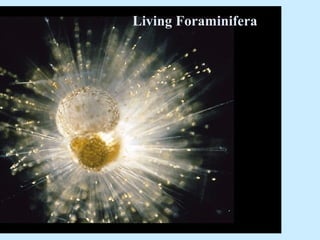
 ForaminiferaForaminifera
(protozoans)(protozoans)
 UseUse
externalexternal
foodfood
 CalcareousCalcareous
oozeooze
P
Living Foraminifera
Distribution of biogenousDistribution of biogenous
sedimentssediments
 Factors controlling distributionFactors controlling distribution
 ProductivityProductivity
 Destruction (dissolution)Destruction (dissolution)
Calcareous ooze and the CCDCalcareous ooze and the CCD
 Warm, shallow ocean saturated withWarm, shallow ocean saturated with
calcium carbonatecalcium carbonate
 Cool, deep ocean undersaturatedCool, deep ocean undersaturated
with calcium carbonatewith calcium carbonate
 LysoclineLysocline--depth at which CaCO--depth at which CaCO33 beginsbegins
to dissolve rapidlyto dissolve rapidly
 Calcite compensation depthCalcite compensation depth CCD--CCD--
depth where CaCOdepth where CaCO33 readily dissolvesreadily dissolves
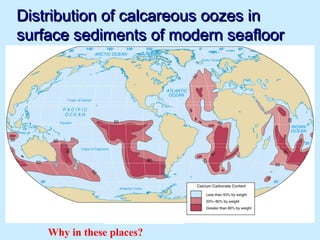
Distribution of calcareous oozes inDistribution of calcareous oozes in
surface sediments of modern seafloorsurface sediments of modern seafloor
Why in these places?
Hydrogenous marine sedimentsHydrogenous marine sediments
 Minerals precipitate directly fromMinerals precipitate directly from
seawaterseawater
 Manganese nodulesManganese nodules
 PhosphatesPhosphates
 CarbonatesCarbonates
 Metal sulfidesMetal sulfides
 Small proportion of marine sedimentsSmall proportion of marine sediments
 Distributed in diverse environmentsDistributed in diverse environments
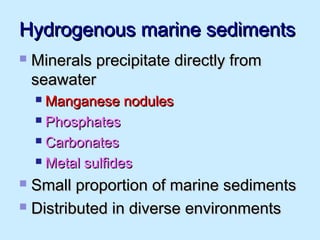
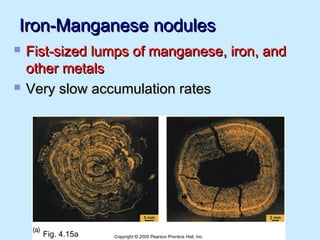
Iron-Manganese nodulesIron-Manganese nodules
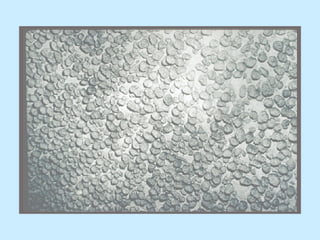
 Fist-sized lumps of manganese, iron, andFist-sized lumps of manganese, iron, and
other metalsother metals
 Very slow accumulation ratesVery slow accumulation rates
Fig. 4.15a
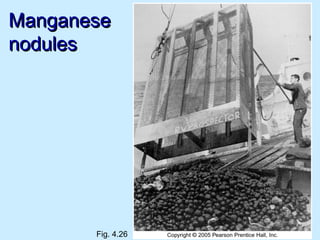
ManganeseManganese
nodulesnodules
Fig. 4.26
Cosmogenous marineCosmogenous marine
sedimentssediments
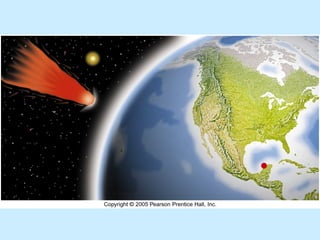
 Macroscopic meteor debrisMacroscopic meteor debris
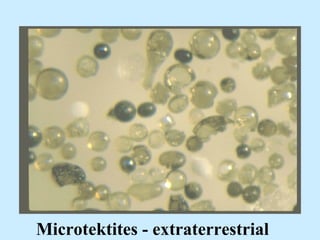
 MicroscopicMicroscopic iron-nickel and silicateiron-nickel and silicate
spherulesspherules
 TektitesTektites
 Space dustSpace dust
 Overall, insignificant proportion ofOverall, insignificant proportion of
marine sedimentsmarine sediments
Microtektites - extraterrestrial
Mixtures of marine sedimentsMixtures of marine sediments
 Usually mixture of different sedimentUsually mixture of different sediment
typestypes
 For example, biogenic oozes canFor example, biogenic oozes can
contain up to 70% non-biogeniccontain up to 70% non-biogenic
componentscomponents
 Typically one sediment typeTypically one sediment type
dominates in different areas of thedominates in different areas of the
sea floorsea floor
Distribution of neritic and pelagic marineDistribution of neritic and pelagic marine
sedimentssediments
Fig. 4.19
WHS Ocean -Marine Sed.

WHS Ocean -Marine Sed.

  • 1.
    CHAPTER 5: MarineCHAPTER5: Marine SedimentsSediments
  • 2.
    Marine sedimentsMarine sediments Eroded rock particles and fragmentsEroded rock particles and fragments  Transported to or produced in the oceanTransported to or produced in the ocean  Deposit by settling through water columnDeposit by settling through water column  Oceanographers decipher Earth historyOceanographers decipher Earth history through studying sedimentsthrough studying sediments S
  • 3.
    Classification of marineClassificationof marine sedimentssediments  Classified by originClassified by origin  LithogenousLithogenous (derived from(derived from landland))  BiogenousBiogenous (derived from(derived from organismsorganisms))  HydrogenousHydrogenous also called authigenicalso called authigenic (derived from(derived from waterwater))  CosmogenousCosmogenous (derived from(derived from outerouter spacespace))
  • 4.
    Lithogenous sedimentsLithogenous sediments Eroded rock fragments from land (Eroded rock fragments from land (originorigin))  TransportedTransported from landfrom land byby  Water (e.g.,Water (e.g., riverriver transported sediment)transported sediment)  WindWind (e.g., windblown dust)(e.g., windblown dust)  IceIce (e.g., ice-rafted rocks)(e.g., ice-rafted rocks)  Gravity (e.g.,Gravity (e.g., turbidity currentsturbidity currents))
  • 5.
  • 6.
  • 7.
  • 8.
    Lithogenous sedimentsLithogenous sediments Most lithogenous sediments at continentalMost lithogenous sediments at continental marginsmargins  Coarser sediments closer to shoreCoarser sediments closer to shore  Finer sediments farther from shoreFiner sediments farther from shore WHY?WHY?  Mainly mineral quartz (SiOMainly mineral quartz (SiO22))
  • 10.
    Smaller particles havea larger SA/Vol. ratio, increasing the frictional drag (sinking rates) and making small particles sink more slowly than large particles
  • 11.
    Brazos River Meetsthe GulfBrazos River Meets the Gulf of Mexicoof Mexico FLOCCULATIONFLOCCULATION - THE JOINING- THE JOINING TOGETHER OF ELECTRICALLYTOGETHER OF ELECTRICALLY CHARGED CLAY PARTICLESCHARGED CLAY PARTICLES WHICH SETTLE MORE RAPIDLYWHICH SETTLE MORE RAPIDLY THAN INDIVIDUAL ONESTHAN INDIVIDUAL ONES
  • 12.
  • 14.
    Distribution of sedimentsDistributionof sediments  NeriticNeritic  Shallow water depositsShallow water deposits  Close to landClose to land  Dominantly lithogenousDominantly lithogenous  Typically deposited quicklyTypically deposited quickly  PelagicPelagic  Deeper water depositsDeeper water deposits  Finer-grained sedimentsFiner-grained sediments  Deposited slowlyDeposited slowly UNDERSTANDING THE PROCESSES WOULDUNDERSTANDING THE PROCESSES WOULD ALLOW YOU TO GENERATE THIS TABLEALLOW YOU TO GENERATE THIS TABLE YOURSELVESYOURSELVES
  • 15.
    Neritic lithogenous sedimentsNeriticlithogenous sediments  Beach depositsBeach deposits  Mainly wave-deposited quartz-richMainly wave-deposited quartz-rich sandssands  Continental shelf depositsContinental shelf deposits  Relict sedimentsRelict sediments  Turbidite depositsTurbidite deposits  Glacial depositsGlacial deposits  High latitude continental shelfHigh latitude continental shelf
  • 16.
    Pelagic lithogenous sedimentsPelagiclithogenous sediments  Sources of fine material:Sources of fine material:  Volcanic ashVolcanic ash (volcanic eruptions)(volcanic eruptions)  Wind-blown dustWind-blown dust  Fine grained material transported byFine grained material transported by deep ocean currentsdeep ocean currents  Abyssal clay (red clay)Abyssal clay (red clay)  Oxidized ironOxidized iron  Abundant if other sediments absentAbundant if other sediments absent
  • 17.
    BiogenousBiogenous marine sedimentsmarinesediments  Hard remains of once-livingHard remains of once-living organismsorganisms  Shells, bones, teethShells, bones, teeth  Macroscopic (large remains)Macroscopic (large remains)  Microscopic (small remains)Microscopic (small remains)  Tiny shells or testsTiny shells or tests settle throughsettle through water columnwater column  Biogenic ooze (30% or more tests)Biogenic ooze (30% or more tests)  Mainly algae and protozoansMainly algae and protozoans
  • 18.
    Biogenous marine sedimentsBiogenousmarine sediments  Commonly eitherCommonly either calcium carbonatecalcium carbonate (CaCO(CaCO33)) oror silicasilica (SiO(SiO22 or SiOor SiO22.nH.nH22O)O)  UsuallyUsually planktonicplanktonic (free-floating)(free-floating)
  • 19.
    SilicaSilica in biogenicsedimentsin biogenic sediments  DiatomsDiatoms (algae)(algae)  PhotosyntheticPhotosynthetic
  • 20.
    Siliceous oozeSiliceous ooze Seawater undersaturated with silicaSeawater undersaturated with silica  Siliceous ooze commonly associated withSiliceous ooze commonly associated with high biologic productivity in surface oceanhigh biologic productivity in surface ocean Fig. 4.12
  • 21.
    Calcium carbonateCalcium carbonatein biogenousin biogenous sedimentssediments  CoccolithophCoccolithoph oresores (algae)(algae)  Photo-Photo- syntheticsynthetic  CoccolithsCoccoliths (nanno-(nanno- plankton)plankton)
  • 22.
  • 23.
    Calcium carbonateCalcium carbonatein biogenousin biogenous sedimentssediments  ForaminiferaForaminifera (protozoans)(protozoans)  UseUse externalexternal foodfood  CalcareousCalcareous oozeooze P
  • 24.
  • 25.
    Distribution of biogenousDistributionof biogenous sedimentssediments  Factors controlling distributionFactors controlling distribution  ProductivityProductivity  Destruction (dissolution)Destruction (dissolution)
  • 26.
    Calcareous ooze andthe CCDCalcareous ooze and the CCD  Warm, shallow ocean saturated withWarm, shallow ocean saturated with calcium carbonatecalcium carbonate  Cool, deep ocean undersaturatedCool, deep ocean undersaturated with calcium carbonatewith calcium carbonate  LysoclineLysocline--depth at which CaCO--depth at which CaCO33 beginsbegins to dissolve rapidlyto dissolve rapidly  Calcite compensation depthCalcite compensation depth CCD--CCD-- depth where CaCOdepth where CaCO33 readily dissolvesreadily dissolves
  • 27.
    Distribution of calcareousoozes inDistribution of calcareous oozes in surface sediments of modern seafloorsurface sediments of modern seafloor Why in these places?
  • 28.
    Hydrogenous marine sedimentsHydrogenousmarine sediments  Minerals precipitate directly fromMinerals precipitate directly from seawaterseawater  Manganese nodulesManganese nodules  PhosphatesPhosphates  CarbonatesCarbonates  Metal sulfidesMetal sulfides  Small proportion of marine sedimentsSmall proportion of marine sediments  Distributed in diverse environmentsDistributed in diverse environments
  • 29.
    Iron-Manganese nodulesIron-Manganese nodules Fist-sized lumps of manganese, iron, andFist-sized lumps of manganese, iron, and other metalsother metals  Very slow accumulation ratesVery slow accumulation rates Fig. 4.15a
  • 31.
  • 32.
    Cosmogenous marineCosmogenous marine sedimentssediments Macroscopic meteor debrisMacroscopic meteor debris  MicroscopicMicroscopic iron-nickel and silicateiron-nickel and silicate spherulesspherules  TektitesTektites  Space dustSpace dust  Overall, insignificant proportion ofOverall, insignificant proportion of marine sedimentsmarine sediments
  • 34.
  • 35.
    Mixtures of marinesedimentsMixtures of marine sediments  Usually mixture of different sedimentUsually mixture of different sediment typestypes  For example, biogenic oozes canFor example, biogenic oozes can contain up to 70% non-biogeniccontain up to 70% non-biogenic componentscomponents  Typically one sediment typeTypically one sediment type dominates in different areas of thedominates in different areas of the sea floorsea floor
  • 36.
    Distribution of neriticand pelagic marineDistribution of neritic and pelagic marine sedimentssediments Fig. 4.19