Classificationof sedimentaryrock-
Allochthonous sediments
SUBJECT : SEDIMENTOLOGY
SUBMITTED BY : AASISH GIRI
INTRODUCTION
 Hatch et al., 1971 recognized five main classes of sediments : chemical,
organic, residual, terrigenous, and pyroclstic.
 Allochthonous sediments consists of terrigenous and pyroclastic classes
while rest are autochthonous sediments.
 The allochthonous sediments are those that are transported into the
environment in which they are deposited.
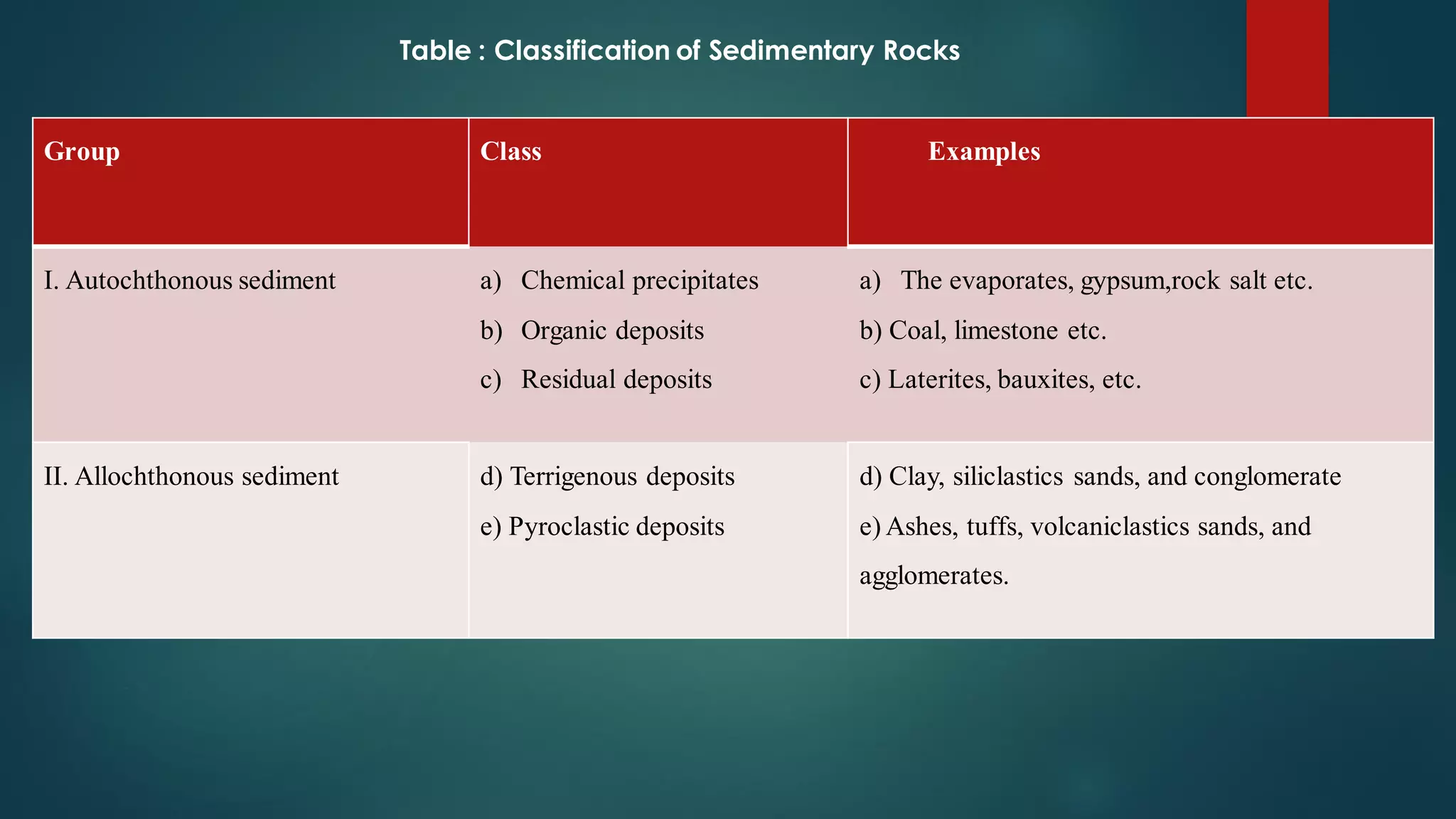
Group Class Examples
I. Autochthonous sediment a) Chemical precipitates
b) Organic deposits
c) Residual deposits
a) The evaporates, gypsum,rock salt etc.
b) Coal, limestone etc.
c) Laterites, bauxites, etc.
II. Allochthonous sediment d) Terrigenous deposits
e) Pyroclastic deposits
d) Clay, siliclastics sands, and conglomerate
e) Ashes, tuffs, volcaniclastics sands, and
agglomerates.
Table : Classification of Sedimentary Rocks
Classification using End-Member concept
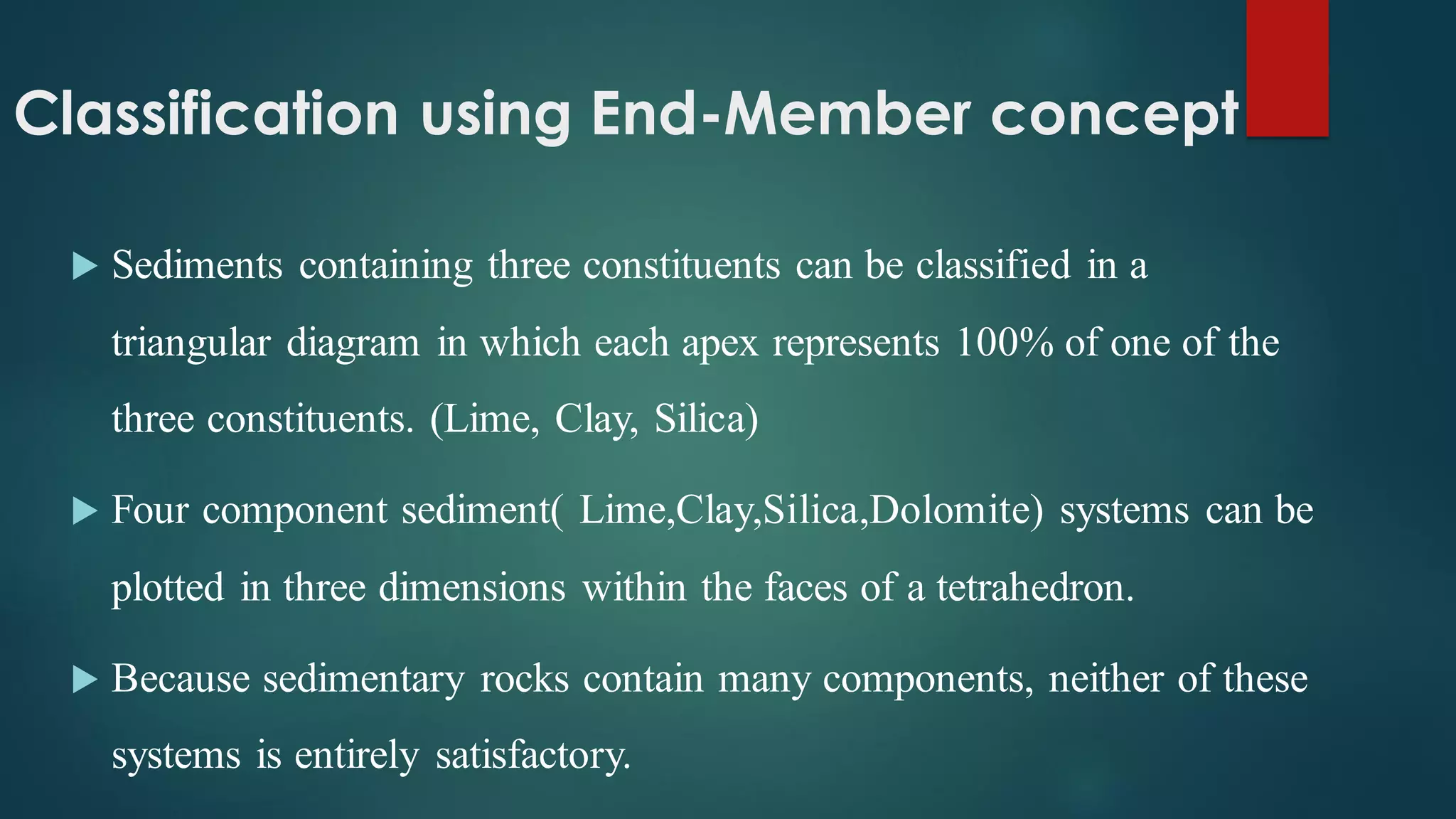
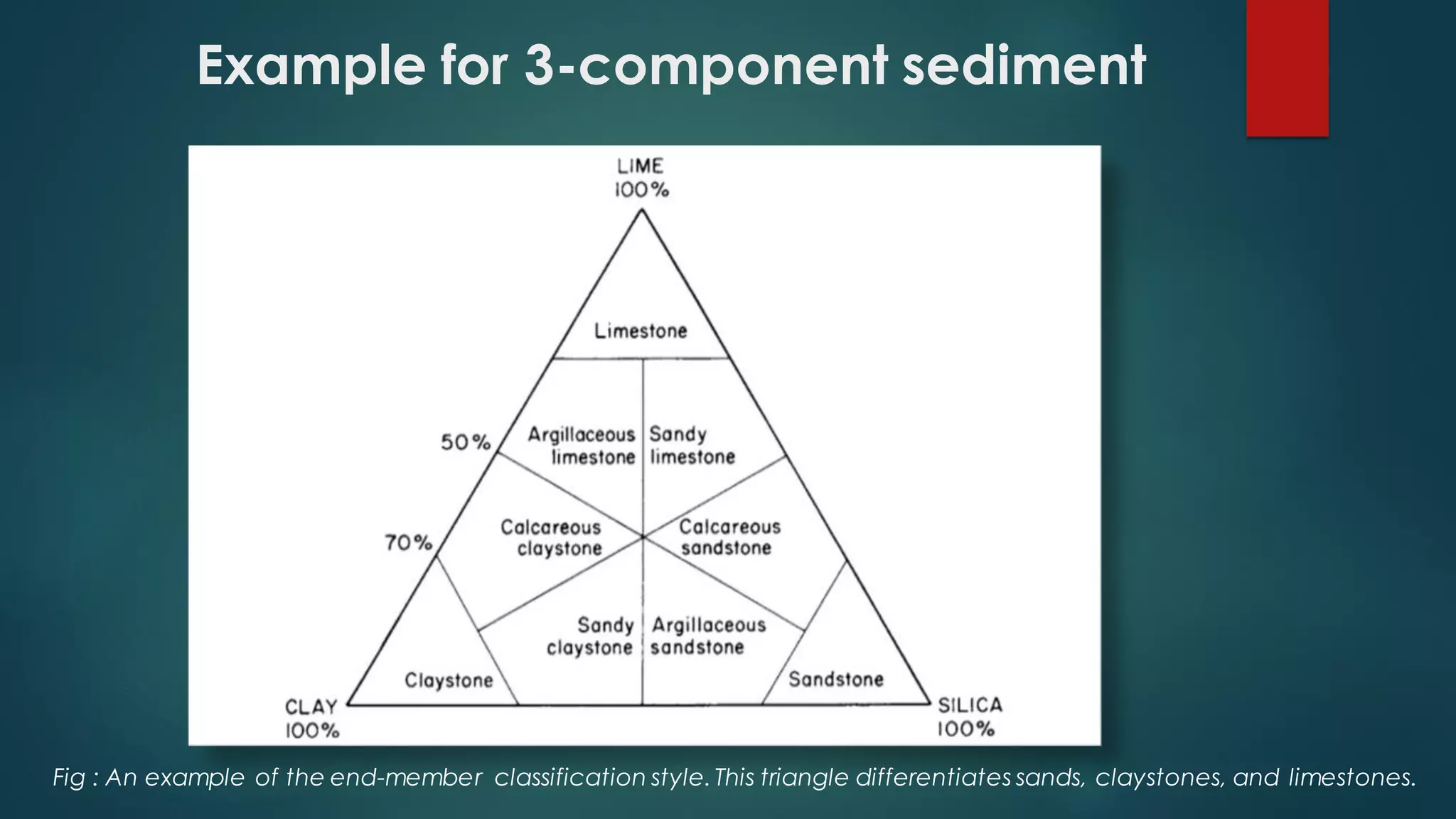
 Sediments containing three constituents can be classified in a
triangular diagram in which each apex represents 100% of one of the
three constituents. (Lime, Clay, Silica)
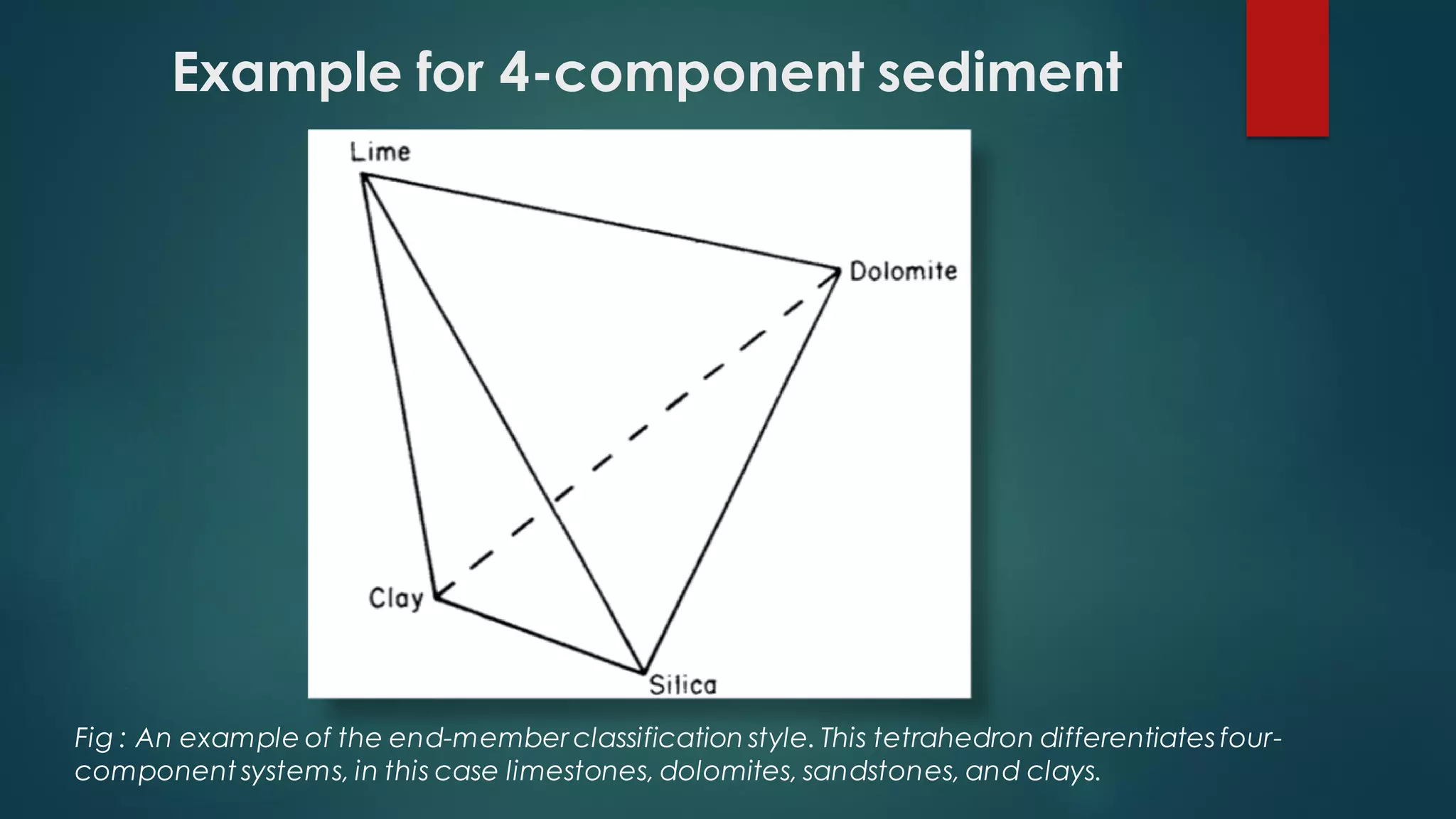
 Four component sediment( Lime,Clay,Silica,Dolomite) systems can be
plotted in three dimensions within the faces of a tetrahedron.
 Because sedimentary rocks contain many components, neither of these
systems is entirely satisfactory.
Example for 3-component sediment
Fig : An example of the end-member classification style. This triangle differentiates sands, claystones, and limestones.
Example for 4-component sediment
Fig : An example of the end-member classification style. This tetrahedron differentiates four-
component systems, in this case limestones, dolomites, sandstones, and clays.
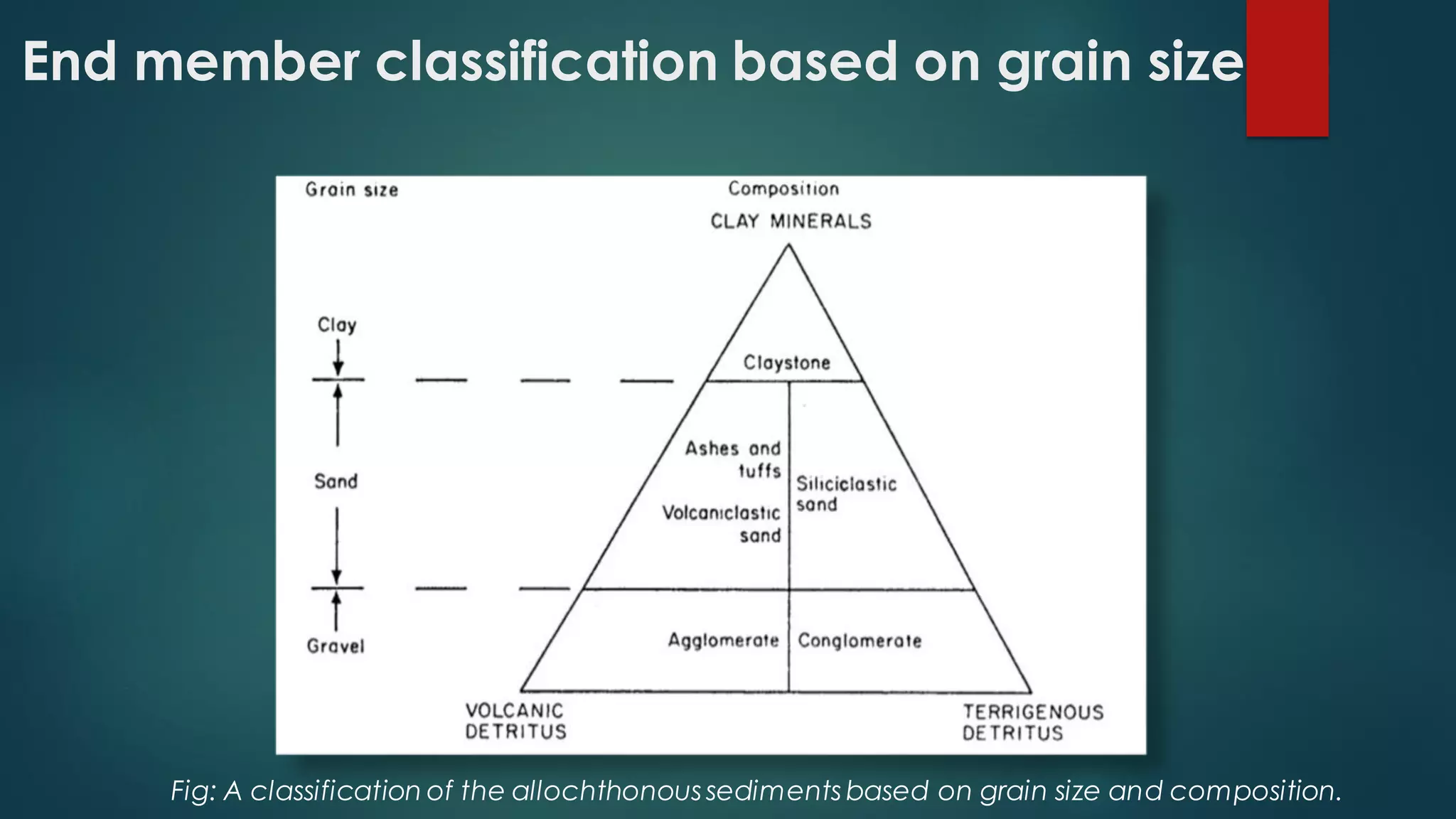
End member classification based on grain size
Fig: A classification of the allochthonous sediments based on grain size and composition.
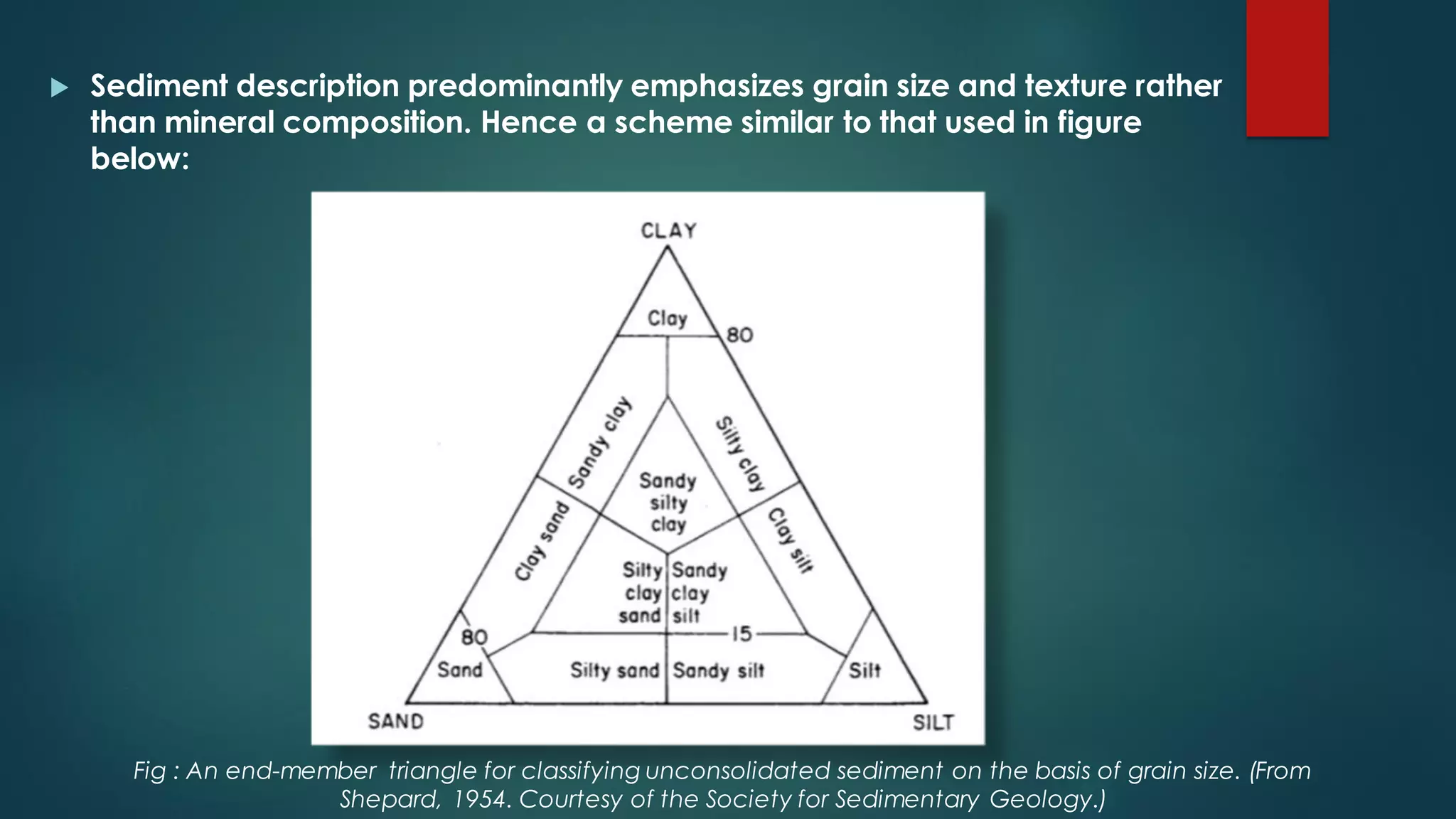
 Sediment description predominantly emphasizes grain size and texture rather
than mineral composition. Hence a scheme similar to that used in figure
below:
Fig : An end-member triangle for classifying unconsolidated sediment on the basis of grain size. (From
Shepard, 1954. Courtesy of the Society for Sedimentary Geology.)
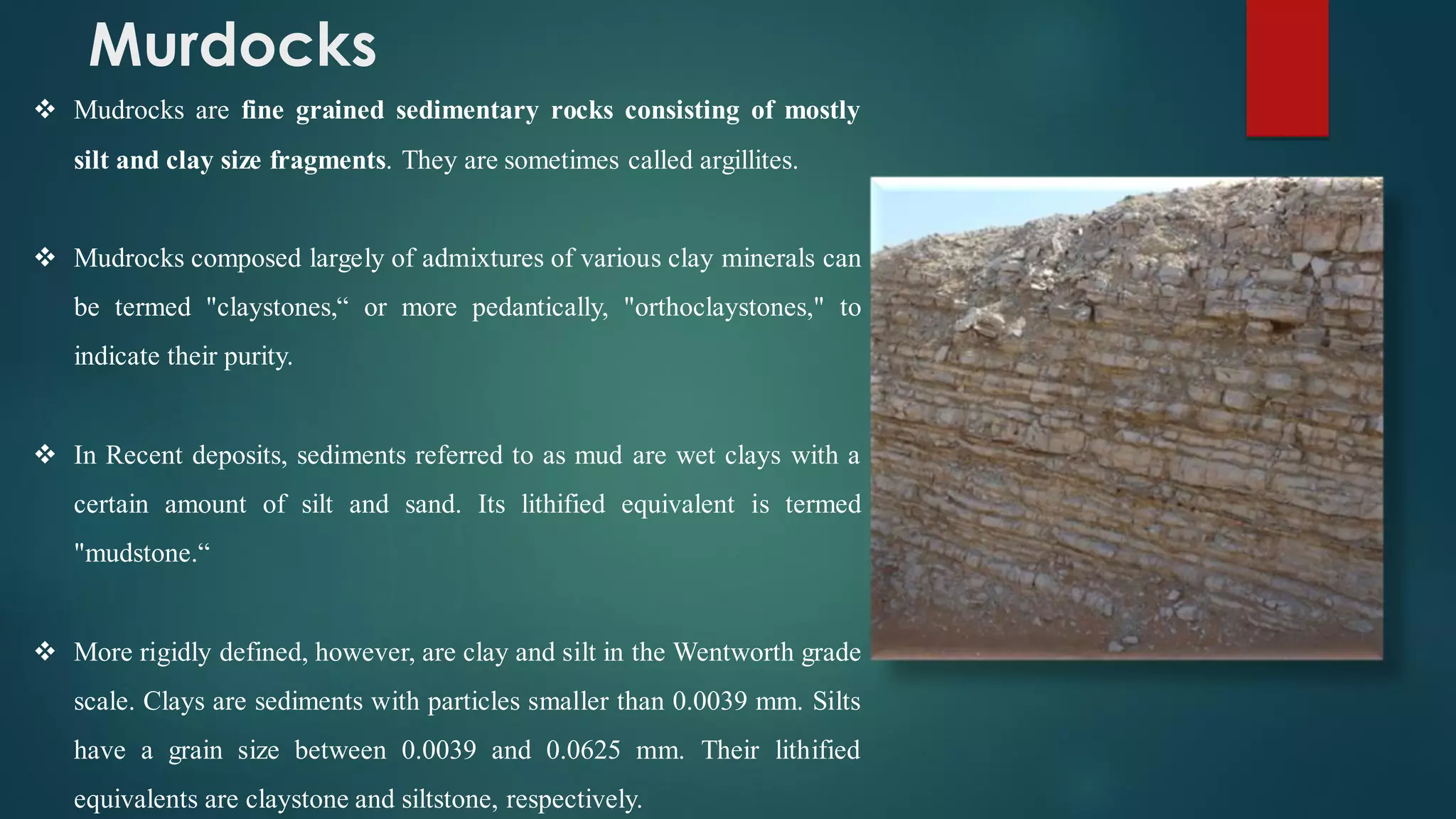
Murdocks
❖ Mudrocks are fine grained sedimentary rocks consisting of mostly
silt and clay size fragments. They are sometimes called argillites.
❖ Mudrocks composed largely of admixtures of various clay minerals can
be termed "claystones,“ or more pedantically, "orthoclaystones," to
indicate their purity.
❖ In Recent deposits, sediments referred to as mud are wet clays with a
certain amount of silt and sand. Its lithified equivalent is termed
"mudstone.“
❖ More rigidly defined, however, are clay and silt in the Wentworth grade
scale. Clays are sediments with particles smaller than 0.0039 mm. Silts
have a grain size between 0.0039 and 0.0625 mm. Their lithified
equivalents are claystone and siltstone, respectively.
Classification of Mudrocks
1. Sapropelites, Oil shales, and Oil Sources Rocks
2. Orthoclaystonesand Clay Minerals
I. Illite Group
II. Smecite Group
III. Chlorite
IV. Glauconite
V. Glauconite
VI. Compaction of clays
VII. Clay and clay diagenesis
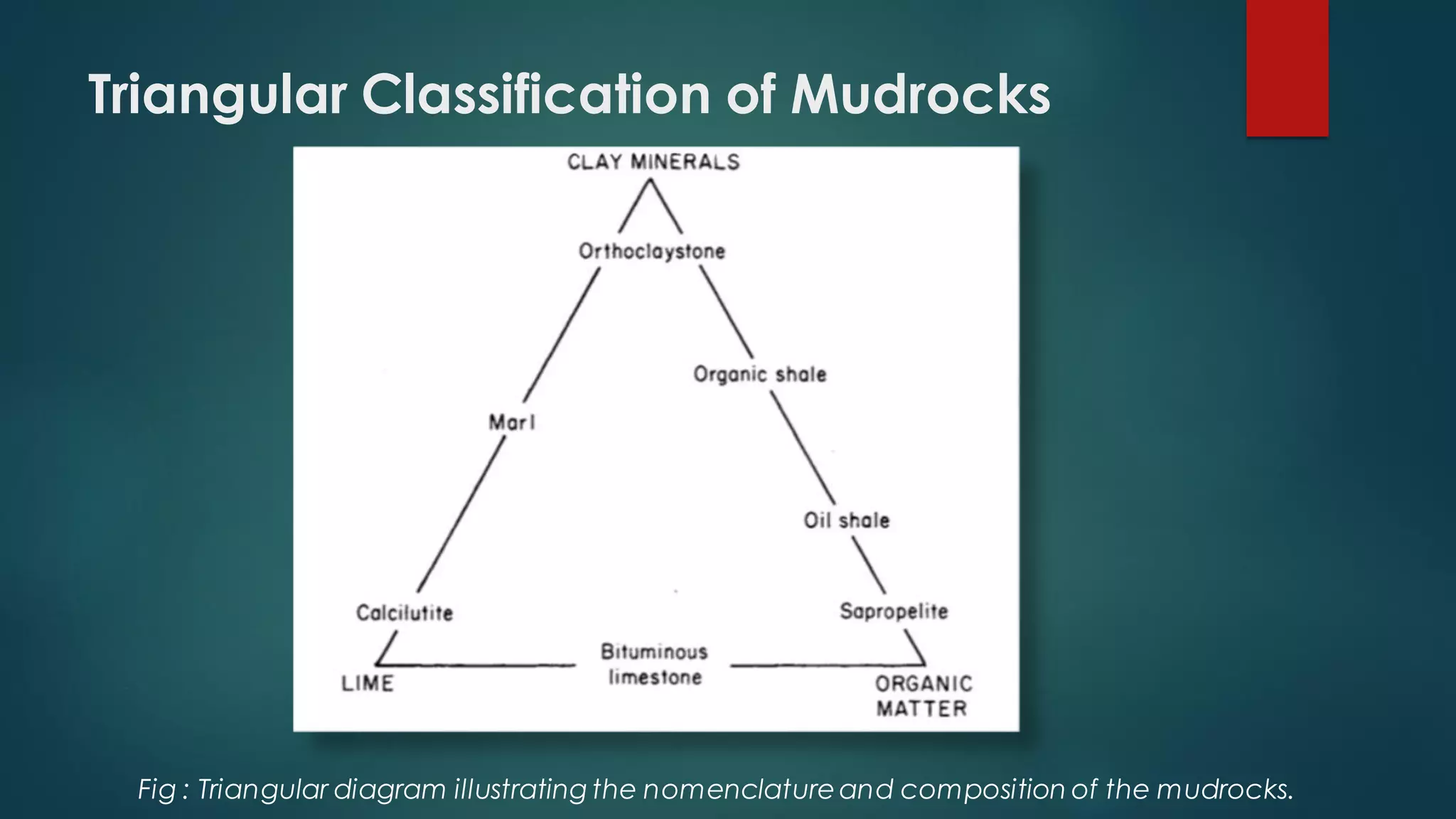
Triangular Classification of Mudrocks
Fig : Triangular diagram illustrating the nomenclatureand composition of the mudrocks.
1. Sapropelites, Oil shales, & Oil Source Rocks
 Organic matter is present in at least small quantities in all sediments. It is, however,
most abundant in the mudrocks and has been studied intensively.
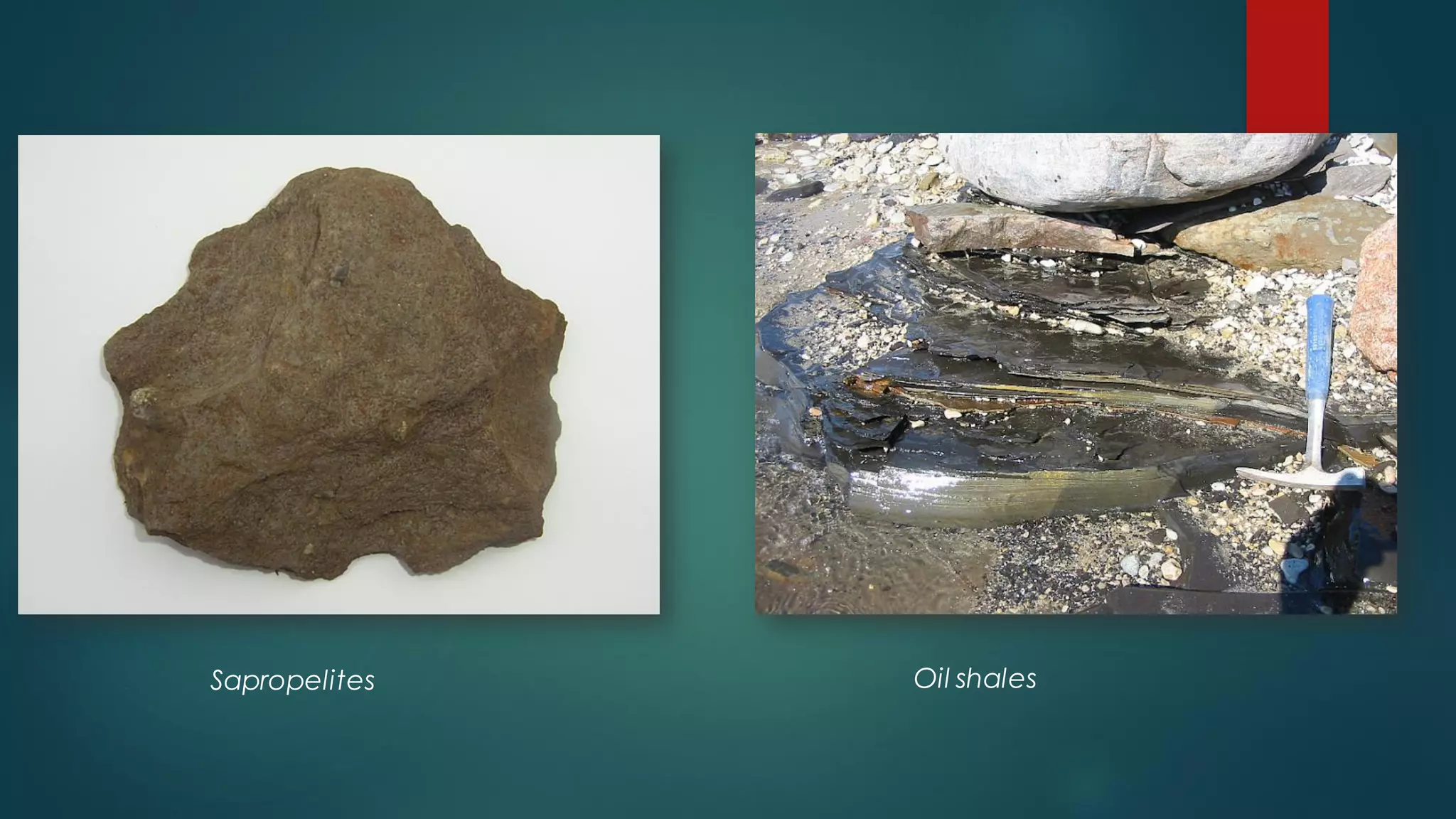
 Sapropelite is a name given to organic-rich mudrocks.
 Oil shales are mudrocks that are sufficiently rich in organic matter to yield free oil on
heating (Duncan, 1967).
 With increasing organic content, the claystones grade from organic claystone into oil
shale (or, strictly, oil claystone) and thence into the dominantly carbonaceous
sapropelites, torbanites, and coals.
Sapropelites Oil shales
Sapropelites, Oil shales, & Oil Source Rocks (contd.)
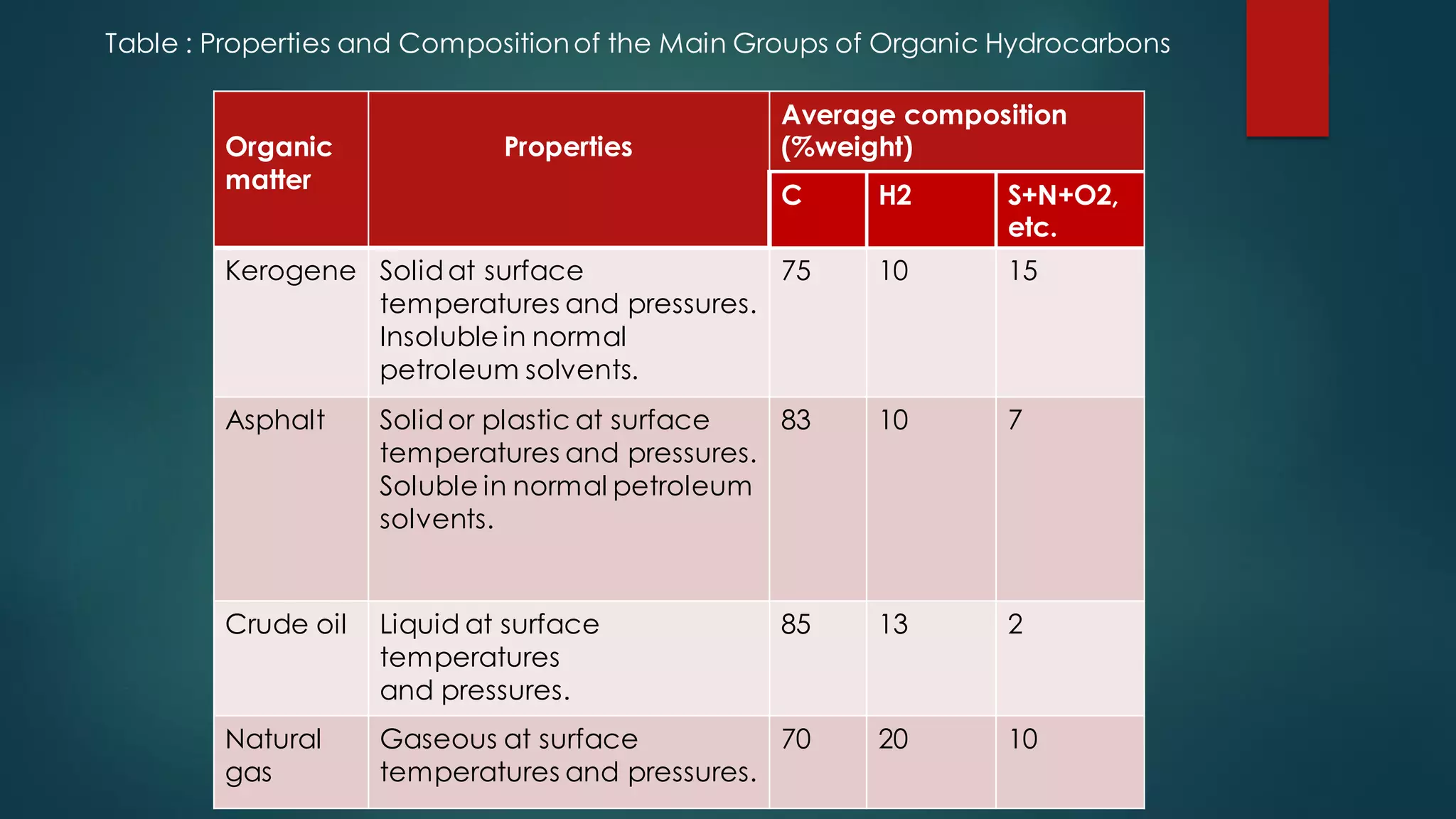
 Essentially the organic matter in sediments is of four types: kerogen, asphalt, crude oil, and
natural gas.
 Kerogen is the major constituent of the organic-rich mudrocks (see Tissot and Welte,1984; Hunt,
1996).
 Kerogen is a dark gray-black amorphous solid that is present in varying quantities in mudrocks;
when pure it is termed "coal.“
 It contains between 70 and 80% carbon, 7 and 11% hydrogen, 10 and 15% oxygen, and traces of
nitrogen and sulfur.
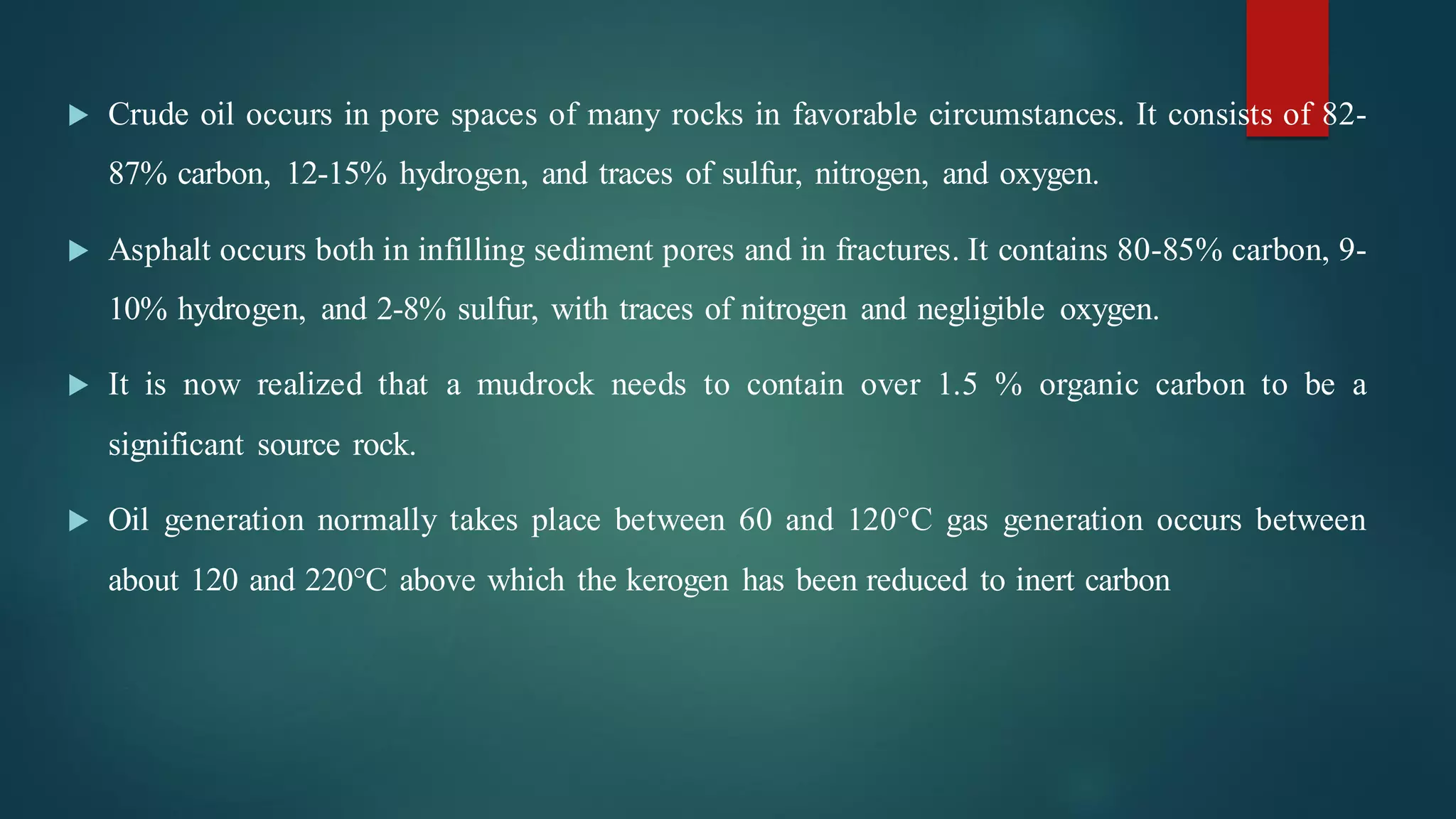
 Crude oil occurs in pore spaces of many rocks in favorable circumstances. It consists of 82-
87% carbon, 12-15% hydrogen, and traces of sulfur, nitrogen, and oxygen.
 Asphalt occurs both in infilling sediment pores and in fractures. It contains 80-85% carbon, 9-
10% hydrogen, and 2-8% sulfur, with traces of nitrogen and negligible oxygen.
 It is now realized that a mudrock needs to contain over 1.5 % organic carbon to be a
significant source rock.
 Oil generation normally takes place between 60 and 120°C gas generation occurs between
about 120 and 220°C above which the kerogen has been reduced to inert carbon
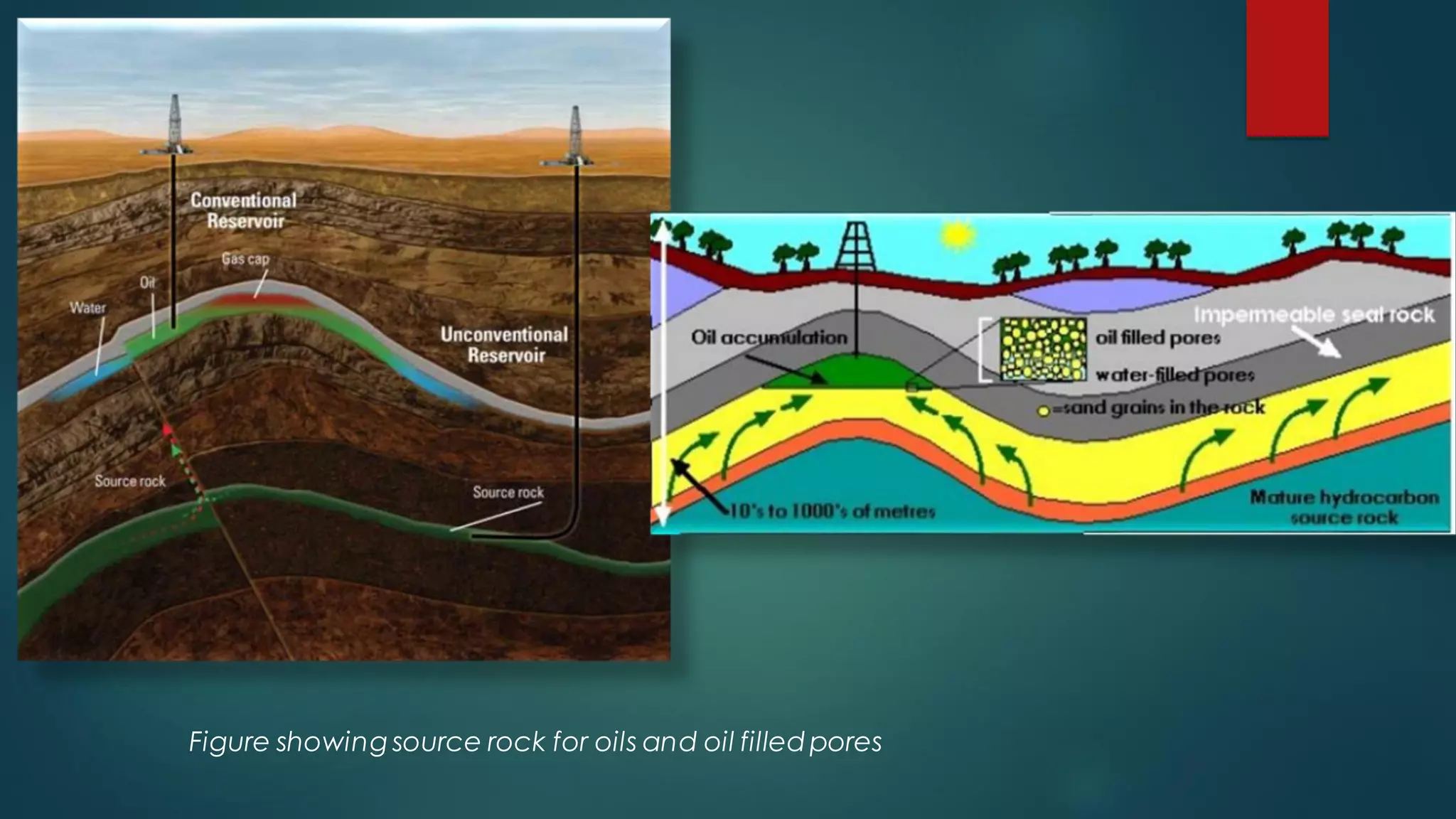
Figure showing source rock for oils and oil filledpores
Organic
matter
Properties
Average composition
(%weight)
C H2 S+N+O2,
etc.
Kerogene Solidat surface
temperatures and pressures.
Insolublein normal
petroleum solvents.
75 10 15
Asphalt Solidor plastic at surface
temperatures and pressures.
Soluble in normal petroleum
solvents.
83 10 7
Crude oil Liquid at surface
temperatures
and pressures.
85 13 2
Natural
gas
Gaseous at surface
temperatures and pressures.
70 20 10
Table : Properties and Compositionof the Main Groups of Organic Hydrocarbons
Orthoclaystone & Clay minerals
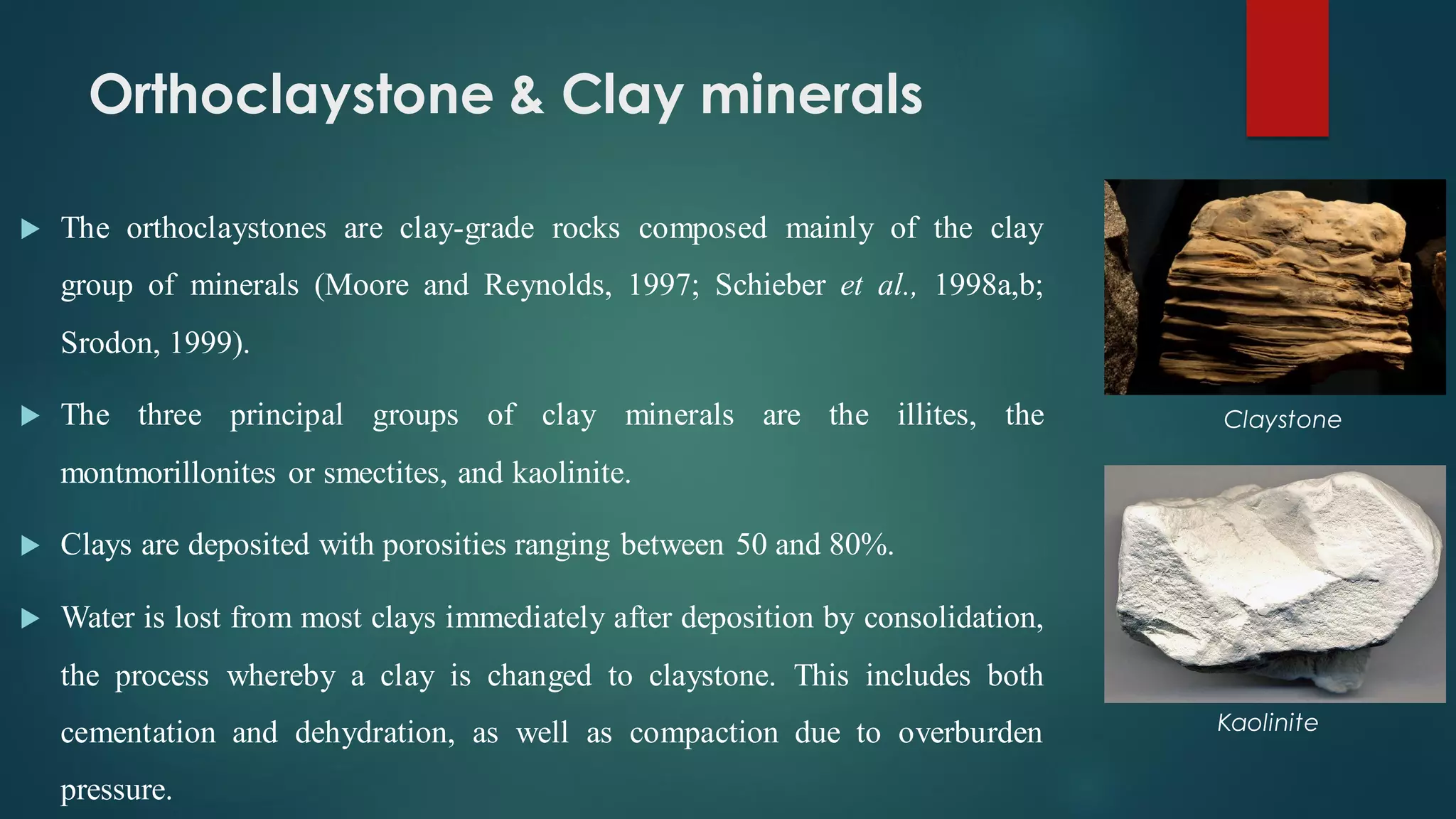
 The orthoclaystones are clay-grade rocks composed mainly of the clay
group of minerals (Moore and Reynolds, 1997; Schieber et al., 1998a,b;
Srodon, 1999).
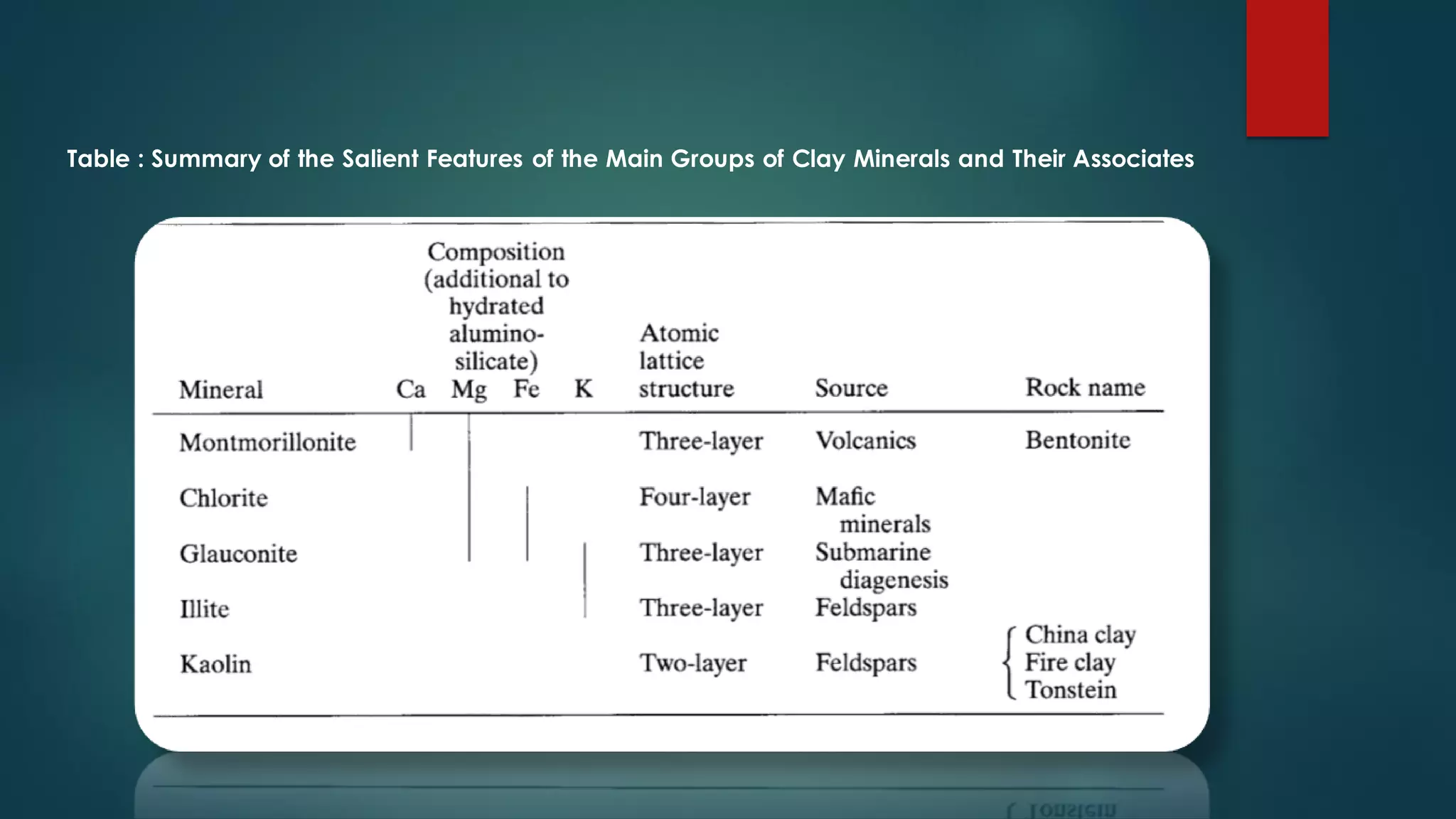
 The three principal groups of clay minerals are the illites, the
montmorillonites or smectites, and kaolinite.
 Clays are deposited with porosities ranging between 50 and 80%.
 Water is lost from most clays immediately after deposition by consolidation,
the process whereby a clay is changed to claystone. This includes both
cementation and dehydration, as well as compaction due to overburden
pressure.
Kaolinite
Claystone
Clays and Clay Diagenesis
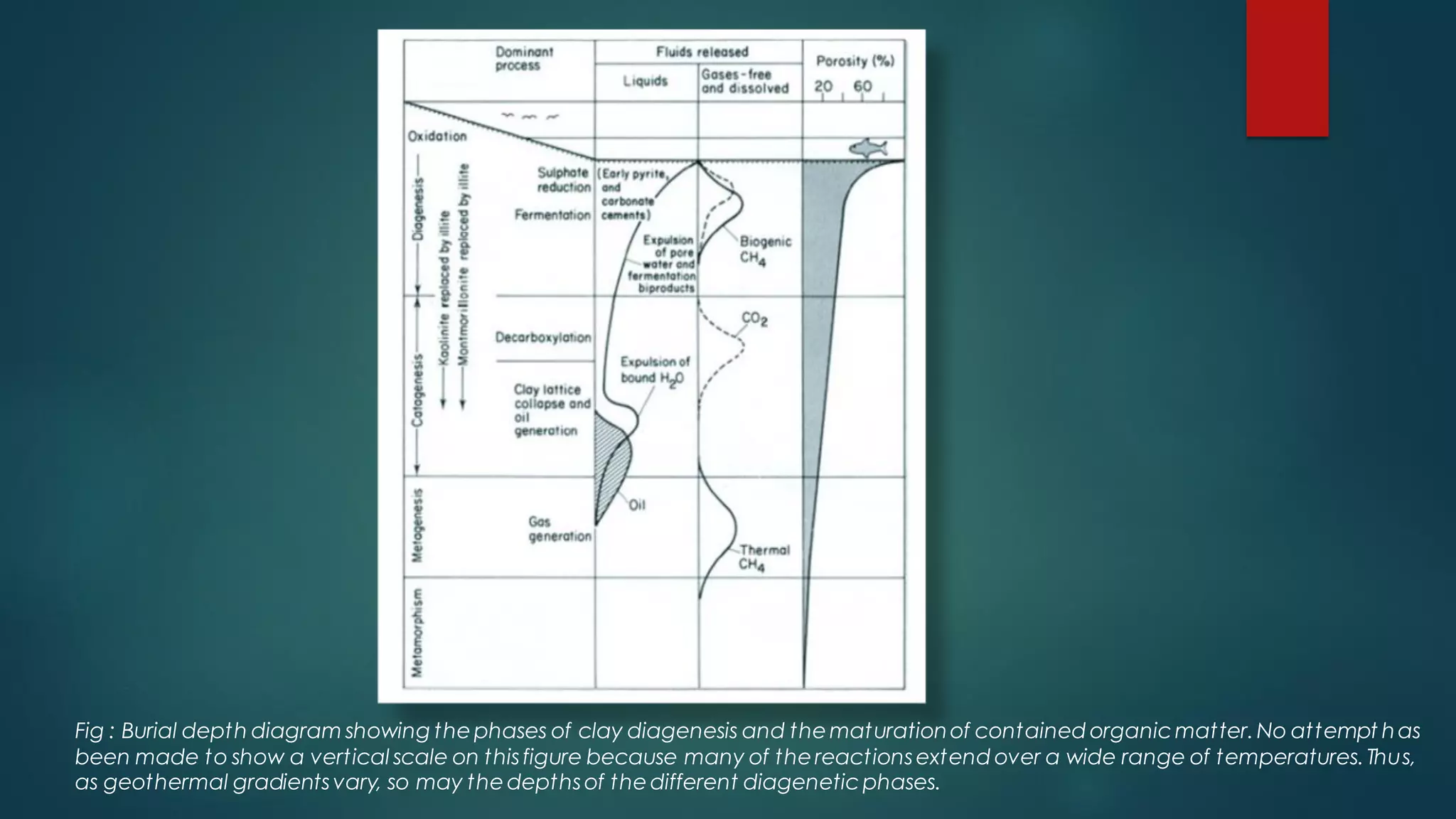
 As clays compact and bury they also undergo a number of geochemical
changes. These occur in three main stages: diagenesis, catagenesis, and
metagenesis.
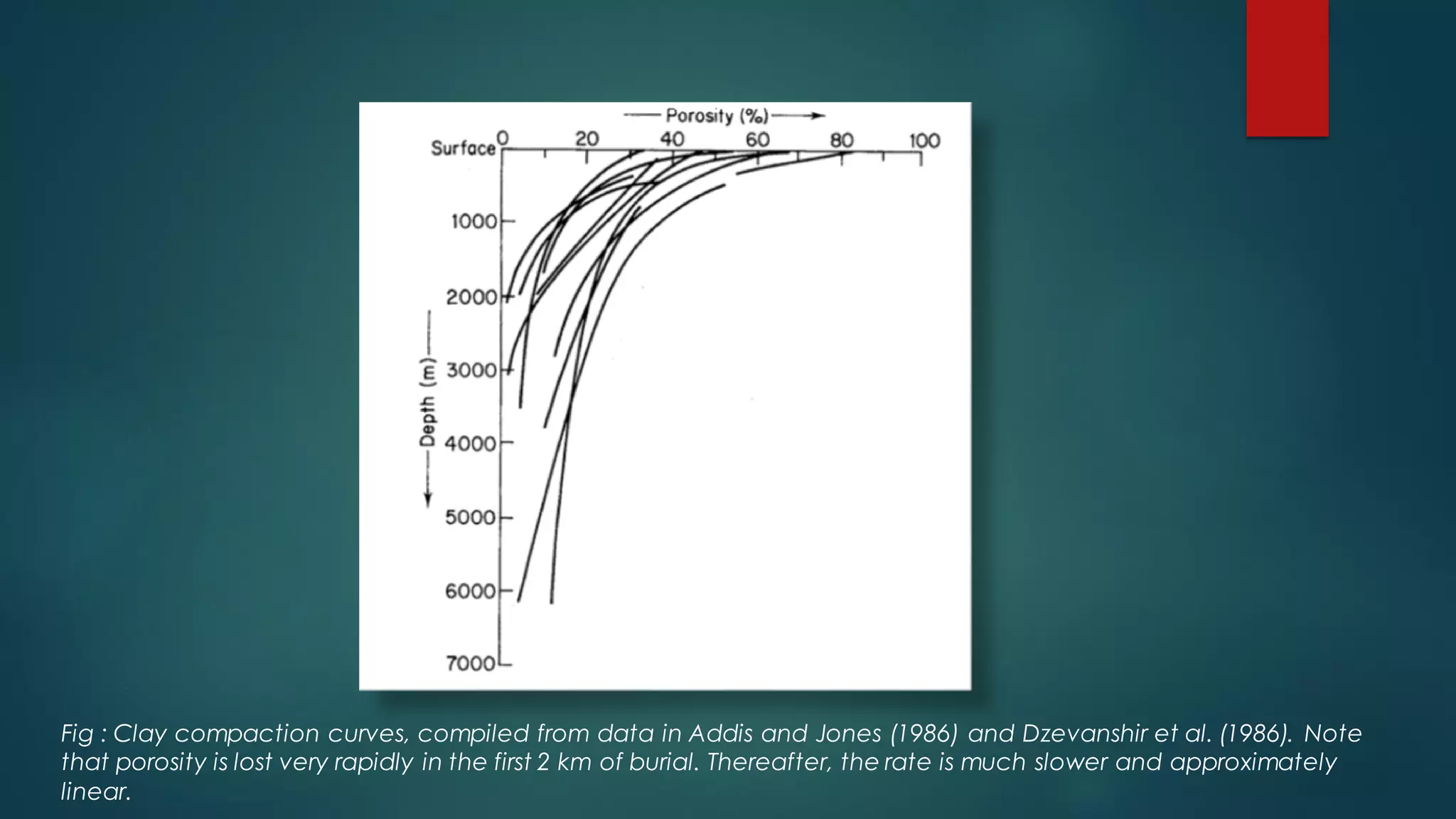
 Diagenesis refers to processes operating in the first 2 km of burial. As
already seen this is the zone in which porosity is lost rapidly by compaction.
 Chemical reactions take place at relativelylow temperatures and pressures.
 They are intimately related to bacterial reactions of organic matter.
Clays and Clay Diagenesis (contd.)
 The shallowest diagenetic zone is one of oxygenation. This is very thin or completely
absent in subaqueously deposited muds.
 Diagenesis merges into catagenesis toward about 2 km as the temperature exceeds
50°C.
 At temperatures of about 100-110°C the montmorillonite lattice collapses, to expel a
large volume of pore water, and hence increase the pore pressure. Montmorillonite and
kaolinite change into illite.
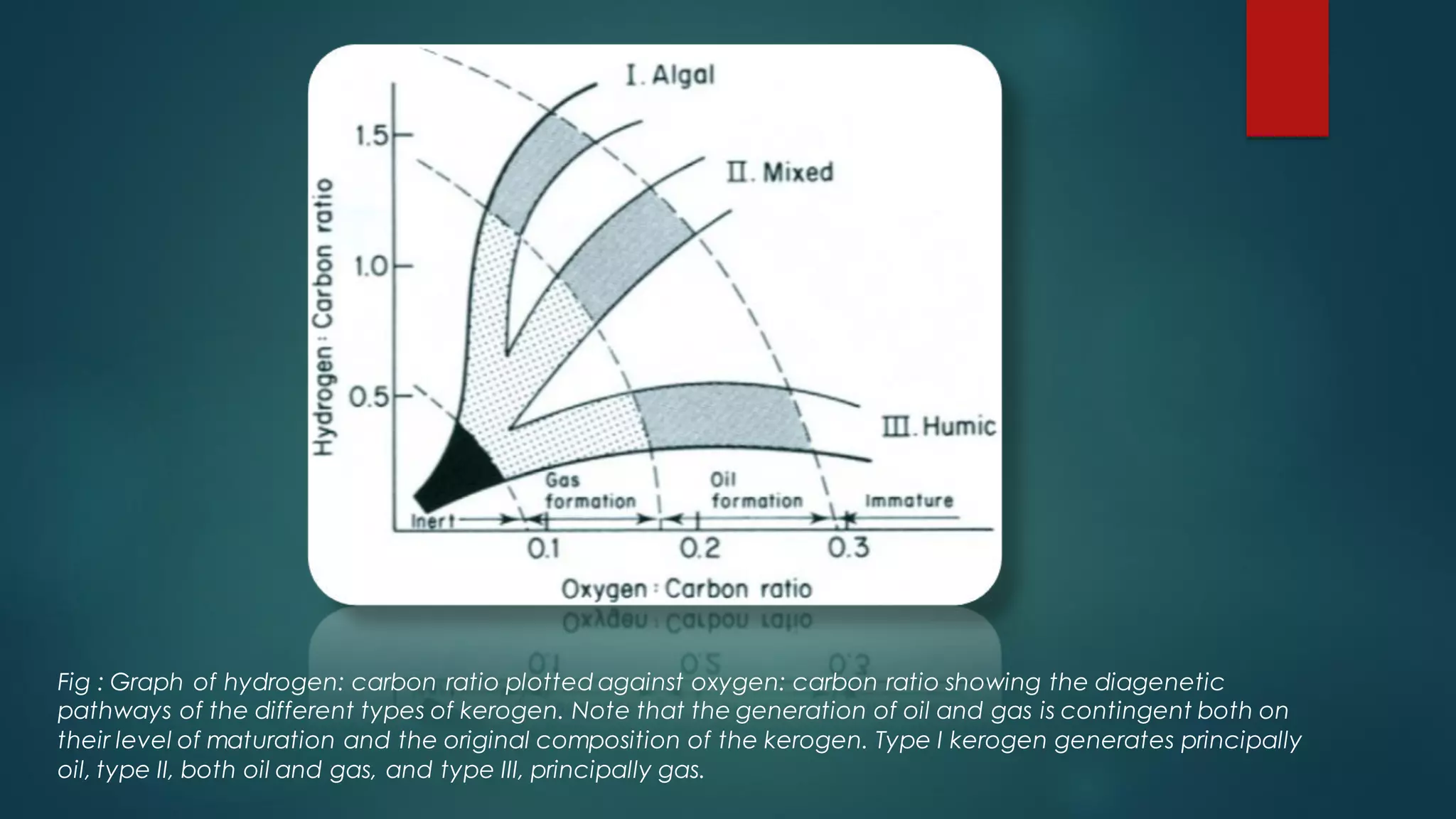
 The changes that occur in clays as they change to claystones at greater depths is of
interest to the petroleum geologist
Fig : Graph of hydrogen: carbon ratio plotted against oxygen: carbon ratio showing the diagenetic
pathways of the different types of kerogen. Note that the generation of oil and gas is contingent both on
their level of maturation and the original composition of the kerogen. Type I kerogen generates principally
oil, type II, both oil and gas, and type III, principally gas.
Table : Summary of the Salient Features of the Main Groups of Clay Minerals and Their Associates
Fig : Clay compaction curves, compiled from data in Addis and Jones (1986) and Dzevanshir et al. (1986). Note
that porosity is lost very rapidly in the first 2 km of burial. Thereafter, the rate is much slower and approximately
linear.
Fig : Burial depth diagram showing thephases of clay diagenesis and thematurationof contained organicmatter.No attempt has
been made to show a vertical scale on thisfigure because many of thereactionsextend over a wide range of temperatures.Thus,
as geothermal gradientsvary, so may thedepthsof thedifferent diageneticphases.
Sandstone
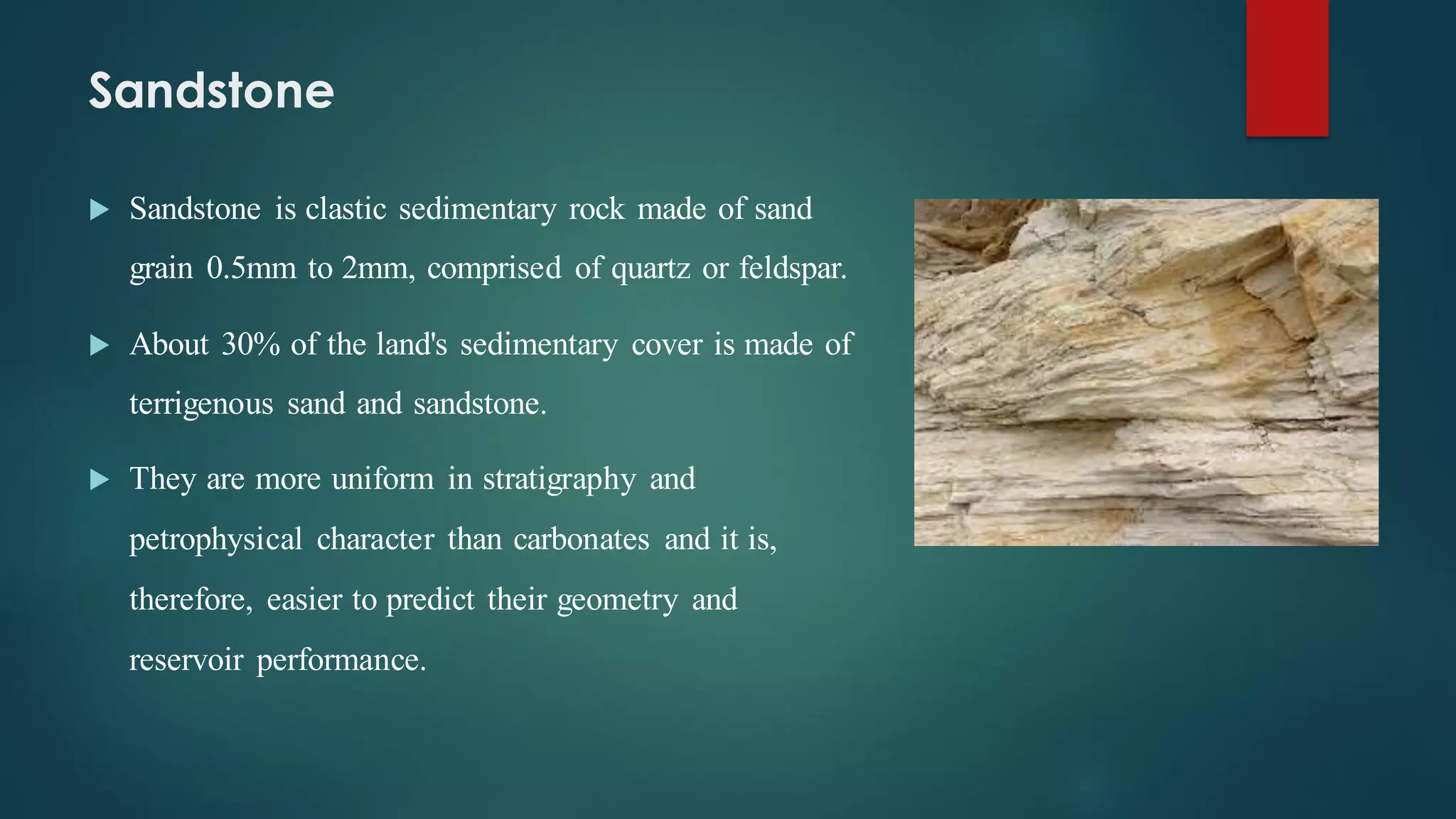
 Sandstone is clastic sedimentary rock made of sand
grain 0.5mm to 2mm, comprised of quartz or feldspar.
 About 30% of the land's sedimentary cover is made of
terrigenous sand and sandstone.
 They are more uniform in stratigraphy and
petrophysical character than carbonates and it is,
therefore, easier to predict their geometry and
reservoir performance.
Nomenclature of sandstone based on maturity
 One of the most fruitful conceptson which sandstonenomenclatureis based is the idea
of maturity. The maturation of a sand takes place in two ways.
I. Physical Maturity
II. Chemical Maturity
 Both physical and chemical maturation occurduring the history of a sand population,
but they are not closely related (Johnsson and Basu, 1993).
I. Physical Maturity
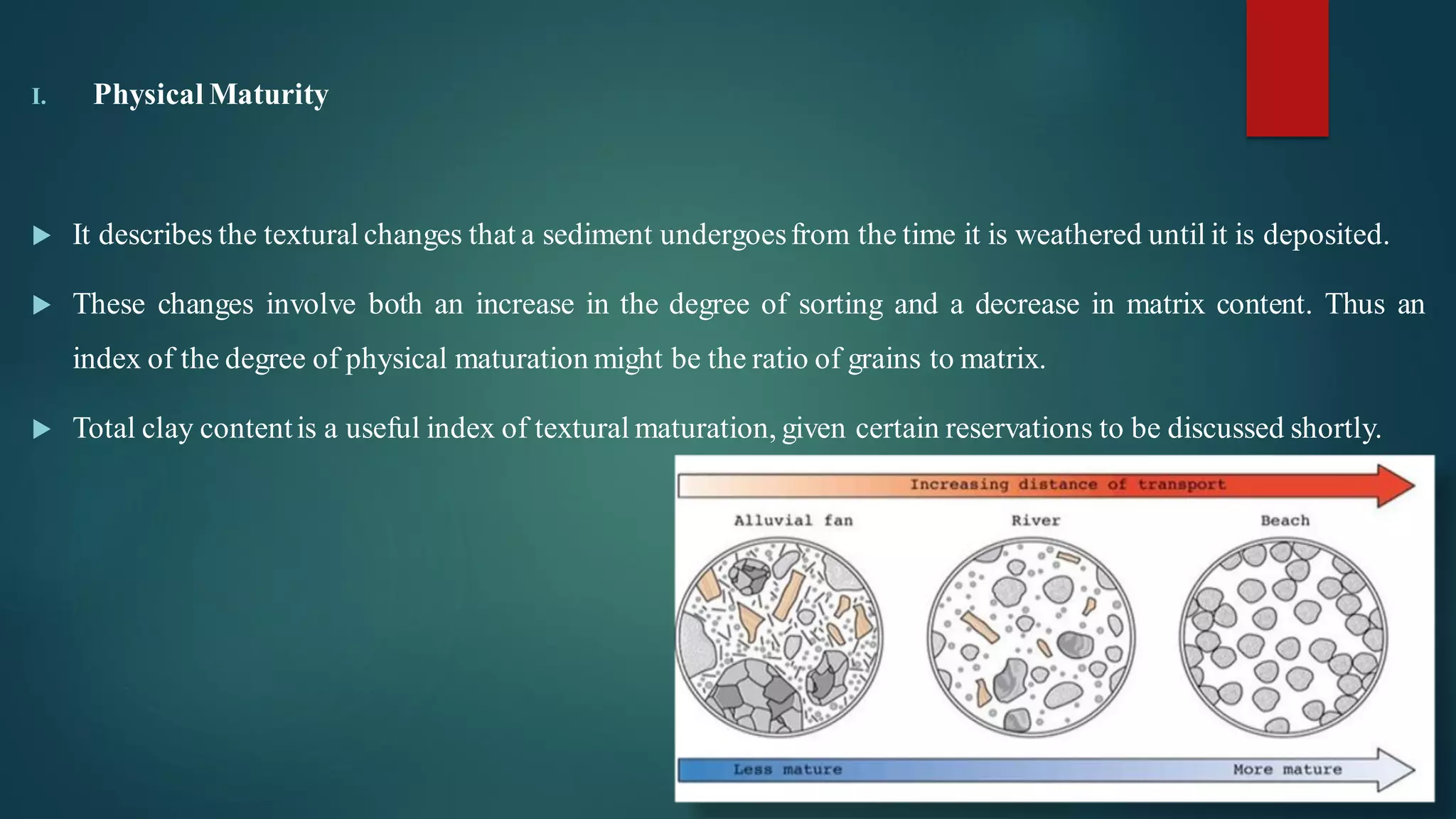
 It describes the textural changes that a sediment undergoesfrom the time it is weathered until it is deposited.
 These changes involve both an increase in the degree of sorting and a decrease in matrix content. Thus an
index of the degree of physical maturation might be the ratio of grains to matrix.
 Total clay contentis a useful index of textural maturation, given certain reservations to be discussed shortly.
II. Chemical Maturity
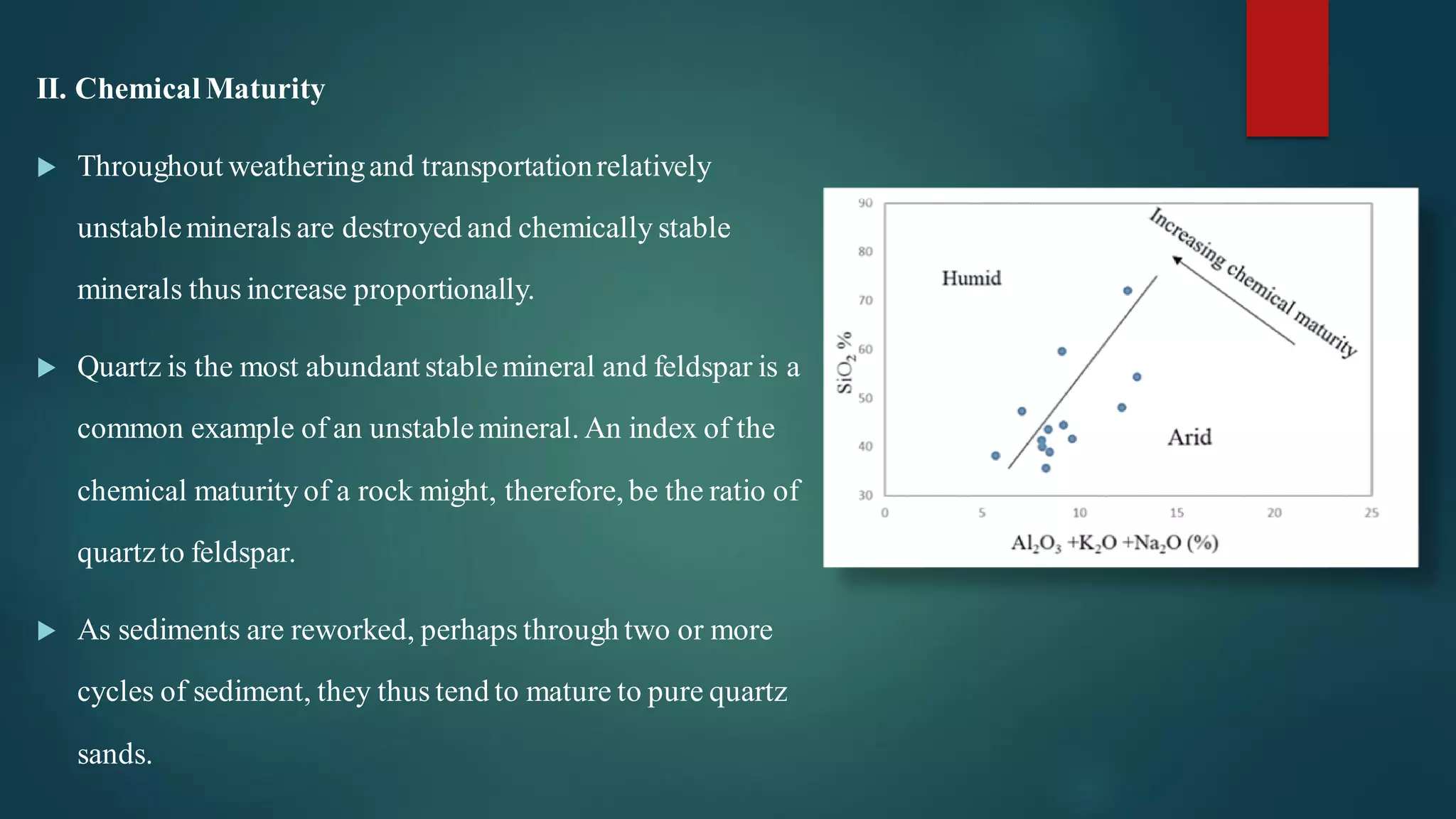
 Throughout weatheringand transportationrelatively
unstableminerals are destroyed and chemically stable
minerals thus increase proportionally.
 Quartz is the most abundant stablemineral and feldspar is a
common example of an unstablemineral. An index of the
chemical maturity of a rock might, therefore, be the ratio of
quartzto feldspar.
 As sediments are reworked, perhaps through two or more
cycles of sediment, they thus tend to mature to pure quartz
sands.
End-member classification of sandstone
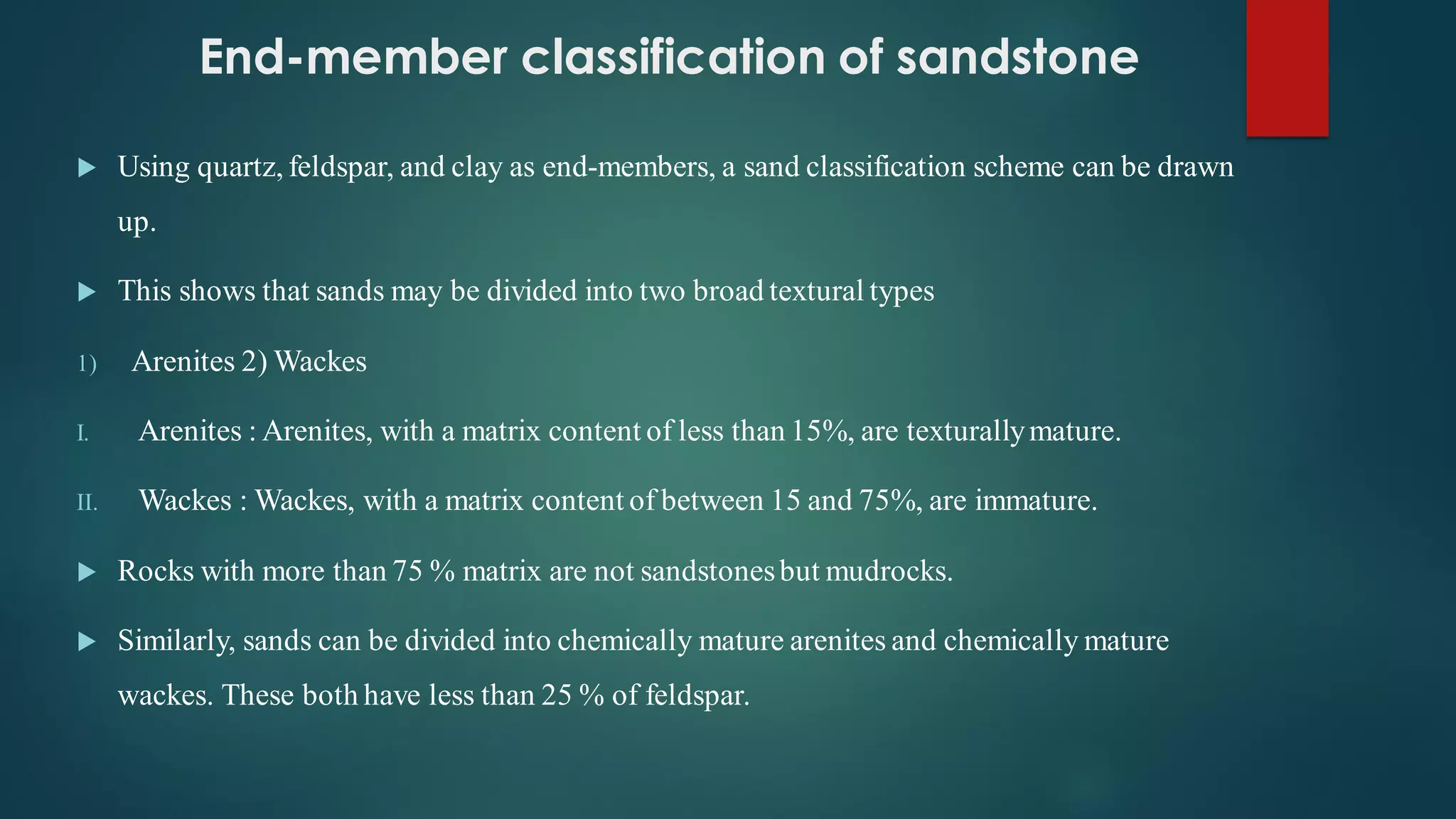
 Using quartz, feldspar, and clay as end-members, a sand classification scheme can be drawn
up.
 This shows that sands may be divided into two broad textural types
1) Arenites 2) Wackes
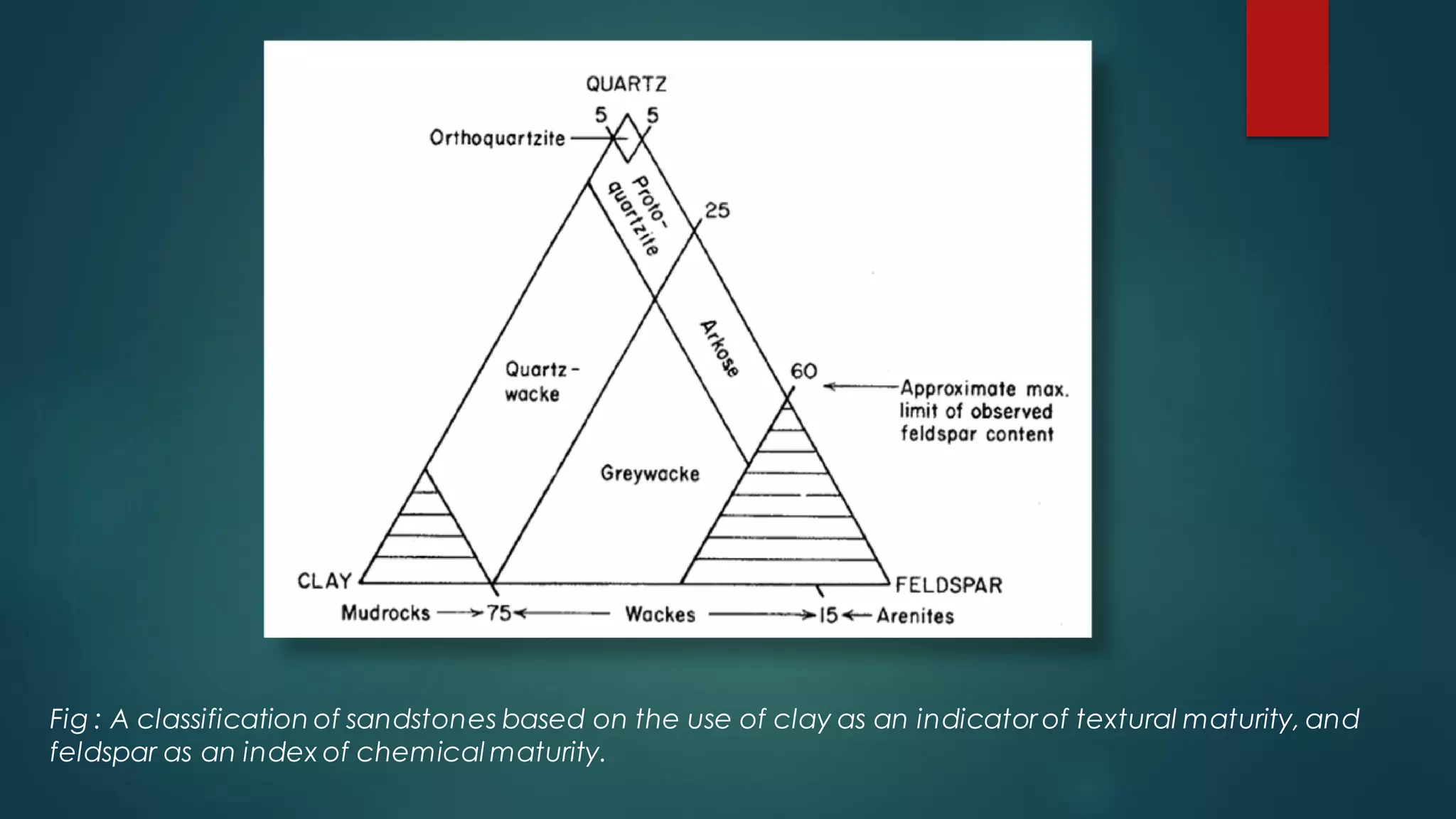
I. Arenites : Arenites, with a matrix content of less than 15%, are texturallymature.
II. Wackes : Wackes, with a matrix content of between 15 and 75%, are immature.
 Rocks with more than 75 % matrix are not sandstonesbut mudrocks.
 Similarly, sands can be divided into chemically mature arenites and chemically mature
wackes. These both have less than 25 % of feldspar.
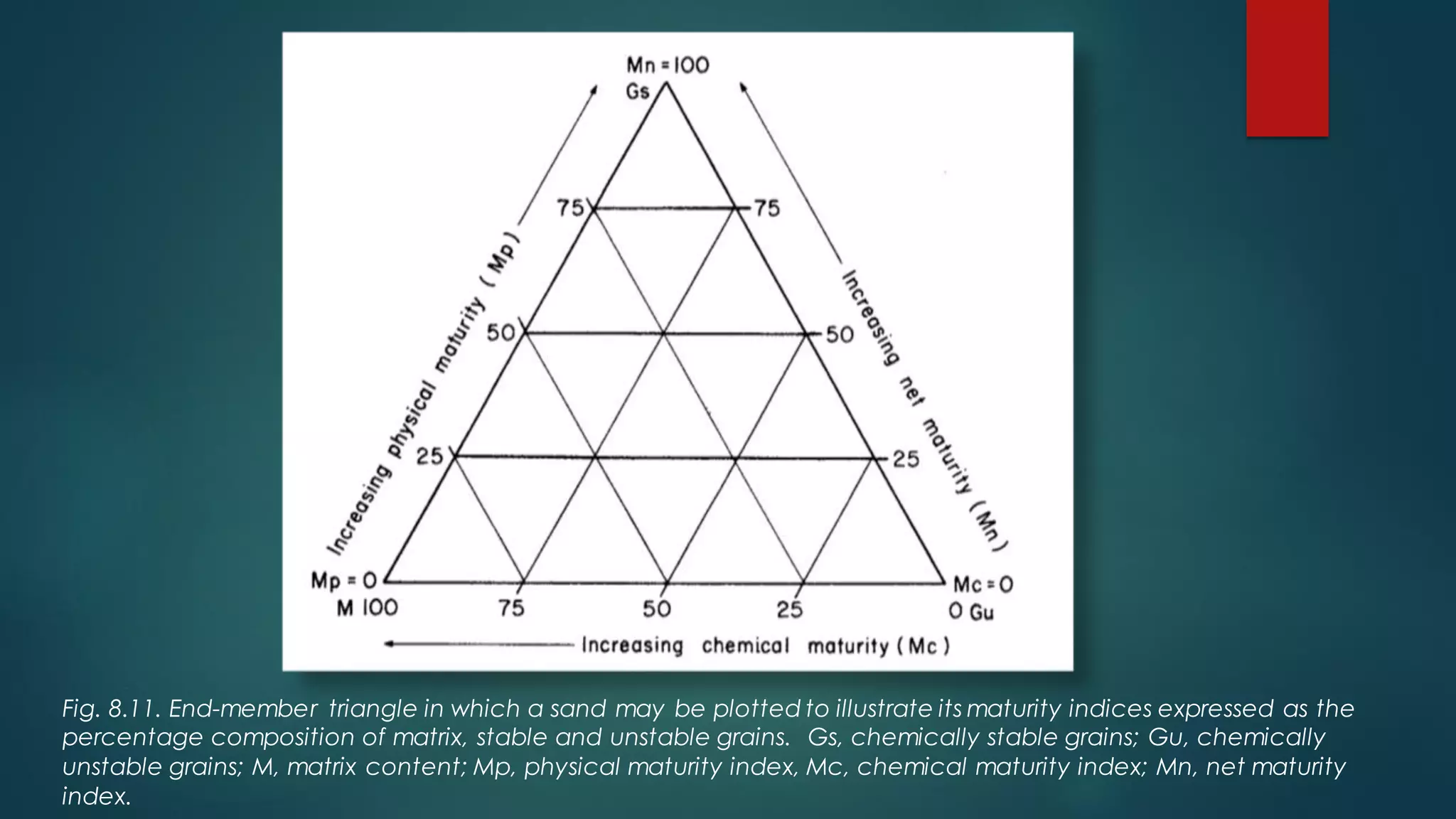
Fig. 8.11. End-member triangle in which a sand may be plotted to illustrate its maturity indices expressed as the
percentage composition of matrix, stable and unstable grains. Gs, chemically stable grains; Gu, chemically
unstable grains; M, matrix content; Mp, physical maturity index, Mc, chemical maturity index; Mn, net maturity
index.
Fig : A classification of sandstones based on the use of clay as an indicator of textural maturity, and
feldspar as an index of chemical maturity.
Classification of sandstone based on 4-end member
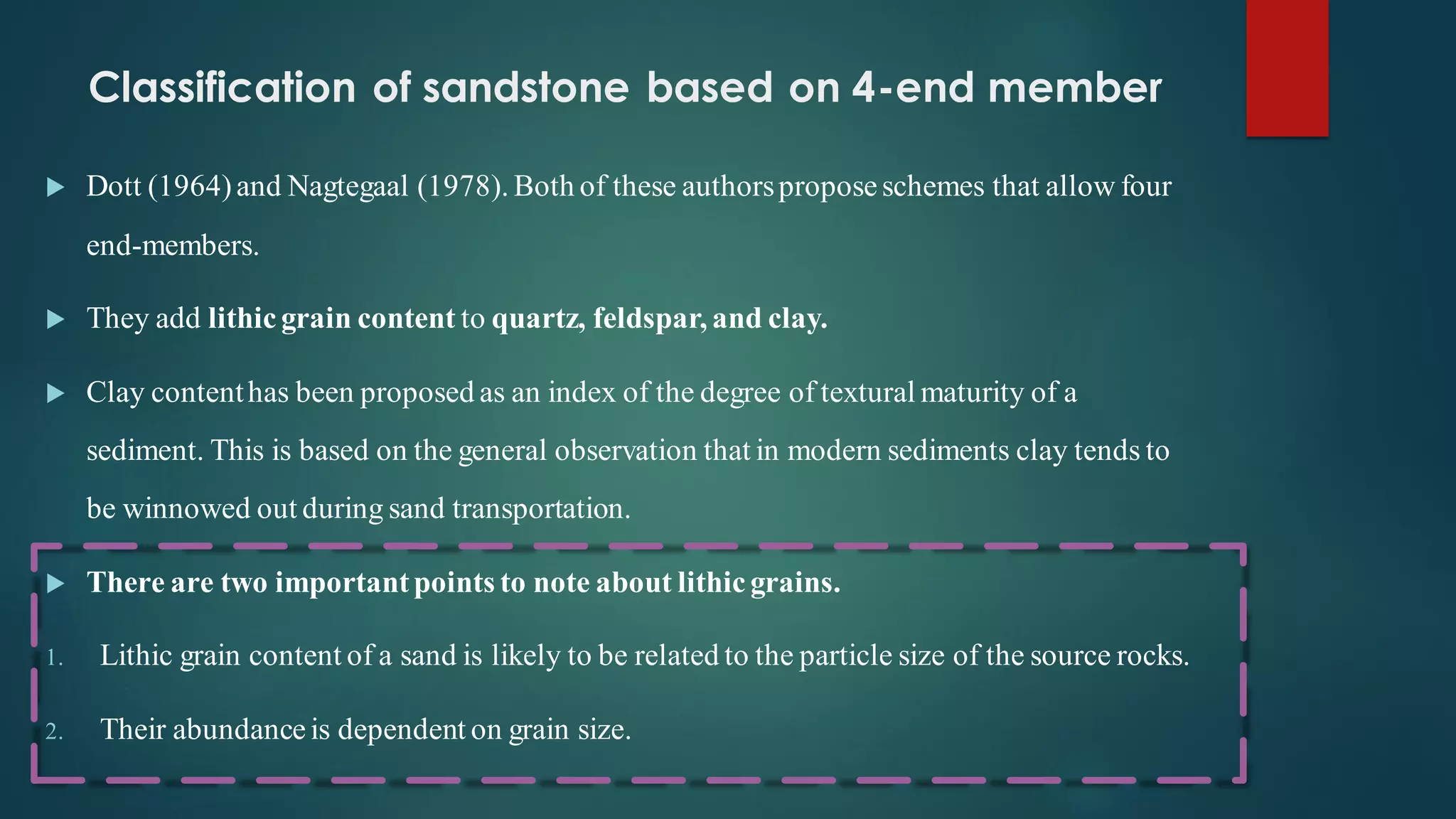
 Dott (1964)and Nagtegaal (1978). Both of these authorsproposeschemes that allow four
end-members.
 They add lithicgrain content to quartz, feldspar, and clay.
 Clay contenthas been proposed as an index of the degree of textural maturity of a
sediment. This is based on the general observation that in modern sediments clay tends to
be winnowed out during sand transportation.
 There are two importantpoints to note about lithicgrains.
1. Lithic grain content of a sand is likely to be related to the particle size of the source rocks.
2. Their abundanceis dependent on grain size.
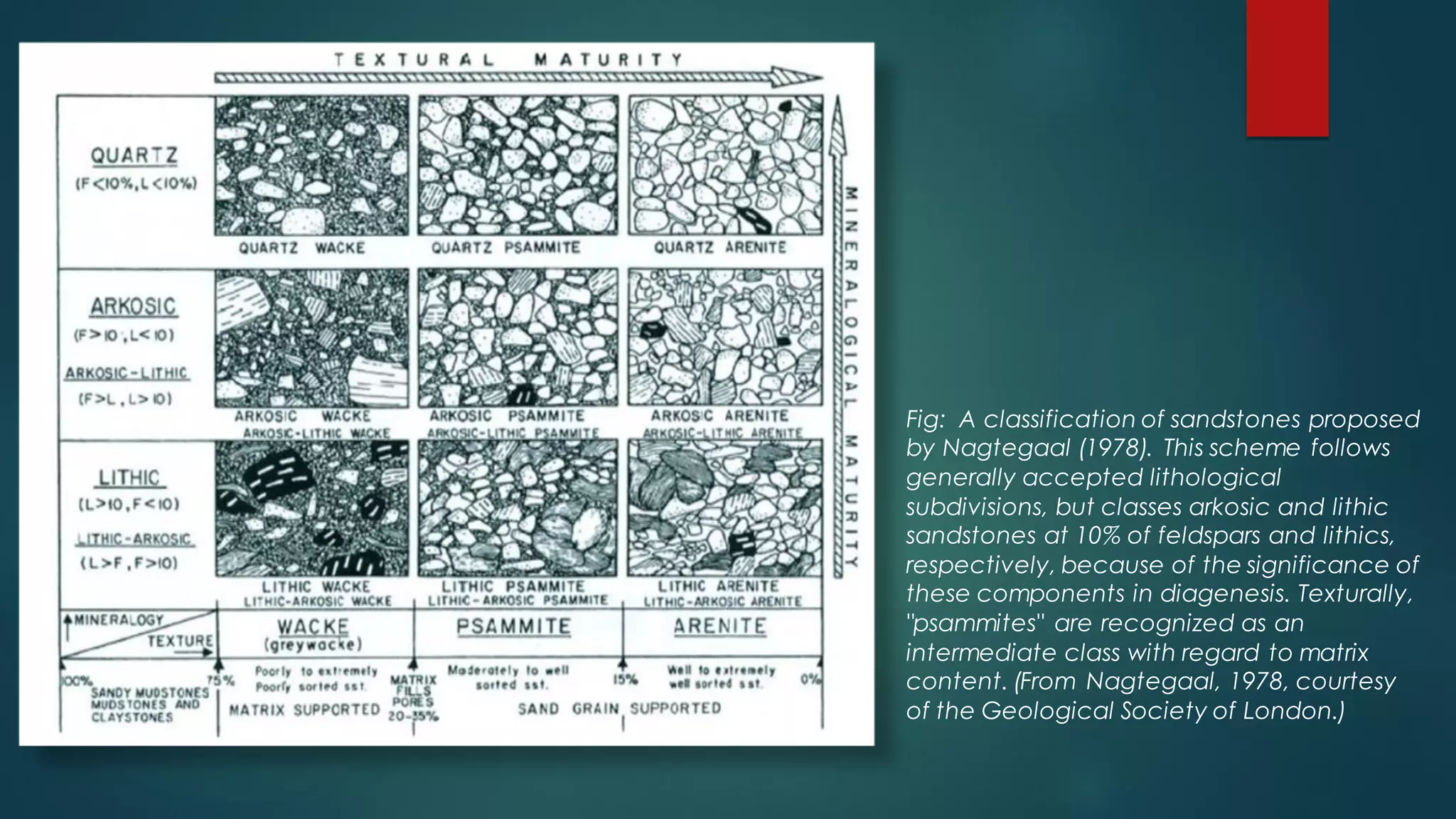
Fig: A classification of sandstones proposed
by Nagtegaal (1978). This scheme follows
generally accepted lithological
subdivisions, but classes arkosic and lithic
sandstones at 10% of feldspars and lithics,
respectively, because of the significance of
these components in diagenesis. Texturally,
"psammites" are recognized as an
intermediate class with regard to matrix
content. (From Nagtegaal, 1978, courtesy
of the Geological Society of London.)
Diagenesis & Porosity Evolution in Sandstone
Sandstonediagenesis occurs by three processes:
 Cementation
 Dissolution (leaching)
 Compaction
Cementation destroys pore space; grain leaching creates it. Compaction decreases porosity through
grain rearrangement, plastic deformation, pressure solution,and fracturing.
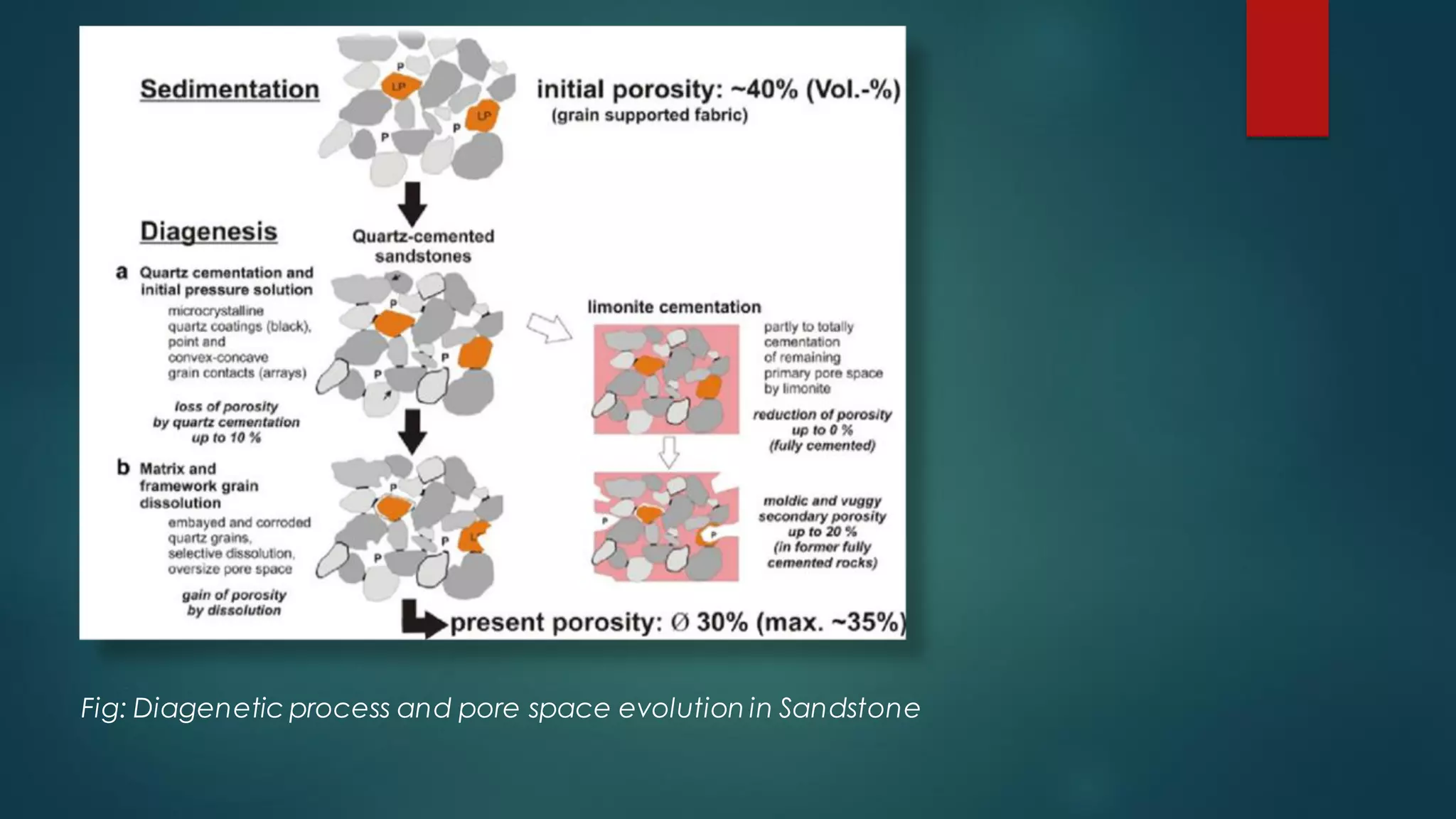
Fig: Diagenetic process and pore space evolution in Sandstone
Porosity gradient of sandstone
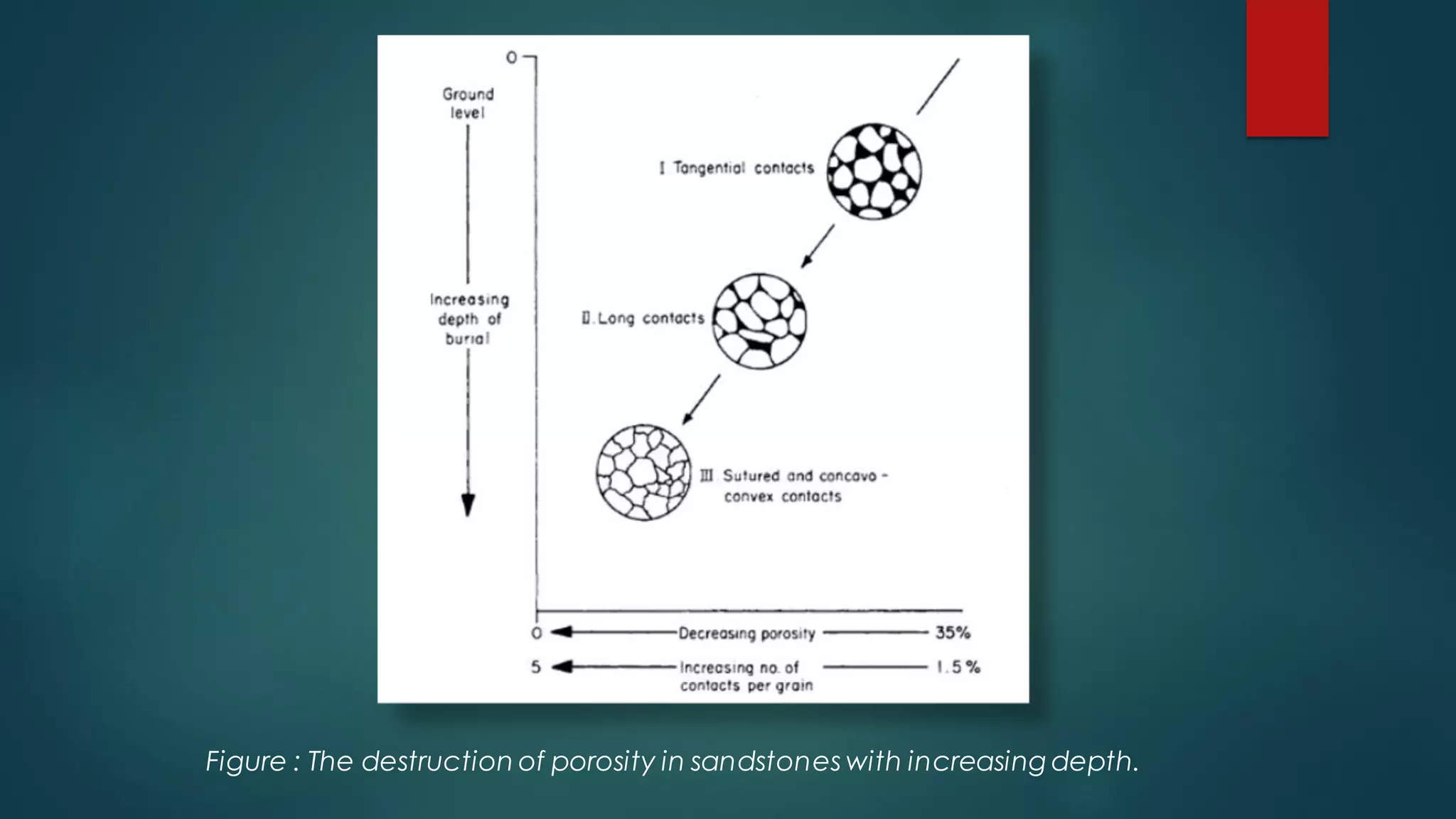
 The porosity of sandstones decreases with depth. The porosity of a sandstone at a given
depth may be expressed thus (Selley,1978):
ϕd = ϕp – G.D,
 where d is the porosity at depth D, p is the original porosity at the surface, G is the
porosity gradient, and D is the depth below surface.
 Fuchtbauer (1967), Wolf and Chilingarian (1976), Nagtegaal (1978), Magara (1980), and
Schmoker and Gautier (1988), who have produced an improved formula for calculating
porosity as an exponential function of depth:
ϕ = a .eᵇᶻ , where ϕ is the porosity, z is the depth, and a and b are constants representing
particularsediment properties.
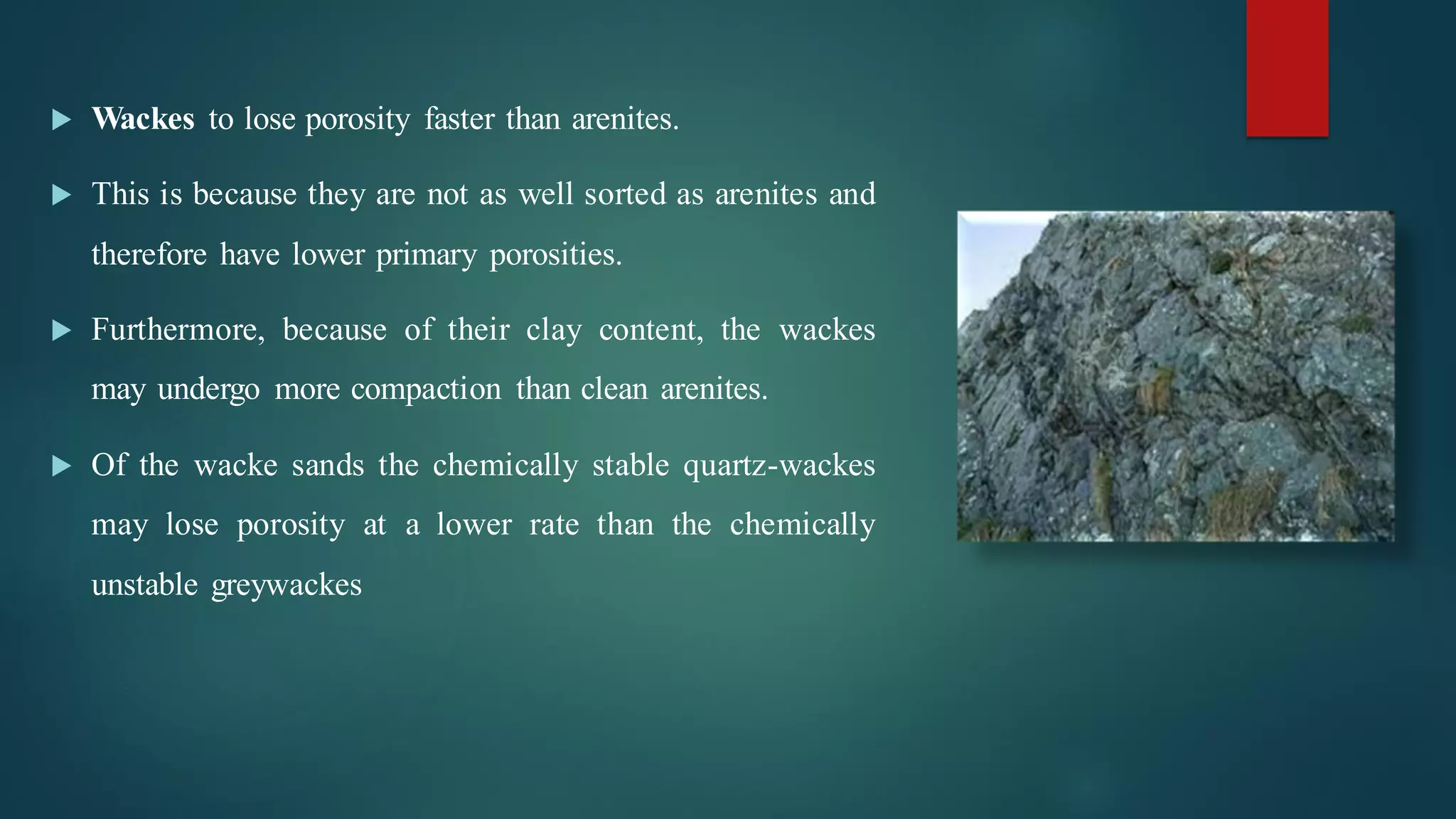
 Wackes to lose porosity faster than arenites.
 This is because they are not as well sorted as arenites and
therefore have lower primary porosities.
 Furthermore, because of their clay content, the wackes
may undergo more compaction than clean arenites.
 Of the wacke sands the chemically stable quartz-wackes
may lose porosity at a lower rate than the chemically
unstable greywackes
Figure : The destruction of porosity in sandstones with increasing depth.
Porosity loss by Cementation
 The three most common cements of sandstonesare carbonates, silica, and clays. Many other
authigenic minerals occurin sandstonesbut they are seldom sufficiently abundant to form the
dominant cementing mineral. These minerals includebarytes, celestite, anhydrite, halite,
hematite, and feldspar.
 The net effect of all these mineral cements is to diminishor completelydestroy the primary
intergranularporosityand the permeabilityof the sandstone.
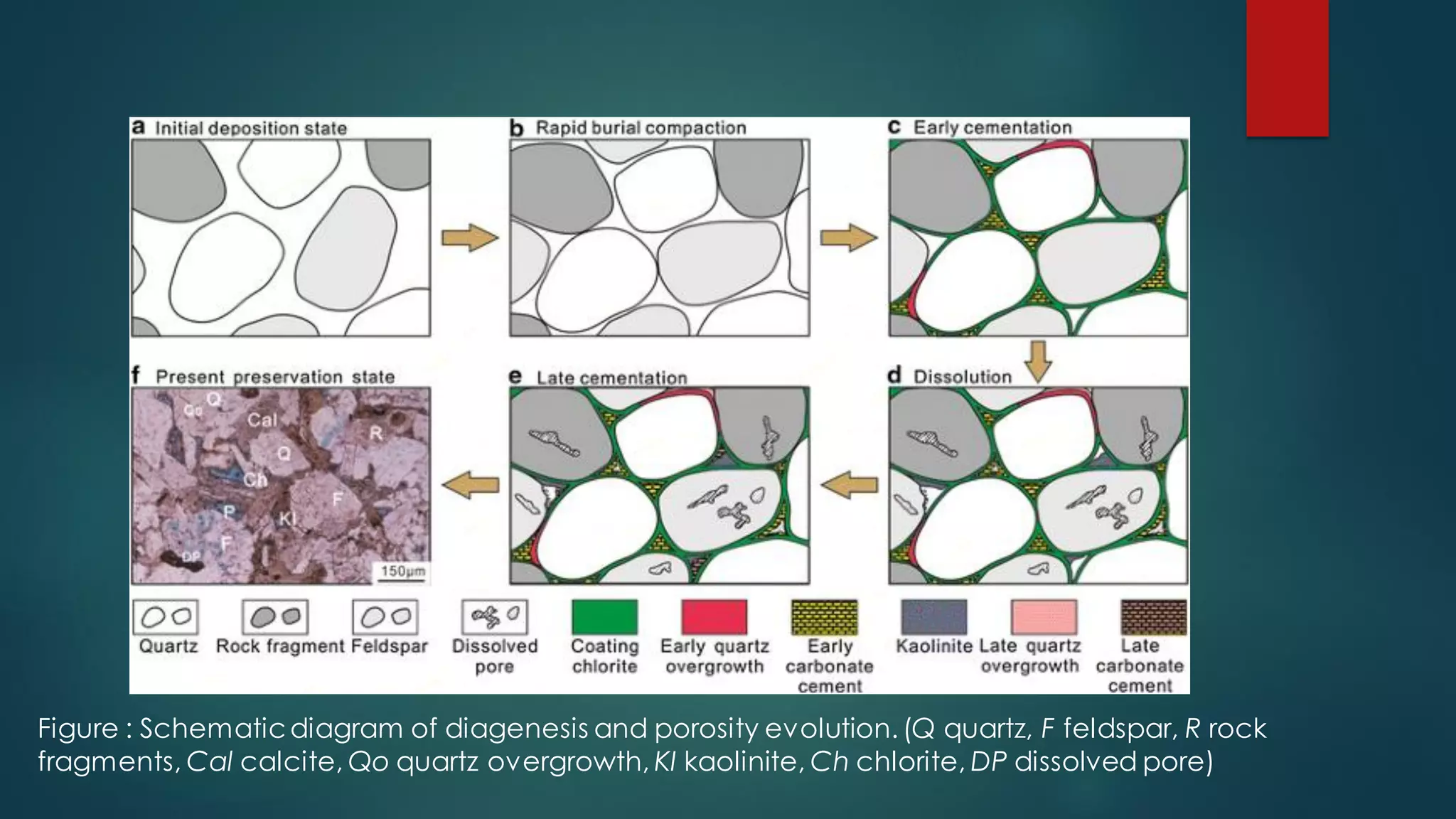
Figure : Schematicdiagram of diagenesis and porosity evolution.(Q quartz, F feldspar, R rock
fragments, Cal calcite, Qo quartz overgrowth, KI kaolinite, Ch chlorite, DP dissolved pore)
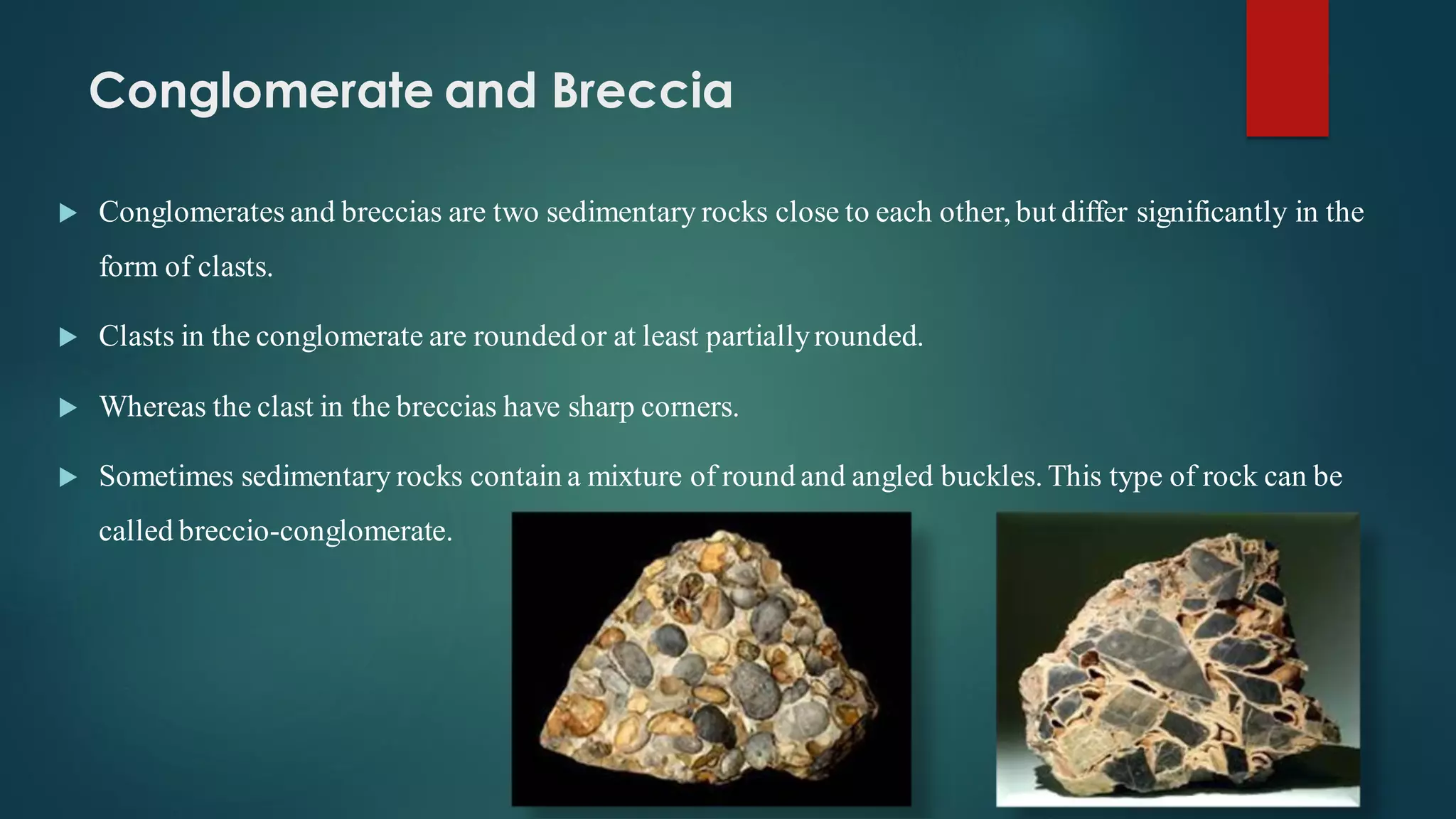
Conglomerate and Breccia
 Conglomerates and breccias are two sedimentary rocks close to each other, but differ significantly in the
form of clasts.
 Clasts in the conglomerate are roundedor at least partiallyrounded.
 Whereas the clast in the breccias have sharp corners.
 Sometimes sedimentary rocks contain a mixture of round and angled buckles. This type of rock can be
called breccio-conglomerate.
Conglomerate
 Conglomerate is a clastic sedimentary rock that shaped from rounded gravel and bouldersized
clasts cemented or in a matrix supported.
 Texture: Clastic (coarse-grained).
 Grain size: > 2mm; Clasts easily visible to the naked eye, should be identifiable.
 Hardness: Soft to hard, dependenton clast composition and strength of cement.
 Color: variable, dependenton clast and matrix composition.
 Clasts:variable, but generally harderrock types and / or minerals dominate.
 Other features: Clasts generally smooth to touch,matrix variable.
Classification of conglomerate based on composition
 The conglomerates can be divided into three groups by their composition.
1. Agglomerates : The volcaniclastic conglomerates.
2. Calcirudites: The Carbonateconglomerates.
3. Silicirudites: The terrigenous conglomerates.
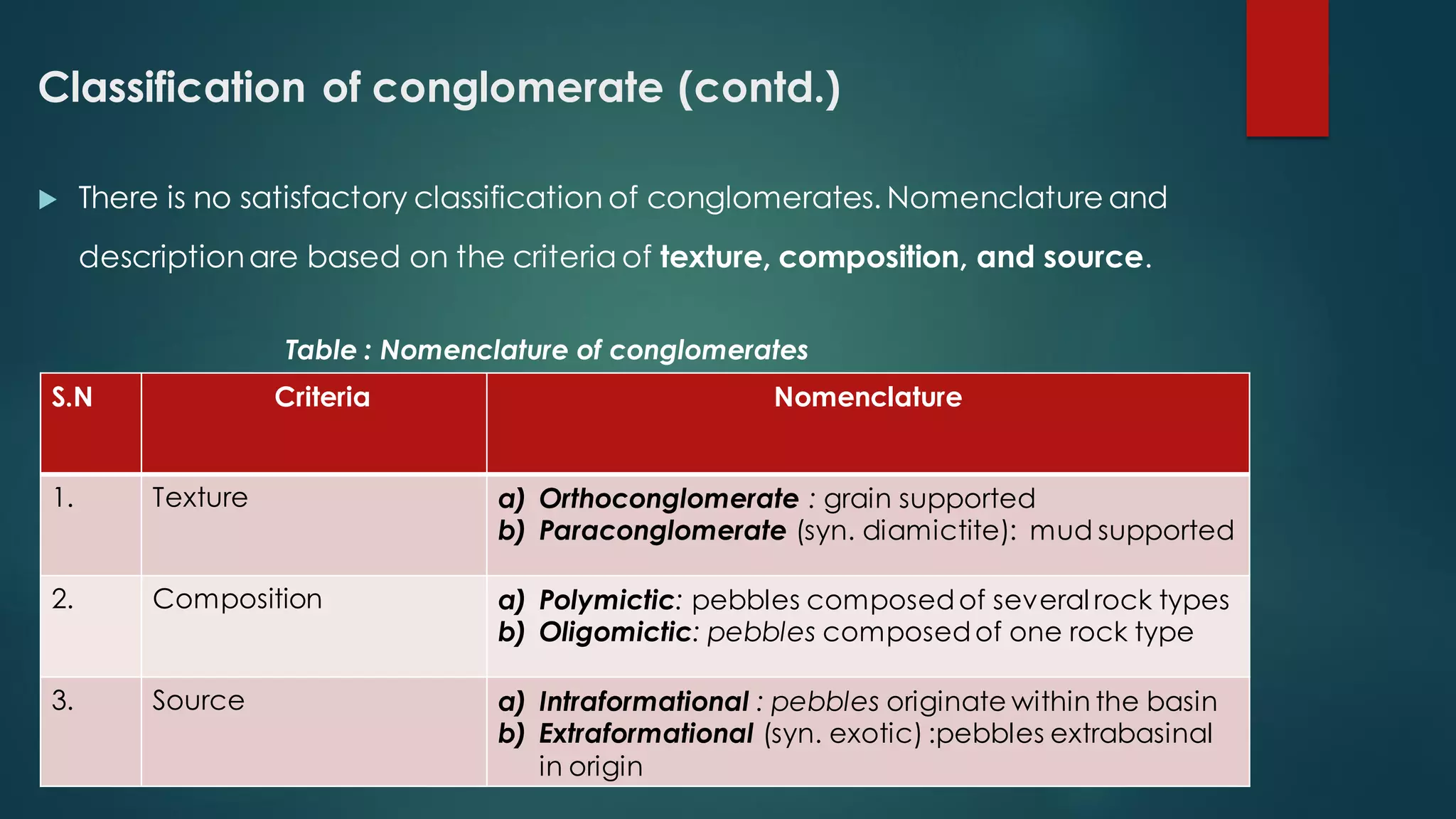
Classification of conglomerate (contd.)
 There is no satisfactory classification of conglomerates. Nomenclature and
descriptionare based on the criteria of texture, composition, and source.
S.N Criteria Nomenclature
1. Texture a) Orthoconglomerate : grain supported
b) Paraconglomerate (syn. diamictite): mud supported
2. Composition a) Polymictic: pebbles composedof several rock types
b) Oligomictic: pebbles composedof one rock type
3. Source a) Intraformational : pebbles originate within the basin
b) Extraformational (syn. exotic) :pebbles extrabasinal
in origin
Table : Nomenclature of conglomerates
Breccia
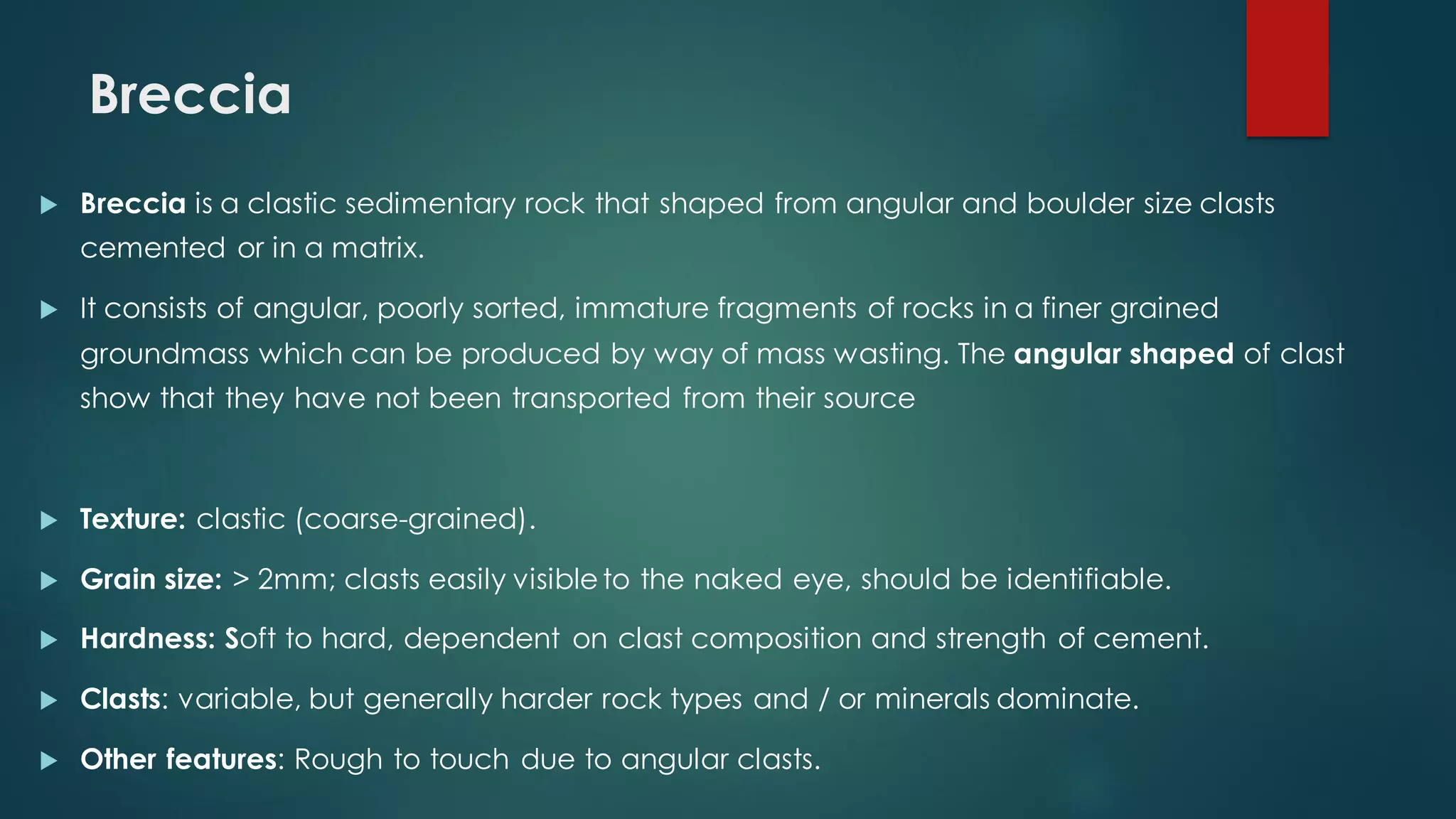
 Breccia is a clastic sedimentary rock that shaped from angular and boulder size clasts
cemented or in a matrix.
 It consists of angular, poorly sorted, immature fragments of rocks in a finer grained
groundmass which can be produced by way of mass wasting. The angular shaped of clast
show that they have not been transported from their source
 Texture: clastic (coarse-grained).
 Grain size: > 2mm; clasts easily visibleto the naked eye, should be identifiable.
 Hardness: Soft to hard, dependent on clast composition and strength of cement.
 Clasts: variable, but generally harder rock types and / or minerals dominate.
 Other features: Rough to touch due to angular clasts.
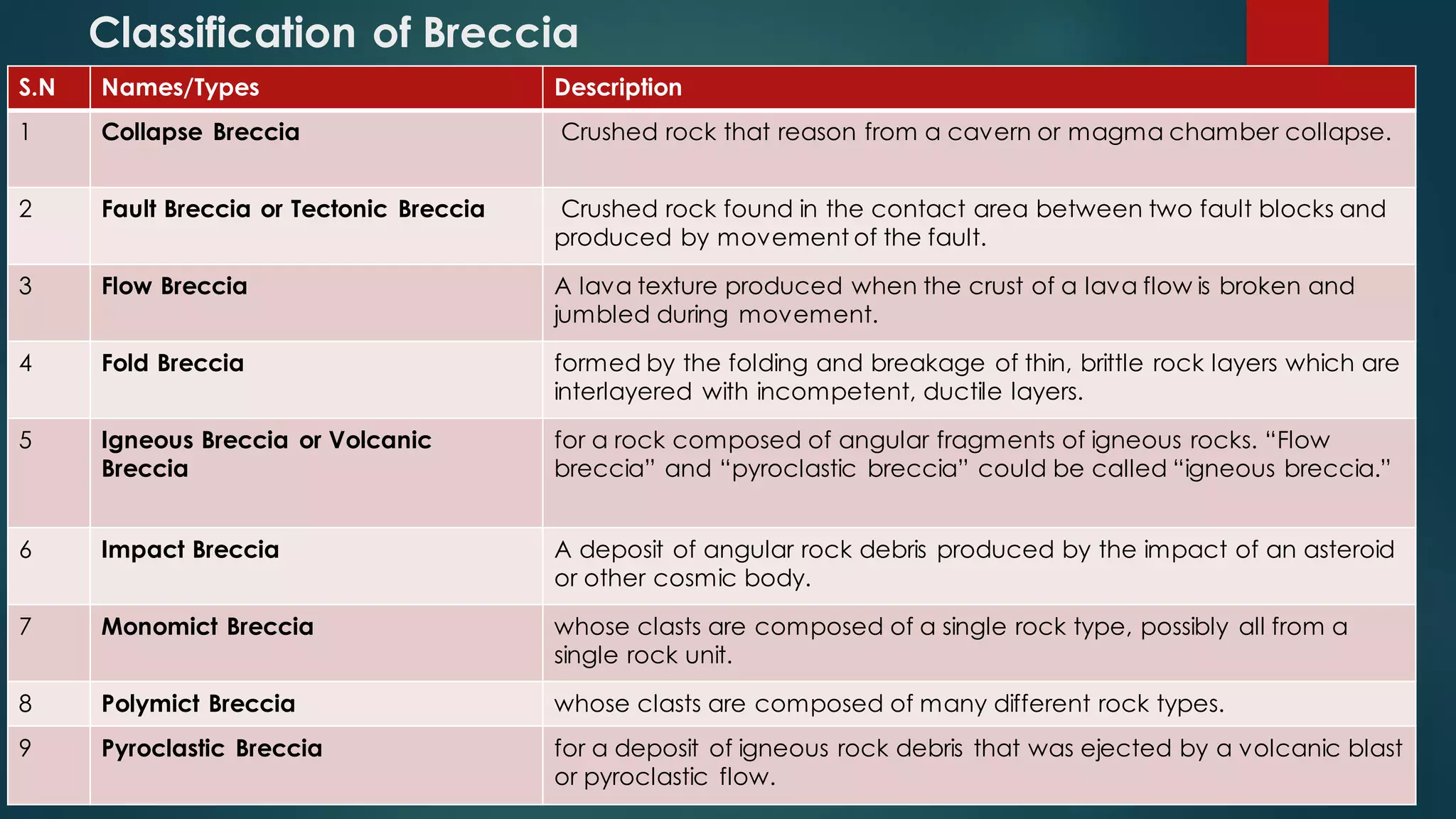
Classification of Breccia
S.N Names/Types Description
1 Collapse Breccia Crushed rock that reason from a cavern or magma chamber collapse.
2 Fault Breccia or Tectonic Breccia Crushed rock found in the contact area between two fault blocks and
produced by movement of the fault.
3 Flow Breccia A lava texture produced when the crust of a lava flow is broken and
jumbled during movement.
4 Fold Breccia formed by the folding and breakage of thin, brittle rock layers which are
interlayered with incompetent, ductile layers.
5 Igneous Breccia or Volcanic
Breccia
for a rock composed of angular fragments of igneous rocks. “Flow
breccia” and “pyroclastic breccia” could be called “igneous breccia.”
6 Impact Breccia A deposit of angular rock debris produced by the impact of an asteroid
or other cosmic body.
7 Monomict Breccia whose clasts are composed of a single rock type, possibly all from a
single rock unit.
8 Polymict Breccia whose clasts are composed of many different rock types.
9 Pyroclastic Breccia for a deposit of igneous rock debris that was ejected by a volcanic blast
or pyroclastic flow.
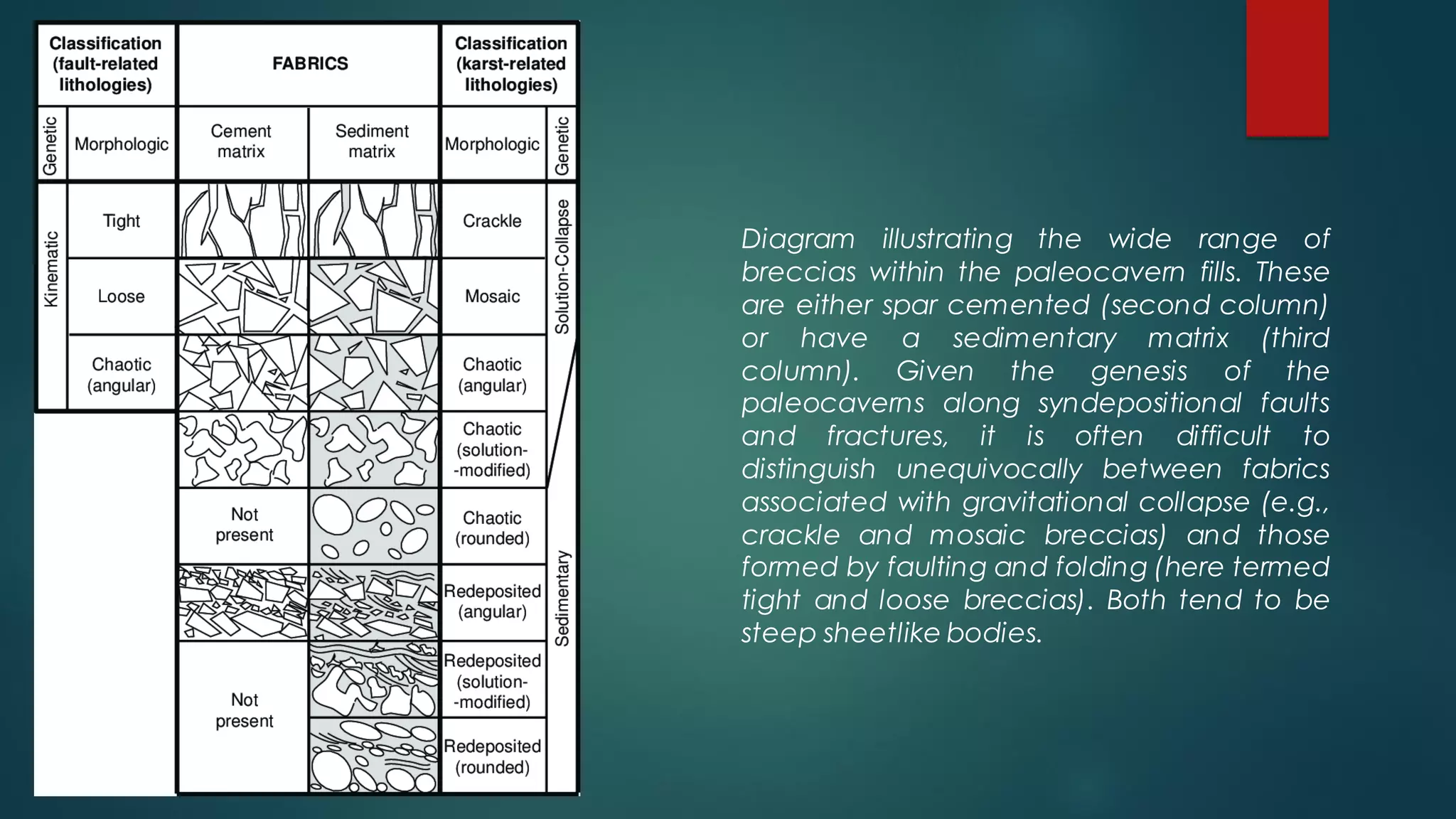
Diagram illustrating the wide range of
breccias within the paleocavern fills. These
are either spar cemented (second column)
or have a sedimentary matrix (third
column). Given the genesis of the
paleocaverns along syndepositional faults
and fractures, it is often difficult to
distinguish unequivocally between fabrics
associated with gravitational collapse (e.g.,
crackle and mosaic breccias) and those
formed by faulting and folding (here termed
tight and loose breccias). Both tend to be
steep sheetlike bodies.
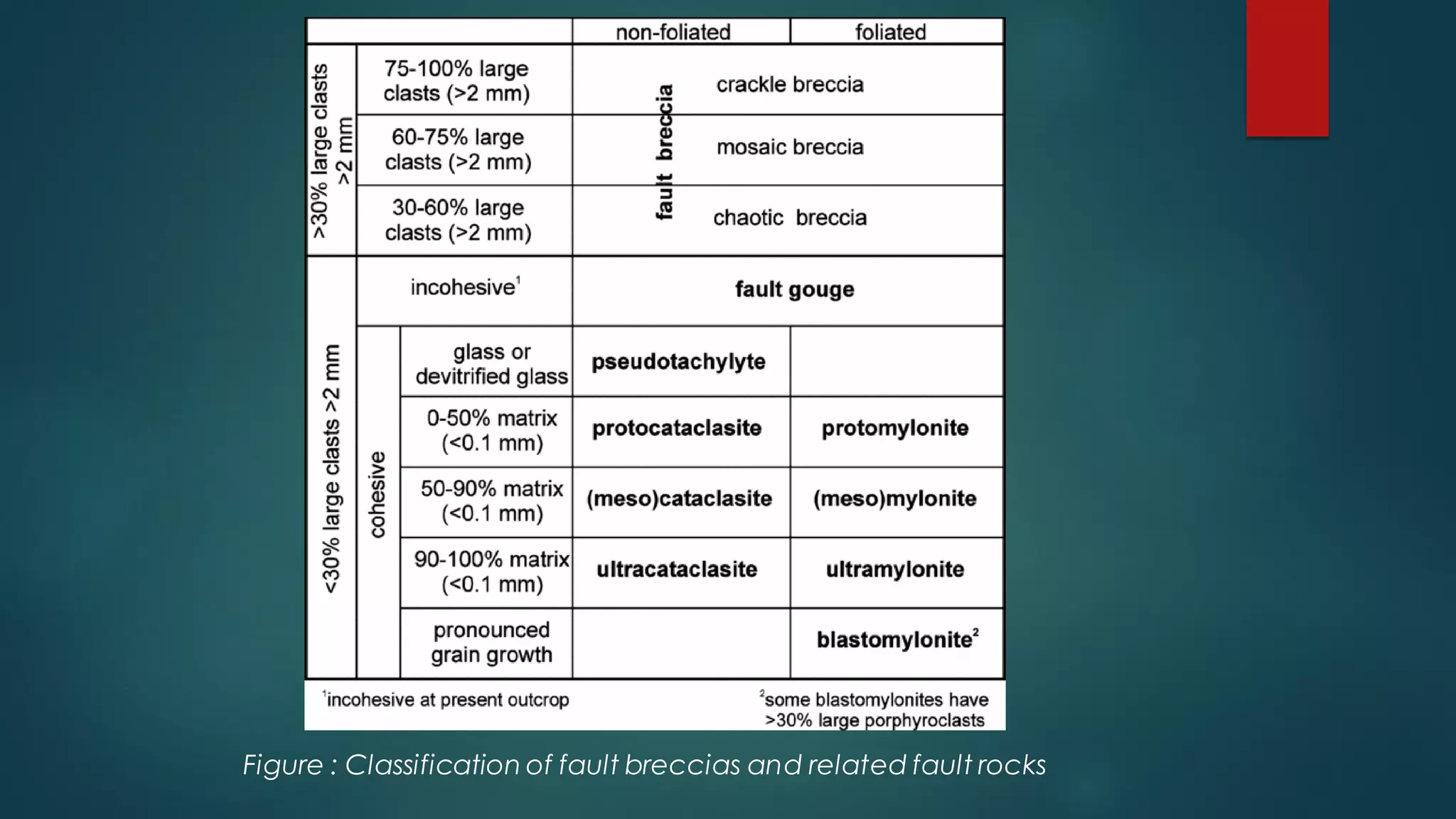
Figure : Classification of fault breccias and related fault rocks
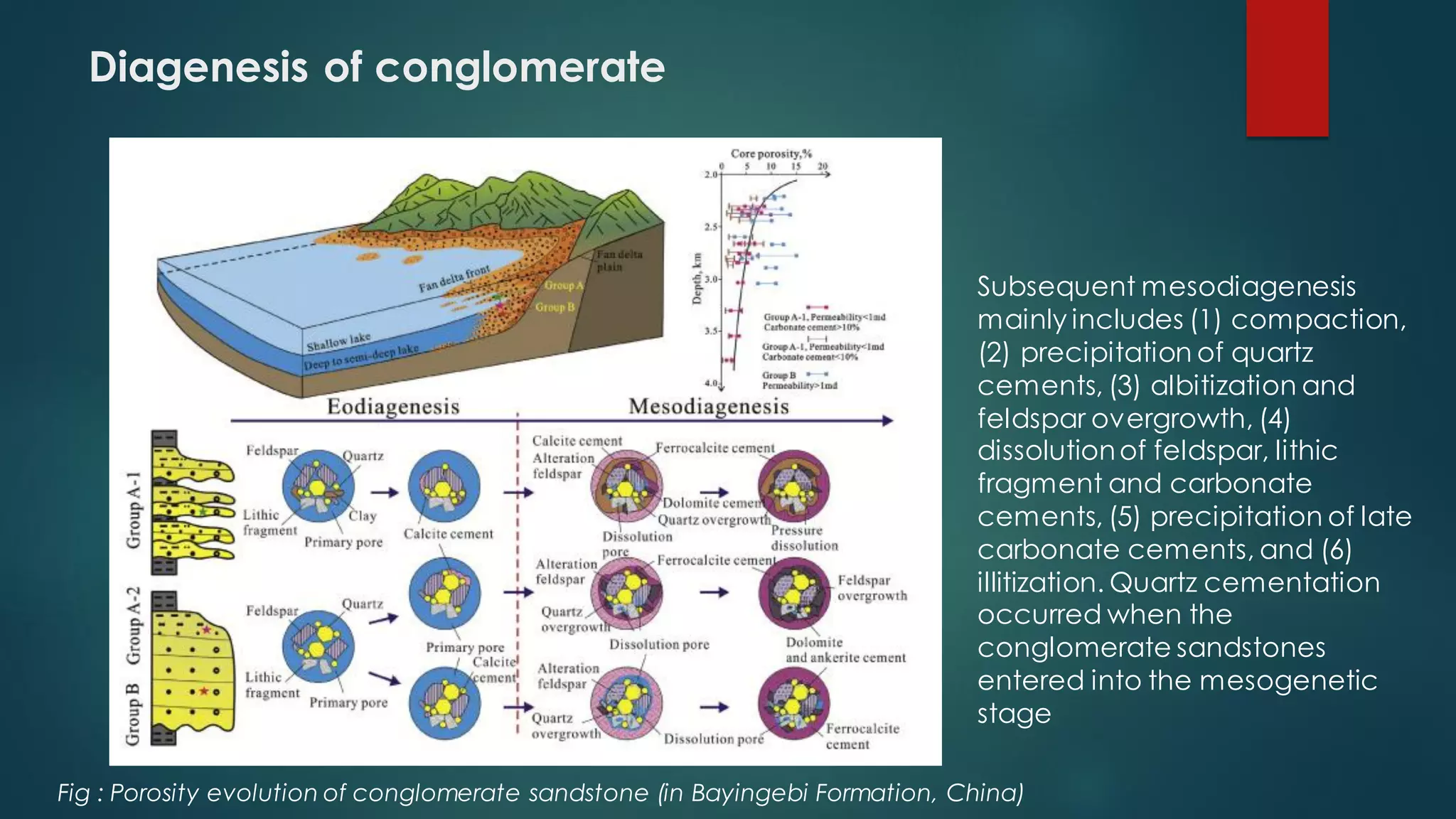
Diagenesis of conglomerate
Subsequent mesodiagenesis
mainly includes (1) compaction,
(2) precipitation of quartz
cements, (3) albitization and
feldspar overgrowth, (4)
dissolutionof feldspar, lithic
fragment and carbonate
cements, (5) precipitation of late
carbonate cements, and (6)
illitization. Quartz cementation
occurred when the
conglomerate sandstones
entered into the mesogenetic
stage
Fig : Porosity evolution of conglomerate sandstone (in Bayingebi Formation, China)
Uses of Allochthonous Sediments
 Allochthonous sediments contribute to seasonal and spatial variability of organic
matter sedimentation.
 Sandstone is popular in constructing buildings because it is resistant to weathering.
 Conglomerate can be used as a fill material for roads and construction. Hard
rock may be cut and polished to make dimension stone.
 Mudrocks are important in the preservation of petroleum and natural gas
THANK YOU !!

Classification of sedimentary rock- Allochthonous sediments.pdf

  • 1.
  • 2.
    INTRODUCTION  Hatch etal., 1971 recognized five main classes of sediments : chemical, organic, residual, terrigenous, and pyroclstic.  Allochthonous sediments consists of terrigenous and pyroclastic classes while rest are autochthonous sediments.  The allochthonous sediments are those that are transported into the environment in which they are deposited.
  • 3.
    Group Class Examples I.Autochthonous sediment a) Chemical precipitates b) Organic deposits c) Residual deposits a) The evaporates, gypsum,rock salt etc. b) Coal, limestone etc. c) Laterites, bauxites, etc. II. Allochthonous sediment d) Terrigenous deposits e) Pyroclastic deposits d) Clay, siliclastics sands, and conglomerate e) Ashes, tuffs, volcaniclastics sands, and agglomerates. Table : Classification of Sedimentary Rocks
  • 4.
    Classification using End-Memberconcept  Sediments containing three constituents can be classified in a triangular diagram in which each apex represents 100% of one of the three constituents. (Lime, Clay, Silica)  Four component sediment( Lime,Clay,Silica,Dolomite) systems can be plotted in three dimensions within the faces of a tetrahedron.  Because sedimentary rocks contain many components, neither of these systems is entirely satisfactory.
  • 5.
    Example for 3-componentsediment Fig : An example of the end-member classification style. This triangle differentiates sands, claystones, and limestones.
  • 6.
    Example for 4-componentsediment Fig : An example of the end-member classification style. This tetrahedron differentiates four- component systems, in this case limestones, dolomites, sandstones, and clays.
  • 7.
    End member classificationbased on grain size Fig: A classification of the allochthonous sediments based on grain size and composition.
  • 8.
     Sediment descriptionpredominantly emphasizes grain size and texture rather than mineral composition. Hence a scheme similar to that used in figure below: Fig : An end-member triangle for classifying unconsolidated sediment on the basis of grain size. (From Shepard, 1954. Courtesy of the Society for Sedimentary Geology.)
  • 9.
    Murdocks ❖ Mudrocks arefine grained sedimentary rocks consisting of mostly silt and clay size fragments. They are sometimes called argillites. ❖ Mudrocks composed largely of admixtures of various clay minerals can be termed "claystones,“ or more pedantically, "orthoclaystones," to indicate their purity. ❖ In Recent deposits, sediments referred to as mud are wet clays with a certain amount of silt and sand. Its lithified equivalent is termed "mudstone.“ ❖ More rigidly defined, however, are clay and silt in the Wentworth grade scale. Clays are sediments with particles smaller than 0.0039 mm. Silts have a grain size between 0.0039 and 0.0625 mm. Their lithified equivalents are claystone and siltstone, respectively.
  • 10.
    Classification of Mudrocks 1.Sapropelites, Oil shales, and Oil Sources Rocks 2. Orthoclaystonesand Clay Minerals I. Illite Group II. Smecite Group III. Chlorite IV. Glauconite V. Glauconite VI. Compaction of clays VII. Clay and clay diagenesis
  • 11.
    Triangular Classification ofMudrocks Fig : Triangular diagram illustrating the nomenclatureand composition of the mudrocks.
  • 12.
    1. Sapropelites, Oilshales, & Oil Source Rocks  Organic matter is present in at least small quantities in all sediments. It is, however, most abundant in the mudrocks and has been studied intensively.  Sapropelite is a name given to organic-rich mudrocks.  Oil shales are mudrocks that are sufficiently rich in organic matter to yield free oil on heating (Duncan, 1967).  With increasing organic content, the claystones grade from organic claystone into oil shale (or, strictly, oil claystone) and thence into the dominantly carbonaceous sapropelites, torbanites, and coals.
  • 13.
  • 14.
    Sapropelites, Oil shales,& Oil Source Rocks (contd.)  Essentially the organic matter in sediments is of four types: kerogen, asphalt, crude oil, and natural gas.  Kerogen is the major constituent of the organic-rich mudrocks (see Tissot and Welte,1984; Hunt, 1996).  Kerogen is a dark gray-black amorphous solid that is present in varying quantities in mudrocks; when pure it is termed "coal.“  It contains between 70 and 80% carbon, 7 and 11% hydrogen, 10 and 15% oxygen, and traces of nitrogen and sulfur.
  • 15.
     Crude oiloccurs in pore spaces of many rocks in favorable circumstances. It consists of 82- 87% carbon, 12-15% hydrogen, and traces of sulfur, nitrogen, and oxygen.  Asphalt occurs both in infilling sediment pores and in fractures. It contains 80-85% carbon, 9- 10% hydrogen, and 2-8% sulfur, with traces of nitrogen and negligible oxygen.  It is now realized that a mudrock needs to contain over 1.5 % organic carbon to be a significant source rock.  Oil generation normally takes place between 60 and 120°C gas generation occurs between about 120 and 220°C above which the kerogen has been reduced to inert carbon
  • 16.
    Figure showing sourcerock for oils and oil filledpores
  • 17.
    Organic matter Properties Average composition (%weight) C H2S+N+O2, etc. Kerogene Solidat surface temperatures and pressures. Insolublein normal petroleum solvents. 75 10 15 Asphalt Solidor plastic at surface temperatures and pressures. Soluble in normal petroleum solvents. 83 10 7 Crude oil Liquid at surface temperatures and pressures. 85 13 2 Natural gas Gaseous at surface temperatures and pressures. 70 20 10 Table : Properties and Compositionof the Main Groups of Organic Hydrocarbons
  • 18.
    Orthoclaystone & Clayminerals  The orthoclaystones are clay-grade rocks composed mainly of the clay group of minerals (Moore and Reynolds, 1997; Schieber et al., 1998a,b; Srodon, 1999).  The three principal groups of clay minerals are the illites, the montmorillonites or smectites, and kaolinite.  Clays are deposited with porosities ranging between 50 and 80%.  Water is lost from most clays immediately after deposition by consolidation, the process whereby a clay is changed to claystone. This includes both cementation and dehydration, as well as compaction due to overburden pressure. Kaolinite Claystone
  • 19.
    Clays and ClayDiagenesis  As clays compact and bury they also undergo a number of geochemical changes. These occur in three main stages: diagenesis, catagenesis, and metagenesis.  Diagenesis refers to processes operating in the first 2 km of burial. As already seen this is the zone in which porosity is lost rapidly by compaction.  Chemical reactions take place at relativelylow temperatures and pressures.  They are intimately related to bacterial reactions of organic matter.
  • 20.
    Clays and ClayDiagenesis (contd.)  The shallowest diagenetic zone is one of oxygenation. This is very thin or completely absent in subaqueously deposited muds.  Diagenesis merges into catagenesis toward about 2 km as the temperature exceeds 50°C.  At temperatures of about 100-110°C the montmorillonite lattice collapses, to expel a large volume of pore water, and hence increase the pore pressure. Montmorillonite and kaolinite change into illite.  The changes that occur in clays as they change to claystones at greater depths is of interest to the petroleum geologist
  • 21.
    Fig : Graphof hydrogen: carbon ratio plotted against oxygen: carbon ratio showing the diagenetic pathways of the different types of kerogen. Note that the generation of oil and gas is contingent both on their level of maturation and the original composition of the kerogen. Type I kerogen generates principally oil, type II, both oil and gas, and type III, principally gas.
  • 22.
    Table : Summaryof the Salient Features of the Main Groups of Clay Minerals and Their Associates
  • 23.
    Fig : Claycompaction curves, compiled from data in Addis and Jones (1986) and Dzevanshir et al. (1986). Note that porosity is lost very rapidly in the first 2 km of burial. Thereafter, the rate is much slower and approximately linear.
  • 24.
    Fig : Burialdepth diagram showing thephases of clay diagenesis and thematurationof contained organicmatter.No attempt has been made to show a vertical scale on thisfigure because many of thereactionsextend over a wide range of temperatures.Thus, as geothermal gradientsvary, so may thedepthsof thedifferent diageneticphases.
  • 25.
    Sandstone  Sandstone isclastic sedimentary rock made of sand grain 0.5mm to 2mm, comprised of quartz or feldspar.  About 30% of the land's sedimentary cover is made of terrigenous sand and sandstone.  They are more uniform in stratigraphy and petrophysical character than carbonates and it is, therefore, easier to predict their geometry and reservoir performance.
  • 26.
    Nomenclature of sandstonebased on maturity  One of the most fruitful conceptson which sandstonenomenclatureis based is the idea of maturity. The maturation of a sand takes place in two ways. I. Physical Maturity II. Chemical Maturity  Both physical and chemical maturation occurduring the history of a sand population, but they are not closely related (Johnsson and Basu, 1993).
  • 27.
    I. Physical Maturity It describes the textural changes that a sediment undergoesfrom the time it is weathered until it is deposited.  These changes involve both an increase in the degree of sorting and a decrease in matrix content. Thus an index of the degree of physical maturation might be the ratio of grains to matrix.  Total clay contentis a useful index of textural maturation, given certain reservations to be discussed shortly.
  • 28.
    II. Chemical Maturity Throughout weatheringand transportationrelatively unstableminerals are destroyed and chemically stable minerals thus increase proportionally.  Quartz is the most abundant stablemineral and feldspar is a common example of an unstablemineral. An index of the chemical maturity of a rock might, therefore, be the ratio of quartzto feldspar.  As sediments are reworked, perhaps through two or more cycles of sediment, they thus tend to mature to pure quartz sands.
  • 29.
    End-member classification ofsandstone  Using quartz, feldspar, and clay as end-members, a sand classification scheme can be drawn up.  This shows that sands may be divided into two broad textural types 1) Arenites 2) Wackes I. Arenites : Arenites, with a matrix content of less than 15%, are texturallymature. II. Wackes : Wackes, with a matrix content of between 15 and 75%, are immature.  Rocks with more than 75 % matrix are not sandstonesbut mudrocks.  Similarly, sands can be divided into chemically mature arenites and chemically mature wackes. These both have less than 25 % of feldspar.
  • 30.
    Fig. 8.11. End-membertriangle in which a sand may be plotted to illustrate its maturity indices expressed as the percentage composition of matrix, stable and unstable grains. Gs, chemically stable grains; Gu, chemically unstable grains; M, matrix content; Mp, physical maturity index, Mc, chemical maturity index; Mn, net maturity index.
  • 31.
    Fig : Aclassification of sandstones based on the use of clay as an indicator of textural maturity, and feldspar as an index of chemical maturity.
  • 32.
    Classification of sandstonebased on 4-end member  Dott (1964)and Nagtegaal (1978). Both of these authorsproposeschemes that allow four end-members.  They add lithicgrain content to quartz, feldspar, and clay.  Clay contenthas been proposed as an index of the degree of textural maturity of a sediment. This is based on the general observation that in modern sediments clay tends to be winnowed out during sand transportation.  There are two importantpoints to note about lithicgrains. 1. Lithic grain content of a sand is likely to be related to the particle size of the source rocks. 2. Their abundanceis dependent on grain size.
  • 33.
    Fig: A classificationof sandstones proposed by Nagtegaal (1978). This scheme follows generally accepted lithological subdivisions, but classes arkosic and lithic sandstones at 10% of feldspars and lithics, respectively, because of the significance of these components in diagenesis. Texturally, "psammites" are recognized as an intermediate class with regard to matrix content. (From Nagtegaal, 1978, courtesy of the Geological Society of London.)
  • 34.
    Diagenesis & PorosityEvolution in Sandstone Sandstonediagenesis occurs by three processes:  Cementation  Dissolution (leaching)  Compaction Cementation destroys pore space; grain leaching creates it. Compaction decreases porosity through grain rearrangement, plastic deformation, pressure solution,and fracturing.
  • 35.
    Fig: Diagenetic processand pore space evolution in Sandstone
  • 36.
    Porosity gradient ofsandstone  The porosity of sandstones decreases with depth. The porosity of a sandstone at a given depth may be expressed thus (Selley,1978): ϕd = ϕp – G.D,  where d is the porosity at depth D, p is the original porosity at the surface, G is the porosity gradient, and D is the depth below surface.  Fuchtbauer (1967), Wolf and Chilingarian (1976), Nagtegaal (1978), Magara (1980), and Schmoker and Gautier (1988), who have produced an improved formula for calculating porosity as an exponential function of depth: ϕ = a .eᵇᶻ , where ϕ is the porosity, z is the depth, and a and b are constants representing particularsediment properties.
  • 37.
     Wackes tolose porosity faster than arenites.  This is because they are not as well sorted as arenites and therefore have lower primary porosities.  Furthermore, because of their clay content, the wackes may undergo more compaction than clean arenites.  Of the wacke sands the chemically stable quartz-wackes may lose porosity at a lower rate than the chemically unstable greywackes
  • 38.
    Figure : Thedestruction of porosity in sandstones with increasing depth.
  • 39.
    Porosity loss byCementation  The three most common cements of sandstonesare carbonates, silica, and clays. Many other authigenic minerals occurin sandstonesbut they are seldom sufficiently abundant to form the dominant cementing mineral. These minerals includebarytes, celestite, anhydrite, halite, hematite, and feldspar.  The net effect of all these mineral cements is to diminishor completelydestroy the primary intergranularporosityand the permeabilityof the sandstone.
  • 40.
    Figure : Schematicdiagramof diagenesis and porosity evolution.(Q quartz, F feldspar, R rock fragments, Cal calcite, Qo quartz overgrowth, KI kaolinite, Ch chlorite, DP dissolved pore)
  • 41.
    Conglomerate and Breccia Conglomerates and breccias are two sedimentary rocks close to each other, but differ significantly in the form of clasts.  Clasts in the conglomerate are roundedor at least partiallyrounded.  Whereas the clast in the breccias have sharp corners.  Sometimes sedimentary rocks contain a mixture of round and angled buckles. This type of rock can be called breccio-conglomerate.
  • 42.
    Conglomerate  Conglomerate isa clastic sedimentary rock that shaped from rounded gravel and bouldersized clasts cemented or in a matrix supported.  Texture: Clastic (coarse-grained).  Grain size: > 2mm; Clasts easily visible to the naked eye, should be identifiable.  Hardness: Soft to hard, dependenton clast composition and strength of cement.  Color: variable, dependenton clast and matrix composition.  Clasts:variable, but generally harderrock types and / or minerals dominate.  Other features: Clasts generally smooth to touch,matrix variable.
  • 43.
    Classification of conglomeratebased on composition  The conglomerates can be divided into three groups by their composition. 1. Agglomerates : The volcaniclastic conglomerates. 2. Calcirudites: The Carbonateconglomerates. 3. Silicirudites: The terrigenous conglomerates.
  • 44.
    Classification of conglomerate(contd.)  There is no satisfactory classification of conglomerates. Nomenclature and descriptionare based on the criteria of texture, composition, and source. S.N Criteria Nomenclature 1. Texture a) Orthoconglomerate : grain supported b) Paraconglomerate (syn. diamictite): mud supported 2. Composition a) Polymictic: pebbles composedof several rock types b) Oligomictic: pebbles composedof one rock type 3. Source a) Intraformational : pebbles originate within the basin b) Extraformational (syn. exotic) :pebbles extrabasinal in origin Table : Nomenclature of conglomerates
  • 45.
    Breccia  Breccia isa clastic sedimentary rock that shaped from angular and boulder size clasts cemented or in a matrix.  It consists of angular, poorly sorted, immature fragments of rocks in a finer grained groundmass which can be produced by way of mass wasting. The angular shaped of clast show that they have not been transported from their source  Texture: clastic (coarse-grained).  Grain size: > 2mm; clasts easily visibleto the naked eye, should be identifiable.  Hardness: Soft to hard, dependent on clast composition and strength of cement.  Clasts: variable, but generally harder rock types and / or minerals dominate.  Other features: Rough to touch due to angular clasts.
  • 46.
    Classification of Breccia S.NNames/Types Description 1 Collapse Breccia Crushed rock that reason from a cavern or magma chamber collapse. 2 Fault Breccia or Tectonic Breccia Crushed rock found in the contact area between two fault blocks and produced by movement of the fault. 3 Flow Breccia A lava texture produced when the crust of a lava flow is broken and jumbled during movement. 4 Fold Breccia formed by the folding and breakage of thin, brittle rock layers which are interlayered with incompetent, ductile layers. 5 Igneous Breccia or Volcanic Breccia for a rock composed of angular fragments of igneous rocks. “Flow breccia” and “pyroclastic breccia” could be called “igneous breccia.” 6 Impact Breccia A deposit of angular rock debris produced by the impact of an asteroid or other cosmic body. 7 Monomict Breccia whose clasts are composed of a single rock type, possibly all from a single rock unit. 8 Polymict Breccia whose clasts are composed of many different rock types. 9 Pyroclastic Breccia for a deposit of igneous rock debris that was ejected by a volcanic blast or pyroclastic flow.
  • 47.
    Diagram illustrating thewide range of breccias within the paleocavern fills. These are either spar cemented (second column) or have a sedimentary matrix (third column). Given the genesis of the paleocaverns along syndepositional faults and fractures, it is often difficult to distinguish unequivocally between fabrics associated with gravitational collapse (e.g., crackle and mosaic breccias) and those formed by faulting and folding (here termed tight and loose breccias). Both tend to be steep sheetlike bodies.
  • 48.
    Figure : Classificationof fault breccias and related fault rocks
  • 49.
    Diagenesis of conglomerate Subsequentmesodiagenesis mainly includes (1) compaction, (2) precipitation of quartz cements, (3) albitization and feldspar overgrowth, (4) dissolutionof feldspar, lithic fragment and carbonate cements, (5) precipitation of late carbonate cements, and (6) illitization. Quartz cementation occurred when the conglomerate sandstones entered into the mesogenetic stage Fig : Porosity evolution of conglomerate sandstone (in Bayingebi Formation, China)
  • 50.
    Uses of AllochthonousSediments  Allochthonous sediments contribute to seasonal and spatial variability of organic matter sedimentation.  Sandstone is popular in constructing buildings because it is resistant to weathering.  Conglomerate can be used as a fill material for roads and construction. Hard rock may be cut and polished to make dimension stone.  Mudrocks are important in the preservation of petroleum and natural gas
  • 51.