Photo by W. W. Little
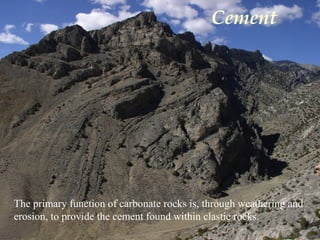
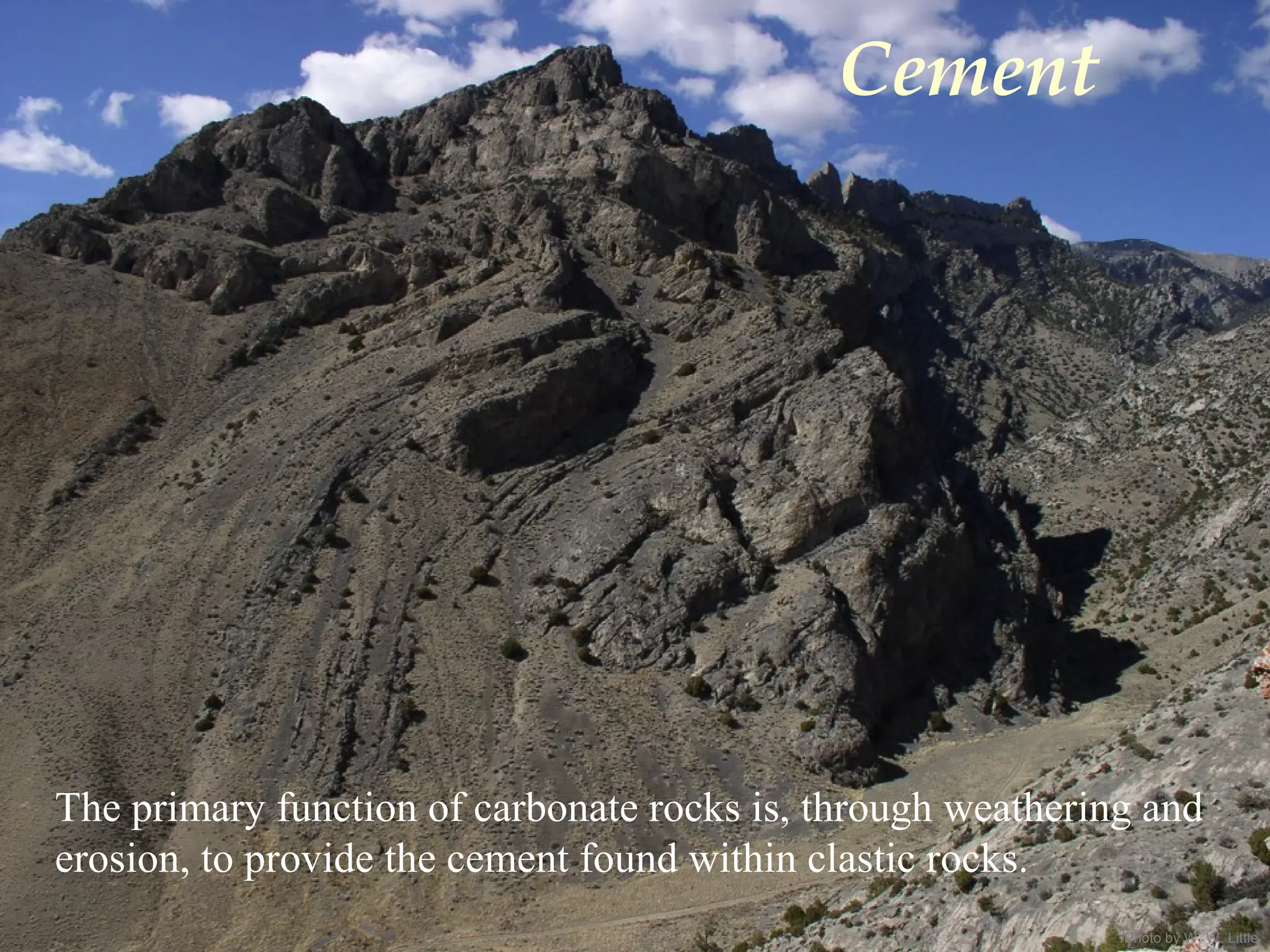
The primary function of carbonate rocks is, through weathering and
erosion, to provide the cement found within clastic rocks.
Cement
Photo by W. W. Little
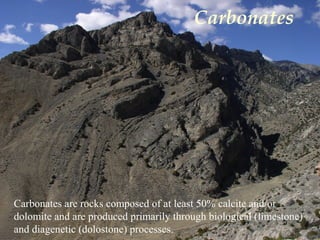
Carbonates are rocks composed of at least 50% calcite and/or
dolomite and are produced primarily through biological (limestone)
and diagenetic (dolostone) processes.
Carbonates
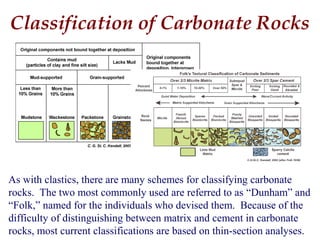
As with clastics, there are many schemes for classifying carbonate
rocks. The two most commonly used are referred to as “Dunham” and
“Folk,” named for the individuals who devised them. Because of the
difficulty of distinguishing between matrix and cement in carbonate
rocks, most current classifications are based on thin-section analyses.
Classification of Carbonate Rocks
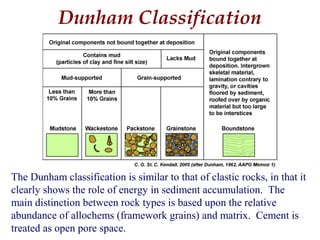
The Dunham classification is similar to that of clastic rocks, in that it
clearly shows the role of energy in sediment accumulation. The
main distinction between rock types is based upon the relative
abundance of allochems (framework grains) and matrix. Cement is
treated as open pore space.
Dunham Classification
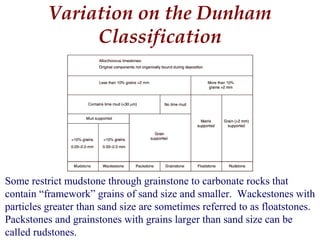
Some restrict mudstone through grainstone to carbonate rocks that
contain “framework” grains of sand size and smaller. Wackestones with
particles greater than sand size are sometimes referred to as floatstones.
Packstones and grainstones with grains larger than sand size can be
called rudstones.
Variation on the Dunham
Classification
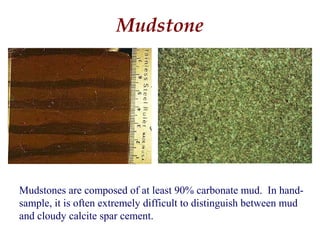
Mudstones are composed of at least 90% carbonate mud. In hand-
sample, it is often extremely difficult to distinguish between mud
and cloudy calcite spar cement.
Mudstone
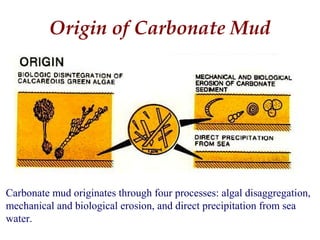
Carbonate mud originates through four processes: algal disaggregation,
mechanical and biological erosion, and direct precipitation from sea
water.
Origin of Carbonate Mud
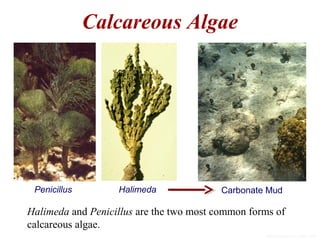
Calcareous Algae
Halimeda and Penicillus are the two most common forms of
calcareous algae.
Penicillus Halimeda Carbonate Mud
Slide modified from Gahn, 2006
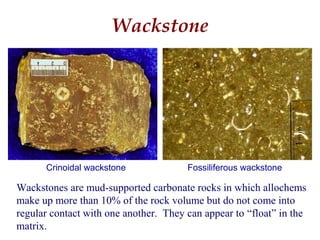
Wackstones are mud-supported carbonate rocks in which allochems
make up more than 10% of the rock volume but do not come into
regular contact with one another. They can appear to “float” in the
matrix.
Wackstone
Fossiliferous wackstoneCrinoidal wackstone
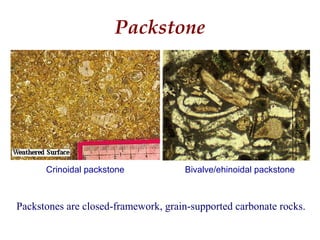
Packstone
Packstones are closed-framework, grain-supported carbonate rocks.
Crinoidal packstone Bivalve/ehinoidal packstone
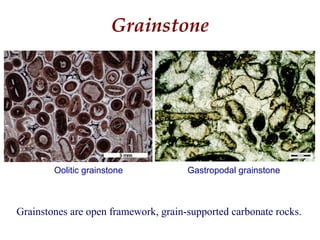
Grainstone
Grainstones are open framework, grain-supported carbonate rocks.
Gastropodal grainstoneOolitic grainstone
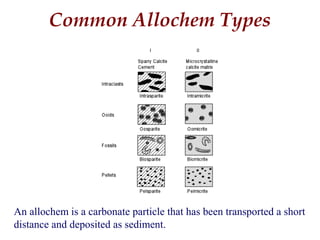
An allochem is a carbonate particle that has been transported a short
distance and deposited as sediment.
Common Allochem Types
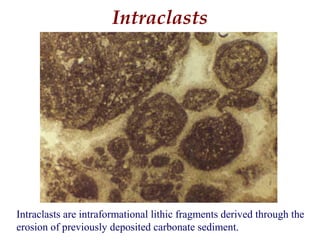
Intraclasts are intraformational lithic fragments derived through the
erosion of previously deposited carbonate sediment.
Intraclasts
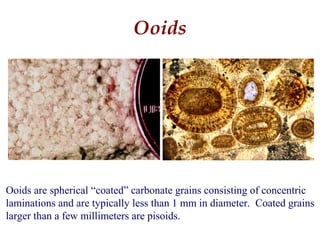
Ooids are spherical “coated” carbonate grains consisting of concentric
laminations and are typically less than 1 mm in diameter. Coated grains
larger than a few millimeters are pisoids.
Ooids
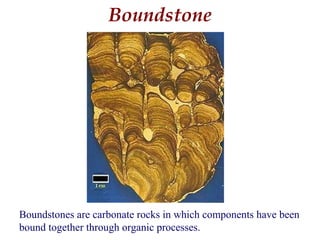
Boundstones are carbonate rocks in which components have been
bound together through organic processes.
Boundstone
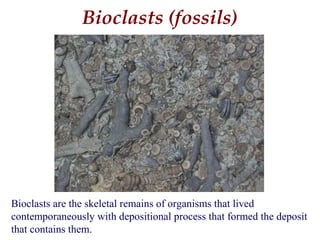
Bioclasts are the skeletal remains of organisms that lived
contemporaneously with depositional process that formed the deposit
that contains them.
Bioclasts (fossils)
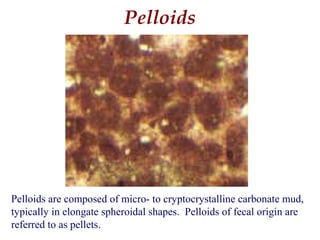
Pelloids are composed of micro- to cryptocrystalline carbonate mud,
typically in elongate spheroidal shapes. Pelloids of fecal origin are
referred to as pellets.
Pelloids
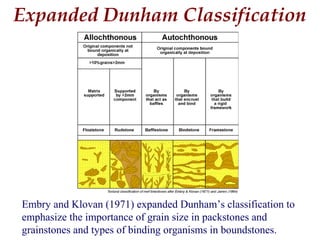
Embry and Klovan (1971) expanded Dunham’s classification to
emphasize the importance of grain size in packstones and
grainstones and types of binding organisms in boundstones.
Expanded Dunham Classification
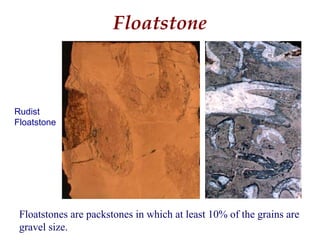
Floatstone
Floatstones are packstones in which at least 10% of the grains are
gravel size.
Rudist
Floatstone
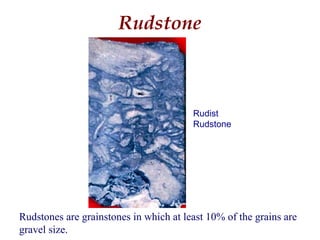
Rudstone
Rudstones are grainstones in which at least 10% of the grains are
gravel size.
Rudist
Rudstone
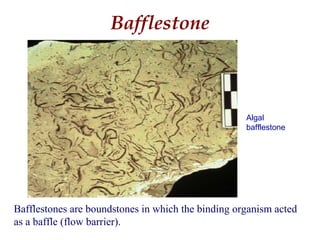
Bafflestones are boundstones in which the binding organism acted
as a baffle (flow barrier).
Bafflestone
Algal
bafflestone
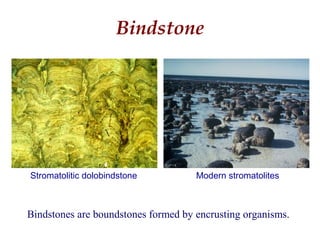
Bindstones are boundstones formed by encrusting organisms.
Bindstone
Modern stromatolitesStromatolitic dolobindstone
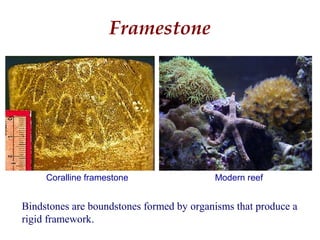
Bindstones are boundstones formed by organisms that produce a
rigid framework.
Framestone
Modern reefCoralline framestone
Photo by F. J. Gahn
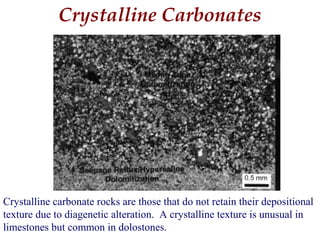
Crystalline Carbonates
Crystalline carbonate rocks are those that do not retain their depositional
texture due to diagenetic alteration. A crystalline texture is unusual in
limestones but common in dolostones.
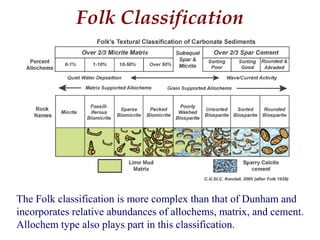
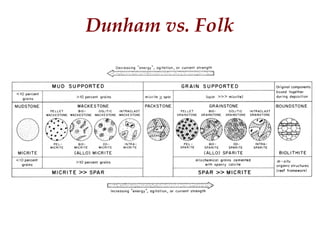
The Folk classification is more complex than that of Dunham and
incorporates relative abundances of allochems, matrix, and cement.
Allochem type also plays part in this classification.
Folk Classification
Micrite is equivalent to mudstone in the Dunham classification. As
the relative abundance of allochems increase, the type and
abundance of the allochem is used to modify the term micrite.
Micrite
Packed biomicriteMicrite
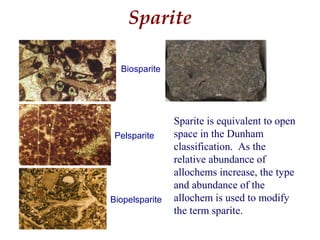
Sparite
Pelsparite
Biopelsparite
Biosparite
Sparite is equivalent to open
space in the Dunham
classification. As the
relative abundance of
allochems increase, the type
and abundance of the
allochem is used to modify
the term sparite.
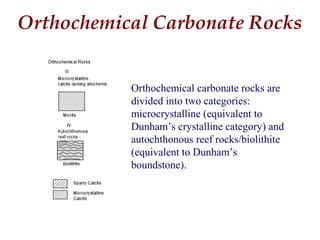
Orthochemical carbonate rocks are
divided into two categories:
microcrystalline (equivalent to
Dunham’s crystalline category) and
autochthonous reef rocks/biolithite
(equivalent to Dunham’s
boundstone).
Orthochemical Carbonate Rocks
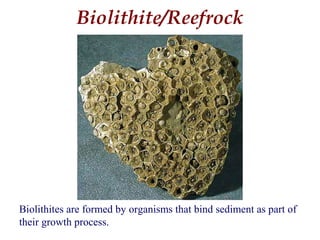
Biolithites are formed by organisms that bind sediment as part of
their growth process.
Biolithite/Reefrock
Dunham vs. Folk
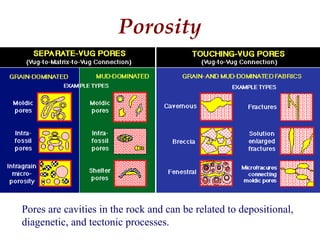
Pores are cavities in the rock and can be related to depositional,
diagenetic, and tectonic processes.
Porosity
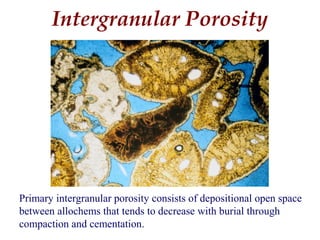
Primary intergranular porosity consists of depositional open space
between allochems that tends to decrease with burial through
compaction and cementation.
Intergranular Porosity
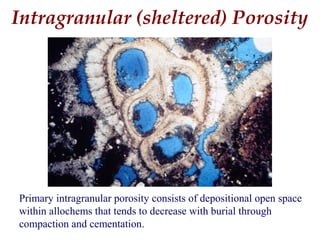
Primary intragranular porosity consists of depositional open space
within allochems that tends to decrease with burial through
compaction and cementation.
Intragranular (sheltered) Porosity
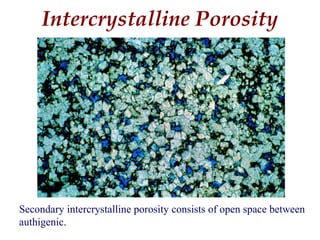
Secondary intercrystalline porosity consists of open space between
authigenic.
Intercrystalline Porosity
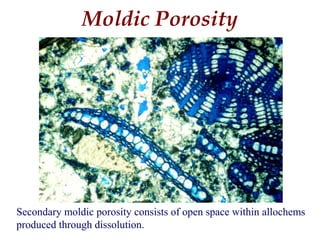
Secondary moldic porosity consists of open space within allochems
produced through dissolution.
Moldic Porosity
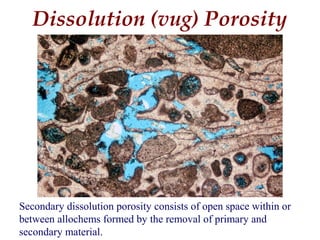
Secondary dissolution porosity consists of open space within or
between allochems formed by the removal of primary and
secondary material.
Dissolution (vug) Porosity
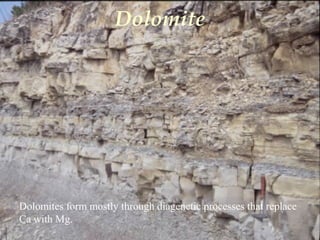
Dolomites form mostly through diagenetic processes that replace
Ca with Mg.
Dolomite

Classification of Carbonates

  • 1.
    Photo by W.W. Little The primary function of carbonate rocks is, through weathering and erosion, to provide the cement found within clastic rocks. Cement
  • 2.
    Photo by W.W. Little Carbonates are rocks composed of at least 50% calcite and/or dolomite and are produced primarily through biological (limestone) and diagenetic (dolostone) processes. Carbonates
  • 3.
    As with clastics,there are many schemes for classifying carbonate rocks. The two most commonly used are referred to as “Dunham” and “Folk,” named for the individuals who devised them. Because of the difficulty of distinguishing between matrix and cement in carbonate rocks, most current classifications are based on thin-section analyses. Classification of Carbonate Rocks
  • 4.
    The Dunham classificationis similar to that of clastic rocks, in that it clearly shows the role of energy in sediment accumulation. The main distinction between rock types is based upon the relative abundance of allochems (framework grains) and matrix. Cement is treated as open pore space. Dunham Classification
  • 5.
    Some restrict mudstonethrough grainstone to carbonate rocks that contain “framework” grains of sand size and smaller. Wackestones with particles greater than sand size are sometimes referred to as floatstones. Packstones and grainstones with grains larger than sand size can be called rudstones. Variation on the Dunham Classification
  • 6.
    Mudstones are composedof at least 90% carbonate mud. In hand- sample, it is often extremely difficult to distinguish between mud and cloudy calcite spar cement. Mudstone
  • 7.
    Carbonate mud originatesthrough four processes: algal disaggregation, mechanical and biological erosion, and direct precipitation from sea water. Origin of Carbonate Mud
  • 8.
    Calcareous Algae Halimeda andPenicillus are the two most common forms of calcareous algae. Penicillus Halimeda Carbonate Mud Slide modified from Gahn, 2006
  • 9.
    Wackstones are mud-supportedcarbonate rocks in which allochems make up more than 10% of the rock volume but do not come into regular contact with one another. They can appear to “float” in the matrix. Wackstone Fossiliferous wackstoneCrinoidal wackstone
  • 10.
    Packstone Packstones are closed-framework,grain-supported carbonate rocks. Crinoidal packstone Bivalve/ehinoidal packstone
  • 11.
    Grainstone Grainstones are openframework, grain-supported carbonate rocks. Gastropodal grainstoneOolitic grainstone
  • 12.
    An allochem isa carbonate particle that has been transported a short distance and deposited as sediment. Common Allochem Types
  • 13.
    Intraclasts are intraformationallithic fragments derived through the erosion of previously deposited carbonate sediment. Intraclasts
  • 14.
    Ooids are spherical“coated” carbonate grains consisting of concentric laminations and are typically less than 1 mm in diameter. Coated grains larger than a few millimeters are pisoids. Ooids
  • 15.
    Boundstones are carbonaterocks in which components have been bound together through organic processes. Boundstone
  • 16.
    Bioclasts are theskeletal remains of organisms that lived contemporaneously with depositional process that formed the deposit that contains them. Bioclasts (fossils)
  • 17.
    Pelloids are composedof micro- to cryptocrystalline carbonate mud, typically in elongate spheroidal shapes. Pelloids of fecal origin are referred to as pellets. Pelloids
  • 18.
    Embry and Klovan(1971) expanded Dunham’s classification to emphasize the importance of grain size in packstones and grainstones and types of binding organisms in boundstones. Expanded Dunham Classification
  • 19.
    Floatstone Floatstones are packstonesin which at least 10% of the grains are gravel size. Rudist Floatstone
  • 20.
    Rudstone Rudstones are grainstonesin which at least 10% of the grains are gravel size. Rudist Rudstone
  • 21.
    Bafflestones are boundstonesin which the binding organism acted as a baffle (flow barrier). Bafflestone Algal bafflestone
  • 22.
    Bindstones are boundstonesformed by encrusting organisms. Bindstone Modern stromatolitesStromatolitic dolobindstone
  • 23.
    Bindstones are boundstonesformed by organisms that produce a rigid framework. Framestone Modern reefCoralline framestone Photo by F. J. Gahn
  • 24.
    Crystalline Carbonates Crystalline carbonaterocks are those that do not retain their depositional texture due to diagenetic alteration. A crystalline texture is unusual in limestones but common in dolostones.
  • 25.
    The Folk classificationis more complex than that of Dunham and incorporates relative abundances of allochems, matrix, and cement. Allochem type also plays part in this classification. Folk Classification
  • 26.
    Micrite is equivalentto mudstone in the Dunham classification. As the relative abundance of allochems increase, the type and abundance of the allochem is used to modify the term micrite. Micrite Packed biomicriteMicrite
  • 27.
    Sparite Pelsparite Biopelsparite Biosparite Sparite is equivalentto open space in the Dunham classification. As the relative abundance of allochems increase, the type and abundance of the allochem is used to modify the term sparite.
  • 28.
    Orthochemical carbonate rocksare divided into two categories: microcrystalline (equivalent to Dunham’s crystalline category) and autochthonous reef rocks/biolithite (equivalent to Dunham’s boundstone). Orthochemical Carbonate Rocks
  • 29.
    Biolithites are formedby organisms that bind sediment as part of their growth process. Biolithite/Reefrock
  • 30.
  • 31.
    Pores are cavitiesin the rock and can be related to depositional, diagenetic, and tectonic processes. Porosity
  • 32.
    Primary intergranular porosityconsists of depositional open space between allochems that tends to decrease with burial through compaction and cementation. Intergranular Porosity
  • 33.
    Primary intragranular porosityconsists of depositional open space within allochems that tends to decrease with burial through compaction and cementation. Intragranular (sheltered) Porosity
  • 34.
    Secondary intercrystalline porosityconsists of open space between authigenic. Intercrystalline Porosity
  • 35.
    Secondary moldic porosityconsists of open space within allochems produced through dissolution. Moldic Porosity
  • 36.
    Secondary dissolution porosityconsists of open space within or between allochems formed by the removal of primary and secondary material. Dissolution (vug) Porosity
  • 37.
    Dolomites form mostlythrough diagenetic processes that replace Ca with Mg. Dolomite