RESPIRATORY PHYSIOLOGY
GASEOUS TRANSPORT
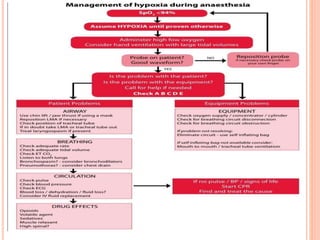
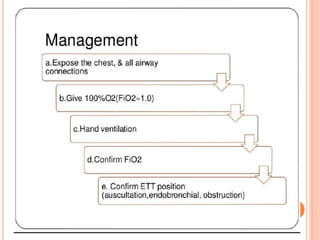
INTRAOP HYPOXIA
INTRAOP HYPERCARBIA
PRESENTATION BY DR SHALINI
MODERATOR DR MAJUMDAR
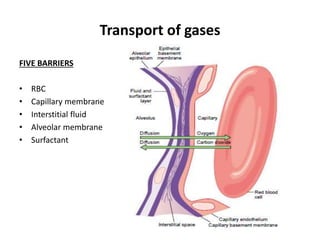
Transport of gases
FIVE BARRIERS
• RBC
• Capillary membrane
• Interstitial fluid
• Alveolar membrane
• Surfactant
TRANSPORT OF RESPIRATORY GASES
Diffusion of Gases Across the Alveolar Membrane
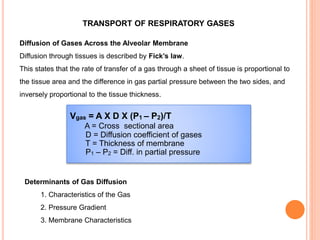
Diffusion through tissues is described by Fick’s law.
This states that the rate of transfer of a gas through a sheet of tissue is proportional to
the tissue area and the difference in gas partial pressure between the two sides, and
inversely proportional to the tissue thickness.
Vgas = A X D X (P1 – P2)/T
A = Cross sectional area
D = Diffusion coefficient of gases
T = Thickness of membrane
P1 – P2 = Diff. in partial pressure
Determinants of Gas Diffusion
1. Characteristics of the Gas
2. Pressure Gradient
3. Membrane Characteristics
1. CHARACTERISTICS OF THE GAS
a. Molecular Weight - V α 1/√MW
Graham's Law: relative rates of diffusion are inversely proportional to the square root of the gas
molecular weight.
Thus, lighter gases diffuse faster in gaseous media than heavier gases.
b. Solubility Coefficient
Henry's Law: the amount of a gas which dissolves in unit volume of a liquid,
at a given temperature, is directly proportional to the partial pressure of the gas in the equilibrium
phase.
CO₂ is almost 30 times more soluble in water than O₂ is and diffuses more than 20 times faster (the
net effect of all mentioned factors).
i. diffusion limited, as for CO, which due to its high solubility in blood does not reach equilibrium
during the passage of blood through the alveoli.
ii. perfusion limited, as for N2O, which due to its very low solubility reaches pressure equilibrium
very early with perfusing blood.
2. PRESSURE GRADIENT
The rate of O₂ diffusion is dependent on the integrated mean PO ₂ difference
between alveoli and pulmonary capillary blood, therefore depends upon:
a. FIO₂
b. alveolar ventilation
c. pulmonary capillary blood flow
d. oxygenation of Hb
•The mixed venous blood entering the pulmonary capillary has a PO2 of 40 mm Hg ,
and alveolar PO2 is approximately 100 mm Hg , thus creating a driving pressure of 60
mm Hg.
3. MEMBRANE THICKNESS.
• The thicker the membrane, the longer the diffusion distance and the lower the
diffusion capacity.
• In addition, solubility for O2 (and CO2) is lower in fibrotic tissue than in water.
• Thickening of the membranes may therefore impede diffusion even more than
the increase in diffusion distance does.
GAS TRANSPORT - OXYGEN
Oxygen is transported in the blood in 2 forms:
1. Dissolved in plasma
Henry's Law: the amount of a gas which dissolves in unit volume of a liquid, at a given
temperature, is directly proportional to the partial pressure of the gas in the equilibrium
phase.
Solubility coefficient for O₂ at 37°C = 0.0034 ml/100ml blood/mmHg.
Therefore, at PO₂ of 100 mmHg dissolved O₂ ~ 0.3 ml/100ml blood
2. Oxygen Carriage by Haemoglobin
1 gm pure Hb combines with 1.34 ml O₂
•O2 content: amount of O2 carried by 100 ml of blood
• dissolved + combined with Hb
•Arterial O2 content = (0.003 x PO2) + (Hb x 1.34 x SaO2)
= (0.003 x 100) + (15 x 1.34 x 0.975)
= 19.5 ml/dl
•Venous O2 content = (0.003 x 40) + (15 x 1.34 x 0.75)
= 14.8 ml/dl
Oxygen delivery/ flux = amount of O2 leaving LV/minute
= arterial O2 content X Cardiac Output
= 20ml/dl X 50dl/min
= 1000ml/min
Oxygen consumption = Cardiac Output X (arterial O2 content – mixed
venous oxygen content)
= 50 dl/min X (20-15)
= 50 X 5 = 250 ml/min
Oxygen extraction ratio = (CaO2-CvO2)/CaO2
= (20-15)/20 = 25% (normally)
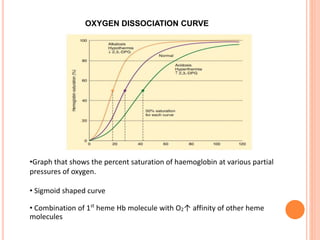
OXYGEN DISSOCIATION CURVE
•Graph that shows the percent saturation of haemoglobin at various partial
pressures of oxygen.
• Sigmoid shaped curve
• Combination of 1st
heme Hb molecule with O2↑ affinity of other heme
molecules
Measure of Hb affinity for O2 quantified by P50.
which is the PO2 when Hb is 50% saturated, at pH = 7.4, T = 37°C
P50 = 26.6 mmHg
Shift of curve to right : lowers O2 affinity → displaces O2 from haemoglobin, and
makes more O2 available to tissues
• Fall in blood pH due to
↑ CO2
• ↑ temp
• Inhalational anesthetics: Isoflurane shifts P50 to right by 2.6 mmHg.
• ↑ conc of 2,3- DPG
• 2,3-DPG is a by-product of glycolysis
• increased in chronic anemia
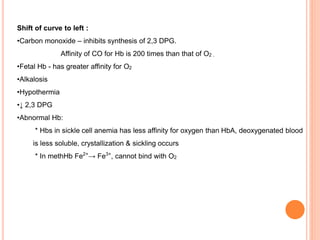
Shift of curve to left :
•Carbon monoxide – inhibits synthesis of 2,3 DPG.
Affinity of CO for Hb is 200 times than that of O2 .
•Fetal Hb - has greater affinity for O2
•Alkalosis
•Hypothermia
•↓ 2,3 DPG
•Abnormal Hb:
* Hbs in sickle cell anemia has less affinity for oxygen than HbA, deoxygenated blood
is less soluble, crystallization & sickling occurs
* In methHb Fe2+
→ Fe3+
, cannot bind with O2
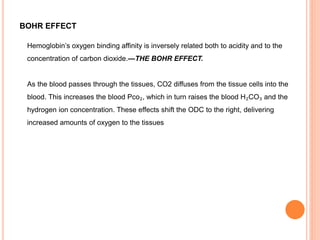
BOHR EFFECT
Hemoglobin’s oxygen binding affinity is inversely related both to acidity and to the
concentration of carbon dioxide.—THE BOHR EFFECT.
As the blood passes through the tissues, CO2 diffuses from the tissue cells into the
blood. This increases the blood Pco₂, which in turn raises the blood H₂CO₃ and the
hydrogen ion concentration. These effects shift the ODC to the right, delivering
increased amounts of oxygen to the tissues
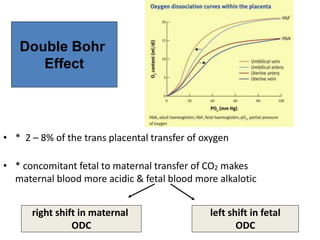
• * 2 – 8% of the trans placental transfer of oxygen
• * concomitant fetal to maternal transfer of CO2 makes
maternal blood more acidic & fetal blood more alkalotic
right shift in maternal
ODC
left shift in fetal
ODC
Double Bohr
Effect
TRANSPORT OF CO2
1. AS DISSOLVED CO2 (7%)
CO2 is more soluble in blood than oxygen with a solubility coefficient of 0.0308 mmol/ litre/ mm Hg at
37°C.
only about 0.3 milliliter of carbon dioxide is transported in the dissolved form by each 100 milliliters of
blood flow.
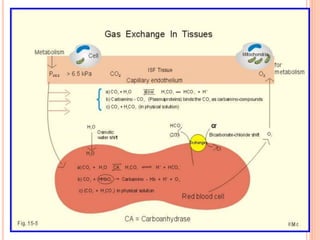
2. IONIZED AS BICARBONATES (70%)
a. In plasma – partly in solution,remaining combines with water forming carbonic acid.
CO2 + H2O → H2CO3 (slow reaction)
b. b. In RBC – this reaction is rapid due to presence of enzyme carbonic anhydrase.
Chloride shift or hamburger phenomenon :
To maintain electrical neutrality Cl¯ ions shift from plasma to RBCs in exchange of HCO3 ions.
3. CHEMICALLY COMBINED WITH PROTEINS (23%)
• carbon dioxide reacts directly with amine radicals of the hemoglobin molecule to form the compound
carbaminohemoglobin (CO2Hgb)
a. In plasma – with plasma proteins (slow reaction)
b. In RBC – with Hb – carbaminoHb (fast reaction)
Hb-NH2 + CO2 ↔ Hb-NH-COOH
Deoxygenated Hb has a higher affinity(3.5 times) for CO2, thus venous blood carries more CO2.
HALDANE EFFECT: The more deoxygenated the blood becomes the more CO2 it carries at a
given PCO2.
a. The more highly acidic hemoglobin has less tendency to combine with carbon dioxide to form

carbaminohemoglobin, thus displacing much of the carbon dioxide that is present in the
carbamino form from the blood.
b. The increased acidity of the hemoglobin also causes it to release an excess of hydrogen ions,
and these bind with bicarbonate ions to form carbonic acid; this then dissociates into later and
carbon dioxide, and the carbon dioxide is released from the blood into the alveoli and, finally,
into the air
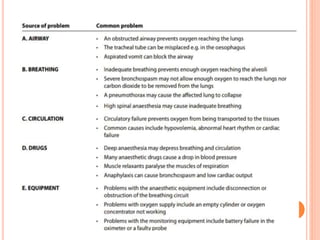
Tissues fail to receive adequate quantity of O2
1. Hypoxic hypoxia: Reduction in PaO2 (refer to oxygen cascade)
2. Anaemic hypoxia: O2 content of arterial blood is reduced. PaO2
is normal. (refer to transport to O2)
3. Stagnant hypoxia: Reduced tissue perfusion / LOW CARDIAC
OUTPUT
4. Histotoxic hypoxia: Cells are unable to use oxygen/ CYANIDE
POISONING
HYPOXIA
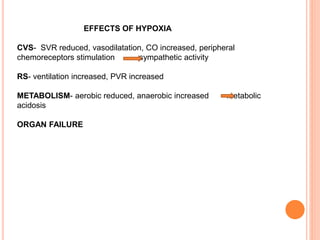
EFFECTS OF HYPOXIA
CVS- SVR reduced, vasodilatation, CO increased, peripheral
chemoreceptors stimulation sympathetic activity
RS- ventilation increased, PVR increased
METABOLISM- aerobic reduced, anaerobic increased metabolic
acidosis
ORGAN FAILURE
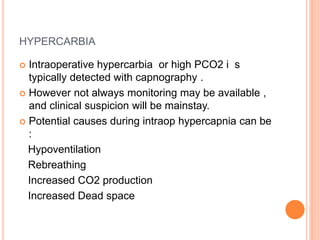
HYPERCARBIA
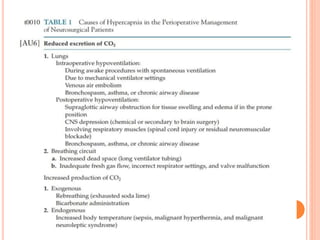
 Intraoperative hypercarbia or high PCO2 i s
typically detected with capnography .
 However not always monitoring may be available ,
and clinical suspicion will be mainstay.
 Potential causes during intraop hypercapnia can be
:
Hypoventilation
Rebreathing
Increased CO2 production
Increased Dead space
HYPOVENTILATION
 In mechanically ventilated pts: inadequate TV / RR
contributing to low minute ventilation.
 In spontaneously breathing patients : drug induced
depression of ventilatory response to co2 .
Common agents are opioids , benzodiazepine,
propofol and halogenated inhalational agents .
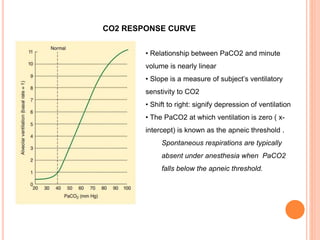
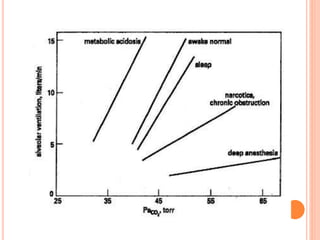
CO2 RESPONSE CURVE
• Relationship between PaCO2 and minute
volume is nearly linear
• Slope is a measure of subject’s ventilatory
senstivity to CO2
• Shift to right: signify depression of ventilation
• The PaCO2 at which ventilation is zero ( x-
intercept) is known as the apneic threshold .
Spontaneous respirations are typically
absent under anesthesia when PaCO2
falls below the apneic threshold.
Factors influencing CO2 Curve :
1.Individual responses
2.Hypoxia: steeper curve; reinforces the ventilatory response to CO2
3.Metabolic alkalosis: right shift
4.Metabolic acidosis: left shift
5.Chronic bronchitis and other chronic diffuse airway obstructive diseases- flattened
curve
6.Opiates depress ventilatory response to CO2 (morphine – right, pethidine- right +
depressed slope)
7.Inhalational agents-ventilatory responses to inhaled CO2 progressively reduced as
anaesthesia becomes deeper and eventually becomes flat.
REBREATHING
 Under GA , faulty breathing circuits or inadequate
fresh gas flow in some circuit types , can lead to an
increase in the inspired co2and consequently
increase in expired CO2 .
 Exhausted absorbent agents .
 Faulty expiratory check valves .
INCREASED CO2 PRODUCTION
 Fever : Intrinsic or iatrogenic from overwarming
results in hypermetabolic state and increased CO2
production .
 Systemic absorption during laproscopic procedures
using CO2 of insufflation .
 Rare causes : Thyroid strom and malignant
hyperthermia both are hypermetabolic
processescharacterized by hypercapnia.
INCREASED DEAD SPACE
 Increase in dead space beyond typical
physiological dead space can eult in hypercarbia
due to excessive minute ventilation being delivered
to areas of lung not actively participating in gas
exchange .
 Commonly seen in COPD pts.
 Dead space ventilation can result in normal value
on wave form capnography , thus allowing clinically
significant hypercapnia to go undetected .
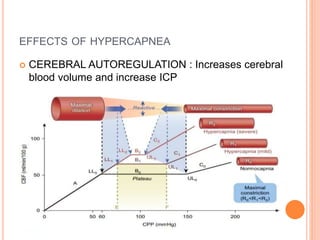
EFFECTS OF HYPERCAPNEA
 CEREBRAL AUTOREGULATION : Increases cerebral
blood volume and increase ICP
 PULMONARY CIRCULATION:Increases PulVR and
can provoke acute rt ventricle dysfunction .
 Oxy HB dissociation curve : shift to right ,
decreased O2 affinity and favours O2 delivery
 CVS: Increased cardiac out put , HR, strenth of
myocardial contraction , CVP.
Decrease in Peripheral vascular resistance .
THANK YOU :) :) :)

respiratoryphysio.pptx

  • 1.
    RESPIRATORY PHYSIOLOGY GASEOUS TRANSPORT INTRAOPHYPOXIA INTRAOP HYPERCARBIA PRESENTATION BY DR SHALINI MODERATOR DR MAJUMDAR
  • 2.
    Transport of gases FIVEBARRIERS • RBC • Capillary membrane • Interstitial fluid • Alveolar membrane • Surfactant
  • 3.
    TRANSPORT OF RESPIRATORYGASES Diffusion of Gases Across the Alveolar Membrane Diffusion through tissues is described by Fick’s law. This states that the rate of transfer of a gas through a sheet of tissue is proportional to the tissue area and the difference in gas partial pressure between the two sides, and inversely proportional to the tissue thickness. Vgas = A X D X (P1 – P2)/T A = Cross sectional area D = Diffusion coefficient of gases T = Thickness of membrane P1 – P2 = Diff. in partial pressure Determinants of Gas Diffusion 1. Characteristics of the Gas 2. Pressure Gradient 3. Membrane Characteristics
  • 4.
    1. CHARACTERISTICS OFTHE GAS a. Molecular Weight - V α 1/√MW Graham's Law: relative rates of diffusion are inversely proportional to the square root of the gas molecular weight. Thus, lighter gases diffuse faster in gaseous media than heavier gases. b. Solubility Coefficient Henry's Law: the amount of a gas which dissolves in unit volume of a liquid, at a given temperature, is directly proportional to the partial pressure of the gas in the equilibrium phase. CO₂ is almost 30 times more soluble in water than O₂ is and diffuses more than 20 times faster (the net effect of all mentioned factors). i. diffusion limited, as for CO, which due to its high solubility in blood does not reach equilibrium during the passage of blood through the alveoli. ii. perfusion limited, as for N2O, which due to its very low solubility reaches pressure equilibrium very early with perfusing blood.
  • 5.
    2. PRESSURE GRADIENT Therate of O₂ diffusion is dependent on the integrated mean PO ₂ difference between alveoli and pulmonary capillary blood, therefore depends upon: a. FIO₂ b. alveolar ventilation c. pulmonary capillary blood flow d. oxygenation of Hb •The mixed venous blood entering the pulmonary capillary has a PO2 of 40 mm Hg , and alveolar PO2 is approximately 100 mm Hg , thus creating a driving pressure of 60 mm Hg.
  • 6.
    3. MEMBRANE THICKNESS. •The thicker the membrane, the longer the diffusion distance and the lower the diffusion capacity. • In addition, solubility for O2 (and CO2) is lower in fibrotic tissue than in water. • Thickening of the membranes may therefore impede diffusion even more than the increase in diffusion distance does.
  • 7.
    GAS TRANSPORT -OXYGEN Oxygen is transported in the blood in 2 forms: 1. Dissolved in plasma Henry's Law: the amount of a gas which dissolves in unit volume of a liquid, at a given temperature, is directly proportional to the partial pressure of the gas in the equilibrium phase. Solubility coefficient for O₂ at 37°C = 0.0034 ml/100ml blood/mmHg. Therefore, at PO₂ of 100 mmHg dissolved O₂ ~ 0.3 ml/100ml blood
  • 8.
    2. Oxygen Carriageby Haemoglobin 1 gm pure Hb combines with 1.34 ml O₂ •O2 content: amount of O2 carried by 100 ml of blood • dissolved + combined with Hb •Arterial O2 content = (0.003 x PO2) + (Hb x 1.34 x SaO2) = (0.003 x 100) + (15 x 1.34 x 0.975) = 19.5 ml/dl •Venous O2 content = (0.003 x 40) + (15 x 1.34 x 0.75) = 14.8 ml/dl
  • 9.
    Oxygen delivery/ flux= amount of O2 leaving LV/minute = arterial O2 content X Cardiac Output = 20ml/dl X 50dl/min = 1000ml/min Oxygen consumption = Cardiac Output X (arterial O2 content – mixed venous oxygen content) = 50 dl/min X (20-15) = 50 X 5 = 250 ml/min Oxygen extraction ratio = (CaO2-CvO2)/CaO2 = (20-15)/20 = 25% (normally)
  • 10.
    OXYGEN DISSOCIATION CURVE •Graphthat shows the percent saturation of haemoglobin at various partial pressures of oxygen. • Sigmoid shaped curve • Combination of 1st heme Hb molecule with O2↑ affinity of other heme molecules
  • 11.
    Measure of Hbaffinity for O2 quantified by P50. which is the PO2 when Hb is 50% saturated, at pH = 7.4, T = 37°C P50 = 26.6 mmHg Shift of curve to right : lowers O2 affinity → displaces O2 from haemoglobin, and makes more O2 available to tissues • Fall in blood pH due to ↑ CO2 • ↑ temp • Inhalational anesthetics: Isoflurane shifts P50 to right by 2.6 mmHg. • ↑ conc of 2,3- DPG • 2,3-DPG is a by-product of glycolysis • increased in chronic anemia
  • 12.
    Shift of curveto left : •Carbon monoxide – inhibits synthesis of 2,3 DPG. Affinity of CO for Hb is 200 times than that of O2 . •Fetal Hb - has greater affinity for O2 •Alkalosis •Hypothermia •↓ 2,3 DPG •Abnormal Hb: * Hbs in sickle cell anemia has less affinity for oxygen than HbA, deoxygenated blood is less soluble, crystallization & sickling occurs * In methHb Fe2+ → Fe3+ , cannot bind with O2
  • 13.
    BOHR EFFECT Hemoglobin’s oxygenbinding affinity is inversely related both to acidity and to the concentration of carbon dioxide.—THE BOHR EFFECT. As the blood passes through the tissues, CO2 diffuses from the tissue cells into the blood. This increases the blood Pco₂, which in turn raises the blood H₂CO₃ and the hydrogen ion concentration. These effects shift the ODC to the right, delivering increased amounts of oxygen to the tissues
  • 14.
    • * 2– 8% of the trans placental transfer of oxygen • * concomitant fetal to maternal transfer of CO2 makes maternal blood more acidic & fetal blood more alkalotic right shift in maternal ODC left shift in fetal ODC Double Bohr Effect
  • 15.
    TRANSPORT OF CO2 1.AS DISSOLVED CO2 (7%) CO2 is more soluble in blood than oxygen with a solubility coefficient of 0.0308 mmol/ litre/ mm Hg at 37°C. only about 0.3 milliliter of carbon dioxide is transported in the dissolved form by each 100 milliliters of blood flow. 2. IONIZED AS BICARBONATES (70%) a. In plasma – partly in solution,remaining combines with water forming carbonic acid. CO2 + H2O → H2CO3 (slow reaction) b. b. In RBC – this reaction is rapid due to presence of enzyme carbonic anhydrase. Chloride shift or hamburger phenomenon : To maintain electrical neutrality Cl¯ ions shift from plasma to RBCs in exchange of HCO3 ions.
  • 16.
    3. CHEMICALLY COMBINEDWITH PROTEINS (23%) • carbon dioxide reacts directly with amine radicals of the hemoglobin molecule to form the compound carbaminohemoglobin (CO2Hgb) a. In plasma – with plasma proteins (slow reaction) b. In RBC – with Hb – carbaminoHb (fast reaction) Hb-NH2 + CO2 ↔ Hb-NH-COOH Deoxygenated Hb has a higher affinity(3.5 times) for CO2, thus venous blood carries more CO2. HALDANE EFFECT: The more deoxygenated the blood becomes the more CO2 it carries at a given PCO2. a. The more highly acidic hemoglobin has less tendency to combine with carbon dioxide to form carbaminohemoglobin, thus displacing much of the carbon dioxide that is present in the carbamino form from the blood. b. The increased acidity of the hemoglobin also causes it to release an excess of hydrogen ions, and these bind with bicarbonate ions to form carbonic acid; this then dissociates into later and carbon dioxide, and the carbon dioxide is released from the blood into the alveoli and, finally, into the air
  • 18.
    Tissues fail toreceive adequate quantity of O2 1. Hypoxic hypoxia: Reduction in PaO2 (refer to oxygen cascade) 2. Anaemic hypoxia: O2 content of arterial blood is reduced. PaO2 is normal. (refer to transport to O2) 3. Stagnant hypoxia: Reduced tissue perfusion / LOW CARDIAC OUTPUT 4. Histotoxic hypoxia: Cells are unable to use oxygen/ CYANIDE POISONING HYPOXIA
  • 19.
    EFFECTS OF HYPOXIA CVS-SVR reduced, vasodilatation, CO increased, peripheral chemoreceptors stimulation sympathetic activity RS- ventilation increased, PVR increased METABOLISM- aerobic reduced, anaerobic increased metabolic acidosis ORGAN FAILURE
  • 26.
    HYPERCARBIA  Intraoperative hypercarbiaor high PCO2 i s typically detected with capnography .  However not always monitoring may be available , and clinical suspicion will be mainstay.  Potential causes during intraop hypercapnia can be : Hypoventilation Rebreathing Increased CO2 production Increased Dead space
  • 28.
    HYPOVENTILATION  In mechanicallyventilated pts: inadequate TV / RR contributing to low minute ventilation.  In spontaneously breathing patients : drug induced depression of ventilatory response to co2 . Common agents are opioids , benzodiazepine, propofol and halogenated inhalational agents .
  • 29.
    CO2 RESPONSE CURVE •Relationship between PaCO2 and minute volume is nearly linear • Slope is a measure of subject’s ventilatory senstivity to CO2 • Shift to right: signify depression of ventilation • The PaCO2 at which ventilation is zero ( x- intercept) is known as the apneic threshold . Spontaneous respirations are typically absent under anesthesia when PaCO2 falls below the apneic threshold.
  • 30.
    Factors influencing CO2Curve : 1.Individual responses 2.Hypoxia: steeper curve; reinforces the ventilatory response to CO2 3.Metabolic alkalosis: right shift 4.Metabolic acidosis: left shift 5.Chronic bronchitis and other chronic diffuse airway obstructive diseases- flattened curve 6.Opiates depress ventilatory response to CO2 (morphine – right, pethidine- right + depressed slope) 7.Inhalational agents-ventilatory responses to inhaled CO2 progressively reduced as anaesthesia becomes deeper and eventually becomes flat.
  • 32.
    REBREATHING  Under GA, faulty breathing circuits or inadequate fresh gas flow in some circuit types , can lead to an increase in the inspired co2and consequently increase in expired CO2 .  Exhausted absorbent agents .  Faulty expiratory check valves .
  • 33.
    INCREASED CO2 PRODUCTION Fever : Intrinsic or iatrogenic from overwarming results in hypermetabolic state and increased CO2 production .  Systemic absorption during laproscopic procedures using CO2 of insufflation .  Rare causes : Thyroid strom and malignant hyperthermia both are hypermetabolic processescharacterized by hypercapnia.
  • 34.
    INCREASED DEAD SPACE Increase in dead space beyond typical physiological dead space can eult in hypercarbia due to excessive minute ventilation being delivered to areas of lung not actively participating in gas exchange .  Commonly seen in COPD pts.  Dead space ventilation can result in normal value on wave form capnography , thus allowing clinically significant hypercapnia to go undetected .
  • 35.
    EFFECTS OF HYPERCAPNEA CEREBRAL AUTOREGULATION : Increases cerebral blood volume and increase ICP
  • 36.
     PULMONARY CIRCULATION:IncreasesPulVR and can provoke acute rt ventricle dysfunction .  Oxy HB dissociation curve : shift to right , decreased O2 affinity and favours O2 delivery  CVS: Increased cardiac out put , HR, strenth of myocardial contraction , CVP. Decrease in Peripheral vascular resistance .
  • 37.