Fossil Fuels and The
            Carbon Cycle
            By Team 3:
            Alexa Elliott, Victoria Garrett, & James Hammond


By: Alexa
Elliott
Question and Hypothesis
                    • Why does CO2 released by the burning of fossil fuels represent a substantial
                      perturbation to the global carbon cycle?
                    • We hypothesize that the release of CO2 during the burning of fossil fuels
                      releases an unnatural and excessive amount of carbon into Earth’s carbon
                      cycle, which causes the global carbon cycle to become perturbed and
                      unbalanced.
                    • We hypothesize this because the way in which humans burn fossil fuels is
                      not something that would be naturally occurring in Earth’s carbon cycle.
                      Humans have only recently begun to use fossil fuels, and the rate at which
                      humans have been consuming and burning these fossil fuels has increased
                      exponentially since the birth of the industry.


By: Alexa Elliott
The Experiment
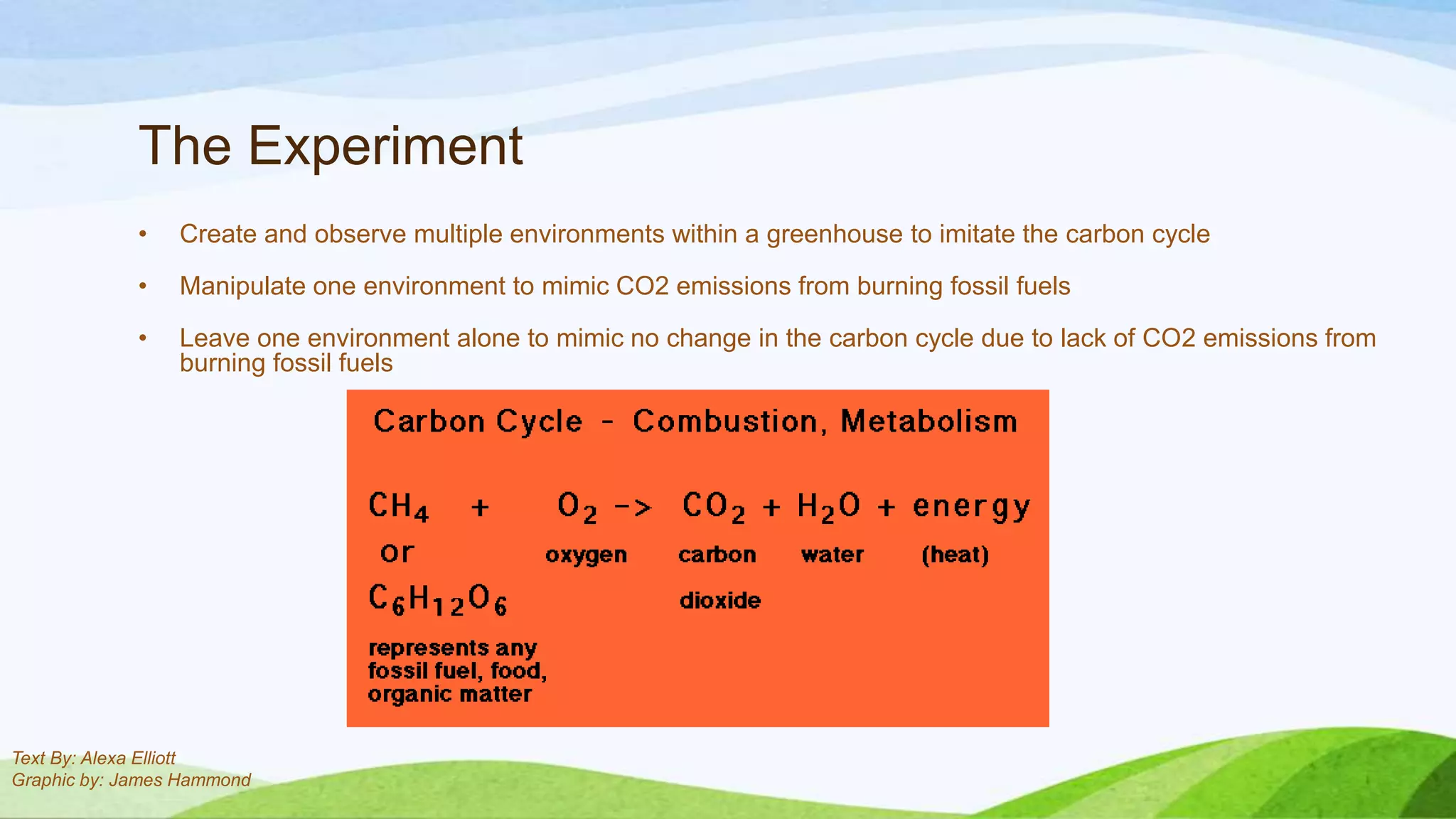
             •   Create and observe multiple environments within a greenhouse to imitate the carbon cycle

             •   Manipulate one environment to mimic CO2 emissions from burning fossil fuels

             •   Leave one environment alone to mimic no change in the carbon cycle due to lack of CO2 emissions from
                 burning fossil fuels


Text By: Alexa Elliott
Graphic by: James Hammond
Introduction to Research
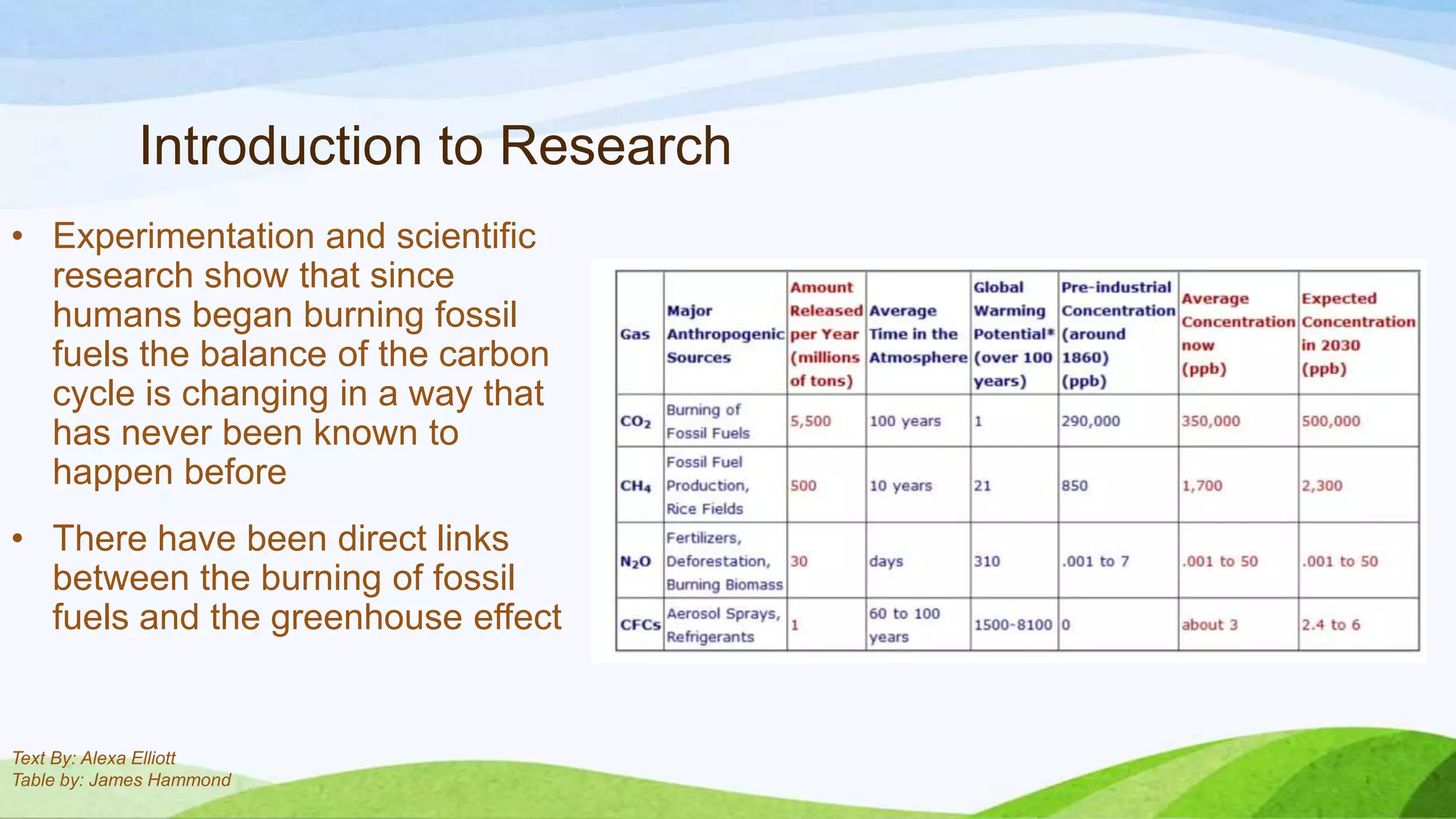
• Experimentation and scientific
  research show that since
  humans began burning fossil
  fuels the balance of the carbon
  cycle is changing in a way that
  has never been known to
  happen before
• There have been direct links
  between the burning of fossil
  fuels and the greenhouse effect


Text By: Alexa Elliott
Table by: James Hammond
Research
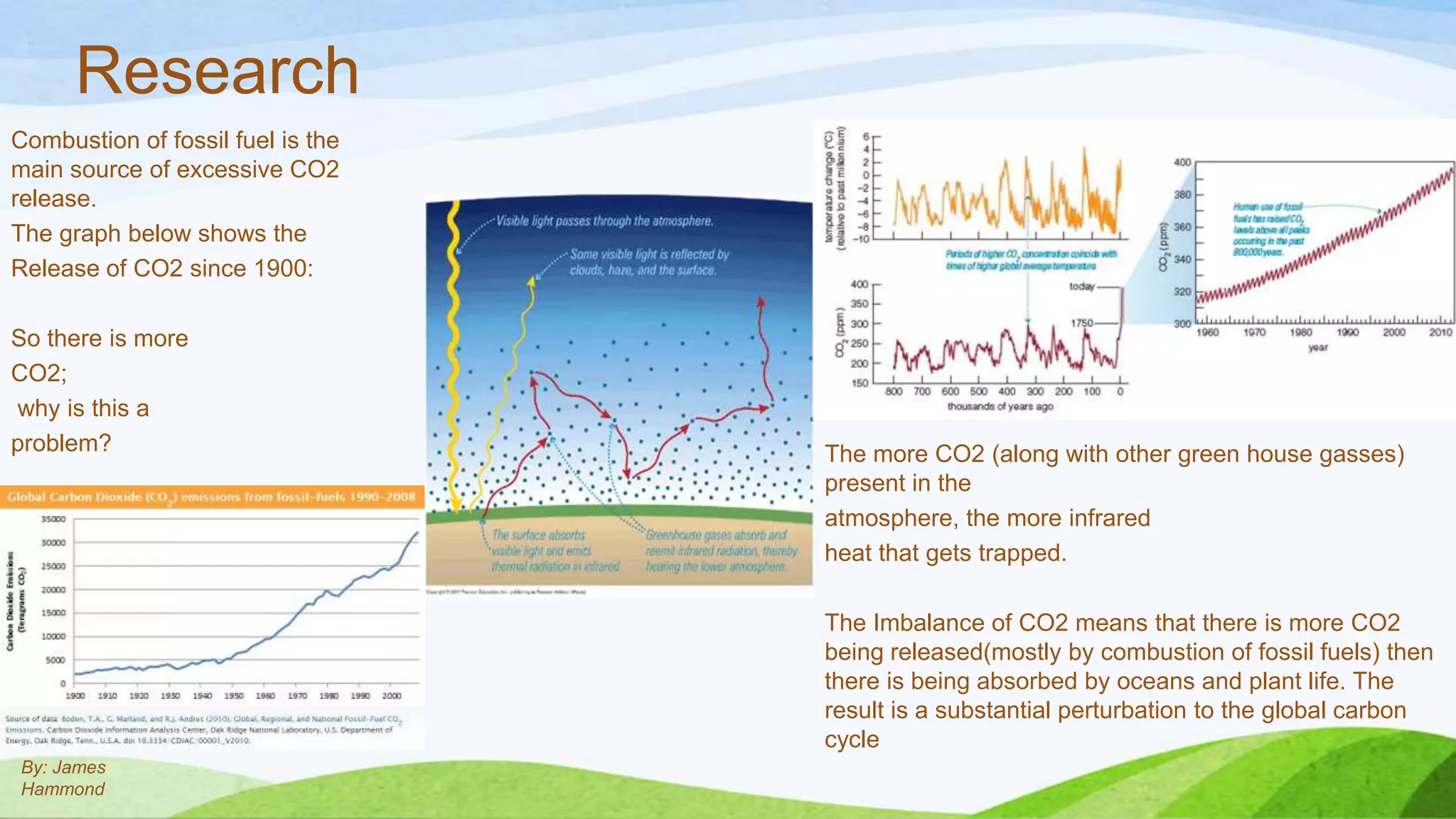
Combustion of fossil fuel is the
main source of excessive CO2
release.
The graph below shows the
Release of CO2 since 1900:

So there is more
CO2;
why is this a
problem?                           The more CO2 (along with other green house gasses)
                                   present in the
                                   atmosphere, the more infrared
                                   heat that gets trapped.

                                   The Imbalance of CO2 means that there is more CO2
                                   being released(mostly by combustion of fossil fuels) then
                                   there is being absorbed by oceans and plant life. The
                                   result is a substantial perturbation to the global carbon
                                   cycle
By: James
Hammond
Conclusion
         The climate is changing. It was bound to happen, whether humans intervened or not. The Earth has gone
         through so many climate changes over its 4.5 billion years of life that it's enough to make your head spin or
         melt, or get eroded by corrosive elements in the atmosphere, depending on what geological era you lived
         through. If we stop using fuels that release carbon, the climate will very slowly return to its cooler state.
         Interestingly, many of the previous climate changes on the planet were caused by mega-volcanoes that
         released gases and carbon that strongly resemble what we're releasing from our factories and vehicles today.
         Very crudely, you might say one industrial revolution equals one mega-volcano.

         In conclusion, anthropogenic CO2 emissions are virtually certain to be the dominant factor determining CO2
         concentrations throughout the 21st century. The importance of anthropogenic emissions is underlined by the
         expectation that the proportion of emissions taken up by both ocean and land will decline at high atmospheric
         CO2 concentrations. There is considerable uncertainty in projections of future CO2 concentration, because of
         uncertainty about the effects of climate change on the processes determining ocean and land uptake of CO2.
         These uncertainties do not negate the main finding that anthropogenic emissions will be the main control.


By: Victoria
Garrett
Sources
               • G.D. Farquhar, M.J.R. Fasham, M.L. Goulden, M.
                 Heimann, V.J. Jaramillo, H.S. Kheshgi, C. Le
                 QuÈrÈ, R.J. Scholes, D.W.R. Wallace. "The Carbon
                 Cycle and Atmospheric Carbon Dioxide." Grida.
                 N.p., n.d. Web.
               • "Greenhouse Gases." A Students Guide to Global
                 Climate Change. EPA, 12 Oct. 2012. Web. 12 Apr.
                 2013.
               • Kump, Lee R., James F. Kasting, and Robert G.
                 Crane. The Earth System. San Francisco: Prentice
                 Hall, 2010. Print.
               • "Unit 2: Atmosphere." The Habitable Planet Unit 2.
                 N.p., n.d. Web. 14 Apr. 2013.


By: Victoria
Garrett

Team3 week2nsci

  • 1.
    Fossil Fuels andThe Carbon Cycle By Team 3: Alexa Elliott, Victoria Garrett, & James Hammond By: Alexa Elliott
  • 2.
    Question and Hypothesis • Why does CO2 released by the burning of fossil fuels represent a substantial perturbation to the global carbon cycle? • We hypothesize that the release of CO2 during the burning of fossil fuels releases an unnatural and excessive amount of carbon into Earth’s carbon cycle, which causes the global carbon cycle to become perturbed and unbalanced. • We hypothesize this because the way in which humans burn fossil fuels is not something that would be naturally occurring in Earth’s carbon cycle. Humans have only recently begun to use fossil fuels, and the rate at which humans have been consuming and burning these fossil fuels has increased exponentially since the birth of the industry. By: Alexa Elliott
  • 3.
    The Experiment • Create and observe multiple environments within a greenhouse to imitate the carbon cycle • Manipulate one environment to mimic CO2 emissions from burning fossil fuels • Leave one environment alone to mimic no change in the carbon cycle due to lack of CO2 emissions from burning fossil fuels Text By: Alexa Elliott Graphic by: James Hammond
  • 4.
    Introduction to Research •Experimentation and scientific research show that since humans began burning fossil fuels the balance of the carbon cycle is changing in a way that has never been known to happen before • There have been direct links between the burning of fossil fuels and the greenhouse effect Text By: Alexa Elliott Table by: James Hammond
  • 5.
    Research Combustion of fossilfuel is the main source of excessive CO2 release. The graph below shows the Release of CO2 since 1900: So there is more CO2; why is this a problem? The more CO2 (along with other green house gasses) present in the atmosphere, the more infrared heat that gets trapped. The Imbalance of CO2 means that there is more CO2 being released(mostly by combustion of fossil fuels) then there is being absorbed by oceans and plant life. The result is a substantial perturbation to the global carbon cycle By: James Hammond
  • 6.
    Conclusion The climate is changing. It was bound to happen, whether humans intervened or not. The Earth has gone through so many climate changes over its 4.5 billion years of life that it's enough to make your head spin or melt, or get eroded by corrosive elements in the atmosphere, depending on what geological era you lived through. If we stop using fuels that release carbon, the climate will very slowly return to its cooler state. Interestingly, many of the previous climate changes on the planet were caused by mega-volcanoes that released gases and carbon that strongly resemble what we're releasing from our factories and vehicles today. Very crudely, you might say one industrial revolution equals one mega-volcano. In conclusion, anthropogenic CO2 emissions are virtually certain to be the dominant factor determining CO2 concentrations throughout the 21st century. The importance of anthropogenic emissions is underlined by the expectation that the proportion of emissions taken up by both ocean and land will decline at high atmospheric CO2 concentrations. There is considerable uncertainty in projections of future CO2 concentration, because of uncertainty about the effects of climate change on the processes determining ocean and land uptake of CO2. These uncertainties do not negate the main finding that anthropogenic emissions will be the main control. By: Victoria Garrett
  • 7.
    Sources • G.D. Farquhar, M.J.R. Fasham, M.L. Goulden, M. Heimann, V.J. Jaramillo, H.S. Kheshgi, C. Le QuÈrÈ, R.J. Scholes, D.W.R. Wallace. "The Carbon Cycle and Atmospheric Carbon Dioxide." Grida. N.p., n.d. Web. • "Greenhouse Gases." A Students Guide to Global Climate Change. EPA, 12 Oct. 2012. Web. 12 Apr. 2013. • Kump, Lee R., James F. Kasting, and Robert G. Crane. The Earth System. San Francisco: Prentice Hall, 2010. Print. • "Unit 2: Atmosphere." The Habitable Planet Unit 2. N.p., n.d. Web. 14 Apr. 2013. By: Victoria Garrett