HE
T
       CARBON
        CYCLE
       BY: Leira Ann P. Figueroa
           BSBA FTM II-1
What is Carbon?
• From Latin: carbo “coal“.
• A chemical element with symbol C and atomic number 6.
• It is the fourth most abundant element in the universe.
• A naturally abundant nonmetallic element which forms
  the basis of most living organisms.
• It is part of oceans, air, rocks, soil and all living things.
• Commonly used as a shorthand for carbon dioxide, the
  most important greenhouse gas released by humans.
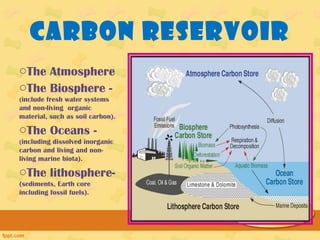
Carbon Reservoir
oThe Atmosphere
oThe Biosphere -
(include fresh water systems
and non-living organic
material, such as soil carbon).
oThe Oceans -
(including dissolved inorganic
carbon and living and non-
living marine biota).
oThe lithosphere-
(sediments, Earth core
including fossil fuels).
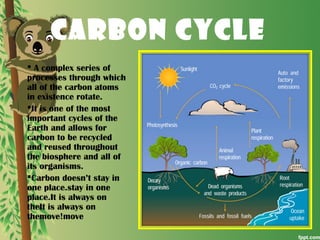
CARBON CYCLE
 A complex series of
processes through which
all of the carbon atoms
in existence rotate.
It is one of the most
important cycles of the
Earth and allows for
carbon to be recycled
and reused throughout
the biosphere and all of
its organisms.
Carbon doesn’t stay in
one place.stay in one
place.It is always on
theIt is always on
themove!move
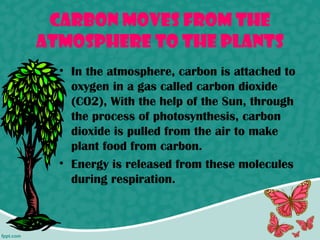
Carbon moves from the
atmosphere to the Plants
  • In the atmosphere, carbon is attached to
    oxygen in a gas called carbon dioxide
    (CO2), With the help of the Sun, through
    the process of photosynthesis, carbon
    dioxide is pulled from the air to make
    plant food from carbon.
  • Energy is released from these molecules
    during respiration.
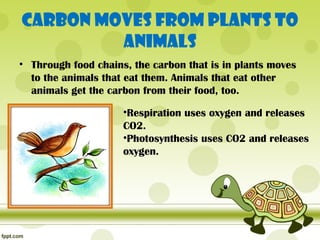
Carbon moves from Plants to
         Animals
• Through food chains, the carbon that is in plants moves
  to the animals that eat them. Animals that eat other
  animals get the carbon from their food, too.

                     •Respiration uses oxygen and releases
                     CO2.
                     •Photosynthesis uses CO2 and releases
                     oxygen.
Carbon moves from Plants
  and Animals to the Ground
• When plants and animals die, their bodies,
  wood, and leaves decay, bringing the carbon
  into the ground.
• Some becomes buried miles underground and
  will become fossil fuels in millions and millions
  of years.
Carbon moves from livings
  things to the atmosphere
• Each time you exhale, you are
  releasing carbon dioxide gas
  (CO2) into the atmosphere.
  Animals and plants get rid of
  carbon dioxide gas through a
  process called respiration.
Carbon moves from fossil
fuels to the atmosphere
 when fuels are burned.
• When humans burn fossil fuels to Power factories,
  Power plants, cars and trucks, mostcks, most of the
  carbon quickly enters the atmosphere as carbon
  dioxide gas. Each year, five and a half billion tons of
  carbon is released by burning fossil fuels.That's the
  weight of 100 adult African elephants! Of the huge
  amount of carbon that is released from fuels,3.3
  billion tons enters the atmosphere and most of the
  rest becomes dissolved in seawater.
Carbon moves from the
         atmosphere to the
         ocean.
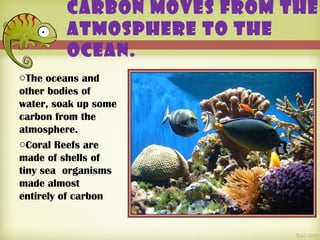
oThe oceans and
other bodies of
water, soak up some
carbon from the
atmosphere.
oCoral Reefs are
made of shells of
tiny sea organisms
made almost
entirely of carbon
CARBON DIOXIDE
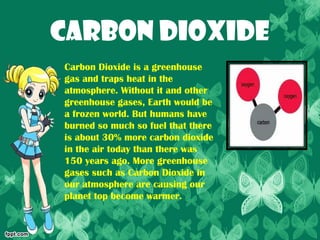
Carbon Dioxide is a greenhouse
gas and traps heat in the
atmosphere. Without it and other
greenhouse gases, Earth would be
a frozen world. But humans have
burned so much so fuel that there
is about 30% more carbon dioxide
in the air today than there was
150 years ago. More greenhouse
gases such as Carbon Dioxide in
our atmosphere are causing our
planet top become warmer.
CARBON CYCLE VIDEO

Carbon cycle

  • 1.
    HE T CARBON CYCLE BY: Leira Ann P. Figueroa BSBA FTM II-1
  • 2.
    What is Carbon? •From Latin: carbo “coal“. • A chemical element with symbol C and atomic number 6. • It is the fourth most abundant element in the universe. • A naturally abundant nonmetallic element which forms the basis of most living organisms. • It is part of oceans, air, rocks, soil and all living things. • Commonly used as a shorthand for carbon dioxide, the most important greenhouse gas released by humans.
  • 3.
    Carbon Reservoir oThe Atmosphere oTheBiosphere - (include fresh water systems and non-living organic material, such as soil carbon). oThe Oceans - (including dissolved inorganic carbon and living and non- living marine biota). oThe lithosphere- (sediments, Earth core including fossil fuels).
  • 4.
    CARBON CYCLE  Acomplex series of processes through which all of the carbon atoms in existence rotate. It is one of the most important cycles of the Earth and allows for carbon to be recycled and reused throughout the biosphere and all of its organisms. Carbon doesn’t stay in one place.stay in one place.It is always on theIt is always on themove!move
  • 5.
    Carbon moves fromthe atmosphere to the Plants • In the atmosphere, carbon is attached to oxygen in a gas called carbon dioxide (CO2), With the help of the Sun, through the process of photosynthesis, carbon dioxide is pulled from the air to make plant food from carbon. • Energy is released from these molecules during respiration.
  • 6.
    Carbon moves fromPlants to Animals • Through food chains, the carbon that is in plants moves to the animals that eat them. Animals that eat other animals get the carbon from their food, too. •Respiration uses oxygen and releases CO2. •Photosynthesis uses CO2 and releases oxygen.
  • 7.
    Carbon moves fromPlants and Animals to the Ground • When plants and animals die, their bodies, wood, and leaves decay, bringing the carbon into the ground. • Some becomes buried miles underground and will become fossil fuels in millions and millions of years.
  • 8.
    Carbon moves fromlivings things to the atmosphere • Each time you exhale, you are releasing carbon dioxide gas (CO2) into the atmosphere. Animals and plants get rid of carbon dioxide gas through a process called respiration.
  • 9.
    Carbon moves fromfossil fuels to the atmosphere when fuels are burned. • When humans burn fossil fuels to Power factories, Power plants, cars and trucks, mostcks, most of the carbon quickly enters the atmosphere as carbon dioxide gas. Each year, five and a half billion tons of carbon is released by burning fossil fuels.That's the weight of 100 adult African elephants! Of the huge amount of carbon that is released from fuels,3.3 billion tons enters the atmosphere and most of the rest becomes dissolved in seawater.
  • 10.
    Carbon moves fromthe atmosphere to the ocean. oThe oceans and other bodies of water, soak up some carbon from the atmosphere. oCoral Reefs are made of shells of tiny sea organisms made almost entirely of carbon
  • 11.
    CARBON DIOXIDE Carbon Dioxideis a greenhouse gas and traps heat in the atmosphere. Without it and other greenhouse gases, Earth would be a frozen world. But humans have burned so much so fuel that there is about 30% more carbon dioxide in the air today than there was 150 years ago. More greenhouse gases such as Carbon Dioxide in our atmosphere are causing our planet top become warmer.
  • 12.