College of Horticulture and Research Station,
Jagdalpur
course- HMET 5311
Submitted to: Submitted by:
Dr Aashish Anant Group 06
“
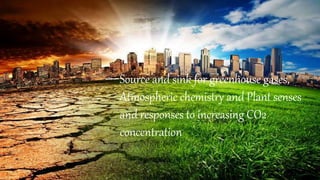
Source and sink for greenhouse gases,
Atmospheric chemistry and Plant senses
and responses to increasing CO2
concentration
Green house gases
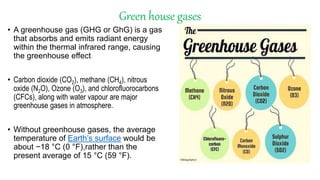
• A greenhouse gas (GHG or GhG) is a gas
that absorbs and emits radiant energy
within the thermal infrared range, causing
the greenhouse effect.
• Carbon dioxide (CO2), methane (CH4), nitrous
oxide (N2O), Ozone (O3), and chlorofluorocarbons
(CFCs), along with water vapour are major
greenhouse gases in atmosphere.
• Without greenhouse gases, the average
temperature of Earth’s surface would be
about −18 °C (0 °F),rather than the
present average of 15 °C (59 °F).
Green house effect
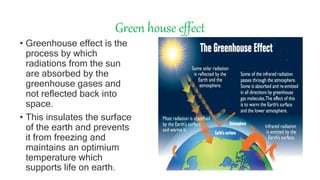
• Greenhouse effect is the
process by which
radiations from the sun
are absorbed by the
greenhouse gases and
not reflected back into
space.
• This insulates the surface
of the earth and prevents
it from freezing and
maintains an optimium
temperature which
supports life on earth.
Sources of greenhouse gases
• There are mainly two important sources of greenhouse gases that is:
1)Natural sources
2) Artificial or Anthropogenic sources
• Natural sources of GHGs are volcanos, respiration by living organisms,
decay and combustion of organic matter,wetlands for CH4 etc.
• The amounts of GHGs are balanced in the atmosphere naturally by
many physical, chemical or biochemical processes such as natural sinks
that take-up CO2, e.g. terrestrial vegetation.
•Due to the industrial revolution and human intervention, the amount of
greenhouse gases present in the atmosphere has drastically increased
•The main source of increased carbon dioxide in the atmosphere is the
burning of fossil fuels, coal, petroleum and natural gas
•Urbanisation, deforestation and soil erosion has also contributed to the
increased amount of carbon dioxide
•Various industries, solid and wastewater management are a source of
increased methane.
•Rice cultivation has contributed considerably to increased greenhouse
gases.
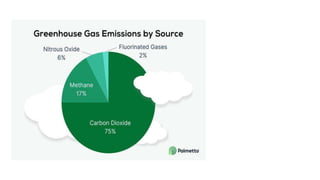
• Carbon dioxide (CO2): Fossil fuel use is the primary source of CO2.
• CO2 can also be emitted from direct human-induced impacts on forestry
and other land use, such as through deforestation, land clearing for
agriculture, and degradation of soils.
• Nitrous oxide (N2O): Agricultural activities, such as fertilizer use, are the
primary source of N2O emissions.
• Fossil fuel combustion also generates N2O.
• Fluorinated gases (F-gases): Industrial processes, refrigeration, and the use
of a variety of consumer products contribute to emissions of F-gases, which
include hydrofluorocarbons (HFCs), perfluorocarbons (PFCs), and sulfur
hexafluoride (SF6).
• Water vapour:Increased evaporation from land areas and water sources.
Sinks for green house gases
• A sink is a reduction in atmospheric GHGs by storing (sequestering)
carbon or any other gas in another form.
• A traditional carbon sink is underground coal and oil deposits where
millions of year ago living plants (and other organisms) used atmospheric
carbon to build the plant.
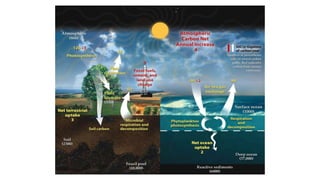
• Growing trees sequester large amounts of carbon dioxide from the
atmosphere through photosynthesis.
• An increase in biomass from the growth of forests (both above ground
and below ground) provides a carbon sink.
• The soil is a great storehouse (sink) of carbon in the form of organic
matter.
• The atmosphere, and more precisely the troposphere, is the largest sink
for methane.
• Methane in the troposphere reacts with hydroxyl (OH) radicals, forming
mainly water and carbon dioxide
• The major sink for atmospheric N2O is destruction in the stratosphere
where the majority undergoes photolysis to N2 + O
• .Greenhouse gas sinks reduce annual greenhouse gas emissions by 11.4%.
Ten percent of these offsets are due to forests and soils.
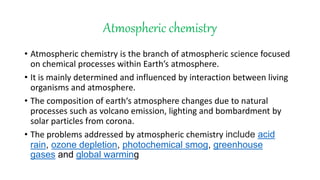
Atmospheric chemistry
• Atmospheric chemistry is the branch of atmospheric science focused
on chemical processes within Earth’s atmosphere.
• It is mainly determined and influenced by interaction between living
organisms and atmosphere.
• The composition of earth‘s atmosphere changes due to natural
processes such as volcano emission, lighting and bombardment by
solar particles from corona.
• The problems addressed by atmospheric chemistry include acid
rain, ozone depletion, photochemical smog, greenhouse
gases and global warming
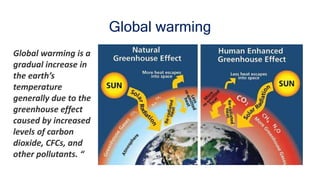
Global warming
Global warming is a
gradual increase in
the earth’s
temperature
generally due to the
greenhouse effect
caused by increased
levels of carbon
dioxide, CFCs, and
other pollutants. “
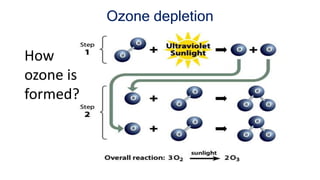
Ozone depletion
How
ozone is
formed?
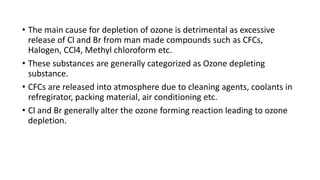
• The main cause for depletion of ozone is detrimental as excessive
release of Cl and Br from man made compounds such as CFCs,
Halogen, CCl4, Methyl chloroform etc.
• These substances are generally categorized as Ozone depleting
substance.
• CFCs are released into atmosphere due to cleaning agents, coolants in
refregirator, packing material, air conditioning etc.
• Cl and Br generally alter the ozone forming reaction leading to ozone
depletion.
Plant senses and responses to changes in CO2 concentration
• Carbon dioxide is an essential component for plant growth and
development.
• Rising CO2 concentration can have both positive and negative effect
on plants.
• Currently the amount of CO2 in atmosphere is approximately
380ppm.
• Plant physiological and biochemical responses to elevated C02 known
as CO2 fertilization effect (Dhakhwa et al, 1997), have been studied in
plants with different photosynthetic pathway namely C3 and C4.
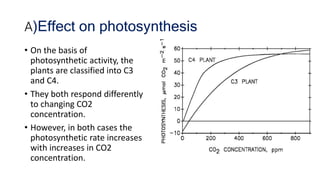
A)Effect on photosynthesis
• On the basis of
photosynthetic activity, the
plants are classified into C3
and C4.
• They both respond differently
to changing CO2
concentration.
• However, in both cases the
photosynthetic rate increases
with increases in CO2
concentration.
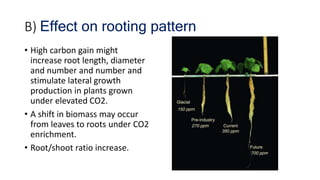
B) Effect on rooting pattern
• High carbon gain might
increase root length, diameter
and number and number and
stimulate lateral growth
production in plants grown
under elevated CO2.
• A shift in biomass may occur
from leaves to roots under CO2
enrichment.
• Root/shoot ratio increase.
C) Effect on leaf and stomata
• Increased leaf area index, leaf duration , leaf thickness etc is generally
observed.
• Elevated CO2 also increase mesophyll and chloroplast content in
leaves.
• Partial closure of stomata may occurs due to rising CO2
concentration.
• Due to this evapotranspiration rate is reduced to upto 10% but also
less air pollutants enter into the cell.
Negative impacts
• The few negative impacts are:
• Increasee CO2 concentration will decrease the rate of seed
germination.
• Food quality is declining under the rising level of CO2.
• According to some reasearches, 14% increase in lead and 8% drop in
iron content of the crop is observed.

HMET.pptx

  • 1.
    College of Horticultureand Research Station, Jagdalpur course- HMET 5311 Submitted to: Submitted by: Dr Aashish Anant Group 06
  • 2.
    “ Source and sinkfor greenhouse gases, Atmospheric chemistry and Plant senses and responses to increasing CO2 concentration
  • 3.
    Green house gases •A greenhouse gas (GHG or GhG) is a gas that absorbs and emits radiant energy within the thermal infrared range, causing the greenhouse effect. • Carbon dioxide (CO2), methane (CH4), nitrous oxide (N2O), Ozone (O3), and chlorofluorocarbons (CFCs), along with water vapour are major greenhouse gases in atmosphere. • Without greenhouse gases, the average temperature of Earth’s surface would be about −18 °C (0 °F),rather than the present average of 15 °C (59 °F).
  • 4.
    Green house effect •Greenhouse effect is the process by which radiations from the sun are absorbed by the greenhouse gases and not reflected back into space. • This insulates the surface of the earth and prevents it from freezing and maintains an optimium temperature which supports life on earth.
  • 5.
    Sources of greenhousegases • There are mainly two important sources of greenhouse gases that is: 1)Natural sources 2) Artificial or Anthropogenic sources • Natural sources of GHGs are volcanos, respiration by living organisms, decay and combustion of organic matter,wetlands for CH4 etc. • The amounts of GHGs are balanced in the atmosphere naturally by many physical, chemical or biochemical processes such as natural sinks that take-up CO2, e.g. terrestrial vegetation.
  • 6.
    •Due to theindustrial revolution and human intervention, the amount of greenhouse gases present in the atmosphere has drastically increased •The main source of increased carbon dioxide in the atmosphere is the burning of fossil fuels, coal, petroleum and natural gas •Urbanisation, deforestation and soil erosion has also contributed to the increased amount of carbon dioxide •Various industries, solid and wastewater management are a source of increased methane. •Rice cultivation has contributed considerably to increased greenhouse gases.
  • 8.
    • Carbon dioxide(CO2): Fossil fuel use is the primary source of CO2. • CO2 can also be emitted from direct human-induced impacts on forestry and other land use, such as through deforestation, land clearing for agriculture, and degradation of soils. • Nitrous oxide (N2O): Agricultural activities, such as fertilizer use, are the primary source of N2O emissions. • Fossil fuel combustion also generates N2O. • Fluorinated gases (F-gases): Industrial processes, refrigeration, and the use of a variety of consumer products contribute to emissions of F-gases, which include hydrofluorocarbons (HFCs), perfluorocarbons (PFCs), and sulfur hexafluoride (SF6). • Water vapour:Increased evaporation from land areas and water sources.
  • 10.
    Sinks for greenhouse gases • A sink is a reduction in atmospheric GHGs by storing (sequestering) carbon or any other gas in another form. • A traditional carbon sink is underground coal and oil deposits where millions of year ago living plants (and other organisms) used atmospheric carbon to build the plant. • Growing trees sequester large amounts of carbon dioxide from the atmosphere through photosynthesis. • An increase in biomass from the growth of forests (both above ground and below ground) provides a carbon sink. • The soil is a great storehouse (sink) of carbon in the form of organic matter.
  • 12.
    • The atmosphere,and more precisely the troposphere, is the largest sink for methane. • Methane in the troposphere reacts with hydroxyl (OH) radicals, forming mainly water and carbon dioxide • The major sink for atmospheric N2O is destruction in the stratosphere where the majority undergoes photolysis to N2 + O • .Greenhouse gas sinks reduce annual greenhouse gas emissions by 11.4%. Ten percent of these offsets are due to forests and soils.
  • 13.
    Atmospheric chemistry • Atmosphericchemistry is the branch of atmospheric science focused on chemical processes within Earth’s atmosphere. • It is mainly determined and influenced by interaction between living organisms and atmosphere. • The composition of earth‘s atmosphere changes due to natural processes such as volcano emission, lighting and bombardment by solar particles from corona. • The problems addressed by atmospheric chemistry include acid rain, ozone depletion, photochemical smog, greenhouse gases and global warming
  • 14.
    Global warming Global warmingis a gradual increase in the earth’s temperature generally due to the greenhouse effect caused by increased levels of carbon dioxide, CFCs, and other pollutants. “
  • 15.
  • 16.
    • The maincause for depletion of ozone is detrimental as excessive release of Cl and Br from man made compounds such as CFCs, Halogen, CCl4, Methyl chloroform etc. • These substances are generally categorized as Ozone depleting substance. • CFCs are released into atmosphere due to cleaning agents, coolants in refregirator, packing material, air conditioning etc. • Cl and Br generally alter the ozone forming reaction leading to ozone depletion.
  • 17.
    Plant senses andresponses to changes in CO2 concentration • Carbon dioxide is an essential component for plant growth and development. • Rising CO2 concentration can have both positive and negative effect on plants. • Currently the amount of CO2 in atmosphere is approximately 380ppm. • Plant physiological and biochemical responses to elevated C02 known as CO2 fertilization effect (Dhakhwa et al, 1997), have been studied in plants with different photosynthetic pathway namely C3 and C4.
  • 18.
    A)Effect on photosynthesis •On the basis of photosynthetic activity, the plants are classified into C3 and C4. • They both respond differently to changing CO2 concentration. • However, in both cases the photosynthetic rate increases with increases in CO2 concentration.
  • 19.
    B) Effect onrooting pattern • High carbon gain might increase root length, diameter and number and number and stimulate lateral growth production in plants grown under elevated CO2. • A shift in biomass may occur from leaves to roots under CO2 enrichment. • Root/shoot ratio increase.
  • 20.
    C) Effect onleaf and stomata • Increased leaf area index, leaf duration , leaf thickness etc is generally observed. • Elevated CO2 also increase mesophyll and chloroplast content in leaves. • Partial closure of stomata may occurs due to rising CO2 concentration. • Due to this evapotranspiration rate is reduced to upto 10% but also less air pollutants enter into the cell.
  • 21.
    Negative impacts • Thefew negative impacts are: • Increasee CO2 concentration will decrease the rate of seed germination. • Food quality is declining under the rising level of CO2. • According to some reasearches, 14% increase in lead and 8% drop in iron content of the crop is observed.