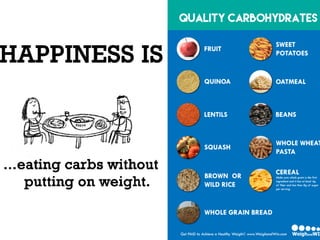
CARBOHYDRATES
Ovya pugalenthi aruna
SOMETHING
TO KNOW
ABOUT CARBS
1. You can stay lean on high-carbs
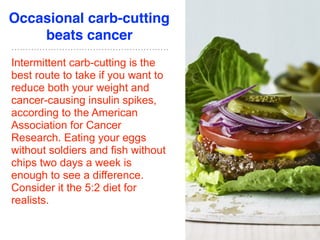
Occasional carb-cutting
beats cancer
Intermittent carb-cutting is the
best route to take if you want to
reduce both your weight and
cancer-causing insulin spikes,
according to the American
Association for Cancer
Research. Eating your eggs
without soldiers and fish without
chips two days a week is
enough to see a difference.
Consider it the 5:2 diet for
realists.
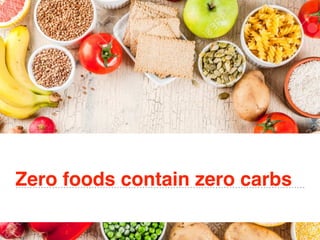
Zero foods contain zero carbs
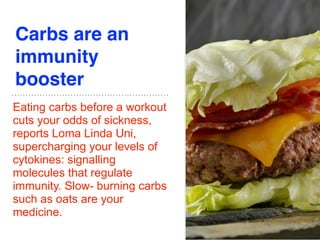
Carbs are an
immunity
booster
Eating carbs before a workout
cuts your odds of sickness,
reports Loma Linda Uni,
supercharging your levels of
cytokines: signalling
molecules that regulate
immunity. Slow- burning carbs
such as oats are your
medicine.
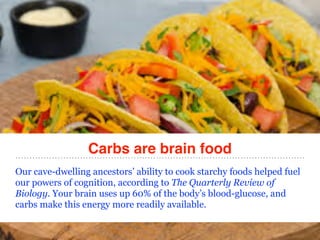
Carbs are brain food
Our cave-dwelling ancestors’ ability to cook starchy foods helped fuel
our powers of cognition, according to The Quarterly Review of
Biology. Your brain uses up 60% of the body’s blood-glucose, and
carbs make this energy more readily available.
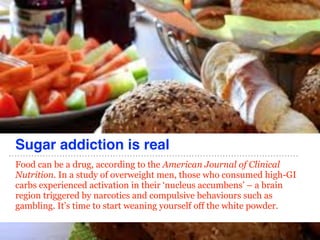
Sugar addiction is real
Food can be a drug, according to the American Journal of Clinical
Nutrition. In a study of overweight men, those who consumed high-GI
carbs experienced activation in their ‘nucleus accumbens’ – a brain
region triggered by narcotics and compulsive behaviours such as
gambling. It’s time to start weaning yourself off the white powder.
What are CARBOHYDRATES ?
–Are hydrated carbon molecules [CnH2nOn or (CH2O)n],
–They are virtually ubiquitous because they have such a wide
range of structures and functions
Structure:
–polyhydroxylated ketones,
–polyhydroxylated aldehydes, or
–compounds that can be hydrolyzed into these compounds.
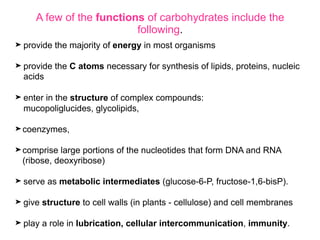
A few of the functions of carbohydrates include the
following.
➤ provide the majority of energy in most organisms
➤ provide the C atoms necessary for synthesis of lipids, proteins, nucleic
acids
➤ enter in the structure of complex compounds:
mucopoliglucides, glycolipids,
➤ coenzymes,
➤ comprise large portions of the nucleotides that form DNA and RNA
(ribose, deoxyribose)
➤ serve as metabolic intermediates (glucose-6-P, fructose-1,6-bisP).
➤ give structure to cell walls (in plants - cellulose) and cell membranes
➤ play a role in lubrication, cellular intercommunication, immunity.
Classification of carbohydrates
Carbohydrates are mainly classified into four different groups:
➤ Monosaccharides
➤ Disaccharides
➤ Oligosaccharides
➤ Polysaccharides
➤
MONOSACCHARIDES
• simple sugars with multiple OH groups. Based on number of carbons
(3, 4, 5, 6), a monosaccharide is a triose, tetrose, pentose or hexose,
cannot be hydrolyzed to simpler carbohydrates; eg. Glucose or fructose
• Monosaccharides are those carbohydrates which Cannot be
Hydrolyzed further into more simple carbohydrates.
• Thus, they are the Simplest form of Carbohydrates.
• Familiar examples are:
➤ Glucose,
➤ Fructose,
➤ Ribose &
➤ Galactose.
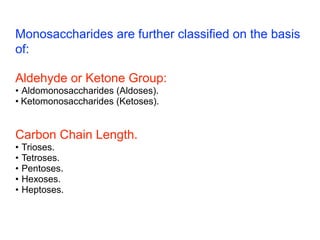
Monosaccharides are further classified on the basis
of:
Aldehyde or Ketone Group:
• Aldomonosaccharides (Aldoses).
• Ketomonosaccharides (Ketoses).
Carbon Chain Length.
• Trioses.
• Tetroses.
• Pentoses.
• Hexoses.
• Heptoses.
 
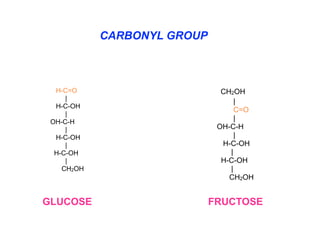
H-C=O
|
H-C-OH
|
OH-C-H
|
H-C-OH
|
H-C-OH
|
CH2OH
 CH2OH
|
C=O
|
OH-C-H
|
H-C-OH
|
H-C-OH
|
CH2OH
CARBONYL GROUP
GLUCOSE FRUCTOSE
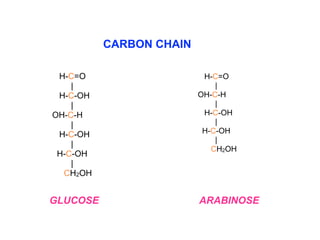
H-C=O
|
H-C-OH
|
OH-C-H
|
H-C-OH
|
H-C-OH
|
CH2OH
H-C=O
|
OH-C-H
|
H-C-OH
|
H-C-OH
|
CH2OH
CARBON CHAIN
ARABINOSEGLUCOSE
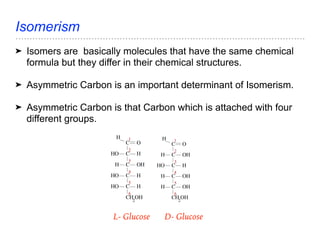
Isomerism
➤ Isomers are basically molecules that have the same chemical
formula but they differ in their chemical structures.
➤ Asymmetric Carbon is an important determinant of Isomerism.
➤ Asymmetric Carbon is that Carbon which is attached with four
different groups.
L- Glucose D- Glucose
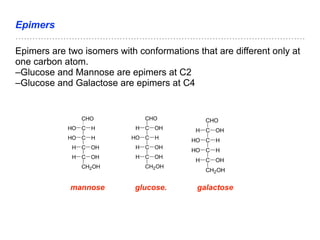
Epimers
Epimers are two isomers with conformations that are different only at
one carbon atom.
–Glucose and Mannose are epimers at C2
–Glucose and Galactose are epimers at C4
CHO
C HHO
C HHO
C OHH
C OHH
CH2OH
H
CHO
C OH
C HHO
C HHO
C OHH
CH2OH
CHO
C OHH
C HHO
C OHH
C OHH
CH2OH
mannose glucose. galactose
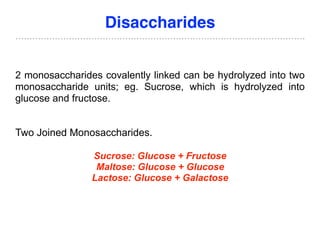
Disaccharides
2 monosaccharides covalently linked can be hydrolyzed into two
monosaccharide units; eg. Sucrose, which is hydrolyzed into
glucose and fructose.
Two Joined Monosaccharides.
Sucrose: Glucose + Fructose
Maltose: Glucose + Glucose
Lactose: Glucose + Galactose
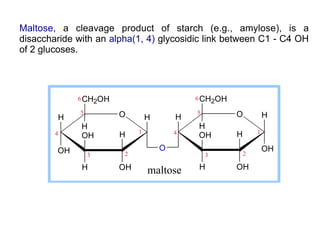
Maltose, a cleavage product of starch (e.g., amylose), is a
disaccharide with an alpha(1, 4) glycosidic link between C1 - C4 OH
of 2 glucoses.
H O
OH
H
OHH
OH
CH2OH
H
O H
OH
H
OHH
OH
CH2OH
H
O
HH
1
23
5
4
6
1
23
4
5
6
maltose
Other disaccharides include:
➤ Sucrose, common table sugar, has a glycosidic bond
linking the anomeric hydroxyls of glucose & fructose.
Because the configuration at the anomeric C of glucose is alpha
(O points down from ring), the linkage is alpha(1,2).
➤ Lactose, milk sugar, is composed of galactose & glucose,
with beta(1,4) linkage from the anomeric OH of galactose.
Polysaccharides
➤ Plants store glucose as amylose or amylopectin,
➤ glucose polymers collectively called starch.
➤ Glucose storage in polymeric form minimizes osmotic effects.
➤ Amylose is a glucose polymer with alpha(1,4) linkages.
➤ The end of the polysaccharide with an anomeric C1
➤ not involved in a glycosidic bond is called the reducing end.
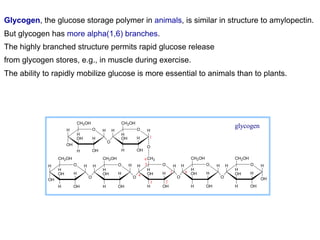
Glycogen, the glucose storage polymer in animals, is similar in structure to amylopectin.
But glycogen has more alpha(1,6) branches.
The highly branched structure permits rapid glucose release
from glycogen stores, e.g., in muscle during exercise.
The ability to rapidly mobilize glucose is more essential to animals than to plants.
H O
OH
H
OHH
OH
CH2OH
H
O H
H
OHH
OH
CH2OH
H
O
HH H O
O
H
OHH
OH
CH2
H
H H O
H
OHH
OH
CH2OH
H
OH
HH O
O
H
OHH
OH
CH2OH
H
O
H
O
1 4
6
H O
H
OHH
OH
CH2OH
H
H H O
H
OHH
OH
CH2OH
H
H
O
1
OH
3
4
5
2
glycogen
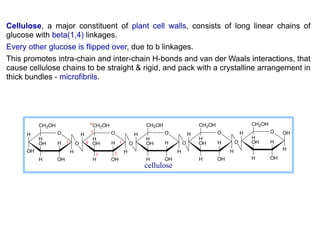
Cellulose, a major constituent of plant cell walls, consists of long linear chains of
glucose with beta(1,4) linkages.
Every other glucose is flipped over, due to b linkages.
This promotes intra-chain and inter-chain H-bonds and van der Waals interactions, that
cause cellulose chains to be straight & rigid, and pack with a crystalline arrangement in
thick bundles - microfibrils.
cellulose
H O
OH
H
OHH
OH
CH2OH
H
O
H
OHH
OH
CH2OH
H
O
H H O
O H
OHH
OH
CH2OH
H
H O
H
OHH
OH
CH2OH
H
H
OHH O
O H
OHH
OH
CH2OH
H
O
H H H H
1
6
5
4
3
1
2
METABOLISM OF CARBOHYDRATES
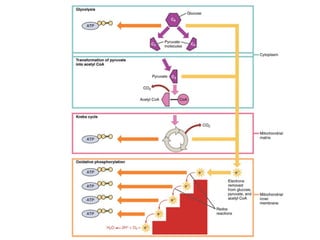
During digestion, carbohydrates are broken down into simple, soluble
sugars that can be transported across the intestinal wall into the
circulatory system to be transported throughout the body. Carbohydrate
digestion begins in the mouth with the action of salivary amylase on
starches and ends with monosaccharides being absorbed across the
epithelium of the small intestine. Once the absorbed monosaccharides are
transported to the tissues, the process of cellular respiration begins. The
following are the processes involved in the metabolism of carbohydrates.
➤ Carbohydrate metabolism begins with digestion in the small
intestine where monosaccharides are absorbed into the blood
stream.
➤ Blood sugar concentrations are controlled by three hormones:
insulin, glucagon, and epinephrine.
➤ If the concentration of glucose in the blood is too high, insulin is
secreted by the pancreas.
➤ Insulin stimulates the transfer of glucose into the cells, especially
in the liver and muscles, although other organs are also able to
metabolize glucose.
➤ In the liver and muscles, most of the glucose is changed into
glycogen by the process of glycogenesis (anabolism).
➤ Glycogen is stored in the liver and muscles until needed at some later
time when glucose levels are low.
➤ If blood glucose levels are low, then epinephrine and glucagon
hormones are secreted to stimulate the conversion of glycogen to
glucose.
➤ This process is called glycogenolysis (catabolism).
➤ If glucose is needed immediately upon entering the cells to supply
energy, it begins the metabolic process called glycolysis (catabolism).
➤ The end products of glycolysis are pyruvic acid and ATP.
➤ Since glycolysis releases relatively little ATP, further reactions continue
to convert pyruvic acid to acetyl CoA and then citric acid in the citric
acid cycle.
➤ The majority of the ATP is made from oxidations in the citric acid cycle
in connection with the electron transport chain.
➤ During strenuous muscular activity, pyruvic acid is converted into
lactic acid rather than acetyl CoA.
➤ During the resting period, the lactic acid is converted back to pyruvic
acid.
➤ The pyruvic acid in turn is converted back to glucose by the process
called gluconeogenesis (anabolism).
➤ If the glucose is not needed at that moment, it is converted into
glycogen by glycogenesis.
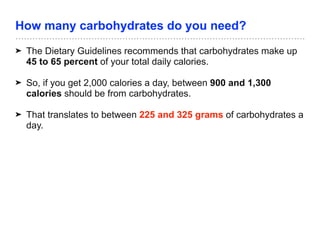
How many carbohydrates do you need?
➤ The Dietary Guidelines recommends that carbohydrates make up
45 to 65 percent of your total daily calories.
➤ So, if you get 2,000 calories a day, between 900 and 1,300
calories should be from carbohydrates.
➤ That translates to between 225 and 325 grams of carbohydrates a
day.
DISORDERS RELATED TO METABOLISM OF CARBS
➤ Obesity
➤ Non-insulin dependent diabetes mellitus (NIDDM)
➤ Cardiovascular disease
➤ Cancer
➤ Gastrointestinal diseases other than cancer
➤ Dental caries
“Insulin is not a cure for diabetes; it is a treatment. It
enables the diabetic to burn sufficient
carbohydrates so that proteins and fats may be
added to the diet in sufficient quantities to provide
energy for the economic burdens of life.
Thank you guys…….

Carbohydrates

  • 1.
  • 2.
  • 3.
    1. You canstay lean on high-carbs
  • 4.
    Occasional carb-cutting beats cancer Intermittentcarb-cutting is the best route to take if you want to reduce both your weight and cancer-causing insulin spikes, according to the American Association for Cancer Research. Eating your eggs without soldiers and fish without chips two days a week is enough to see a difference. Consider it the 5:2 diet for realists.
  • 5.
  • 6.
    Carbs are an immunity booster Eatingcarbs before a workout cuts your odds of sickness, reports Loma Linda Uni, supercharging your levels of cytokines: signalling molecules that regulate immunity. Slow- burning carbs such as oats are your medicine.
  • 7.
    Carbs are brainfood Our cave-dwelling ancestors’ ability to cook starchy foods helped fuel our powers of cognition, according to The Quarterly Review of Biology. Your brain uses up 60% of the body’s blood-glucose, and carbs make this energy more readily available.
  • 8.
    Sugar addiction isreal Food can be a drug, according to the American Journal of Clinical Nutrition. In a study of overweight men, those who consumed high-GI carbs experienced activation in their ‘nucleus accumbens’ – a brain region triggered by narcotics and compulsive behaviours such as gambling. It’s time to start weaning yourself off the white powder.
  • 10.
    What are CARBOHYDRATES? –Are hydrated carbon molecules [CnH2nOn or (CH2O)n], –They are virtually ubiquitous because they have such a wide range of structures and functions Structure: –polyhydroxylated ketones, –polyhydroxylated aldehydes, or –compounds that can be hydrolyzed into these compounds.
  • 11.
    A few ofthe functions of carbohydrates include the following. ➤ provide the majority of energy in most organisms ➤ provide the C atoms necessary for synthesis of lipids, proteins, nucleic acids ➤ enter in the structure of complex compounds: mucopoliglucides, glycolipids, ➤ coenzymes, ➤ comprise large portions of the nucleotides that form DNA and RNA (ribose, deoxyribose) ➤ serve as metabolic intermediates (glucose-6-P, fructose-1,6-bisP). ➤ give structure to cell walls (in plants - cellulose) and cell membranes ➤ play a role in lubrication, cellular intercommunication, immunity.
  • 12.
    Classification of carbohydrates Carbohydratesare mainly classified into four different groups: ➤ Monosaccharides ➤ Disaccharides ➤ Oligosaccharides ➤ Polysaccharides ➤
  • 13.
    MONOSACCHARIDES • simple sugarswith multiple OH groups. Based on number of carbons (3, 4, 5, 6), a monosaccharide is a triose, tetrose, pentose or hexose, cannot be hydrolyzed to simpler carbohydrates; eg. Glucose or fructose • Monosaccharides are those carbohydrates which Cannot be Hydrolyzed further into more simple carbohydrates. • Thus, they are the Simplest form of Carbohydrates. • Familiar examples are: ➤ Glucose, ➤ Fructose, ➤ Ribose & ➤ Galactose.
  • 14.
    Monosaccharides are furtherclassified on the basis of: Aldehyde or Ketone Group: • Aldomonosaccharides (Aldoses). • Ketomonosaccharides (Ketoses). Carbon Chain Length. • Trioses. • Tetroses. • Pentoses. • Hexoses. • Heptoses.
  • 15.
  • 16.
  • 17.
    Isomerism ➤ Isomers arebasically molecules that have the same chemical formula but they differ in their chemical structures. ➤ Asymmetric Carbon is an important determinant of Isomerism. ➤ Asymmetric Carbon is that Carbon which is attached with four different groups. L- Glucose D- Glucose
  • 18.
    Epimers Epimers are twoisomers with conformations that are different only at one carbon atom. –Glucose and Mannose are epimers at C2 –Glucose and Galactose are epimers at C4 CHO C HHO C HHO C OHH C OHH CH2OH H CHO C OH C HHO C HHO C OHH CH2OH CHO C OHH C HHO C OHH C OHH CH2OH mannose glucose. galactose
  • 19.
    Disaccharides 2 monosaccharides covalentlylinked can be hydrolyzed into two monosaccharide units; eg. Sucrose, which is hydrolyzed into glucose and fructose. Two Joined Monosaccharides. Sucrose: Glucose + Fructose Maltose: Glucose + Glucose Lactose: Glucose + Galactose
  • 20.
    Maltose, a cleavageproduct of starch (e.g., amylose), is a disaccharide with an alpha(1, 4) glycosidic link between C1 - C4 OH of 2 glucoses. H O OH H OHH OH CH2OH H O H OH H OHH OH CH2OH H O HH 1 23 5 4 6 1 23 4 5 6 maltose
  • 21.
    Other disaccharides include: ➤Sucrose, common table sugar, has a glycosidic bond linking the anomeric hydroxyls of glucose & fructose. Because the configuration at the anomeric C of glucose is alpha (O points down from ring), the linkage is alpha(1,2). ➤ Lactose, milk sugar, is composed of galactose & glucose, with beta(1,4) linkage from the anomeric OH of galactose.
  • 22.
    Polysaccharides ➤ Plants storeglucose as amylose or amylopectin, ➤ glucose polymers collectively called starch. ➤ Glucose storage in polymeric form minimizes osmotic effects. ➤ Amylose is a glucose polymer with alpha(1,4) linkages. ➤ The end of the polysaccharide with an anomeric C1 ➤ not involved in a glycosidic bond is called the reducing end.
  • 23.
    Glycogen, the glucosestorage polymer in animals, is similar in structure to amylopectin. But glycogen has more alpha(1,6) branches. The highly branched structure permits rapid glucose release from glycogen stores, e.g., in muscle during exercise. The ability to rapidly mobilize glucose is more essential to animals than to plants. H O OH H OHH OH CH2OH H O H H OHH OH CH2OH H O HH H O O H OHH OH CH2 H H H O H OHH OH CH2OH H OH HH O O H OHH OH CH2OH H O H O 1 4 6 H O H OHH OH CH2OH H H H O H OHH OH CH2OH H H O 1 OH 3 4 5 2 glycogen
  • 24.
    Cellulose, a majorconstituent of plant cell walls, consists of long linear chains of glucose with beta(1,4) linkages. Every other glucose is flipped over, due to b linkages. This promotes intra-chain and inter-chain H-bonds and van der Waals interactions, that cause cellulose chains to be straight & rigid, and pack with a crystalline arrangement in thick bundles - microfibrils. cellulose H O OH H OHH OH CH2OH H O H OHH OH CH2OH H O H H O O H OHH OH CH2OH H H O H OHH OH CH2OH H H OHH O O H OHH OH CH2OH H O H H H H 1 6 5 4 3 1 2
  • 25.
    METABOLISM OF CARBOHYDRATES Duringdigestion, carbohydrates are broken down into simple, soluble sugars that can be transported across the intestinal wall into the circulatory system to be transported throughout the body. Carbohydrate digestion begins in the mouth with the action of salivary amylase on starches and ends with monosaccharides being absorbed across the epithelium of the small intestine. Once the absorbed monosaccharides are transported to the tissues, the process of cellular respiration begins. The following are the processes involved in the metabolism of carbohydrates.
  • 27.
    ➤ Carbohydrate metabolismbegins with digestion in the small intestine where monosaccharides are absorbed into the blood stream. ➤ Blood sugar concentrations are controlled by three hormones: insulin, glucagon, and epinephrine. ➤ If the concentration of glucose in the blood is too high, insulin is secreted by the pancreas. ➤ Insulin stimulates the transfer of glucose into the cells, especially in the liver and muscles, although other organs are also able to metabolize glucose. ➤ In the liver and muscles, most of the glucose is changed into glycogen by the process of glycogenesis (anabolism).
  • 28.
    ➤ Glycogen isstored in the liver and muscles until needed at some later time when glucose levels are low. ➤ If blood glucose levels are low, then epinephrine and glucagon hormones are secreted to stimulate the conversion of glycogen to glucose. ➤ This process is called glycogenolysis (catabolism). ➤ If glucose is needed immediately upon entering the cells to supply energy, it begins the metabolic process called glycolysis (catabolism). ➤ The end products of glycolysis are pyruvic acid and ATP.
  • 29.
    ➤ Since glycolysisreleases relatively little ATP, further reactions continue to convert pyruvic acid to acetyl CoA and then citric acid in the citric acid cycle. ➤ The majority of the ATP is made from oxidations in the citric acid cycle in connection with the electron transport chain. ➤ During strenuous muscular activity, pyruvic acid is converted into lactic acid rather than acetyl CoA. ➤ During the resting period, the lactic acid is converted back to pyruvic acid. ➤ The pyruvic acid in turn is converted back to glucose by the process called gluconeogenesis (anabolism). ➤ If the glucose is not needed at that moment, it is converted into glycogen by glycogenesis.
  • 30.
    How many carbohydratesdo you need? ➤ The Dietary Guidelines recommends that carbohydrates make up 45 to 65 percent of your total daily calories. ➤ So, if you get 2,000 calories a day, between 900 and 1,300 calories should be from carbohydrates. ➤ That translates to between 225 and 325 grams of carbohydrates a day.
  • 31.
    DISORDERS RELATED TOMETABOLISM OF CARBS ➤ Obesity ➤ Non-insulin dependent diabetes mellitus (NIDDM) ➤ Cardiovascular disease ➤ Cancer ➤ Gastrointestinal diseases other than cancer ➤ Dental caries
  • 32.
    “Insulin is nota cure for diabetes; it is a treatment. It enables the diabetic to burn sufficient carbohydrates so that proteins and fats may be added to the diet in sufficient quantities to provide energy for the economic burdens of life. Thank you guys…….