CARBOHYDRATES
Carbohydrates
Carbohydrates (say: kar-bo-hi-drate) are the body’s
major source of energy. There are two main types
of carbohydrates- sugar (found in milk, fruit, table
sugar& candy) and starches (which found in grains
breads crackers & pasta):
• Composed of carbon, hydrogen, and oxygen
• -ose indicates sugar
Carbohydrates
• In plants, energy from the Sun is used to convert carbon dioxide and
water into the carbohydrate glucose.
• About 65% of the foods in our diet consist of carbohydrates.
• The body break down carbs in to sugar glucose (say: gloo-kose).
Glucose is absorbed in to bloodstream, which makes the sugar level
in the blood go up. As sugar level rises in the body, the pancreas
releases a hormone called insulin (say: in-suh-lin). Insulin is needed
to move glucose from the blood in to cells, where it can be used as
source of energy.
• In plants, a polymer of glucose called cellulose builds the stru
ctural framework. Cellulose has other important uses, too.
• The wood in our furniture, the pages in your notebook, and the cott
on in our clothing are made of cellulose.
Classification of Carbohydrates
Carbohydrates are classified according to the number
of subunits that make them up
There are 4 Types of Carbohydrates
 Monosaccharides
 Disaccharides
 Oligosaccharides
 Polysaccharides
Monosaccharides
Monosaccharides
 [Greek monos = single; sacchar = sugar]
 or simple sugars consist of one sugar unit that cannot
be further broken down into simpler sugars. Examples
of monosaccharides in foods are glucose, fructose and
galactose.
Oligosaccharides
These are compound sugars that yield 2 to 10 molecules
of the same or different monosaccharides on hydrolysis.
Accordingly, an oligosaccharide yielding 2 molecules of
monosaccharide on hydrolysis is designated as a
disaccharide, and the one yielding 3 molecules of monos
accharide as a trisaccharide and so on.
Polysaccharides
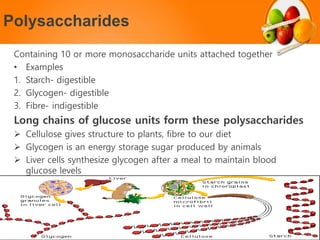
Containing 10 or more monosaccharide units attached together
• Examples
1. Starch- digestible
2. Glycogen- digestible
3. Fibre- indigestible
Long chains of glucose units form these polysaccharides
 Cellulose gives structure to plants, fibre to our diet
 Glycogen is an energy storage sugar produced by animals
 Liver cells synthesize glycogen after a meal to maintain blood
glucose levels
Functions of Carbohydrates
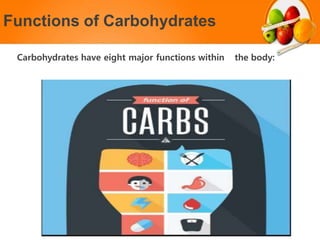
Carbohydrates have eight major functions within the body:
Functions of Carbohydrates
BLOOD SUGAR AND INSULIN
Functions of Carbohydrates
PROVIDES ENERGY
Functions of Carbohydrates
TRIGGERS APPETITE, HUNGER AND FULLNESS
Functions of Carbohydrates
OUR MOOD
Functions of Carbohydrates
DIGESTION
Functions of Carbohydrates
PREBIOTICS AND COLON HEALTH
Functions of Carbohydrates
BRAIN FUNCTIONALITY
Functions of Carbohydrates
WEIGHT
Sources of Carbohydrates
Dairy
Milk, yogurt, and ice cream
Fruit
Whole fruit and fruit juice
Grains
Bread, rice, crackers, and cereal
Legumes
Beans and other plant-based proteins
Starchy Vegetables
Potatoes and corn
GAURAV DHAKA (M.Sc. in H&A, B.Sc. in
H&M)
18
RDA of carbohydrates
The Dietary Guidelines for Americans recommends
that carbohydrates make up 45 to 65 % of your total
daily calories.
So, if you get 2,000 calories a day, between 900 and 1,
300 calories should be from carbohydrates. That
translates to between 225 and 325 grams of
carbohydrates a day.
Deficiency and Excess of carbohydrates
Deficiency
 Weight loss if carbohydrate intake is also reduced
 Body feels cold quickly (not enough insulation)
 Body bruises easily (not a thick enough cushion of fat to prevent
damage to blood vessels and bones)
 Body will not receive enough Vit A, D, E, K (found in foods that
contain fat)
Deficiency and Excess of carbohydrates
Excess
 Weight gain or obesity
Being overweight or obese raises the risk of serious health problems
such as
 Type 2 diabetes
 High blood pressure
 Heart disease
Foods containing fats are energy dense – fat provides 37kJ energy
per gram. So foods high in fat are high in energy too
Obesity develops if you combine eating too many energy rich foods
with a lack of exercise. If the energy from fatty foods is not all used
in physical activity each day it will be stored by the body under the
skin and elsewhere around the organ.
2.carbohydrates.pptx

2.carbohydrates.pptx

  • 1.
  • 2.
    Carbohydrates Carbohydrates (say: kar-bo-hi-drate)are the body’s major source of energy. There are two main types of carbohydrates- sugar (found in milk, fruit, table sugar& candy) and starches (which found in grains breads crackers & pasta): • Composed of carbon, hydrogen, and oxygen • -ose indicates sugar
  • 3.
    Carbohydrates • In plants,energy from the Sun is used to convert carbon dioxide and water into the carbohydrate glucose. • About 65% of the foods in our diet consist of carbohydrates. • The body break down carbs in to sugar glucose (say: gloo-kose). Glucose is absorbed in to bloodstream, which makes the sugar level in the blood go up. As sugar level rises in the body, the pancreas releases a hormone called insulin (say: in-suh-lin). Insulin is needed to move glucose from the blood in to cells, where it can be used as source of energy. • In plants, a polymer of glucose called cellulose builds the stru ctural framework. Cellulose has other important uses, too. • The wood in our furniture, the pages in your notebook, and the cott on in our clothing are made of cellulose.
  • 4.
    Classification of Carbohydrates Carbohydratesare classified according to the number of subunits that make them up There are 4 Types of Carbohydrates  Monosaccharides  Disaccharides  Oligosaccharides  Polysaccharides
  • 5.
    Monosaccharides Monosaccharides  [Greek monos= single; sacchar = sugar]  or simple sugars consist of one sugar unit that cannot be further broken down into simpler sugars. Examples of monosaccharides in foods are glucose, fructose and galactose.
  • 6.
    Oligosaccharides These are compoundsugars that yield 2 to 10 molecules of the same or different monosaccharides on hydrolysis. Accordingly, an oligosaccharide yielding 2 molecules of monosaccharide on hydrolysis is designated as a disaccharide, and the one yielding 3 molecules of monos accharide as a trisaccharide and so on.
  • 7.
    Polysaccharides Containing 10 ormore monosaccharide units attached together • Examples 1. Starch- digestible 2. Glycogen- digestible 3. Fibre- indigestible Long chains of glucose units form these polysaccharides  Cellulose gives structure to plants, fibre to our diet  Glycogen is an energy storage sugar produced by animals  Liver cells synthesize glycogen after a meal to maintain blood glucose levels
  • 8.
    Functions of Carbohydrates Carbohydrateshave eight major functions within the body:
  • 9.
  • 10.
  • 11.
    Functions of Carbohydrates TRIGGERSAPPETITE, HUNGER AND FULLNESS
  • 12.
  • 13.
  • 14.
  • 15.
  • 16.
  • 17.
    Sources of Carbohydrates Dairy Milk,yogurt, and ice cream Fruit Whole fruit and fruit juice Grains Bread, rice, crackers, and cereal Legumes Beans and other plant-based proteins Starchy Vegetables Potatoes and corn
  • 18.
    GAURAV DHAKA (M.Sc.in H&A, B.Sc. in H&M) 18
  • 19.
    RDA of carbohydrates TheDietary Guidelines for Americans recommends that carbohydrates make up 45 to 65 % of your total daily calories. So, if you get 2,000 calories a day, between 900 and 1, 300 calories should be from carbohydrates. That translates to between 225 and 325 grams of carbohydrates a day.
  • 20.
    Deficiency and Excessof carbohydrates Deficiency  Weight loss if carbohydrate intake is also reduced  Body feels cold quickly (not enough insulation)  Body bruises easily (not a thick enough cushion of fat to prevent damage to blood vessels and bones)  Body will not receive enough Vit A, D, E, K (found in foods that contain fat)
  • 21.
    Deficiency and Excessof carbohydrates Excess  Weight gain or obesity Being overweight or obese raises the risk of serious health problems such as  Type 2 diabetes  High blood pressure  Heart disease Foods containing fats are energy dense – fat provides 37kJ energy per gram. So foods high in fat are high in energy too Obesity develops if you combine eating too many energy rich foods with a lack of exercise. If the energy from fatty foods is not all used in physical activity each day it will be stored by the body under the skin and elsewhere around the organ.