The Periodic Table of ElementsCarbon
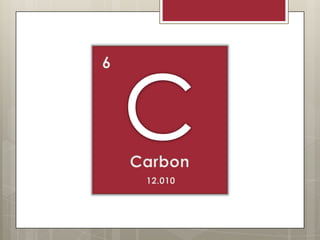
6CCarbon12.010
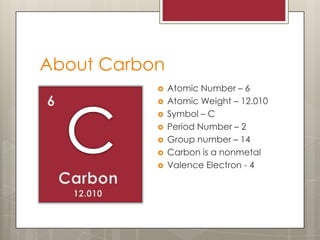
About Carbon6CAtomic Number – 6Atomic Weight – 12.010Symbol – CPeriod Number – 2Group number – 14Carbon is a nonmetalValence Electron - 4Carbon12.010
How carbon got discovered.Carbon was discovered in prehistory in the form of diamonds, charcoal, and graphite.But it hasn't always been recognized as an element.Antoine Lavoisier listed carbon as an element in his 1789 textbook.Diamond and graphite were not known as the same element until Humphrey Davy showed, first, that heating a diamond in the presence of oxygen produced only carbon dioxide, and then that heating a diamond in the absence of air caused it to change into graphite. This was around 1830.
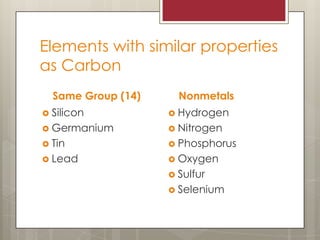
Elements with similar properties as CarbonSame Group (14)SiliconGermaniumTinLeadNonmetalsHydrogenNitrogenPhosphorusOxygenSulfurSelenium
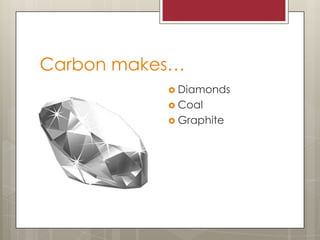
Carbon makes…DiamondsCoalGraphite
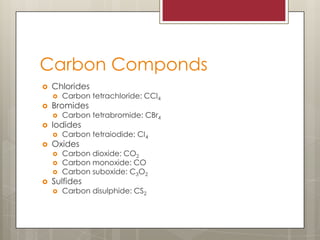
Carbon CompondsChloridesCarbon tetrachloride: CCl4BromidesCarbon tetrabromide: CBr4IodidesCarbon tetraiodide: CI4OxidesCarbon dioxide: CO2Carbon monoxide: COCarbon suboxide: C3O2SulfidesCarbon disulphide: CS2
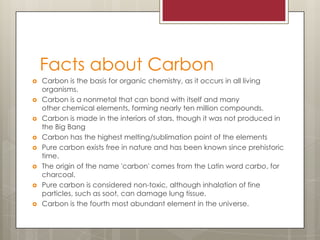
Facts about CarbonCarbon is the basis for organic chemistry, as it occurs in all living organisms.Carbon is a nonmetal that can bond with itself and many other chemical elements, forming nearly ten million compounds.Carbon is made in the interiors of stars, though it was not produced in the Big BangCarbon has the highest melting/sublimation point of the elementsPure carbon exists free in nature and has been known since prehistoric time.The origin of the name 'carbon' comes from the Latin word carbo, for charcoal.Pure carbon is considered non-toxic, although inhalation of fine particles, such as soot, can damage lung tissue.Carbon is the fourth most abundant element in the universe.

The periodic table of elements

  • 1.
    The Periodic Tableof ElementsCarbon
  • 2.
  • 3.
    About Carbon6CAtomic Number– 6Atomic Weight – 12.010Symbol – CPeriod Number – 2Group number – 14Carbon is a nonmetalValence Electron - 4Carbon12.010
  • 4.
    How carbon gotdiscovered.Carbon was discovered in prehistory in the form of diamonds, charcoal, and graphite.But it hasn't always been recognized as an element.Antoine Lavoisier listed carbon as an element in his 1789 textbook.Diamond and graphite were not known as the same element until Humphrey Davy showed, first, that heating a diamond in the presence of oxygen produced only carbon dioxide, and then that heating a diamond in the absence of air caused it to change into graphite. This was around 1830.
  • 5.
    Elements with similarproperties as CarbonSame Group (14)SiliconGermaniumTinLeadNonmetalsHydrogenNitrogenPhosphorusOxygenSulfurSelenium
  • 6.
  • 7.
    Carbon CompondsChloridesCarbon tetrachloride:CCl4BromidesCarbon tetrabromide: CBr4IodidesCarbon tetraiodide: CI4OxidesCarbon dioxide: CO2Carbon monoxide: COCarbon suboxide: C3O2SulfidesCarbon disulphide: CS2
  • 8.
    Facts about CarbonCarbonis the basis for organic chemistry, as it occurs in all living organisms.Carbon is a nonmetal that can bond with itself and many other chemical elements, forming nearly ten million compounds.Carbon is made in the interiors of stars, though it was not produced in the Big BangCarbon has the highest melting/sublimation point of the elementsPure carbon exists free in nature and has been known since prehistoric time.The origin of the name 'carbon' comes from the Latin word carbo, for charcoal.Pure carbon is considered non-toxic, although inhalation of fine particles, such as soot, can damage lung tissue.Carbon is the fourth most abundant element in the universe.