Cardiac markers
Introduction
• Acute myocardial infarction occur when there is
sudden block in blood flow in one or more of the
coronary arteries and this cuts off blood supply to
a part of the heart muscle, causing necrosis
• Cause – atherosclerotic plaque rupture and
thrombus formation
• Diagnostic criteria
– WHO guidelines, requires atleast 2 criterias:
• history of chest pain
• Evolutionary changes on the ECG
• Elevation of cardiac markers
• Heart failure is defined as the pathological
condition in which an abnormality of cardiac
function is responsible for failure of the heart
to pump blood at a rate necessary for the
requirements of the metabolizing tissues
• After myocardial infarction, a number of
intracellular proteins are released from
damaged cells. They have diagnostic
Importance and are called cardiac markers
• They are laboratory test most useful in the
detection of AMI or minor myocardial injury
when individuals have non diagnostic ECG
tracings
• Protein markers includes
– Enzymes
• Creatine kinase (CK)
• Lactate dehydrogenase (LDH)
• Aspartate aminotransferase (AST)
– Non-enzymes
• Myoglobin (Mb)
• Cardiac troponin T and I (cTnT and cTnI)
• Differ in
– Location within myocyte
– Release after damage
– Clearance from serum
Creatine Kinase (CK)
• Catalyzes the formation of phosphocreatine
from creatine and ATP
• Both cytosolic and mitochondrial isoenzymes
have been identified. The cytosolic form of the
enzymes is dimer composed of two subunits
(M and B) and thus has three isoenzymes
• CK-2 or CK-MB isoenzyme is specific for the
heart.
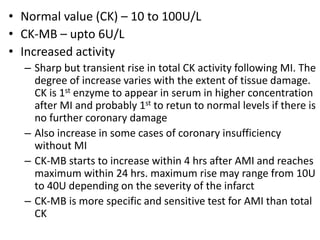
• Normal value (CK) – 10 to 100U/L
• CK-MB – upto 6U/L
• Increased activity
– Sharp but transient rise in total CK activity following MI. The
degree of increase varies with the extent of tissue damage.
CK is 1st enzyme to appear in serum in higher concentration
after MI and probably 1st to retun to normal levels if there is
no further coronary damage
– Also increase in some cases of coronary insufficiency
without MI
– CK-MB starts to increase within 4 hrs after AMI and reaches
maximum within 24 hrs. maximum rise may range from 10U
to 40U depending on the severity of the infarct
– CK-MB is more specific and sensitive test for AMI than total
CK
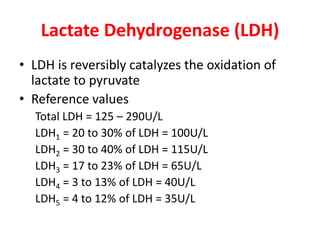
Lactate Dehydrogenase (LDH)
• LDH is reversibly catalyzes the oxidation of
lactate to pyruvate
• Reference values
Total LDH = 125 – 290U/L
LDH1 = 20 to 30% of LDH = 100U/L
LDH2 = 30 to 40% of LDH = 115U/L
LDH3 = 17 to 23% of LDH = 65U/L
LDH4 = 3 to 13% of LDH = 40U/L
LDH5 = 4 to 12% of LDH = 35U/L
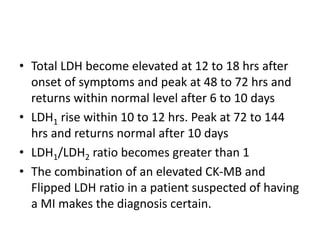
• Total LDH become elevated at 12 to 18 hrs after
onset of symptoms and peak at 48 to 72 hrs and
returns within normal level after 6 to 10 days
• LDH1 rise within 10 to 12 hrs. Peak at 72 to 144
hrs and returns normal after 10 days
• LDH1/LDH2 ratio becomes greater than 1
• The combination of an elevated CK-MB and
Flipped LDH ratio in a patient suspected of having
a MI makes the diagnosis certain.
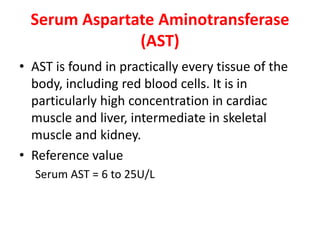
Serum Aspartate Aminotransferase
(AST)
• AST is found in practically every tissue of the
body, including red blood cells. It is in
particularly high concentration in cardiac
muscle and liver, intermediate in skeletal
muscle and kidney.
• Reference value
Serum AST = 6 to 25U/L
• AST begins to rise about 6 to 12 hrs after MI
and usually reaches its maximum in about 24
to 48hrs and returns normal within 4 to 6 days
• The increase in activity is not as great as for
CK, nor does it rises as early after the infarct.
• Less specific indication
Myoglobin (Mb)
• It is an oxygen binding protein of cardiac and
skeletal muscle
• Increase in serum myoglobin occur after
trauma to either skeletal or cardiac muscle, as
in crush injuries or AMI
• The major advantage offered by myoglobin as
a serum marker for myocardial injury is that it
is released early from damaged cells
• It rise as early as 1 hr after the occurrence of an AMI
with peak activity in the range of 4 to 12 hrs
• This peak suggests that serum myoglobin reflects the
early course of myocardial necrosis
• It is cleared rapidly and thus has a substantially reduced
clinical sensitivity after 12 hrs
• The role of Mb in the detection of AMI is within the
first 0 to 4 hrs, the time period in which CK-2 and
cardiac troponin are still within their normal values
• Serum Mb has not used extensively for routine analysis
of AMI because it is non specific, since it is rised in any
form of muscle damage
• Even minor injury to skeletal muscle may result in an
elevated concentration of serum Mb which may lead to
the misdiagnosis of AMI
Cardiac troponin (cTn)
• Troponin is a complex of three protein subunits
– Troponin C
– Troponin I
– Troponin T
• Troponin subunits exist in number of isoforms.
They are varies between cardiac muscle and slow
and fast twitch skeletal muscle
• The heart isofrom of troponin C is identical to the
slow twitch skeletal isoform and so not useful
cardiac marker.
• Cardiac specific: troponin T (cTnT) and troponinI
(cTnI) isoforms have been identified
• Cardiac specific troponin forms are currently the
most sensitive and specific cardiac markers of
AMI available.
• The initial rise in cardiac troponins (cTnI and cTnT)
after MI occurs at about the same time as CK and
CK-MB, but the rise continues for longer than for
most of the enzyme, possibly because of later
release of insoluble troponin from the infarcted
muscle.
• In AMI serum cTnT and cTnI values become elevated at 4 to 8
hrs after onset of the symptoms. Thus the initial rise of both
cTnT and cTnI are similar to those of CK-2 after AMI
• Secondly, cTnT and cTnI remain elevated upto 5 to 10 days.
The long time interval of cardiac troponin increase means it
can replace the LDH assay in the detection of late presenting
AMI individuals
• Thirdly, the very low to undetectable, cardiac troponin
values in serum from individuals without cardiac disease
permits the use of cTnT and cTnI to offer better risk
assessment than use of CK-2
• Cardiac specificity of troponin T and I eliminates a false
diagnosis of AMI in patients with increase CK-2
concentrations after skeletal muscle injuries
• Furthermore cTnT has been an excellent marker of
myocardial injury in the presence of sepsis, drug induced
toxicities, chronic dieseases, malignancies, haematological
disorders and noncardiac surgery
C-Reactive Protein (CRP)
• Acute phase protein become elevated in
inflammatory disease
• In practice measurements of proteins such as
CRP are useful in monitoring of the progress
of the inflammation or its response to
treatment
• Levels of CRP in plasma usually rises
dramatically after MI
• Normal level 0.05mg/l to 0.20 mg/l
• The increase begins with 6 to 12 hrs of the
infarction and the level may reach 200 times
of normal
• Increased risk is associated with
– Aging
– Smoking
– Having symptomatic angina
– Having had previous AMIs
Homocysteine
• Amino acid formed during bio-synthetic
pathway of cysteine from methione
• Causes of hyperhomocysteinaemia
– Mutation of cystathionine β-synthase
– Deficiency of :
• Vitamin B6
• Vitamin B12
• Folic acid
• Normal value = <15µmol/l in plasma
• People with elevated homocysteine have an
unusually high risk for coronary heart disease
and arteriosclerosis
• It appears to damage cells lining blood vessels
and to increase growth of vascular smooth
muscle
• Mildly increased homocysteine causes
dysfunction of the vascular endothelium

Cardiac markers.pptx

  • 1.
  • 2.
    Introduction • Acute myocardialinfarction occur when there is sudden block in blood flow in one or more of the coronary arteries and this cuts off blood supply to a part of the heart muscle, causing necrosis • Cause – atherosclerotic plaque rupture and thrombus formation • Diagnostic criteria – WHO guidelines, requires atleast 2 criterias: • history of chest pain • Evolutionary changes on the ECG • Elevation of cardiac markers
  • 3.
    • Heart failureis defined as the pathological condition in which an abnormality of cardiac function is responsible for failure of the heart to pump blood at a rate necessary for the requirements of the metabolizing tissues
  • 4.
    • After myocardialinfarction, a number of intracellular proteins are released from damaged cells. They have diagnostic Importance and are called cardiac markers • They are laboratory test most useful in the detection of AMI or minor myocardial injury when individuals have non diagnostic ECG tracings
  • 5.
    • Protein markersincludes – Enzymes • Creatine kinase (CK) • Lactate dehydrogenase (LDH) • Aspartate aminotransferase (AST) – Non-enzymes • Myoglobin (Mb) • Cardiac troponin T and I (cTnT and cTnI) • Differ in – Location within myocyte – Release after damage – Clearance from serum
  • 6.
    Creatine Kinase (CK) •Catalyzes the formation of phosphocreatine from creatine and ATP • Both cytosolic and mitochondrial isoenzymes have been identified. The cytosolic form of the enzymes is dimer composed of two subunits (M and B) and thus has three isoenzymes • CK-2 or CK-MB isoenzyme is specific for the heart.
  • 7.
    • Normal value(CK) – 10 to 100U/L • CK-MB – upto 6U/L • Increased activity – Sharp but transient rise in total CK activity following MI. The degree of increase varies with the extent of tissue damage. CK is 1st enzyme to appear in serum in higher concentration after MI and probably 1st to retun to normal levels if there is no further coronary damage – Also increase in some cases of coronary insufficiency without MI – CK-MB starts to increase within 4 hrs after AMI and reaches maximum within 24 hrs. maximum rise may range from 10U to 40U depending on the severity of the infarct – CK-MB is more specific and sensitive test for AMI than total CK
  • 8.
    Lactate Dehydrogenase (LDH) •LDH is reversibly catalyzes the oxidation of lactate to pyruvate • Reference values Total LDH = 125 – 290U/L LDH1 = 20 to 30% of LDH = 100U/L LDH2 = 30 to 40% of LDH = 115U/L LDH3 = 17 to 23% of LDH = 65U/L LDH4 = 3 to 13% of LDH = 40U/L LDH5 = 4 to 12% of LDH = 35U/L
  • 9.
    • Total LDHbecome elevated at 12 to 18 hrs after onset of symptoms and peak at 48 to 72 hrs and returns within normal level after 6 to 10 days • LDH1 rise within 10 to 12 hrs. Peak at 72 to 144 hrs and returns normal after 10 days • LDH1/LDH2 ratio becomes greater than 1 • The combination of an elevated CK-MB and Flipped LDH ratio in a patient suspected of having a MI makes the diagnosis certain.
  • 10.
    Serum Aspartate Aminotransferase (AST) •AST is found in practically every tissue of the body, including red blood cells. It is in particularly high concentration in cardiac muscle and liver, intermediate in skeletal muscle and kidney. • Reference value Serum AST = 6 to 25U/L
  • 11.
    • AST beginsto rise about 6 to 12 hrs after MI and usually reaches its maximum in about 24 to 48hrs and returns normal within 4 to 6 days • The increase in activity is not as great as for CK, nor does it rises as early after the infarct. • Less specific indication
  • 12.
    Myoglobin (Mb) • Itis an oxygen binding protein of cardiac and skeletal muscle • Increase in serum myoglobin occur after trauma to either skeletal or cardiac muscle, as in crush injuries or AMI • The major advantage offered by myoglobin as a serum marker for myocardial injury is that it is released early from damaged cells
  • 13.
    • It riseas early as 1 hr after the occurrence of an AMI with peak activity in the range of 4 to 12 hrs • This peak suggests that serum myoglobin reflects the early course of myocardial necrosis • It is cleared rapidly and thus has a substantially reduced clinical sensitivity after 12 hrs • The role of Mb in the detection of AMI is within the first 0 to 4 hrs, the time period in which CK-2 and cardiac troponin are still within their normal values • Serum Mb has not used extensively for routine analysis of AMI because it is non specific, since it is rised in any form of muscle damage • Even minor injury to skeletal muscle may result in an elevated concentration of serum Mb which may lead to the misdiagnosis of AMI
  • 14.
    Cardiac troponin (cTn) •Troponin is a complex of three protein subunits – Troponin C – Troponin I – Troponin T • Troponin subunits exist in number of isoforms. They are varies between cardiac muscle and slow and fast twitch skeletal muscle • The heart isofrom of troponin C is identical to the slow twitch skeletal isoform and so not useful cardiac marker.
  • 15.
    • Cardiac specific:troponin T (cTnT) and troponinI (cTnI) isoforms have been identified • Cardiac specific troponin forms are currently the most sensitive and specific cardiac markers of AMI available. • The initial rise in cardiac troponins (cTnI and cTnT) after MI occurs at about the same time as CK and CK-MB, but the rise continues for longer than for most of the enzyme, possibly because of later release of insoluble troponin from the infarcted muscle.
  • 16.
    • In AMIserum cTnT and cTnI values become elevated at 4 to 8 hrs after onset of the symptoms. Thus the initial rise of both cTnT and cTnI are similar to those of CK-2 after AMI • Secondly, cTnT and cTnI remain elevated upto 5 to 10 days. The long time interval of cardiac troponin increase means it can replace the LDH assay in the detection of late presenting AMI individuals • Thirdly, the very low to undetectable, cardiac troponin values in serum from individuals without cardiac disease permits the use of cTnT and cTnI to offer better risk assessment than use of CK-2 • Cardiac specificity of troponin T and I eliminates a false diagnosis of AMI in patients with increase CK-2 concentrations after skeletal muscle injuries • Furthermore cTnT has been an excellent marker of myocardial injury in the presence of sepsis, drug induced toxicities, chronic dieseases, malignancies, haematological disorders and noncardiac surgery
  • 17.
    C-Reactive Protein (CRP) •Acute phase protein become elevated in inflammatory disease • In practice measurements of proteins such as CRP are useful in monitoring of the progress of the inflammation or its response to treatment • Levels of CRP in plasma usually rises dramatically after MI
  • 18.
    • Normal level0.05mg/l to 0.20 mg/l • The increase begins with 6 to 12 hrs of the infarction and the level may reach 200 times of normal • Increased risk is associated with – Aging – Smoking – Having symptomatic angina – Having had previous AMIs
  • 19.
    Homocysteine • Amino acidformed during bio-synthetic pathway of cysteine from methione • Causes of hyperhomocysteinaemia – Mutation of cystathionine β-synthase – Deficiency of : • Vitamin B6 • Vitamin B12 • Folic acid
  • 20.
    • Normal value= <15µmol/l in plasma • People with elevated homocysteine have an unusually high risk for coronary heart disease and arteriosclerosis • It appears to damage cells lining blood vessels and to increase growth of vascular smooth muscle • Mildly increased homocysteine causes dysfunction of the vascular endothelium