2
Overview
• Machine learning is the kind of programming which gives
computers the capability to automatically learn from data
without being explicitly programmed.
• This means in other words that these programs change
their behavior by learning from data.
• In this course we will cover various aspects of machine
learning
• Everything will be related to Python. So it is Machine
Learning by using Python.
• What is the best programming language for machine
learning?
• Python is clearly one of the top players!
3
Confusion Matrix
• In the previous lesson of our Machine Learning
(Neural Networks with Python and
Numpy and Neural Networks from Scratch ) we
implemented various algorithms, but we didn't
properly measure the quality of the output.
• The main reason was that we used very simple
and small datasets to learn and test. In the
lesson Neural Network: Testing with MNIST, we
will work with large datasets and ten classes, so
we need proper evaluations tools.
• We will introduce the concepts of the confusion
matrix:
4
Confusion Matrix
5
confusion matrix
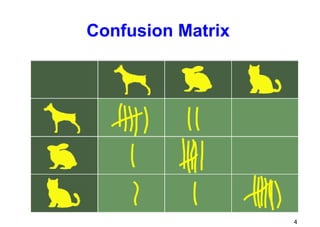
• A confusion matrix is a matrix (table) that can be
used to measure the performance of an machine
learning algorithm, usually a supervised learning
one.
• Each row of the confusion matrix represents the
instances of an actual class and each column
represents the instances of a predicted class.
• This is the way we keep it like this but it can be
the other way around as well, i.e. rows for
predicted classes and columns for actual classes.
•
6
Confusion Matrix
• The name confusion matrix reflects the fact that it
makes it easy for us to see what kind of
confusions occur in our classification algorithms.
• For example the algorithms should have predicted
a sample as Ci because the actual class is Ci, but
the algorithm came out with Cj. In this case of
mislabelling the element cm[i,j] will be incremented
by one, when the confusion matrix is constructed.
• We will define methods to calculate the confusion
matrix, precision and recall in the following class.
7
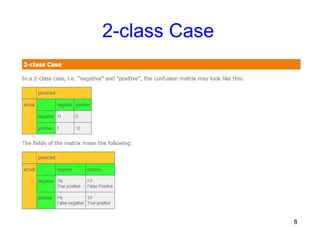
2-class Case
• In a 2-class case, i.e. "negative" and
"positive", the confusion matrix may look
like this:
8
2-class Case
9
2-class Case
10
Multi-class Case
• To measure the results of machine learning
algorithms, the previous confusion matrix will not
be sufficient.
• We will need a generalization for the multi-class
case.
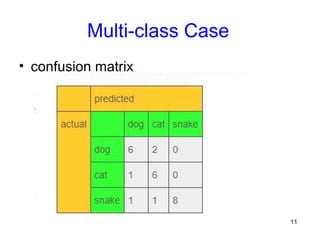
• Let us assume that we have a sample of 25
animals, e.g. 7 cats, 8 dogs, and 10 snakes, most
probably Python snakes.
• The confusion matrix of our recognition algorithm
may look like the following table:
11
Multi-class Case
• confusion matrix
12
Multi-class Case
• In this confusion matrix, the system correctly predicted
six of the eight actual dogs, but in two cases it took a
dog for a cat.
• The seven actual cats were correctly recognized in six
cases but in one case a cat was taken to be a dog.
Usually, it is hard to take a snake for a dog or a cat, but
this is what happened to our classifier in two cases.
• Yet, eight out of ten snakes had been correctly
recognized. (Most probably this machine learning
algorithm was not written in a Python program, because
Python should properly recognize its own species :-) )
13
Multi-class Case
• You can see that all correct predictions are located
in the diagonal of the table, so prediction errors
can be easily found in the table, as they will be
represented by values outside the diagonal.
• We can generalize this to the multi-class case.
• To do this we summarize over the rows and
columns of the confusion matrix.
• Given that the matrix is oriented as above, i.e., that
a given row of the matrix corresponds to specific
value for the "truth", we have:
14
15
Example
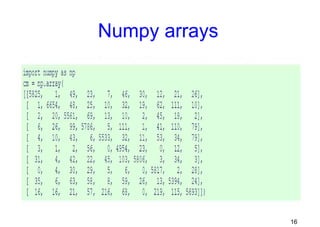
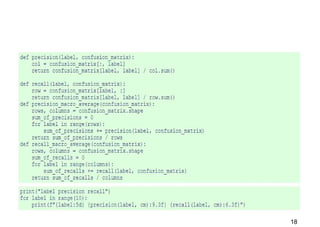
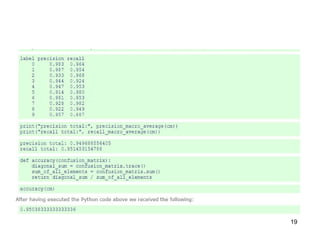
• We are ready now to code this into Python.
• The following code shows a confusion
matrix for a multi-class machine learning
problem with ten labels, so for example an
algorithms for recognizing the ten digits
from handwritten characters.
• Familiarity with Numpy and Numpy arrays,
are recommend .
16
Numpy arrays
17
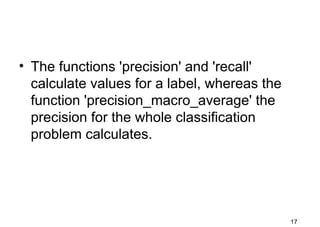
• The functions 'precision' and 'recall'
calculate values for a label, whereas the
function 'precision_macro_average' the
precision for the whole classification
problem calculates.
18
19
20
Machine Learning by
using Python
Confusion Matrix
Lesson 3
By: Professor Lili Saghafi

Machine learning by using python lesson 3 Confusion Matrix By : Professor Lili Saghafi

  • 2.
    2 Overview • Machine learningis the kind of programming which gives computers the capability to automatically learn from data without being explicitly programmed. • This means in other words that these programs change their behavior by learning from data. • In this course we will cover various aspects of machine learning • Everything will be related to Python. So it is Machine Learning by using Python. • What is the best programming language for machine learning? • Python is clearly one of the top players!
  • 3.
    3 Confusion Matrix • Inthe previous lesson of our Machine Learning (Neural Networks with Python and Numpy and Neural Networks from Scratch ) we implemented various algorithms, but we didn't properly measure the quality of the output. • The main reason was that we used very simple and small datasets to learn and test. In the lesson Neural Network: Testing with MNIST, we will work with large datasets and ten classes, so we need proper evaluations tools. • We will introduce the concepts of the confusion matrix:
  • 4.
  • 5.
    5 confusion matrix • Aconfusion matrix is a matrix (table) that can be used to measure the performance of an machine learning algorithm, usually a supervised learning one. • Each row of the confusion matrix represents the instances of an actual class and each column represents the instances of a predicted class. • This is the way we keep it like this but it can be the other way around as well, i.e. rows for predicted classes and columns for actual classes. •
  • 6.
    6 Confusion Matrix • Thename confusion matrix reflects the fact that it makes it easy for us to see what kind of confusions occur in our classification algorithms. • For example the algorithms should have predicted a sample as Ci because the actual class is Ci, but the algorithm came out with Cj. In this case of mislabelling the element cm[i,j] will be incremented by one, when the confusion matrix is constructed. • We will define methods to calculate the confusion matrix, precision and recall in the following class.
  • 7.
    7 2-class Case • Ina 2-class case, i.e. "negative" and "positive", the confusion matrix may look like this:
  • 8.
  • 9.
  • 10.
    10 Multi-class Case • Tomeasure the results of machine learning algorithms, the previous confusion matrix will not be sufficient. • We will need a generalization for the multi-class case. • Let us assume that we have a sample of 25 animals, e.g. 7 cats, 8 dogs, and 10 snakes, most probably Python snakes. • The confusion matrix of our recognition algorithm may look like the following table:
  • 11.
  • 12.
    12 Multi-class Case • Inthis confusion matrix, the system correctly predicted six of the eight actual dogs, but in two cases it took a dog for a cat. • The seven actual cats were correctly recognized in six cases but in one case a cat was taken to be a dog. Usually, it is hard to take a snake for a dog or a cat, but this is what happened to our classifier in two cases. • Yet, eight out of ten snakes had been correctly recognized. (Most probably this machine learning algorithm was not written in a Python program, because Python should properly recognize its own species :-) )
  • 13.
    13 Multi-class Case • Youcan see that all correct predictions are located in the diagonal of the table, so prediction errors can be easily found in the table, as they will be represented by values outside the diagonal. • We can generalize this to the multi-class case. • To do this we summarize over the rows and columns of the confusion matrix. • Given that the matrix is oriented as above, i.e., that a given row of the matrix corresponds to specific value for the "truth", we have:
  • 14.
  • 15.
    15 Example • We areready now to code this into Python. • The following code shows a confusion matrix for a multi-class machine learning problem with ten labels, so for example an algorithms for recognizing the ten digits from handwritten characters. • Familiarity with Numpy and Numpy arrays, are recommend .
  • 16.
  • 17.
    17 • The functions'precision' and 'recall' calculate values for a label, whereas the function 'precision_macro_average' the precision for the whole classification problem calculates.
  • 18.
  • 19.
  • 20.
    20 Machine Learning by usingPython Confusion Matrix Lesson 3 By: Professor Lili Saghafi