Captcha as Graphical 
Passwords—A New Security 
Primitive Based on Hard AI 
Problems 
Bin B. Zhu, Jeff Yan, Guanbo Bao, Maowei Yang, and Ning Xu
Abstract 
Many security primitives are based on hard mathematical problems. Using hard AI 
problems for security is emerging as an exciting new paradigm, but has been 
underexplored. In this paper, we present a new security primitive based on hard 
AI problems, namely, a novel family of graphical password systems built on top of 
Captcha technology, which we call Captcha as graphical passwords (CaRP). CaRP 
is both a Captcha and a graphical password scheme. CaRP addresses a number of 
security problems altogether, such as online guessing attacks, relay attacks, and, 
if combined with dual-view technologies, shoulder-surfing attacks. Notably, a 
CaRP password can be found only probabilistically by automatic online guessing 
attacks even if the password is in the search set. CaRP also offers a novel 
approach to address the well-known image hotspot problem in popular graphical 
password systems, such as PassPoints, that often leads to weak password choices. 
CaRP is not a panacea, but it offers reasonable security and usability and appears 
to fit well with some practical applications for improving online security.
Existing System 
Security primitives are based on hard mathematical problems. Using hard AI 
problems for security is emerging as an exciting new paradigm, but has been 
underexplored. A fundamental task in security is to create cryptographic 
primitives based on hard mathematical problems that are computationally 
intractable.
Disadvantages of Existing System 
 This paradigm has achieved just a limited success as compared with the 
cryptographic primitives based on hard math problems and their wide 
applications. 
 Using hard AI (Artificial Intelligence) problems for security, initially proposed 
in [17], is an exciting new paradigm. Under this paradigm, the most notable 
primitive invented is Captcha, which distinguishes human users from 
computers by presenting a challenge.
Proposed System 
We present a new security primitive based on hard AI problems, namely, a novel family of 
graphical password systems built on top of Captcha technology, which we call Captcha as 
graphical passwords (CaRP). CaRP is both a Captcha and a graphical password scheme. 
CaRP addresses a number of security problems altogether, such as online guessing attacks, 
relay attacks, and, if combined with dual-view technologies, shoulder-surfing attacks. 
Notably, a CaRP password can be found only probabilistically by automatic online guessing 
attacks even if the password is in the search set. CaRP also offers a novel approach to 
address the well-known image hotspot problem in popular graphical password systems, 
such as PassPoints, that often leads to weak password choices. CaRP is not a panacea, but 
it offers reasonable security and usability and appears to fit well with some practical 
applications for improving online security.We present exemplary CaRPs built on both text 
Captcha and image-recognition Captcha. One of them is a text CaRP wherein a password 
is a sequence of characters like a text password, but entered by clicking the right 
character sequence on CaRP images. CaRP offers protection against online dictionary 
attacks on passwords, which have been for long time a major security threat for various 
online services. This threat is widespread and considered as a top cyber security risk. 
Defense against online dictionary attacks is a more subtle problem than it might appear.
Advantages of Proposed System 
 The proposed system offers reasonable security and usability and appears to 
fit well with some practical applications for improving online security. 
 This threat is widespread and considered as a top cyber security risk. Defense 
against online dictionary attacks is a more subtle problem than it might 
appear.
Implementation 
Implementation is the stage of the project when the theoretical design is turned 
out into a working system. Thus it can be considered to be the most critical stage 
in achieving a successful new system and in giving the user, confidence that the 
new system will work and be effective. 
The implementation stage involves careful planning, investigation of the 
existing system and it’s constraints on implementation, designing of methods to 
achieve changeover and evaluation of changeover methods.
Modules 
 Graphical Password 
 Captcha in Authentication 
 Thwart Guessing Attacks 
 Security Of Underlying Captcha
Modules Description 
Graphical Password 
In this module, Users are having authentication and security to access the detail 
which is presented in the Image system. Before accessing or searching the details 
user should have the account in that otherwise they should register first.
 Captcha in Authentication 
It was introduced in [14] to use both Captcha and password in a user 
authentication protocol, which we call Captcha-based Password Authentication 
(CbPA) protocol, to counter online dictionary attacks. The CbPA-protocol in 
requires solving a Captcha challenge after inputting a valid pair of user ID and 
password unless a valid browser cookie is received. For an invalid pair of user ID 
and password, the user has a certain probability to solve a Captcha challenge 
before being denied access.
 Thwart Guessing Attacks 
In a guessing attack, a password guess tested in an unsuccessful 
trial is determined wrong and excluded from subsequent trials. 
The number of undetermined password guesses decreases with 
more trials, leading to a better chance of finding the password. To 
counter guessing attacks, traditional approaches in designing 
graphical passwords aim at increasing the effective password 
space to make passwords harder to guess and thus require more 
trials. No matter how secure a graphical password scheme is, the 
password can always be found by a brute force attack. In this 
paper, we distinguish two types of guessing attacks: automatic 
guessing attacks apply an automatic trial and error process but S 
can be manually constructed whereas human guessing attacks 
apply a manual trial and error process.
 Security Of Underlying Captcha 
Computational intractability in recognizing objects in CaRP images is 
fundamental to CaRP. Existing analyses on Captcha security were mostly case by 
case or used an approximate process. No theoretic security model has been 
established yet. Object segmentation is considered as a computationally 
expensive, combinatorially-hard problem, which modern text Captcha schemes 
rely on.
Minimum Hardware Configuration of the 
proposed system 
 Processor : Intel/AMD 
 Speed : 1.1 GHz 
 RAM : 256 MB 
 Hard Disk : 20 GB 
 Key Board : Standard Keyboard 
 Mouse : Standard Mouse 
 Monitor : SVGA/LCD
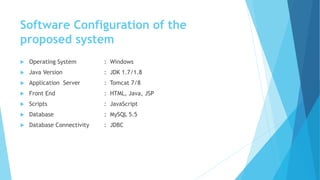
Software Configuration of the 
proposed system 
 Operating System : Windows 
 Java Version : JDK 1.7/1.8 
 Application Server : Tomcat 7/8 
 Front End : HTML, Java, JSP 
 Scripts : JavaScript 
 Database : MySQL 5.5 
 Database Connectivity : JDBC
References 
 R. Biddle, S. Chiasson, and P. C. van Oorschot, “Graphical passwords: Learning 
from the first twelve years,” ACM Comput. Surveys, vol. 44, no. 4, 2012. 
 (2012, Feb.). The Science Behind Passfaces [Online]. Available: 
http://www.realuser.com/published/ScienceBehindPassfaces.pdf 
 I. Jermyn, A. Mayer, F. Monrose, M. Reiter, and A. Rubin, “The design and 
analysis of graphical passwords,” in Proc. 8th USENIX Security Symp., 1999, 
pp. 1–15. 
 H. Tao and C. Adams, “Pass-Go: A proposal to improve the usability of 
graphical passwords,” Int. J. Netw. Security, vol. 7, no. 2, pp. 273–292, 2008. 
 S. Wiedenbeck, J. Waters, J. C. Birget, A. Brodskiy, and N. Memon, 
“PassPoints: Design and longitudinal evaluation of a graphical password 
system,” Int. J. HCI, vol. 63, pp. 102–127, Jul. 2005.

Captcha as graphical passwords a new security primitive based on hard ai problems

  • 1.
    Captcha as Graphical Passwords—A New Security Primitive Based on Hard AI Problems Bin B. Zhu, Jeff Yan, Guanbo Bao, Maowei Yang, and Ning Xu
  • 2.
    Abstract Many securityprimitives are based on hard mathematical problems. Using hard AI problems for security is emerging as an exciting new paradigm, but has been underexplored. In this paper, we present a new security primitive based on hard AI problems, namely, a novel family of graphical password systems built on top of Captcha technology, which we call Captcha as graphical passwords (CaRP). CaRP is both a Captcha and a graphical password scheme. CaRP addresses a number of security problems altogether, such as online guessing attacks, relay attacks, and, if combined with dual-view technologies, shoulder-surfing attacks. Notably, a CaRP password can be found only probabilistically by automatic online guessing attacks even if the password is in the search set. CaRP also offers a novel approach to address the well-known image hotspot problem in popular graphical password systems, such as PassPoints, that often leads to weak password choices. CaRP is not a panacea, but it offers reasonable security and usability and appears to fit well with some practical applications for improving online security.
  • 3.
    Existing System Securityprimitives are based on hard mathematical problems. Using hard AI problems for security is emerging as an exciting new paradigm, but has been underexplored. A fundamental task in security is to create cryptographic primitives based on hard mathematical problems that are computationally intractable.
  • 4.
    Disadvantages of ExistingSystem  This paradigm has achieved just a limited success as compared with the cryptographic primitives based on hard math problems and their wide applications.  Using hard AI (Artificial Intelligence) problems for security, initially proposed in [17], is an exciting new paradigm. Under this paradigm, the most notable primitive invented is Captcha, which distinguishes human users from computers by presenting a challenge.
  • 5.
    Proposed System Wepresent a new security primitive based on hard AI problems, namely, a novel family of graphical password systems built on top of Captcha technology, which we call Captcha as graphical passwords (CaRP). CaRP is both a Captcha and a graphical password scheme. CaRP addresses a number of security problems altogether, such as online guessing attacks, relay attacks, and, if combined with dual-view technologies, shoulder-surfing attacks. Notably, a CaRP password can be found only probabilistically by automatic online guessing attacks even if the password is in the search set. CaRP also offers a novel approach to address the well-known image hotspot problem in popular graphical password systems, such as PassPoints, that often leads to weak password choices. CaRP is not a panacea, but it offers reasonable security and usability and appears to fit well with some practical applications for improving online security.We present exemplary CaRPs built on both text Captcha and image-recognition Captcha. One of them is a text CaRP wherein a password is a sequence of characters like a text password, but entered by clicking the right character sequence on CaRP images. CaRP offers protection against online dictionary attacks on passwords, which have been for long time a major security threat for various online services. This threat is widespread and considered as a top cyber security risk. Defense against online dictionary attacks is a more subtle problem than it might appear.
  • 6.
    Advantages of ProposedSystem  The proposed system offers reasonable security and usability and appears to fit well with some practical applications for improving online security.  This threat is widespread and considered as a top cyber security risk. Defense against online dictionary attacks is a more subtle problem than it might appear.
  • 7.
    Implementation Implementation isthe stage of the project when the theoretical design is turned out into a working system. Thus it can be considered to be the most critical stage in achieving a successful new system and in giving the user, confidence that the new system will work and be effective. The implementation stage involves careful planning, investigation of the existing system and it’s constraints on implementation, designing of methods to achieve changeover and evaluation of changeover methods.
  • 8.
    Modules  GraphicalPassword  Captcha in Authentication  Thwart Guessing Attacks  Security Of Underlying Captcha
  • 9.
    Modules Description GraphicalPassword In this module, Users are having authentication and security to access the detail which is presented in the Image system. Before accessing or searching the details user should have the account in that otherwise they should register first.
  • 10.
     Captcha inAuthentication It was introduced in [14] to use both Captcha and password in a user authentication protocol, which we call Captcha-based Password Authentication (CbPA) protocol, to counter online dictionary attacks. The CbPA-protocol in requires solving a Captcha challenge after inputting a valid pair of user ID and password unless a valid browser cookie is received. For an invalid pair of user ID and password, the user has a certain probability to solve a Captcha challenge before being denied access.
  • 11.
     Thwart GuessingAttacks In a guessing attack, a password guess tested in an unsuccessful trial is determined wrong and excluded from subsequent trials. The number of undetermined password guesses decreases with more trials, leading to a better chance of finding the password. To counter guessing attacks, traditional approaches in designing graphical passwords aim at increasing the effective password space to make passwords harder to guess and thus require more trials. No matter how secure a graphical password scheme is, the password can always be found by a brute force attack. In this paper, we distinguish two types of guessing attacks: automatic guessing attacks apply an automatic trial and error process but S can be manually constructed whereas human guessing attacks apply a manual trial and error process.
  • 12.
     Security OfUnderlying Captcha Computational intractability in recognizing objects in CaRP images is fundamental to CaRP. Existing analyses on Captcha security were mostly case by case or used an approximate process. No theoretic security model has been established yet. Object segmentation is considered as a computationally expensive, combinatorially-hard problem, which modern text Captcha schemes rely on.
  • 13.
    Minimum Hardware Configurationof the proposed system  Processor : Intel/AMD  Speed : 1.1 GHz  RAM : 256 MB  Hard Disk : 20 GB  Key Board : Standard Keyboard  Mouse : Standard Mouse  Monitor : SVGA/LCD
  • 14.
    Software Configuration ofthe proposed system  Operating System : Windows  Java Version : JDK 1.7/1.8  Application Server : Tomcat 7/8  Front End : HTML, Java, JSP  Scripts : JavaScript  Database : MySQL 5.5  Database Connectivity : JDBC
  • 15.
    References  R.Biddle, S. Chiasson, and P. C. van Oorschot, “Graphical passwords: Learning from the first twelve years,” ACM Comput. Surveys, vol. 44, no. 4, 2012.  (2012, Feb.). The Science Behind Passfaces [Online]. Available: http://www.realuser.com/published/ScienceBehindPassfaces.pdf  I. Jermyn, A. Mayer, F. Monrose, M. Reiter, and A. Rubin, “The design and analysis of graphical passwords,” in Proc. 8th USENIX Security Symp., 1999, pp. 1–15.  H. Tao and C. Adams, “Pass-Go: A proposal to improve the usability of graphical passwords,” Int. J. Netw. Security, vol. 7, no. 2, pp. 273–292, 2008.  S. Wiedenbeck, J. Waters, J. C. Birget, A. Brodskiy, and N. Memon, “PassPoints: Design and longitudinal evaluation of a graphical password system,” Int. J. HCI, vol. 63, pp. 102–127, Jul. 2005.