Collection of subjective data


        Maria Carmela L. Domocmat, RN, MSN
Subjective data
are data that are elicited and verified only by the
client
obtained through interviewing


              Maria Carmela L. Domocmat, RN, MSN
consist of:
   •   sensations or symptoms (such as pain, hunger)
   •   preferences
   •   feelings (such as happiness or sadness)
   •   beliefs
   •   perceptions
   •   values
   •   desires
   •   Ideas
   •   personal information
                 Maria Carmela L. Domocmat, RN, MSN
• Skills needed to obtain data
  – Interview and therapies communication skills
  – Caring ability and empathy
  – Listening skills


               Maria Carmela L. Domocmat, RN, MSN
– helps provide the following data
   • clues to possible physiologic, psychological, and
     sociological problems
   • reveal a client’s risk for a problem as well as areas of
     strengths for the client


                Maria Carmela L. Domocmat, RN, MSN
Complete Health History
– Biographical data
– Reasons for seeking health care
– History of Present Health concerns
– Past health history
– Family health history
– Review of body systems (especially for current
  health problems)
– Lifestyle and health practices profile
– Developmental level
              Maria Carmela L. Domocmat, RN, MSN
NURSING INTERVIEW

      Maria Carmela L. Domocmat, RN, MSN
Nursing Interview
• a communication process that focuses on:
  – establishing rapport and a trusting relationship with
    the client to elicit accurate and meaningful
    information
  – gathering information on the client’s developmental,
    psychological, sociocultural, and spiritual statuses to
    identify deviations that can be treated with nursing
    and collaborative interventions or strengths that can
    be enhanced with nurse-client collaboration

                 Maria Carmela L. Domocmat, RN, MSN
Phases of the interview
•   Phase I: Preinteraction
•   Phase II: Introductory Phase
•   Phase III: Working phase
•   Phase IV: Summary and Closing Phase


               Maria Carmela L. Domocmat, RN, MSN
Preinteraction
Gather data from medical records, other health
personnel
Review relevant literature
Plan the setting and time for the initial interview


            Maria Carmela L. Domocmat, RN, MSN
Introductory Phase
Establish a nurse-client relationship/ rapport
Describe the purpose of the interview
Assure the client that the confidential data will
remain confidential
Make sure the client is comfortable (physically
and emotionally) and has privacy


             Maria Carmela L. Domocmat, RN, MSN
Working phase
Interview the client about his health history
Nurse and client collaborate to identify the
client’s problems and goals.
Use information to plan the physical
examination


             Maria Carmela L. Domocmat, RN, MSN
Summary and Closing Phase
Summarize information obtained and validates
problems and goals with the client
Identify possible plans to resolve the problem
(nursing diagnoses and collaborative problems) with
the client.
Ask if anything else concerns the client and if there
are any further questions
Document health history data
Validate the data with secondary sources if
necessary
               Maria Carmela L. Domocmat, RN, MSN
COMMUNICATION DURING
INTERVIEW
      Maria Carmela L. Domocmat, RN, MSN
Communication during interview
• Nonverbal communication
• Verbal communication


             Maria Carmela L. Domocmat, RN, MSN
Communication during interview

• Nonverbal communication
  –   Appearance:
  –   Demeanor
  –   Facial expression
  –   Attitude
  –   Silence
  –   Listening


                  Maria Carmela L. Domocmat, RN, MSN
Communication during interview

• Nonverbal communication
  – Appearance:
    • ensure that your appearance is professional
    • Comfortable, neat clothes
    • Hair, nail, jewelry
  – Demeanor
    • Be professional
    • Maintain professional distance


                Maria Carmela L. Domocmat, RN, MSN
Communication during interview

• Nonverbal communication
  – Facial expression
     • Keep expression neutral and friendly
     • Use right expression at the right time
  – Attitude
     • Nonjudgmental attitude
     • Do not preach to the client or impose your own sense of
       ethics


                  Maria Carmela L. Domocmat, RN, MSN
Communication during interview

• Nonverbal communication
  – Silence
    • Periods of silence allow you and the client to
      reflect and organize thoughts, which facilitates
      more accurate reporting and data collection
  – Listening
    • Most important skill to learn
    • Maintain good eye contact, smile or display open,
      appropriate facial expression, maintain open body
      position
                Maria Carmela L. Domocmat, RN, MSN
Verbal communication
•   Open-ended questions
•   Closed-ended questions
•   Laundry list
•   Rephrasing
•   Well-placed phrases
•   Inferring
•   Providing information

                Maria Carmela L. Domocmat, RN, MSN
Verbal communication
• Open-ended questions
  – “What”
  – “How”


• Closed-ended questions


              Maria Carmela L. Domocmat, RN, MSN
Verbal communication
• Laundry list
  – Provide a choice of words to choose from in
    describing symptoms, conditions, or feelings
  – “Is the pain severe, dull, sharp, mild, cutting, or
    piercing?”
  – “Does the pain occur once every year, day, month,
    or hour?”


                 Maria Carmela L. Domocmat, RN, MSN
• Rephrasing
  – Helps clarify information stated
  – Enables nurse and the client to reflect on what was
    said
  – Ex: Mr. G tells you that he has been really tired and
    nauseated for two months and that he is really scared
    because he fears that he has some horrible disease.
  – Paraphrase by saying, “You are thinking you have
    serious illness?”
                Maria Carmela L. Domocmat, RN, MSN
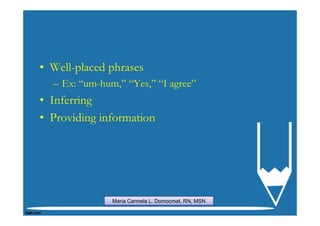
• Well-placed phrases
  – Ex: “um-hum,” “Yes,” “I agree”
• Inferring
• Providing information


               Maria Carmela L. Domocmat, RN, MSN
Let’s practice


Maria Carmela L. Domocmat, RN, MSN
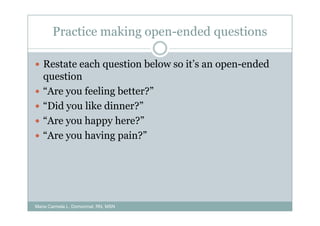
Practice making open-ended questions

   Restate each question below so it’s an open-ended
   question
   “Are you feeling better?”
   “Did you like dinner?”
   “Are you happy here?”
   “Are you having pain?”


Maria Carmela L. Domocmat, RN, MSN
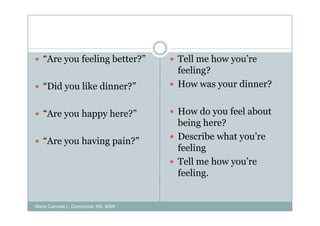
“Are you feeling better?”         Tell me how you’re
                                     feeling?
   “Did you like dinner?”            How was your dinner?


   “Are you happy here?”             How do you feel about
                                     being here?
   “Are you having pain?”            Describe what you’re
                                     feeling
                                     Tell me how you’re
                                     feeling.


Maria Carmela L. Domocmat, RN, MSN
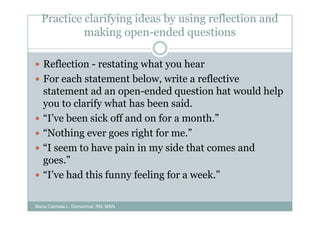
Practice clarifying ideas by using reflection and
           making open-ended questions

   Reflection - restating what you hear
   For each statement below, write a reflective
   statement ad an open-ended question hat would help
   you to clarify what has been said.
   “I’ve been sick off and on for a month.”
   “Nothing ever goes right for me.”
   “I seem to have pain in my side that comes and
   goes.”
   “I’ve had this funny feeling for a week.”

Maria Carmela L. Domocmat, RN, MSN
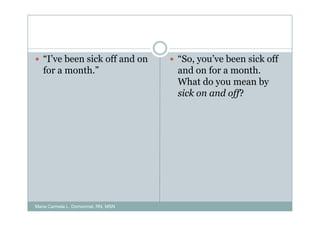
“I’ve been sick off and on        “So, you’ve been sick off
   for a month.”                     and on for a month.
                                     What do you mean by
                                     sick on and off?


Maria Carmela L. Domocmat, RN, MSN
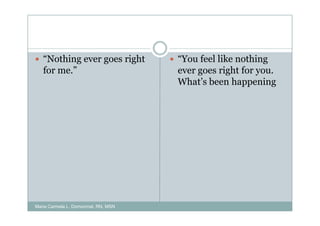
“Nothing ever goes right          “You feel like nothing
   for me.”                          ever goes right for you.
                                     What’s been happening


Maria Carmela L. Domocmat, RN, MSN
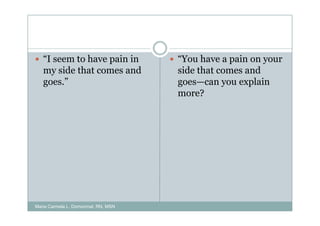
“I seem to have pain in           “You have a pain on your
   my side that comes and            side that comes and
   goes.”                            goes—can you explain
                                     more?


Maria Carmela L. Domocmat, RN, MSN
“I’ve had this funny              “You’ve had a funny
   feeling for a week.”              feeling for a week. What
                                     do you mean by funny?


Maria Carmela L. Domocmat, RN, MSN
Test your knowledge of
            communication techniques


Maria Carmela L. Domocmat, RN, MSN
Read each statement below and identify whether it is
   an open-ended statement (O), a closed-ended
   statement ©, a leading question (L), an exploratory
   statement (E), or a supplementary phrase or
   statement intended to help the person continue (S)


Maria Carmela L. Domocmat, RN, MSN
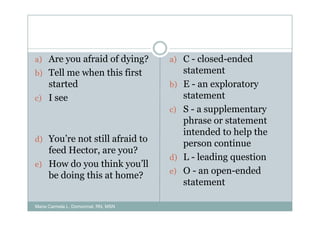
a) Are you afraid of dying?
b) Tell me when this first started
c) I see
d) You’re not still afraid to feed Hector, are you?
e) How do you think you’ll be doing this at home?
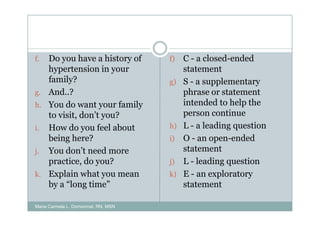
f) Do you have a history of hypertension in your
   family?
g) And..?
h) You do want your family to visit, don’t you?

Maria Carmela L. Domocmat, RN, MSN
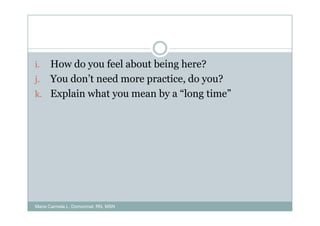
i. How do you feel about being here?
j. You don’t need more practice, do you?
k. Explain what you mean by a “long time”


Maria Carmela L. Domocmat, RN, MSN
a) Are you afraid of dying?          a) C - closed-ended
b) Tell me when this first                statement
   started                           b)   E - an exploratory
c) I see                                  statement
                                     c)   S - a supplementary
                                          phrase or statement
                                          intended to help the
d) You’re not still afraid to
                                          person continue
   feed Hector, are you?
                                     d)   L - leading question
e) How do you think you’ll
   be doing this at home?            e)   O - an open-ended
                                          statement

Maria Carmela L. Domocmat, RN, MSN
f. Do you have a history of          f)   C - a closed-ended
   hypertension in your                   statement
   family?                           g)   S - a supplementary
g. And..?                                 phrase or statement
h. You do want your family                intended to help the
   to visit, don’t you?                   person continue
i. How do you feel about             h)   L - a leading question
   being here?                       i)   O - an open-ended
j. You don’t need more                    statement
   practice, do you?                 j)   L - leading question
k. Explain what you mean             k)   E - an exploratory
   by a “long time”                       statement

Maria Carmela L. Domocmat, RN, MSN
Special considerations

        Maria Carmela L. Domocmat, RN, MSN
Gerontologic
• Assess hearing acuity
  – Hearing loss normally occurs in age
  – Undetected hearing loss is often misinterpreted as
    mental slowness or confusion
• What to do:
  – Speak slowly
  – Face the client at all times during the interview
  – Position yourself so that you are speaking on the
    side of the client that has the ear with better acuity
  – Do no yell at the clientDomocmat, RN, MSN
                 Maria Carmela L.
Gerontologic
• Do not talk down to the elderly – being older
  physically does not mean the client is slower
  mentally
• Show respect
• If client is mentally confused or forgetful, it is
  important to have SO present to clarify the data


                Maria Carmela L. Domocmat, RN, MSN
Cultural
• Be aware of the possible variations in
  communication styles
• If difficulty in communication – seek help from
  “culture broker” or culture expert.


               Maria Carmela L. Domocmat, RN, MSN
Emotional
•   Anxious
•   Angry
•   Depressed
•   Manipulative
•   Seductive
•   When discussing sensitive issues


                 Maria Carmela L. Domocmat, RN, MSN
COMPLETE HEALTH HISTORY

      Maria Carmela L. Domocmat, RN, MSN
Health History
•   Biographical data
•   Reasons for seeking health care
•   History of present health concern
•   Past health history
•   Family health history


                  Maria Carmela L. Domocmat, RN, MSN
Health History
• Review of body systems (especially for current
  health problems)
• Lifestyle and health practices profile
• Developmental level


                Maria Carmela L. Domocmat, RN, MSN
Biographical data
•   Name
•   Age
•   Religion
•   Occupation


                 Maria Carmela L. Domocmat, RN, MSN
Reasons for seeking health care
• “What is your major health problem or concerns
  at this time?” –chief complaints
• “How do you feel about having to seek health
  care?” -encourage the client to discuss fears or
  other feelings about having to see a health care
  provider.


               Maria Carmela L. Domocmat, RN, MSN
History of Present Health concerns
• Mnemonic: COLDSPA, PQRST


           Maria Carmela L. Domocmat, RN, MSN
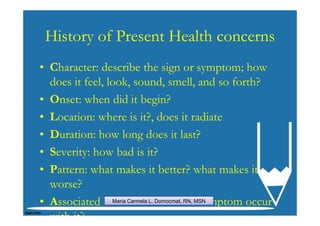
History of Present Health concerns
• Character: describe the sign or symptom; how
  does it feel, look, sound, smell, and so forth?
• Onset: when did it begin?
• Location: where is it?, does it radiate
• Duration: how long does it last?
• Severity: how bad is it?
• Pattern: what makes it better? what makes it
  worse?
• Associated Factors: what otherMSN
                 Maria Carmela L. Domocmat, RN, symptom occur


  with it?
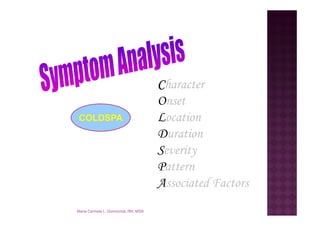
Character
                                     Onset
COLDSPA                              Location
                                     Duration
                                     Severity
                                     Pattern
                                     Associated Factors
Maria Carmela L. Domocmat, RN, MSN
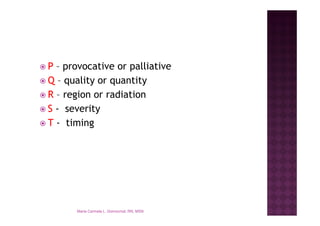
P – provocative or palliative
Q – quality or quantity
R – region or radiation
S - severity
T - timing


      Maria Carmela L. Domocmat, RN, MSN
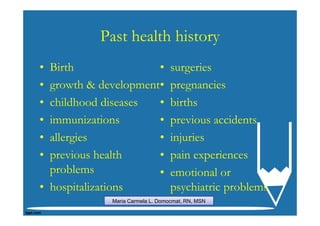
Past health history
• Birth               •           surgeries
• growth & development•           pregnancies
• childhood diseases  •           births
• immunizations       •           previous accidents
• allergies           •           injuries
• previous health     •           pain experiences
  problems            •           emotional or
• hospitalizations                psychiatric problems
             Maria Carmela L. Domocmat, RN, MSN
Family health history

• reveals risk factors for certain disease diseases
  (Diabetes, hypertension, cancer, mental illness).
• Use genogram


               Maria Carmela L. Domocmat, RN, MSN
Review of body systems
• especially for current health problems


               Maria Carmela L. Domocmat, RN, MSN
Lifestyle and health practices profile
Include:
• nutritional habits, activity and exercise patterns,
• sleep and rest patterns,
• use of medications, & substances


                Maria Carmela L. Domocmat, RN, MSN
Lifestyle and health practices profile
•   self-concept & self-care activities
•   social and community activities,
•   relationships,
•   values and belief system,
•   education and work,


                  Maria Carmela L. Domocmat, RN, MSN
Lifestyle and health practices profile
• stress level and coping style, and
• environment.


                Maria Carmela L. Domocmat, RN, MSN
Social data
• include family relationships, ethnic and
  educational background, economic status, home
  and neighborhood conditions.


              Maria Carmela L. Domocmat, RN, MSN
Psychological data
• information about the client’s emotional state.


               Maria Carmela L. Domocmat, RN, MSN
Pattern of health care
• includes all health care resources: hospitals,
  clinics, health centers, family doctors.


                Maria Carmela L. Domocmat, RN, MSN
Developmental level


  Maria Carmela L. Domocmat, RN, MSN

4 subjective data

  • 1.
    Collection of subjectivedata Maria Carmela L. Domocmat, RN, MSN
  • 2.
    Subjective data are datathat are elicited and verified only by the client obtained through interviewing Maria Carmela L. Domocmat, RN, MSN
  • 3.
    consist of: • sensations or symptoms (such as pain, hunger) • preferences • feelings (such as happiness or sadness) • beliefs • perceptions • values • desires • Ideas • personal information Maria Carmela L. Domocmat, RN, MSN
  • 4.
    • Skills neededto obtain data – Interview and therapies communication skills – Caring ability and empathy – Listening skills Maria Carmela L. Domocmat, RN, MSN
  • 5.
    – helps providethe following data • clues to possible physiologic, psychological, and sociological problems • reveal a client’s risk for a problem as well as areas of strengths for the client Maria Carmela L. Domocmat, RN, MSN
  • 6.
    Complete Health History –Biographical data – Reasons for seeking health care – History of Present Health concerns – Past health history – Family health history – Review of body systems (especially for current health problems) – Lifestyle and health practices profile – Developmental level Maria Carmela L. Domocmat, RN, MSN
  • 7.
    NURSING INTERVIEW Maria Carmela L. Domocmat, RN, MSN
  • 8.
    Nursing Interview • acommunication process that focuses on: – establishing rapport and a trusting relationship with the client to elicit accurate and meaningful information – gathering information on the client’s developmental, psychological, sociocultural, and spiritual statuses to identify deviations that can be treated with nursing and collaborative interventions or strengths that can be enhanced with nurse-client collaboration Maria Carmela L. Domocmat, RN, MSN
  • 9.
    Phases of theinterview • Phase I: Preinteraction • Phase II: Introductory Phase • Phase III: Working phase • Phase IV: Summary and Closing Phase Maria Carmela L. Domocmat, RN, MSN
  • 10.
    Preinteraction Gather data frommedical records, other health personnel Review relevant literature Plan the setting and time for the initial interview Maria Carmela L. Domocmat, RN, MSN
  • 11.
    Introductory Phase Establish anurse-client relationship/ rapport Describe the purpose of the interview Assure the client that the confidential data will remain confidential Make sure the client is comfortable (physically and emotionally) and has privacy Maria Carmela L. Domocmat, RN, MSN
  • 12.
    Working phase Interview theclient about his health history Nurse and client collaborate to identify the client’s problems and goals. Use information to plan the physical examination Maria Carmela L. Domocmat, RN, MSN
  • 13.
    Summary and ClosingPhase Summarize information obtained and validates problems and goals with the client Identify possible plans to resolve the problem (nursing diagnoses and collaborative problems) with the client. Ask if anything else concerns the client and if there are any further questions Document health history data Validate the data with secondary sources if necessary Maria Carmela L. Domocmat, RN, MSN
  • 14.
    COMMUNICATION DURING INTERVIEW Maria Carmela L. Domocmat, RN, MSN
  • 15.
    Communication during interview •Nonverbal communication • Verbal communication Maria Carmela L. Domocmat, RN, MSN
  • 16.
    Communication during interview •Nonverbal communication – Appearance: – Demeanor – Facial expression – Attitude – Silence – Listening Maria Carmela L. Domocmat, RN, MSN
  • 17.
    Communication during interview •Nonverbal communication – Appearance: • ensure that your appearance is professional • Comfortable, neat clothes • Hair, nail, jewelry – Demeanor • Be professional • Maintain professional distance Maria Carmela L. Domocmat, RN, MSN
  • 18.
    Communication during interview •Nonverbal communication – Facial expression • Keep expression neutral and friendly • Use right expression at the right time – Attitude • Nonjudgmental attitude • Do not preach to the client or impose your own sense of ethics Maria Carmela L. Domocmat, RN, MSN
  • 19.
    Communication during interview •Nonverbal communication – Silence • Periods of silence allow you and the client to reflect and organize thoughts, which facilitates more accurate reporting and data collection – Listening • Most important skill to learn • Maintain good eye contact, smile or display open, appropriate facial expression, maintain open body position Maria Carmela L. Domocmat, RN, MSN
  • 20.
    Verbal communication • Open-ended questions • Closed-ended questions • Laundry list • Rephrasing • Well-placed phrases • Inferring • Providing information Maria Carmela L. Domocmat, RN, MSN
  • 21.
    Verbal communication • Open-endedquestions – “What” – “How” • Closed-ended questions Maria Carmela L. Domocmat, RN, MSN
  • 22.
    Verbal communication • Laundrylist – Provide a choice of words to choose from in describing symptoms, conditions, or feelings – “Is the pain severe, dull, sharp, mild, cutting, or piercing?” – “Does the pain occur once every year, day, month, or hour?” Maria Carmela L. Domocmat, RN, MSN
  • 23.
    • Rephrasing – Helps clarify information stated – Enables nurse and the client to reflect on what was said – Ex: Mr. G tells you that he has been really tired and nauseated for two months and that he is really scared because he fears that he has some horrible disease. – Paraphrase by saying, “You are thinking you have serious illness?” Maria Carmela L. Domocmat, RN, MSN
  • 24.
    • Well-placed phrases – Ex: “um-hum,” “Yes,” “I agree” • Inferring • Providing information Maria Carmela L. Domocmat, RN, MSN
  • 25.
    Let’s practice Maria CarmelaL. Domocmat, RN, MSN
  • 26.
    Practice making open-endedquestions Restate each question below so it’s an open-ended question “Are you feeling better?” “Did you like dinner?” “Are you happy here?” “Are you having pain?” Maria Carmela L. Domocmat, RN, MSN
  • 27.
    “Are you feelingbetter?” Tell me how you’re feeling? “Did you like dinner?” How was your dinner? “Are you happy here?” How do you feel about being here? “Are you having pain?” Describe what you’re feeling Tell me how you’re feeling. Maria Carmela L. Domocmat, RN, MSN
  • 28.
    Practice clarifying ideasby using reflection and making open-ended questions Reflection - restating what you hear For each statement below, write a reflective statement ad an open-ended question hat would help you to clarify what has been said. “I’ve been sick off and on for a month.” “Nothing ever goes right for me.” “I seem to have pain in my side that comes and goes.” “I’ve had this funny feeling for a week.” Maria Carmela L. Domocmat, RN, MSN
  • 29.
    “I’ve been sickoff and on “So, you’ve been sick off for a month.” and on for a month. What do you mean by sick on and off? Maria Carmela L. Domocmat, RN, MSN
  • 30.
    “Nothing ever goesright “You feel like nothing for me.” ever goes right for you. What’s been happening Maria Carmela L. Domocmat, RN, MSN
  • 31.
    “I seem tohave pain in “You have a pain on your my side that comes and side that comes and goes.” goes—can you explain more? Maria Carmela L. Domocmat, RN, MSN
  • 32.
    “I’ve had thisfunny “You’ve had a funny feeling for a week.” feeling for a week. What do you mean by funny? Maria Carmela L. Domocmat, RN, MSN
  • 33.
    Test your knowledgeof communication techniques Maria Carmela L. Domocmat, RN, MSN
  • 34.
    Read each statementbelow and identify whether it is an open-ended statement (O), a closed-ended statement ©, a leading question (L), an exploratory statement (E), or a supplementary phrase or statement intended to help the person continue (S) Maria Carmela L. Domocmat, RN, MSN
  • 35.
    a) Are youafraid of dying? b) Tell me when this first started c) I see d) You’re not still afraid to feed Hector, are you? e) How do you think you’ll be doing this at home? f) Do you have a history of hypertension in your family? g) And..? h) You do want your family to visit, don’t you? Maria Carmela L. Domocmat, RN, MSN
  • 36.
    i. How doyou feel about being here? j. You don’t need more practice, do you? k. Explain what you mean by a “long time” Maria Carmela L. Domocmat, RN, MSN
  • 37.
    a) Are youafraid of dying? a) C - closed-ended b) Tell me when this first statement started b) E - an exploratory c) I see statement c) S - a supplementary phrase or statement intended to help the d) You’re not still afraid to person continue feed Hector, are you? d) L - leading question e) How do you think you’ll be doing this at home? e) O - an open-ended statement Maria Carmela L. Domocmat, RN, MSN
  • 38.
    f. Do youhave a history of f) C - a closed-ended hypertension in your statement family? g) S - a supplementary g. And..? phrase or statement h. You do want your family intended to help the to visit, don’t you? person continue i. How do you feel about h) L - a leading question being here? i) O - an open-ended j. You don’t need more statement practice, do you? j) L - leading question k. Explain what you mean k) E - an exploratory by a “long time” statement Maria Carmela L. Domocmat, RN, MSN
  • 39.
    Maria Carmela L.Domocmat, RN, MSN
  • 40.
    Maria Carmela L.Domocmat, RN, MSN
  • 41.
    Special considerations Maria Carmela L. Domocmat, RN, MSN
  • 42.
    Gerontologic • Assess hearingacuity – Hearing loss normally occurs in age – Undetected hearing loss is often misinterpreted as mental slowness or confusion • What to do: – Speak slowly – Face the client at all times during the interview – Position yourself so that you are speaking on the side of the client that has the ear with better acuity – Do no yell at the clientDomocmat, RN, MSN Maria Carmela L.
  • 43.
    Gerontologic • Do nottalk down to the elderly – being older physically does not mean the client is slower mentally • Show respect • If client is mentally confused or forgetful, it is important to have SO present to clarify the data Maria Carmela L. Domocmat, RN, MSN
  • 44.
    Cultural • Be awareof the possible variations in communication styles • If difficulty in communication – seek help from “culture broker” or culture expert. Maria Carmela L. Domocmat, RN, MSN
  • 45.
    Emotional • Anxious • Angry • Depressed • Manipulative • Seductive • When discussing sensitive issues Maria Carmela L. Domocmat, RN, MSN
  • 46.
    COMPLETE HEALTH HISTORY Maria Carmela L. Domocmat, RN, MSN
  • 47.
    Health History • Biographical data • Reasons for seeking health care • History of present health concern • Past health history • Family health history Maria Carmela L. Domocmat, RN, MSN
  • 48.
    Health History • Reviewof body systems (especially for current health problems) • Lifestyle and health practices profile • Developmental level Maria Carmela L. Domocmat, RN, MSN
  • 49.
    Biographical data • Name • Age • Religion • Occupation Maria Carmela L. Domocmat, RN, MSN
  • 50.
    Reasons for seekinghealth care • “What is your major health problem or concerns at this time?” –chief complaints • “How do you feel about having to seek health care?” -encourage the client to discuss fears or other feelings about having to see a health care provider. Maria Carmela L. Domocmat, RN, MSN
  • 51.
    History of PresentHealth concerns • Mnemonic: COLDSPA, PQRST Maria Carmela L. Domocmat, RN, MSN
  • 52.
    History of PresentHealth concerns • Character: describe the sign or symptom; how does it feel, look, sound, smell, and so forth? • Onset: when did it begin? • Location: where is it?, does it radiate • Duration: how long does it last? • Severity: how bad is it? • Pattern: what makes it better? what makes it worse? • Associated Factors: what otherMSN Maria Carmela L. Domocmat, RN, symptom occur with it?
  • 53.
    Character Onset COLDSPA Location Duration Severity Pattern Associated Factors Maria Carmela L. Domocmat, RN, MSN
  • 54.
    P – provocativeor palliative Q – quality or quantity R – region or radiation S - severity T - timing Maria Carmela L. Domocmat, RN, MSN
  • 55.
    Past health history •Birth • surgeries • growth & development• pregnancies • childhood diseases • births • immunizations • previous accidents • allergies • injuries • previous health • pain experiences problems • emotional or • hospitalizations psychiatric problems Maria Carmela L. Domocmat, RN, MSN
  • 56.
    Family health history •reveals risk factors for certain disease diseases (Diabetes, hypertension, cancer, mental illness). • Use genogram Maria Carmela L. Domocmat, RN, MSN
  • 57.
    Review of bodysystems • especially for current health problems Maria Carmela L. Domocmat, RN, MSN
  • 58.
    Lifestyle and healthpractices profile Include: • nutritional habits, activity and exercise patterns, • sleep and rest patterns, • use of medications, & substances Maria Carmela L. Domocmat, RN, MSN
  • 59.
    Lifestyle and healthpractices profile • self-concept & self-care activities • social and community activities, • relationships, • values and belief system, • education and work, Maria Carmela L. Domocmat, RN, MSN
  • 60.
    Lifestyle and healthpractices profile • stress level and coping style, and • environment. Maria Carmela L. Domocmat, RN, MSN
  • 61.
    Social data • includefamily relationships, ethnic and educational background, economic status, home and neighborhood conditions. Maria Carmela L. Domocmat, RN, MSN
  • 62.
    Psychological data • informationabout the client’s emotional state. Maria Carmela L. Domocmat, RN, MSN
  • 63.
    Pattern of healthcare • includes all health care resources: hospitals, clinics, health centers, family doctors. Maria Carmela L. Domocmat, RN, MSN
  • 64.
    Developmental level Maria Carmela L. Domocmat, RN, MSN