Basics about
Capital
Capital structure
Cost of Capital
Prepared By:
Mohammed Jasir PV
Asst. Professor
MIIMS, Puthanathani
Contact: 9605 69 32 66
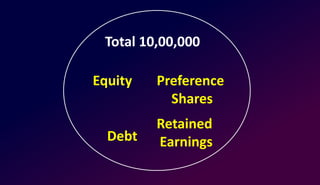
Total 10,00,000
Equity Preference
Shares
Debt
Retained
Earnings
Capital structure decisions
• Combination of capital is called capital structure
• Capital structure is the mix of the long-term sources of funds used by
a firm
• Decision related to capital structure is Capital structure decisions
• How much Equity, Debt, Preference Shares and Retained Earnings
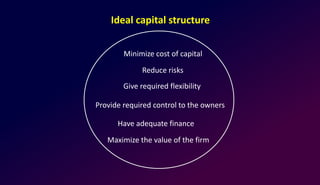
Minimize cost of capital
Reduce risks
Give required flexibility
Provide required control to the owners
Have adequate finance
Maximize the value of the firm
Ideal capital structure
Cost of Capital
Cost of capital
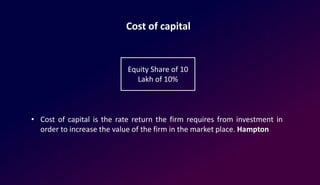
• Cost of capital is the rate return the firm requires from investment in
order to increase the value of the firm in the market place. Hampton
Equity Share of 10
Lakh of 10%
Meaning of Cost of Capital
• Cost of capital is the required rate of return on its investments which
belongs to equity , debt and retained earnings
• If a firm fails to earn return at the expected rate, the market value of the
shares will fall and it will result in the reduction of overall wealth of the
shareholders
Importance of Cost of Capital
• Importance to Capital Budgeting Decision
• Importance to Capital Structure Decision
• Importance to Evolution of Financial Performance
• Importance to Other Financial Decisions
Classification of Cost of Capital
1) Historical cost and Future cost
2) Specific cost and Composite cost
3) Average cost and Marginal cost
4) Explicit cost (IRR) and Implicit cost
Historical cost and Future cost
• Historical cost are the costs which are incurred for the procurement
of funds based upon the existing capital structure of the firm. It is a
book cost.
• Future cost is the cost which is relate to estimated for the future.
Simply it is the cost to be incurred for raising new funds.
Specific cost and composite cost
• Specific cost refers to the cost which is associated with the particular
sources of capital.
E.g.- Cost of Equity
• Composite cost is the combined cost of different sources of capital taken
together.
E.g.- Cost of debt, cost of equity & Cost of pref.shares.
Average cost and Marginal cost
• Average cost is the combined cost of various sources of capital such as
equity shares, debentures, preference shares.
• Marginal cost of capital is the average cost of capital which has to be
incurred due to new funds raised by the company for their financial
requirements.
Explicit cost and Implicit cost
• Explicit cost is the cut-off rate or internal rate of return.
• Implicit cost is the rate of return related to the best investment
opportunity of the firm and its shareholders that will be foregone in order
to take up a particular project
Computation of Cost of Capital
• Computation of the Cost of Capital involves
I. Computation of specific costs
Ke, Kp, Kd, Kr
II. Computation of composite cost
WACC
A. Cost of Equity Capital (Ke)
• Cost of equity capital may be defined as the minimum rate of return that
a firm must earn on it investment, and also the market price of the
equity shares on unchanged
• Different Methods to calculate Ke
– Dividend price method (D/P Approach)
– Dividend price plus growth (D/P + g Approach)
– Earning Price / Earning Per Share Approach (E/P Approach)
– CAPM Method
Cost of Preference Shares (Kp)
• Normally a fixed rate of dividend is payable on preference shares
• But in the practical sense preference dividend is regularly paid by the
companies when they earn sufficient amount of profit
• Two types
– Irredeemable Preference Shares
– Redeemable Preference Shares
Cost of Debt (Kd)
• Cost of debt is the interest a company pays on its borrowings
• It is expressed as a percentage rate
• In addition, cost of debt can be calculated as a before-tax rate or an
after-tax rate
• Because interest is deductible for income taxes, the cost of debt is
usually expressed as an after-tax rate
• Two cases
– Redeemable Debt
– Irredeemable Debt
• Issue in Par Value
• Issue in Discount or Premium
Cost of Retained Earnings (Kr)
• Many people believe that retained earnings are free of cost, but it
includes some cost
• It is the opportunity cost of dividend over one by the shareholders
• It is the return that the share holder could have earned if the would
have interest elsewhere
Weighted Average Cost Of Capital
or
Composite Cost Of Capital
or
Average Cost Of Capital
or
Overall Cost Of Capital
WACC
• WACC is the average cost of various source of capital.
• Once the specific cost of individual capital is determined we can compute
the WACC by putting weightage to specific cost of capital in proportion of
the various source of fund to the total.
• The weight may be given by using either book value or market value
Thank You

Capital structure

  • 1.
    Basics about Capital Capital structure Costof Capital Prepared By: Mohammed Jasir PV Asst. Professor MIIMS, Puthanathani Contact: 9605 69 32 66
  • 2.
  • 3.
    Capital structure decisions •Combination of capital is called capital structure • Capital structure is the mix of the long-term sources of funds used by a firm • Decision related to capital structure is Capital structure decisions • How much Equity, Debt, Preference Shares and Retained Earnings
  • 4.
    Minimize cost ofcapital Reduce risks Give required flexibility Provide required control to the owners Have adequate finance Maximize the value of the firm Ideal capital structure
  • 5.
  • 6.
    Cost of capital •Cost of capital is the rate return the firm requires from investment in order to increase the value of the firm in the market place. Hampton Equity Share of 10 Lakh of 10%
  • 7.
    Meaning of Costof Capital • Cost of capital is the required rate of return on its investments which belongs to equity , debt and retained earnings • If a firm fails to earn return at the expected rate, the market value of the shares will fall and it will result in the reduction of overall wealth of the shareholders
  • 8.
    Importance of Costof Capital • Importance to Capital Budgeting Decision • Importance to Capital Structure Decision • Importance to Evolution of Financial Performance • Importance to Other Financial Decisions
  • 9.
    Classification of Costof Capital 1) Historical cost and Future cost 2) Specific cost and Composite cost 3) Average cost and Marginal cost 4) Explicit cost (IRR) and Implicit cost
  • 10.
    Historical cost andFuture cost • Historical cost are the costs which are incurred for the procurement of funds based upon the existing capital structure of the firm. It is a book cost. • Future cost is the cost which is relate to estimated for the future. Simply it is the cost to be incurred for raising new funds.
  • 11.
    Specific cost andcomposite cost • Specific cost refers to the cost which is associated with the particular sources of capital. E.g.- Cost of Equity • Composite cost is the combined cost of different sources of capital taken together. E.g.- Cost of debt, cost of equity & Cost of pref.shares.
  • 12.
    Average cost andMarginal cost • Average cost is the combined cost of various sources of capital such as equity shares, debentures, preference shares. • Marginal cost of capital is the average cost of capital which has to be incurred due to new funds raised by the company for their financial requirements.
  • 13.
    Explicit cost andImplicit cost • Explicit cost is the cut-off rate or internal rate of return. • Implicit cost is the rate of return related to the best investment opportunity of the firm and its shareholders that will be foregone in order to take up a particular project
  • 14.
    Computation of Costof Capital • Computation of the Cost of Capital involves I. Computation of specific costs Ke, Kp, Kd, Kr II. Computation of composite cost WACC
  • 15.
    A. Cost ofEquity Capital (Ke) • Cost of equity capital may be defined as the minimum rate of return that a firm must earn on it investment, and also the market price of the equity shares on unchanged • Different Methods to calculate Ke – Dividend price method (D/P Approach) – Dividend price plus growth (D/P + g Approach) – Earning Price / Earning Per Share Approach (E/P Approach) – CAPM Method
  • 16.
    Cost of PreferenceShares (Kp) • Normally a fixed rate of dividend is payable on preference shares • But in the practical sense preference dividend is regularly paid by the companies when they earn sufficient amount of profit • Two types – Irredeemable Preference Shares – Redeemable Preference Shares
  • 17.
    Cost of Debt(Kd) • Cost of debt is the interest a company pays on its borrowings • It is expressed as a percentage rate • In addition, cost of debt can be calculated as a before-tax rate or an after-tax rate • Because interest is deductible for income taxes, the cost of debt is usually expressed as an after-tax rate • Two cases – Redeemable Debt – Irredeemable Debt • Issue in Par Value • Issue in Discount or Premium
  • 18.
    Cost of RetainedEarnings (Kr) • Many people believe that retained earnings are free of cost, but it includes some cost • It is the opportunity cost of dividend over one by the shareholders • It is the return that the share holder could have earned if the would have interest elsewhere
  • 19.
    Weighted Average CostOf Capital or Composite Cost Of Capital or Average Cost Of Capital or Overall Cost Of Capital
  • 20.
    WACC • WACC isthe average cost of various source of capital. • Once the specific cost of individual capital is determined we can compute the WACC by putting weightage to specific cost of capital in proportion of the various source of fund to the total. • The weight may be given by using either book value or market value
  • 21.