“Impact of Aggressive Working
Capital
Management Policy on Firms’
Profitability”
Ben10 Members:
×
×
×
×
×
×

Ben Jose
Christeena James
Deepa Rose Jacob
Indu Sukumaran
Jenita
Stephanie
The present study…
• investigates the traditional relationship between
working capital management policies and a firm’s
profitability.
• Managers can create value if they adopt a
conservative approach towards working capital
investment and working capital financing policies.

The study also finds that investors give weight to
the stocks of those firms that adopt an aggressive
approach to managing their short-term liabilities.
What It Says…
• Management of short-term assets and liabilities
need a careful investigation because the working

capital management plays an important role in a
firm’s profitability and risk as well as its value.
•

Efficient management of working capital is a
fundamental part of the overall corporate strategy
in creating the shareholders’ value.
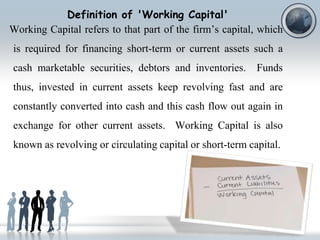
Definition of 'Working Capital'
Working Capital refers to that part of the firm’s capital, which
is required for financing short-term or current assets such a
cash marketable securities, debtors and inventories.

Funds

thus, invested in current assets keep revolving fast and are
constantly converted into cash and this cash flow out again in
exchange for other current assets. Working Capital is also

known as revolving or circulating capital or short-term capital.
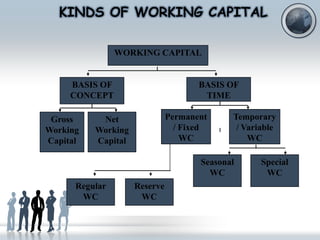
KINDS OF WORKING CAPITAL
WORKING CAPITAL

BASIS OF
CONCEPT
Gross
Working
Capital

BASIS OF
TIME
Permanent
/ Fixed
WC

Net
Working
Capital

Temporary
/ Variable
WC

Seasonal
WC
Regular
WC

Reserve
WC

Special
WC
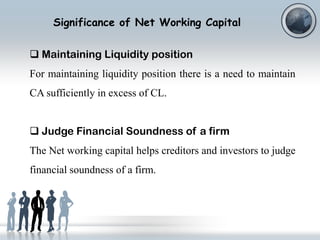
Significance of Net Working Capital
 Maintaining Liquidity position
For maintaining liquidity position there is a need to maintain
CA sufficiently in excess of CL.
 Judge Financial Soundness of a firm
The Net working capital helps creditors and investors to judge
financial soundness of a firm.
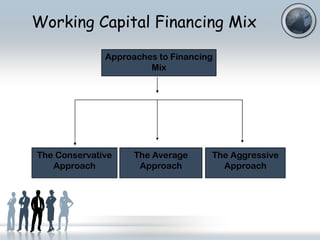
Working Capital Financing Mix
Approaches to Financing
Mix

The Conservative
Approach

The Average
Approach

The Aggressive
Approach
Aggressive and conservative levels of working capital
sit at the opposite ends of a spectrum.
Conservative Approach
This approach suggested that the entire estimated
investments in current asset should be finance from
long term source and short term should be use only
for emergency requirement.
Distinct features of this approach
•Liquidity is greater

•Risk is minimized
Companies in volatile or seasonal industries such as
tourism, farming or construction might adopt
conservative working capital policies to buffer against
risk.
1. If you employ a conservative working capital policy:
there’s plenty of cash in the bank,
2. your warehouses are full of inventory and
3. your payables are all up to date.
If you compute the working capital ratio –
current assets/current liabilities

a conservative

policy might yield a ratio above 2.0.
That is, you have more than $2 in current assets for

every dollar of short-term liabilities. Conservatively
managed working capital will help lower your risks of
short-term cash shortages but might hurt your long-

term profitability, because excess cash doesn’t earn
much of a return.
Aggressive approach
• The aggressive approach suggests that the entire
estimated requirement of current asset should be

financed from short-term sources and even a part of
fixed asset investment be financed from short - term
sources.

This approach make the finance mix :
• More Risky
• Less costly
• More Profitable
• An aggressive working capital policy is one in which
you try to squeeze by with a minimal investment in
current assets coupled with an extensive use of shortterm credit.
• Your goal is to put as much money to work as possible
to decrease the time needed to produce products, turn
over inventory or deliver services.
• Speeding up your business cycle grows your sales
and revenues. You keep little money on hand, cut

slow-moving inventory and unnecessary supplies to
the maximum and pay out your bills for as long as
possible.
In Simple Words…
Conservative- Use permanent capital for permanent
assets and temporary assets.
Average - Match the maturity of the assets with the
maturity of the financing.

Aggressive - Use
short-term financing to finance permanent assets.
So, the

present study done by Mian Sajid Nazir and Talat

Afza, lecturer and professor of CIIT, Lahore, Pakistan, investigates
the relative relationship between the aggressive/conservative

working capital policies and profitability as well as risk of firms for
208 public limited companies listed at Karachi Stock Exchange for
the period of 1998-2005. The empirical results, which is in line with

the study of Afza and Nazir (2007), found the negative relationship
between working capital policies and profitability. It also says that
there is no relationship between the level of current assets and
liabilities and risk of the firms.
Impact of aggressive working capital

Impact of aggressive working capital

  • 1.
    “Impact of AggressiveWorking Capital Management Policy on Firms’ Profitability” Ben10 Members: × × × × × × Ben Jose Christeena James Deepa Rose Jacob Indu Sukumaran Jenita Stephanie
  • 2.
    The present study… •investigates the traditional relationship between working capital management policies and a firm’s profitability. • Managers can create value if they adopt a conservative approach towards working capital investment and working capital financing policies. The study also finds that investors give weight to the stocks of those firms that adopt an aggressive approach to managing their short-term liabilities.
  • 3.
    What It Says… •Management of short-term assets and liabilities need a careful investigation because the working capital management plays an important role in a firm’s profitability and risk as well as its value. • Efficient management of working capital is a fundamental part of the overall corporate strategy in creating the shareholders’ value.
  • 4.
    Definition of 'WorkingCapital' Working Capital refers to that part of the firm’s capital, which is required for financing short-term or current assets such a cash marketable securities, debtors and inventories. Funds thus, invested in current assets keep revolving fast and are constantly converted into cash and this cash flow out again in exchange for other current assets. Working Capital is also known as revolving or circulating capital or short-term capital.
  • 5.
    KINDS OF WORKINGCAPITAL WORKING CAPITAL BASIS OF CONCEPT Gross Working Capital BASIS OF TIME Permanent / Fixed WC Net Working Capital Temporary / Variable WC Seasonal WC Regular WC Reserve WC Special WC
  • 6.
    Significance of NetWorking Capital  Maintaining Liquidity position For maintaining liquidity position there is a need to maintain CA sufficiently in excess of CL.  Judge Financial Soundness of a firm The Net working capital helps creditors and investors to judge financial soundness of a firm.
  • 7.
    Working Capital FinancingMix Approaches to Financing Mix The Conservative Approach The Average Approach The Aggressive Approach
  • 8.
    Aggressive and conservativelevels of working capital sit at the opposite ends of a spectrum.
  • 9.
    Conservative Approach This approachsuggested that the entire estimated investments in current asset should be finance from long term source and short term should be use only for emergency requirement. Distinct features of this approach •Liquidity is greater •Risk is minimized
  • 10.
    Companies in volatileor seasonal industries such as tourism, farming or construction might adopt conservative working capital policies to buffer against risk. 1. If you employ a conservative working capital policy: there’s plenty of cash in the bank, 2. your warehouses are full of inventory and 3. your payables are all up to date.
  • 11.
    If you computethe working capital ratio – current assets/current liabilities a conservative policy might yield a ratio above 2.0. That is, you have more than $2 in current assets for every dollar of short-term liabilities. Conservatively managed working capital will help lower your risks of short-term cash shortages but might hurt your long- term profitability, because excess cash doesn’t earn much of a return.
  • 12.
    Aggressive approach • Theaggressive approach suggests that the entire estimated requirement of current asset should be financed from short-term sources and even a part of fixed asset investment be financed from short - term sources. This approach make the finance mix : • More Risky • Less costly • More Profitable
  • 13.
    • An aggressiveworking capital policy is one in which you try to squeeze by with a minimal investment in current assets coupled with an extensive use of shortterm credit. • Your goal is to put as much money to work as possible to decrease the time needed to produce products, turn over inventory or deliver services.
  • 14.
    • Speeding upyour business cycle grows your sales and revenues. You keep little money on hand, cut slow-moving inventory and unnecessary supplies to the maximum and pay out your bills for as long as possible.
  • 15.
    In Simple Words… Conservative-Use permanent capital for permanent assets and temporary assets. Average - Match the maturity of the assets with the maturity of the financing. Aggressive - Use short-term financing to finance permanent assets.
  • 16.
    So, the present studydone by Mian Sajid Nazir and Talat Afza, lecturer and professor of CIIT, Lahore, Pakistan, investigates the relative relationship between the aggressive/conservative working capital policies and profitability as well as risk of firms for 208 public limited companies listed at Karachi Stock Exchange for the period of 1998-2005. The empirical results, which is in line with the study of Afza and Nazir (2007), found the negative relationship between working capital policies and profitability. It also says that there is no relationship between the level of current assets and liabilities and risk of the firms.