Cost ofCapital
Financial Management:
Lesson 6
DiscussionOutline
Definition &
Assumption of
Cost of Capital
•Classification
of Cost Capital
•Importance of
Cost of Capital
Computation
of Cost of
Capital
Definition ofCost ofCapital
Cost of capital of an investor, in financial
management, is equal to return, an investor can fetch
from the next best alternative investment.
Definition ofCost ofCapital
In simple words, it is the opportunity cost of investing
the same money in different investment having similar
risk and other characteristics.
Definition ofCost ofCapital
From a financing angle, cost of
capital is simply the cost which
is paid for using the capital.
Alternatively, a percentage
return on investment that
convinces an investor to
invest in a particular project
or company is the appropriate
cost of capital for that investor.
Assumption ofCost ofCapital
Cost of capital is based on certain assumptions which
are closely associated while calculating and measuring
the cost of capital. It is to be considered that there are
three basic concepts:
It is not a cost as such. It is merely a hurdle rate.
It is the minimum rate of return.
It consists of three important risks such as zero risk
level, business risk and financial risk.
Assumption ofCost ofCapital
Cost of capital can be measured with the help of the
following equation:
K = rj + b + f
Where:
K = Cost of capital.
rj =The riskless cost of the finance.
b =The business risk premium.
f =The financial risk premium.
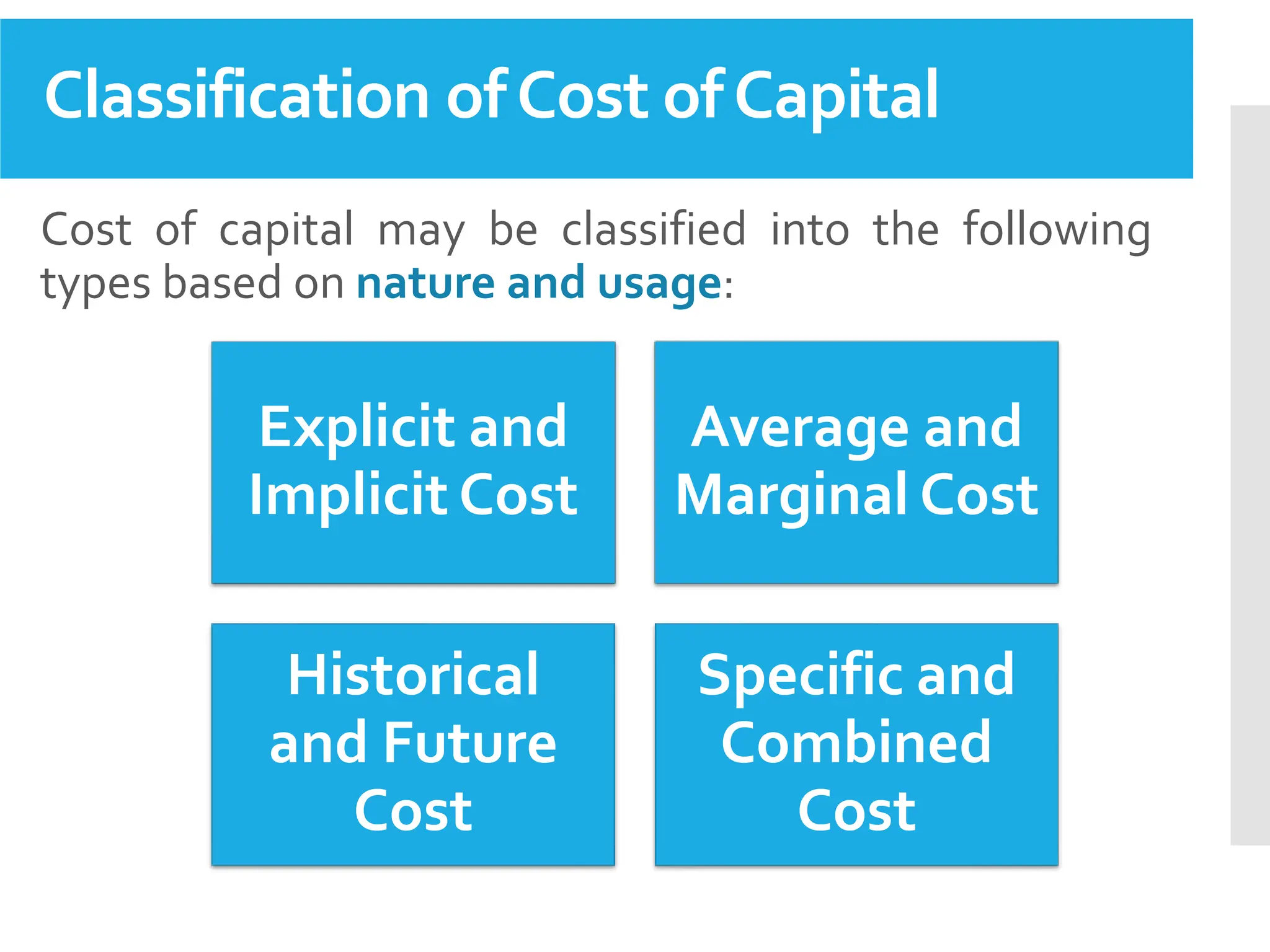
Classification ofCost ofCapital
Cost of capital may be classified into the following
types based on nature and usage:
Explicit and
Implicit Cost
Average and
Marginal Cost
Historical
and Future
Cost
Specific and
Combined
Cost
Explicit and ImplicitCost
The cost of capital may be explicit or implicit cost
based on the computation of cost of capital.
Explicit and ImplicitCost
Explicit cost is the rate that the firm pays to procure
financing. This may be calculated with the help of the
following equation:
Where:
CIo = initial cash inflow
C = outflow in the period concerned
N = duration for which the funds are provided
T = tax rate
Explicit and ImplicitCost
Implicit cost is the rate of return
associated with the best
investment opportunity for the
firm and its shareholders that
will be forgone if the projects
presently under consideration by
the firm were accepted.
Average and MarginalCost
Average cost of capital is the
weighted average cost of each
component of capital
employed by the company. It
considers weighted average
cost of all kinds of financing
such as equity, debt, retained
earnings etc.
Average and MarginalCost
Marginal cost is the weighted
average cost of new finance
raised by the company. It is the
additional cost of capital when
the company goes for further
raising of finance.
Historical and FutureCost
Historical cost is the cost
which as It is based on the
actual cost incurred in the
previous project.
Future cost is the expected
cost of financing in the
proposed project. Expected
cost is calculated based on
previous experience.
Specific andCombinedCost
The cost of each sources of
capital such as equity, debt,
retained earnings and loans is
called as specific cost of capital.
It is very useful to determine
each specific source of capital.
Specific andCombinedCost
The composite or combined
cost of capital is the
combination of all sources of
capital. It is also called as
overall cost of capital. It is used
to understand the total cost
associated with the total
finance of the firm.
Importance ofCost ofCapital
Computation of cost of capital is a very important part
of the financial management to decide the capital
structure of the business concern.
Importance ofCost ofCapital
• Capital budget decision largely depends on
the cost of capital of each source. According
to net present value method, present value
of cash inflow must be more than the
present value of cash outflow. Hence, cost
of capital is used to capital budgeting
decision.
Importance to Capital Budgeting
Decision
Importance ofCost ofCapital
• Capital structure is the mix or proportion of
the different kinds of long-term securities. A
firm uses sources if the cost of capital is
suitable. Hence, cost of capital helps to take
decision regarding structure.
Importance to Structure Decision
Importance ofCost ofCapital
• Cost of capital is one of the important
determine which affects the capital
budgeting, capital structure and value of the
firm. Hence, it helps to evaluate the financial
performance of the firm.
Importance to Evolution of
Financial Performance
Importance ofCost ofCapital
• Apart from the above points, cost of capital
is also used in some other areas such as,
market value of share, earning capacity of
securities etc. hence, it plays a major part in
the financial management.
Importance to Other Financial
Decisions
Computation ofCost ofCapital
Computation of cost of capital consists of two
important parts:
Measurement
of specific costs
Measurement of
overall cost of capital
Measurement ofCost ofCapital
It refers to the cost of each specific sources of finance
like:
Cost of
equity
Cost of debt
Cost of
preference
share
Cost of
retained
earnings
Cost of Equity
Cost of equity capital is the rate at
which investors discount the
expected dividends of the firm to
determine its share value.
Cost of Equity
Conceptually the cost of equity capital (Ke) defined as
the “Minimum rate of return that a firm must earn on
the equity financed portion of an investment project to
leave unchanged the market price of the shares.”
Cost of Equity
Cost of equity can be calculated from the following
approach:
Dividend price
(D/P) approach
Dividend price
plus growth (D/P
+ g) approach
Earning price
(E/P) approach
Realized yield
approach
Cost of Equity: Dividend PriceApproach
The cost of equity capital will be that rate of expected
dividend which will maintain the present market
price of equity shares.
Cost of Equity: Dividend PriceApproach
Dividend price approach can be measured with the
help of the following formula:
Where:
Ke = Cost of equity capital
D = Dividend per equity share
Np = Net proceeds of an equity share
Illustrative Example:
A company issues 10,000 equity shares of $100 each at
a premium of 10%. The company has been paying 25%
dividend to equity shareholders for the past five years
and expects to maintain the same in the future also.
Compute the cost of equity capital. Will it make any
difference if the market price of equity share is $175?
Illustrative Example:
Solution:
Illustrative Example:
If the market price of an equity share is $175.
Cost of Equity: Dividend Price Plus
GrowthApproach
The cost of equity is calculated based on the expected
dividend rate per share plus growth in dividend. It can be
measured with the help of the following formula:
Where:
Ke = Cost of equity capital
D = Dividend per equity share
g = Growth in expected dividend
Np = Net proceeds of an equity share
Illustrative Example:
(a) A company plans to issue 10000 new shares of
$100 each at a par. The floatation costs are
expected to be 4% of the share price. The company
pays a dividend of $12 per share initially and
growth in dividends is expected to be 5%. Compute
the cost of new issue of equity shares.
(b) If the current market price of an equity share is
$120. Calculate the cost of existing equity share
capital
Illustrative Example:
Solution:
Cost of Equity: Earning PriceApproach
Cost of equity determines the market price of the
shares. It is based on the future earning prospects of
the equity. The formula for calculating the cost of
equity according to this approach is as follows:
Where:
Ke = Cost of equity capital
E = Earning per share
Np = Net proceeds of an equity share
Cost of Equity: RealizedYieldApproach
It is the easy method for calculating cost of equity
capital. Under this method, cost of equity is calculated
based on return realized by the investor in a company
on their equity capital.
Where:
Ke = Cost of equity capital
PVƒ = Present value of discount factor
D = Dividend per share
Cost of Debt
Cost of debt is the after-tax cost of
long-term funds through
borrowing. Debt may be issued at
par, at premium or at discount and
it may be perpetual or
redeemable.
Debt Issued at Par
Debt issued at par means debt is issued at the face
value of the debt. It may be calculated with the help of
the following formula.
Kd = (1 – t) R
Where:
Kd = Cost of debt capital
t =Tax rate
R = Debenture interest rate
Debt Issued at Premium or Discount
If the debt is issued at premium or discount, the cost of
debt is calculated with the help of the following
formula:
Where:
Kd = Cost of debt capital
I = Annual interest payable
Np = Net proceeds of debenture
t =Tax rate
Cost of Perpetual Debt and Redeemable
Debt
It is the rate of return which the lenders expect. The debt
carries a certain rate of interest.
Where:
I = Annual interest payable
P = Par value of debt
Np = Net proceeds of the debenture
n = Number of years to maturity
Kdb = Cost of debt before tax.
Cost of Perpetual Debt and Redeemable
Debt
Cost of debt after tax can be calculated with the help
of the following formula:
Where:
Kda = Cost of debt after tax
Kdb = Cost of debt before tax
t =Tax rate
Cost of Preference ShareCapital
Cost of preference share
capital is the annual preference
share dividend by the net
proceeds from the sale of
preference share. There are two
types of preference shares:
irredeemable and redeemable.
Cost of Preference ShareCapital
Cost of redeemable preference share capital is
calculated with the help of the following formula:
Where:
Kp = Cost of preference share
Dp = Fixed preference dividend
Np = Net proceeds of an equity share
Cost of Preference ShareCapital
Cost of irredeemable preference share is calculated with
the help of the following formula:
Where:
Kp = Cost of preference share
Dp = Fixed preference share
P = Par value of debt
Np = Net proceeds of the preference share
n = Number of maturity period.
Cost of Retained Earnings
Retained earnings is one of
the sources of finance for
investment proposal; it is
different from other sources
like debt, equity and
preference shares. Cost of
retained earnings is the same
as the cost of an equivalent
fully subscripted issue of
additional shares, which is
measured by the cost of
equity capital.
Cost of Retained Earnings
Cost of retained earnings can be calculated with the
help of the following formula:
Where:
Kr =Cost of retained earnings
Ke = Cost of equity
t =Tax rate
b =Brokerage cost
Measurement ofOverallCost ofCapital
It is also called as weighted
average cost of capital and
composite cost of capital.
Weighted average cost of
capital is the expected
average future cost of funds
over the long run found by
weighting the cost of each
specific type of capital by its
proportion in the firm’s capital
structure.
Measurement ofOverallCost ofCapital
The computation of the overall cost of capital (Ko)
involves the following steps:
Assigning weights to specific costs.
Multiplying the cost of each of the
sources by the appropriate weights.
Dividing the total weighted cost by
the total weights.
Measurement ofOverallCost ofCapital
The overall cost of capital can be calculated with the help of the following formula:
Where:
Ko = Overall cost of capital
Kd = Cost of debt
Kp = Cost of preference share
Ke = Cost of equity
Kr = Cost of retained earnings
Wd= Percentage of debt of total capital
Wp = Percentage of preference share to total capital
We = Percentage of equity to total capital
Wr = Percentage of retained earnings
Measurement ofOverallCost ofCapital
Weighted average cost of capital is calculated in the
following formula:
Where:
Kw =Weighted average cost of capital
X = Cost of specific sources of finance
W = Weight, proportion of specific sources of
finance.
AnyQuestions?
Let’s Discuss…
How do Philippine companies
interpret and incorporate the
concept of cost of capital into their
financial planning especially
considering the diverse industries in
the country?
Let’s Discuss…
Given the economic challenges and
opportunities in the Philippines,
what assumptions about the cost of
capital do companies commonly
make when making strategic
financial decisions?

FM - Lesson 6 - Cost of Capitalization.pptx

  • 1.
  • 2.
    DiscussionOutline Definition & Assumption of Costof Capital •Classification of Cost Capital •Importance of Cost of Capital Computation of Cost of Capital
  • 3.
    Definition ofCost ofCapital Costof capital of an investor, in financial management, is equal to return, an investor can fetch from the next best alternative investment.
  • 4.
    Definition ofCost ofCapital Insimple words, it is the opportunity cost of investing the same money in different investment having similar risk and other characteristics.
  • 5.
    Definition ofCost ofCapital Froma financing angle, cost of capital is simply the cost which is paid for using the capital. Alternatively, a percentage return on investment that convinces an investor to invest in a particular project or company is the appropriate cost of capital for that investor.
  • 6.
    Assumption ofCost ofCapital Costof capital is based on certain assumptions which are closely associated while calculating and measuring the cost of capital. It is to be considered that there are three basic concepts: It is not a cost as such. It is merely a hurdle rate. It is the minimum rate of return. It consists of three important risks such as zero risk level, business risk and financial risk.
  • 7.
    Assumption ofCost ofCapital Costof capital can be measured with the help of the following equation: K = rj + b + f Where: K = Cost of capital. rj =The riskless cost of the finance. b =The business risk premium. f =The financial risk premium.
  • 8.
    Classification ofCost ofCapital Costof capital may be classified into the following types based on nature and usage: Explicit and Implicit Cost Average and Marginal Cost Historical and Future Cost Specific and Combined Cost
  • 9.
    Explicit and ImplicitCost Thecost of capital may be explicit or implicit cost based on the computation of cost of capital.
  • 10.
    Explicit and ImplicitCost Explicitcost is the rate that the firm pays to procure financing. This may be calculated with the help of the following equation: Where: CIo = initial cash inflow C = outflow in the period concerned N = duration for which the funds are provided T = tax rate
  • 11.
    Explicit and ImplicitCost Implicitcost is the rate of return associated with the best investment opportunity for the firm and its shareholders that will be forgone if the projects presently under consideration by the firm were accepted.
  • 12.
    Average and MarginalCost Averagecost of capital is the weighted average cost of each component of capital employed by the company. It considers weighted average cost of all kinds of financing such as equity, debt, retained earnings etc.
  • 13.
    Average and MarginalCost Marginalcost is the weighted average cost of new finance raised by the company. It is the additional cost of capital when the company goes for further raising of finance.
  • 14.
    Historical and FutureCost Historicalcost is the cost which as It is based on the actual cost incurred in the previous project. Future cost is the expected cost of financing in the proposed project. Expected cost is calculated based on previous experience.
  • 15.
    Specific andCombinedCost The costof each sources of capital such as equity, debt, retained earnings and loans is called as specific cost of capital. It is very useful to determine each specific source of capital.
  • 16.
    Specific andCombinedCost The compositeor combined cost of capital is the combination of all sources of capital. It is also called as overall cost of capital. It is used to understand the total cost associated with the total finance of the firm.
  • 17.
    Importance ofCost ofCapital Computationof cost of capital is a very important part of the financial management to decide the capital structure of the business concern.
  • 18.
    Importance ofCost ofCapital •Capital budget decision largely depends on the cost of capital of each source. According to net present value method, present value of cash inflow must be more than the present value of cash outflow. Hence, cost of capital is used to capital budgeting decision. Importance to Capital Budgeting Decision
  • 19.
    Importance ofCost ofCapital •Capital structure is the mix or proportion of the different kinds of long-term securities. A firm uses sources if the cost of capital is suitable. Hence, cost of capital helps to take decision regarding structure. Importance to Structure Decision
  • 20.
    Importance ofCost ofCapital •Cost of capital is one of the important determine which affects the capital budgeting, capital structure and value of the firm. Hence, it helps to evaluate the financial performance of the firm. Importance to Evolution of Financial Performance
  • 21.
    Importance ofCost ofCapital •Apart from the above points, cost of capital is also used in some other areas such as, market value of share, earning capacity of securities etc. hence, it plays a major part in the financial management. Importance to Other Financial Decisions
  • 22.
    Computation ofCost ofCapital Computationof cost of capital consists of two important parts: Measurement of specific costs Measurement of overall cost of capital
  • 23.
    Measurement ofCost ofCapital Itrefers to the cost of each specific sources of finance like: Cost of equity Cost of debt Cost of preference share Cost of retained earnings
  • 24.
    Cost of Equity Costof equity capital is the rate at which investors discount the expected dividends of the firm to determine its share value.
  • 25.
    Cost of Equity Conceptuallythe cost of equity capital (Ke) defined as the “Minimum rate of return that a firm must earn on the equity financed portion of an investment project to leave unchanged the market price of the shares.”
  • 26.
    Cost of Equity Costof equity can be calculated from the following approach: Dividend price (D/P) approach Dividend price plus growth (D/P + g) approach Earning price (E/P) approach Realized yield approach
  • 27.
    Cost of Equity:Dividend PriceApproach The cost of equity capital will be that rate of expected dividend which will maintain the present market price of equity shares.
  • 28.
    Cost of Equity:Dividend PriceApproach Dividend price approach can be measured with the help of the following formula: Where: Ke = Cost of equity capital D = Dividend per equity share Np = Net proceeds of an equity share
  • 29.
    Illustrative Example: A companyissues 10,000 equity shares of $100 each at a premium of 10%. The company has been paying 25% dividend to equity shareholders for the past five years and expects to maintain the same in the future also. Compute the cost of equity capital. Will it make any difference if the market price of equity share is $175?
  • 30.
  • 31.
    Illustrative Example: If themarket price of an equity share is $175.
  • 32.
    Cost of Equity:Dividend Price Plus GrowthApproach The cost of equity is calculated based on the expected dividend rate per share plus growth in dividend. It can be measured with the help of the following formula: Where: Ke = Cost of equity capital D = Dividend per equity share g = Growth in expected dividend Np = Net proceeds of an equity share
  • 33.
    Illustrative Example: (a) Acompany plans to issue 10000 new shares of $100 each at a par. The floatation costs are expected to be 4% of the share price. The company pays a dividend of $12 per share initially and growth in dividends is expected to be 5%. Compute the cost of new issue of equity shares. (b) If the current market price of an equity share is $120. Calculate the cost of existing equity share capital
  • 34.
  • 35.
    Cost of Equity:Earning PriceApproach Cost of equity determines the market price of the shares. It is based on the future earning prospects of the equity. The formula for calculating the cost of equity according to this approach is as follows: Where: Ke = Cost of equity capital E = Earning per share Np = Net proceeds of an equity share
  • 36.
    Cost of Equity:RealizedYieldApproach It is the easy method for calculating cost of equity capital. Under this method, cost of equity is calculated based on return realized by the investor in a company on their equity capital. Where: Ke = Cost of equity capital PVƒ = Present value of discount factor D = Dividend per share
  • 37.
    Cost of Debt Costof debt is the after-tax cost of long-term funds through borrowing. Debt may be issued at par, at premium or at discount and it may be perpetual or redeemable.
  • 38.
    Debt Issued atPar Debt issued at par means debt is issued at the face value of the debt. It may be calculated with the help of the following formula. Kd = (1 – t) R Where: Kd = Cost of debt capital t =Tax rate R = Debenture interest rate
  • 39.
    Debt Issued atPremium or Discount If the debt is issued at premium or discount, the cost of debt is calculated with the help of the following formula: Where: Kd = Cost of debt capital I = Annual interest payable Np = Net proceeds of debenture t =Tax rate
  • 40.
    Cost of PerpetualDebt and Redeemable Debt It is the rate of return which the lenders expect. The debt carries a certain rate of interest. Where: I = Annual interest payable P = Par value of debt Np = Net proceeds of the debenture n = Number of years to maturity Kdb = Cost of debt before tax.
  • 41.
    Cost of PerpetualDebt and Redeemable Debt Cost of debt after tax can be calculated with the help of the following formula: Where: Kda = Cost of debt after tax Kdb = Cost of debt before tax t =Tax rate
  • 42.
    Cost of PreferenceShareCapital Cost of preference share capital is the annual preference share dividend by the net proceeds from the sale of preference share. There are two types of preference shares: irredeemable and redeemable.
  • 43.
    Cost of PreferenceShareCapital Cost of redeemable preference share capital is calculated with the help of the following formula: Where: Kp = Cost of preference share Dp = Fixed preference dividend Np = Net proceeds of an equity share
  • 44.
    Cost of PreferenceShareCapital Cost of irredeemable preference share is calculated with the help of the following formula: Where: Kp = Cost of preference share Dp = Fixed preference share P = Par value of debt Np = Net proceeds of the preference share n = Number of maturity period.
  • 45.
    Cost of RetainedEarnings Retained earnings is one of the sources of finance for investment proposal; it is different from other sources like debt, equity and preference shares. Cost of retained earnings is the same as the cost of an equivalent fully subscripted issue of additional shares, which is measured by the cost of equity capital.
  • 46.
    Cost of RetainedEarnings Cost of retained earnings can be calculated with the help of the following formula: Where: Kr =Cost of retained earnings Ke = Cost of equity t =Tax rate b =Brokerage cost
  • 47.
    Measurement ofOverallCost ofCapital Itis also called as weighted average cost of capital and composite cost of capital. Weighted average cost of capital is the expected average future cost of funds over the long run found by weighting the cost of each specific type of capital by its proportion in the firm’s capital structure.
  • 48.
    Measurement ofOverallCost ofCapital Thecomputation of the overall cost of capital (Ko) involves the following steps: Assigning weights to specific costs. Multiplying the cost of each of the sources by the appropriate weights. Dividing the total weighted cost by the total weights.
  • 49.
    Measurement ofOverallCost ofCapital Theoverall cost of capital can be calculated with the help of the following formula: Where: Ko = Overall cost of capital Kd = Cost of debt Kp = Cost of preference share Ke = Cost of equity Kr = Cost of retained earnings Wd= Percentage of debt of total capital Wp = Percentage of preference share to total capital We = Percentage of equity to total capital Wr = Percentage of retained earnings
  • 50.
    Measurement ofOverallCost ofCapital Weightedaverage cost of capital is calculated in the following formula: Where: Kw =Weighted average cost of capital X = Cost of specific sources of finance W = Weight, proportion of specific sources of finance.
  • 51.
  • 52.
    Let’s Discuss… How doPhilippine companies interpret and incorporate the concept of cost of capital into their financial planning especially considering the diverse industries in the country?
  • 53.
    Let’s Discuss… Given theeconomic challenges and opportunities in the Philippines, what assumptions about the cost of capital do companies commonly make when making strategic financial decisions?