MODULE-3
AGGREGATE PLANNING
• Aggregate planning involves planning the best quality to
produce in the intermediate-range horizon (3 months to
one year)
• Aggregate production planning is the process of
determining output levels of product groups over the next
6 to 18 months period.
• Objectives of Aggregate Planning
i. The overall objective is to balance conflicting
objectives involving customer service, work force
stability, cost and profit.
ii. To establish company-wide strategic plan for
allocating resources.
iii.To develop an economic strategy to meet customer
demand.
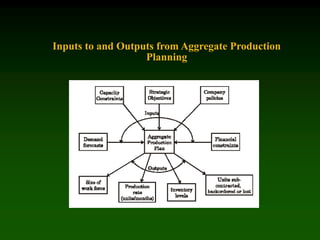
Inputs to and Outputs from Aggregate Production
Planning
Importance of Aggregate Plans
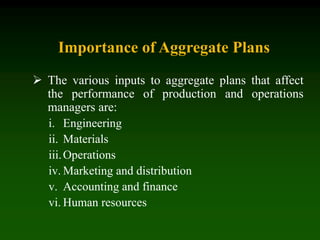
 The various inputs to aggregate plans that affect
the performance of production and operations
managers are:
i. Engineering
ii. Materials
iii.Operations
iv. Marketing and distribution
v. Accounting and finance
vi. Human resources
Aggregate Planning or Aggregate
Capacity Planning
 Need for Aggregate Capacity Planning
1. It facilitates fully loaded facilities and minimizes
overloading and underloading and keeps production
costs low.
2. Adequate production capacity is provided to meet
expected aggregate demand.
3. Orderly and systematic transition of production
capacity to meet the peaks and valleys of expected
customer demand is facilitated.
 Steps in Aggregate Capacity Planning
i. Determine the demand (i.e., sales forecast) for each product for
each time period (i.e., weeks or months or quarters) over the
planning horizon (6 to 12 months).
ii. Determine the aggregate demand by summing up the demand for
individual products.
iii. Transform the aggregate demand for each time period into workers,
materials, machines required to satisfy aggregate demand.
iv. Identify company policies that are pertinent (e.g., policy regarding
safety stock maintenance, maintaining stable workforce etc.).
v. Determine unit costs for regular time, overtime, subcontracting,
holding inventories, back orders, layoffs etc.
vi. Develop alternative resource plans for providing necessary
production capacity to support the cumulative aggregate demand
and compute the cost of each alternative plan.
vii.Select the resource plan from among the alternatives considered that
satisfies aggregate demand and best meets the objectives of the
firm.
Capacity Types
 Production capacity is defined as the maximum production
rate of a facility or a plant.
• Types of Capacity
1. License Capacity
2. Installed Capacity
3. Rated Capacity
4. Normal Capacity
5. Practical Capacity
6. Ideal Capacity
7. Actual or utilised capacity
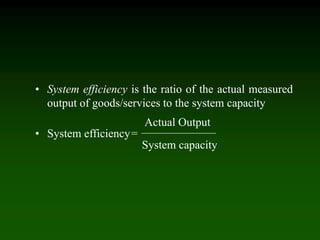
Actual Output
• System efficiency is the ratio of the actual measured
output of goods/services to the system capacity
• System efficiency=
System capacity
• Capacity Decisions
• Major considerations in capacity decisions are
a. What size of plant? How much capacity to install?
b. When capacity is needed? When to phase-in capacity or
phase-out capacity?
c. At what cost? How to budget for the cost?
• Factors Affecting Determination of Plant Capacity
1. Market demand for a product/service.
2. The amount of capital that can be invested.
3. Degree of automation desired.
4. Level of integration (i.e., vertical integration).
5. Type of technology selected.
6. Flexibility for capacity additions.
Capacity Planning
 Capacity planning involves activities such as:
a. Assessing existing capacity
b. Forecasting future capacity needs
c. Identifying alternative ways to modify capacity
d. Evaluating financial, economical and technological
capacity alternatives
e. Selecting a capacity alternative most suited to achieve
the strategic mission of the firm. Capacity planning
involves capacity decisions that must merge consumer
demands with human, material and financial resources
of the organization.
4 Types of Capacity Planning are:
• Long term Capacity Planning
• Short-term Capacity Planing
• Finite Capacity Planning
• Infinite Capacity Planning.
• Two catagories of factors affecting capacity planning are:
• Controllable Factors
• Less Controllable Factors.
• Capacity Requirement Planning (CRP): A technique to
determine the labour and equipment capacities needed to
meet the objectives.
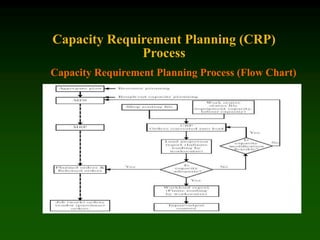
Capacity Requirement Planning (CRP)
Process
Capacity Requirement Planning Process (Flow Chart)
Master Production Scheduling
• Objectives of Master Production Scheduling
1. To schedule end items to be completed promptly
and when promised to customers.
2. To avoid overloading or underloading the
production facility so that production capacity is
efficiently utilized and low production costs result.
Functions of MPS:
• Translating aggregate plans
• Evaluating alternative master schedules
• Generating material and capacity requirements
• Facilitating information processing
• Maintaining priorities
• Utilizing the capacity effectively.
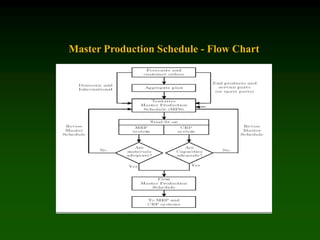
Master Production Schedule - Flow Chart
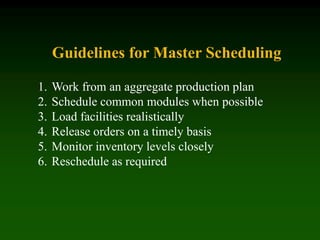
Guidelines for Master Scheduling
1. Work from an aggregate production plan
2. Schedule common modules when possible
3. Load facilities realistically
4. Release orders on a timely basis
5. Monitor inventory levels closely
6. Reschedule as required
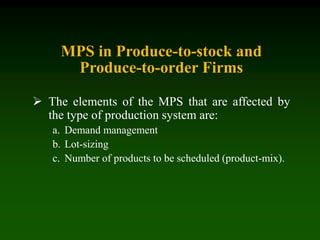
MPS in Produce-to-stock and
Produce-to-order Firms
 The elements of the MPS that are affected by
the type of production system are:
a. Demand management
b. Lot-sizing
c. Number of products to be scheduled (product-mix).
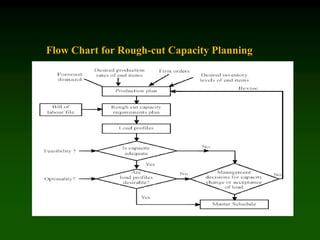
Flow Chart for Rough-cut Capacity Planning

aggregate planning.ppt

  • 1.
  • 2.
    • Aggregate planninginvolves planning the best quality to produce in the intermediate-range horizon (3 months to one year) • Aggregate production planning is the process of determining output levels of product groups over the next 6 to 18 months period. • Objectives of Aggregate Planning i. The overall objective is to balance conflicting objectives involving customer service, work force stability, cost and profit. ii. To establish company-wide strategic plan for allocating resources. iii.To develop an economic strategy to meet customer demand.
  • 3.
    Inputs to andOutputs from Aggregate Production Planning
  • 4.
    Importance of AggregatePlans  The various inputs to aggregate plans that affect the performance of production and operations managers are: i. Engineering ii. Materials iii.Operations iv. Marketing and distribution v. Accounting and finance vi. Human resources
  • 5.
    Aggregate Planning orAggregate Capacity Planning  Need for Aggregate Capacity Planning 1. It facilitates fully loaded facilities and minimizes overloading and underloading and keeps production costs low. 2. Adequate production capacity is provided to meet expected aggregate demand. 3. Orderly and systematic transition of production capacity to meet the peaks and valleys of expected customer demand is facilitated.
  • 6.
     Steps inAggregate Capacity Planning i. Determine the demand (i.e., sales forecast) for each product for each time period (i.e., weeks or months or quarters) over the planning horizon (6 to 12 months). ii. Determine the aggregate demand by summing up the demand for individual products. iii. Transform the aggregate demand for each time period into workers, materials, machines required to satisfy aggregate demand. iv. Identify company policies that are pertinent (e.g., policy regarding safety stock maintenance, maintaining stable workforce etc.). v. Determine unit costs for regular time, overtime, subcontracting, holding inventories, back orders, layoffs etc. vi. Develop alternative resource plans for providing necessary production capacity to support the cumulative aggregate demand and compute the cost of each alternative plan. vii.Select the resource plan from among the alternatives considered that satisfies aggregate demand and best meets the objectives of the firm.
  • 7.
    Capacity Types  Productioncapacity is defined as the maximum production rate of a facility or a plant. • Types of Capacity 1. License Capacity 2. Installed Capacity 3. Rated Capacity 4. Normal Capacity 5. Practical Capacity 6. Ideal Capacity 7. Actual or utilised capacity
  • 8.
    Actual Output • Systemefficiency is the ratio of the actual measured output of goods/services to the system capacity • System efficiency= System capacity
  • 9.
    • Capacity Decisions •Major considerations in capacity decisions are a. What size of plant? How much capacity to install? b. When capacity is needed? When to phase-in capacity or phase-out capacity? c. At what cost? How to budget for the cost? • Factors Affecting Determination of Plant Capacity 1. Market demand for a product/service. 2. The amount of capital that can be invested. 3. Degree of automation desired. 4. Level of integration (i.e., vertical integration). 5. Type of technology selected. 6. Flexibility for capacity additions.
  • 10.
    Capacity Planning  Capacityplanning involves activities such as: a. Assessing existing capacity b. Forecasting future capacity needs c. Identifying alternative ways to modify capacity d. Evaluating financial, economical and technological capacity alternatives e. Selecting a capacity alternative most suited to achieve the strategic mission of the firm. Capacity planning involves capacity decisions that must merge consumer demands with human, material and financial resources of the organization.
  • 11.
    4 Types ofCapacity Planning are: • Long term Capacity Planning • Short-term Capacity Planing • Finite Capacity Planning • Infinite Capacity Planning. • Two catagories of factors affecting capacity planning are: • Controllable Factors • Less Controllable Factors. • Capacity Requirement Planning (CRP): A technique to determine the labour and equipment capacities needed to meet the objectives.
  • 12.
    Capacity Requirement Planning(CRP) Process Capacity Requirement Planning Process (Flow Chart)
  • 13.
    Master Production Scheduling •Objectives of Master Production Scheduling 1. To schedule end items to be completed promptly and when promised to customers. 2. To avoid overloading or underloading the production facility so that production capacity is efficiently utilized and low production costs result. Functions of MPS: • Translating aggregate plans • Evaluating alternative master schedules • Generating material and capacity requirements • Facilitating information processing • Maintaining priorities • Utilizing the capacity effectively.
  • 14.
  • 15.
    Guidelines for MasterScheduling 1. Work from an aggregate production plan 2. Schedule common modules when possible 3. Load facilities realistically 4. Release orders on a timely basis 5. Monitor inventory levels closely 6. Reschedule as required
  • 16.
    MPS in Produce-to-stockand Produce-to-order Firms  The elements of the MPS that are affected by the type of production system are: a. Demand management b. Lot-sizing c. Number of products to be scheduled (product-mix).
  • 17.
    Flow Chart forRough-cut Capacity Planning