Course: MBA
Subject: Production & Operation
Management
Unit:2.1
Capacity
Capacity
• Capacity is defined as the ability to achieve,
store or produce.
• For an organization, capacity would be the
ability of a given system to produce output
within the specific time period.
• In operations, management capacity is
referred as an amount of the input resources
available to produce relative output over
period of time.
• Capacity planning is essential to be determining optimum utilization
of resource and plays an important role decision-making process,
for example, extension of existing operations, modification to
product lines, starting new products, etc.
• Strategic Capacity Planning:
• A technique used to identify and measure overall capacity of
production is referred to as strategic capacity planning. Strategic
capacity planning is utilized for capital intensive resource like plant,
machinery, labor, etc.
• Strategic capacity planning is essential as it helps the organization in
meeting the future requirements of the organization. Planning
ensures that operating cost are maintained at a minimum possible
level without affecting the quality. It ensures the organization
remain competitive and can achieve the long-term growth plan.
Types of Capacity Planning
• Capacity planning based on the timeline is
classified into three main categories:
• Long range
• Medium range
• Short range
Long term planning
• Long range capacity of an organization is dependent on various
other capacities like design capacity, production capacity,
sustainable capacity and effective capacity.
• Design capacity is the maximum output possible as indicated by
equipment manufacturer under ideal working condition.
• Production capacity is the maximum output possible from
equipment under normal working condition or day.
• Sustainable capacity is the maximum production level achievable in
realistic work condition and considering normal machine
breakdown, maintenance, etc.
• Effective capacity is the optimum production level under pre-
defined job and work-schedules, normal machine breakdown,
maintenance, etc.
• Medium Term Capacity: The strategic capacity
planning undertaken by organization for 2 to 3
years of a time frame is referred to as medium
term capacity planning.
• Short Term Capacity: The strategic planning
undertaken by organization for a daily weekly
or quarterly time frame is referred to as short
term capacity planning.
Goal of Capacity Planning
• The ultimate goal of capacity planning is to
meet the current and future level of the
requirement at a minimal wastage.
• The three types of capacity planning based on
goal are
• Lead capacity planning,
• Lag strategy planning
• Match strategy planning.
Factors Affecting Capacity Planning
• Effective capacity planning is dependent upon
factors like
• production facility (layout, design, and location),
• product line or matrix,
• production technology,
• human capital (job design, compensation),
• operational structure (scheduling, quality
assurance)
• external structure ( policy, safety regulations)
Forecasting v/s Capacity Planning
• There would be a scenario where capacity planning
done on a basis of forecasting may not exactly match.
• For example, there could be a scenario where demand
is more than production capacity;
• in this situation, a company needs to fulfill its
requirement by buying from outside.
• If demand is equal to production capacity;
• company is in a position to use its production capacity
to the fullest.
• If the demand is less than the production capacity,
company can choose to reduce the production or share
it output with other manufacturers.
Capacity Planning
• Capacity is the upper limit or ceiling on the load
that an operating unit can handle.
• The basic questions in capacity handling are:
– What kind of capacity is needed?
– How much is needed?
– When is it needed?
• Impacts ability to meet future demands
• Affects operating costs
• Major determinant of initial costs
• Involves long-term commitment
• Affects competitiveness
• Affects ease of management
Importance of Capacity Decisions
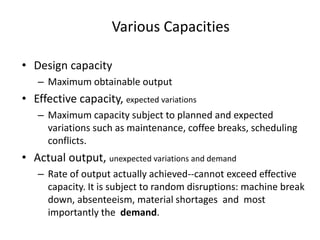
Various Capacities
• Design capacity
– Maximum obtainable output
• Effective capacity, expected variations
– Maximum capacity subject to planned and expected
variations such as maintenance, coffee breaks, scheduling
conflicts.
• Actual output, unexpected variations and demand
– Rate of output actually achieved--cannot exceed effective
capacity. It is subject to random disruptions: machine break
down, absenteeism, material shortages and most
importantly the demand.
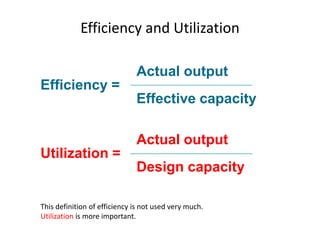
Efficiency and Utilization
Actual output
Efficiency =
Effective capacity
Actual output
Utilization =
Design capacity
This definition of efficiency is not used very much.
Utilization is more important.
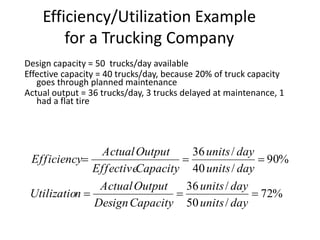
Design capacity = 50 trucks/day available
Effective capacity = 40 trucks/day, because 20% of truck capacity
goes through planned maintenance
Actual output = 36 trucks/day, 3 trucks delayed at maintenance, 1
had a flat tire
Efficiency/Utilization Example
for a Trucking Company
%72
/50
/36
%90
/40
/36


dayunits
dayunits
CapacityDesign
OutputActual
nUtilizatio
dayunits
dayunits
CapacityEffective
OutputActual
Efficiency
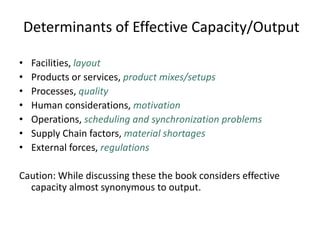
Determinants of Effective Capacity/Output
• Facilities, layout
• Products or services, product mixes/setups
• Processes, quality
• Human considerations, motivation
• Operations, scheduling and synchronization problems
• Supply Chain factors, material shortages
• External forces, regulations
Caution: While discussing these the book considers effective
capacity almost synonymous to output.
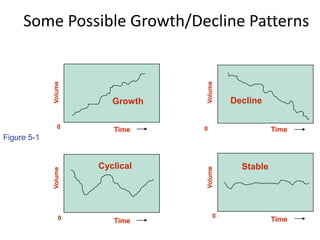
Some Possible Growth/Decline Patterns
Volume
Volume
Volume
Volume
0 0
0 0
Time Time
Time Time
Growth Decline
Cyclical Stable
Figure 5-1
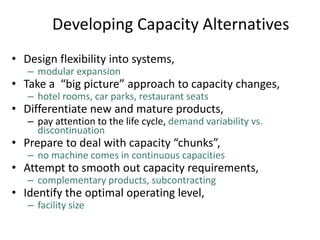
Developing Capacity Alternatives
• Design flexibility into systems,
– modular expansion
• Take a “big picture” approach to capacity changes,
– hotel rooms, car parks, restaurant seats
• Differentiate new and mature products,
– pay attention to the life cycle, demand variability vs.
discontinuation
• Prepare to deal with capacity “chunks”,
– no machine comes in continuous capacities
• Attempt to smooth out capacity requirements,
– complementary products, subcontracting
• Identify the optimal operating level,
– facility size
Outsourcing: Make or Buy
• Outsourcing: Obtaining a good or service from an
external provider
• Decide on outsourcing by considering
– Available capacity
– Expertise
– Quality considerations
– The nature of demand: Stability
– Cost
– Risk: Loss of control over operations with outsourcing; loss
of know-how. Loss of revenue.
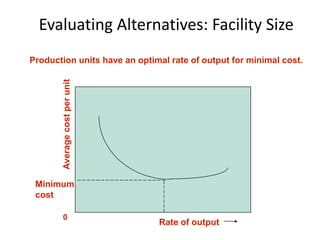
Evaluating Alternatives: Facility Size
Minimum
cost
Averagecostperunit
0
Rate of output
Production units have an optimal rate of output for minimal cost.
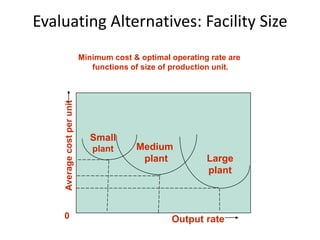
Evaluating Alternatives: Facility Size
Minimum cost & optimal operating rate are
functions of size of production unit.Averagecostperunit
0
Small
plant Medium
plant Large
plant
Output rate
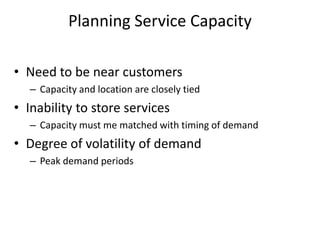
• Need to be near customers
– Capacity and location are closely tied
• Inability to store services
– Capacity must me matched with timing of demand
• Degree of volatility of demand
– Peak demand periods
Planning Service Capacity
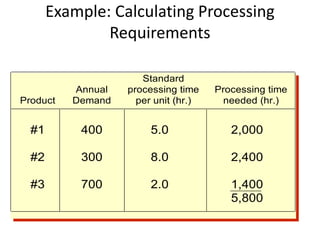
Example: Calculating Processing
Requirements
Product
Annual
Demand
Standard
processing time
per unit (hr.)
Processing time
needed (hr.)
#1
#2
#3
400
300
700
5.0
8.0
2.0
2,000
2,400
1,400
5,800
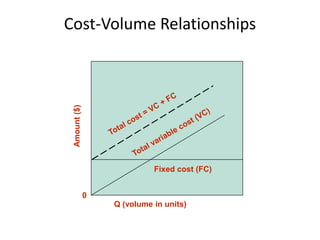
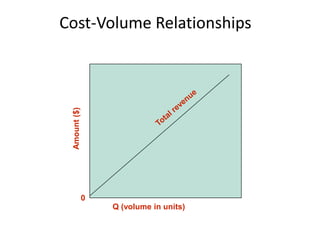
Cost-Volume Relationships
Amount($)
0
Q (volume in units)
Fixed cost (FC)
Cost-Volume Relationships
Amount($)
Q (volume in units)
0
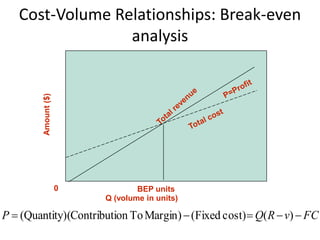
Cost-Volume Relationships: Break-even
analysisAmount($)
Q (volume in units)
0 BEP units
FCvRQP  )(cost)Fixed()MarginToonContributi)(Quantity(
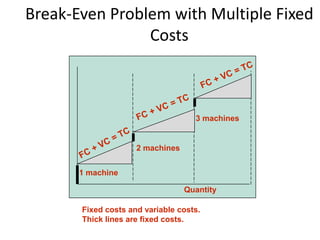
Break-Even Problem with Multiple Fixed
Costs
Quantity
Fixed costs and variable costs.
Thick lines are fixed costs.
1 machine
2 machines
3 machines
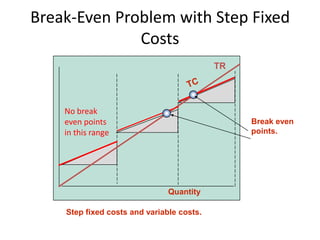
Break-Even Problem with Step Fixed
Costs
Quantity
Step fixed costs and variable costs.
Break even
points.
TR
No break
even points
in this range
Lean and Mean Manufacturing
Lean has been defined in many different ways.
“A systematic approach to identifying and
eliminating waste(non-value-added activities)
through continuous improvement by flowing the
product at the pull of the customer in pursuit of
perfection.”
By The MEP Lean Network
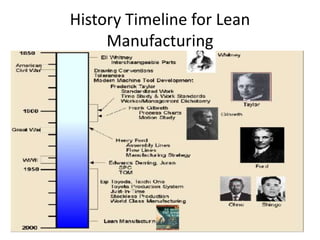
History Timeline for Lean
Manufacturing
Lean manufacturing is a philosophy
• In 1990 James Womack, Daniel T. Jones, and Daniel
Roos wrote a book called “The Machine That
Changed the World: The Story of Lean
Production-- Toyota's Secret Weapon in the Global Car
Wars That Is Now Revolutionizing World Industry”
• In this book, Womack introduced the Toyota
Production System to American.
• What was new was a phrase–
• "Lean Manufacturing."
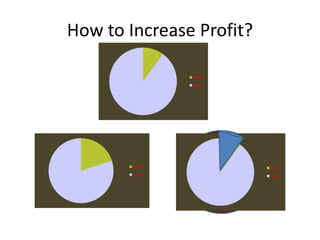
How to Increase Profit?
Profit
Cost
Profit
Cost
Profit
Cost
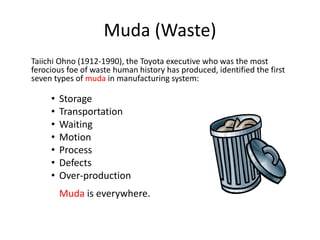
Muda (Waste)
Taiichi Ohno (1912-1990), the Toyota executive who was the most
ferocious foe of waste human history has produced, identified the first
seven types of muda in manufacturing system:
• Storage
• Transportation
• Waiting
• Motion
• Process
• Defects
• Over-production
Muda is everywhere.
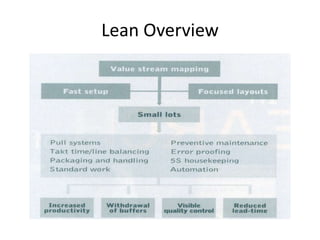
Lean Overview
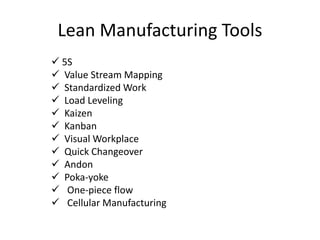
Lean Manufacturing Tools
 5S
 Value Stream Mapping
 Standardized Work
 Load Leveling
 Kaizen
 Kanban
 Visual Workplace
 Quick Changeover
 Andon
 Poka-yoke
 One-piece flow
 Cellular Manufacturing
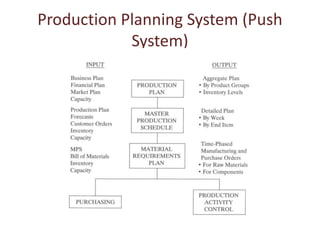
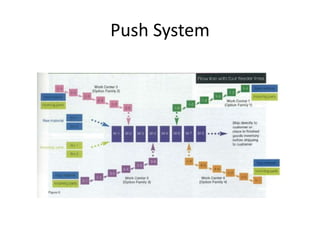
Production Planning System (Push
System)
Push System
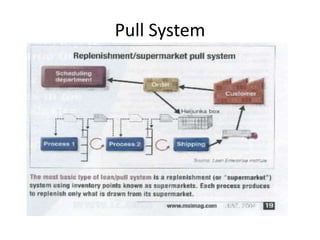
Pull System
References
• Society of Manufacturing Engineers, Lean Manufacturing
2007, Supplement to Manufacturing Engineering, 2007.
• Society of Manufacturing Engineers, Lean Manufacturing
2008, Supplement to Manufacturing Engineering, 2008.
• Garrett Brown and Dara O’Rourke, “Lean Manufacturing
Comes to China: A Case Study of its Impact on Workplace
Health and Safety,” International Journal of Occupational
and Environmental Health (IJOEH), 13(3), JUL/SEP 2007.
• Challenges in Applying Lean Manufacturing in China,
McKinsey Quarterly, 2006 Special Edition available at
Jackson Library. Friday, October 12, 2007 | Posted by
Simone Yu in International

Mba ii pmom_unit-2.1 capacity a

  • 1.
    Course: MBA Subject: Production& Operation Management Unit:2.1 Capacity
  • 2.
    Capacity • Capacity isdefined as the ability to achieve, store or produce. • For an organization, capacity would be the ability of a given system to produce output within the specific time period. • In operations, management capacity is referred as an amount of the input resources available to produce relative output over period of time.
  • 3.
    • Capacity planningis essential to be determining optimum utilization of resource and plays an important role decision-making process, for example, extension of existing operations, modification to product lines, starting new products, etc. • Strategic Capacity Planning: • A technique used to identify and measure overall capacity of production is referred to as strategic capacity planning. Strategic capacity planning is utilized for capital intensive resource like plant, machinery, labor, etc. • Strategic capacity planning is essential as it helps the organization in meeting the future requirements of the organization. Planning ensures that operating cost are maintained at a minimum possible level without affecting the quality. It ensures the organization remain competitive and can achieve the long-term growth plan.
  • 4.
    Types of CapacityPlanning • Capacity planning based on the timeline is classified into three main categories: • Long range • Medium range • Short range
  • 5.
    Long term planning •Long range capacity of an organization is dependent on various other capacities like design capacity, production capacity, sustainable capacity and effective capacity. • Design capacity is the maximum output possible as indicated by equipment manufacturer under ideal working condition. • Production capacity is the maximum output possible from equipment under normal working condition or day. • Sustainable capacity is the maximum production level achievable in realistic work condition and considering normal machine breakdown, maintenance, etc. • Effective capacity is the optimum production level under pre- defined job and work-schedules, normal machine breakdown, maintenance, etc.
  • 6.
    • Medium TermCapacity: The strategic capacity planning undertaken by organization for 2 to 3 years of a time frame is referred to as medium term capacity planning. • Short Term Capacity: The strategic planning undertaken by organization for a daily weekly or quarterly time frame is referred to as short term capacity planning.
  • 7.
    Goal of CapacityPlanning • The ultimate goal of capacity planning is to meet the current and future level of the requirement at a minimal wastage. • The three types of capacity planning based on goal are • Lead capacity planning, • Lag strategy planning • Match strategy planning.
  • 8.
    Factors Affecting CapacityPlanning • Effective capacity planning is dependent upon factors like • production facility (layout, design, and location), • product line or matrix, • production technology, • human capital (job design, compensation), • operational structure (scheduling, quality assurance) • external structure ( policy, safety regulations)
  • 9.
    Forecasting v/s CapacityPlanning • There would be a scenario where capacity planning done on a basis of forecasting may not exactly match. • For example, there could be a scenario where demand is more than production capacity; • in this situation, a company needs to fulfill its requirement by buying from outside. • If demand is equal to production capacity; • company is in a position to use its production capacity to the fullest. • If the demand is less than the production capacity, company can choose to reduce the production or share it output with other manufacturers.
  • 10.
    Capacity Planning • Capacityis the upper limit or ceiling on the load that an operating unit can handle. • The basic questions in capacity handling are: – What kind of capacity is needed? – How much is needed? – When is it needed?
  • 11.
    • Impacts abilityto meet future demands • Affects operating costs • Major determinant of initial costs • Involves long-term commitment • Affects competitiveness • Affects ease of management Importance of Capacity Decisions
  • 12.
    Various Capacities • Designcapacity – Maximum obtainable output • Effective capacity, expected variations – Maximum capacity subject to planned and expected variations such as maintenance, coffee breaks, scheduling conflicts. • Actual output, unexpected variations and demand – Rate of output actually achieved--cannot exceed effective capacity. It is subject to random disruptions: machine break down, absenteeism, material shortages and most importantly the demand.
  • 13.
    Efficiency and Utilization Actualoutput Efficiency = Effective capacity Actual output Utilization = Design capacity This definition of efficiency is not used very much. Utilization is more important.
  • 14.
    Design capacity =50 trucks/day available Effective capacity = 40 trucks/day, because 20% of truck capacity goes through planned maintenance Actual output = 36 trucks/day, 3 trucks delayed at maintenance, 1 had a flat tire Efficiency/Utilization Example for a Trucking Company %72 /50 /36 %90 /40 /36   dayunits dayunits CapacityDesign OutputActual nUtilizatio dayunits dayunits CapacityEffective OutputActual Efficiency
  • 15.
    Determinants of EffectiveCapacity/Output • Facilities, layout • Products or services, product mixes/setups • Processes, quality • Human considerations, motivation • Operations, scheduling and synchronization problems • Supply Chain factors, material shortages • External forces, regulations Caution: While discussing these the book considers effective capacity almost synonymous to output.
  • 16.
    Some Possible Growth/DeclinePatterns Volume Volume Volume Volume 0 0 0 0 Time Time Time Time Growth Decline Cyclical Stable Figure 5-1
  • 17.
    Developing Capacity Alternatives •Design flexibility into systems, – modular expansion • Take a “big picture” approach to capacity changes, – hotel rooms, car parks, restaurant seats • Differentiate new and mature products, – pay attention to the life cycle, demand variability vs. discontinuation • Prepare to deal with capacity “chunks”, – no machine comes in continuous capacities • Attempt to smooth out capacity requirements, – complementary products, subcontracting • Identify the optimal operating level, – facility size
  • 18.
    Outsourcing: Make orBuy • Outsourcing: Obtaining a good or service from an external provider • Decide on outsourcing by considering – Available capacity – Expertise – Quality considerations – The nature of demand: Stability – Cost – Risk: Loss of control over operations with outsourcing; loss of know-how. Loss of revenue.
  • 19.
    Evaluating Alternatives: FacilitySize Minimum cost Averagecostperunit 0 Rate of output Production units have an optimal rate of output for minimal cost.
  • 20.
    Evaluating Alternatives: FacilitySize Minimum cost & optimal operating rate are functions of size of production unit.Averagecostperunit 0 Small plant Medium plant Large plant Output rate
  • 21.
    • Need tobe near customers – Capacity and location are closely tied • Inability to store services – Capacity must me matched with timing of demand • Degree of volatility of demand – Peak demand periods Planning Service Capacity
  • 22.
    Example: Calculating Processing Requirements Product Annual Demand Standard processingtime per unit (hr.) Processing time needed (hr.) #1 #2 #3 400 300 700 5.0 8.0 2.0 2,000 2,400 1,400 5,800
  • 23.
  • 24.
  • 25.
    Cost-Volume Relationships: Break-even analysisAmount($) Q(volume in units) 0 BEP units FCvRQP  )(cost)Fixed()MarginToonContributi)(Quantity(
  • 26.
    Break-Even Problem withMultiple Fixed Costs Quantity Fixed costs and variable costs. Thick lines are fixed costs. 1 machine 2 machines 3 machines
  • 27.
    Break-Even Problem withStep Fixed Costs Quantity Step fixed costs and variable costs. Break even points. TR No break even points in this range
  • 28.
    Lean and MeanManufacturing Lean has been defined in many different ways. “A systematic approach to identifying and eliminating waste(non-value-added activities) through continuous improvement by flowing the product at the pull of the customer in pursuit of perfection.” By The MEP Lean Network
  • 29.
    History Timeline forLean Manufacturing
  • 30.
    Lean manufacturing isa philosophy • In 1990 James Womack, Daniel T. Jones, and Daniel Roos wrote a book called “The Machine That Changed the World: The Story of Lean Production-- Toyota's Secret Weapon in the Global Car Wars That Is Now Revolutionizing World Industry” • In this book, Womack introduced the Toyota Production System to American. • What was new was a phrase– • "Lean Manufacturing."
  • 31.
    How to IncreaseProfit? Profit Cost Profit Cost Profit Cost
  • 32.
    Muda (Waste) Taiichi Ohno(1912-1990), the Toyota executive who was the most ferocious foe of waste human history has produced, identified the first seven types of muda in manufacturing system: • Storage • Transportation • Waiting • Motion • Process • Defects • Over-production Muda is everywhere.
  • 33.
  • 34.
    Lean Manufacturing Tools 5S  Value Stream Mapping  Standardized Work  Load Leveling  Kaizen  Kanban  Visual Workplace  Quick Changeover  Andon  Poka-yoke  One-piece flow  Cellular Manufacturing
  • 35.
  • 36.
  • 37.
  • 38.
    References • Society ofManufacturing Engineers, Lean Manufacturing 2007, Supplement to Manufacturing Engineering, 2007. • Society of Manufacturing Engineers, Lean Manufacturing 2008, Supplement to Manufacturing Engineering, 2008. • Garrett Brown and Dara O’Rourke, “Lean Manufacturing Comes to China: A Case Study of its Impact on Workplace Health and Safety,” International Journal of Occupational and Environmental Health (IJOEH), 13(3), JUL/SEP 2007. • Challenges in Applying Lean Manufacturing in China, McKinsey Quarterly, 2006 Special Edition available at Jackson Library. Friday, October 12, 2007 | Posted by Simone Yu in International