Capability Maturity Model
Integration
(CMMI)
CMMI-Definition
 CMMI stands for Capability Maturity Model
Integration.
 Its is a process improvement approach that
provides companies with the essential
elements of an effective process.
 It is a good guide for process improvement
across a project or organization.
 CMMI is formed by using multiple CMM
processes.
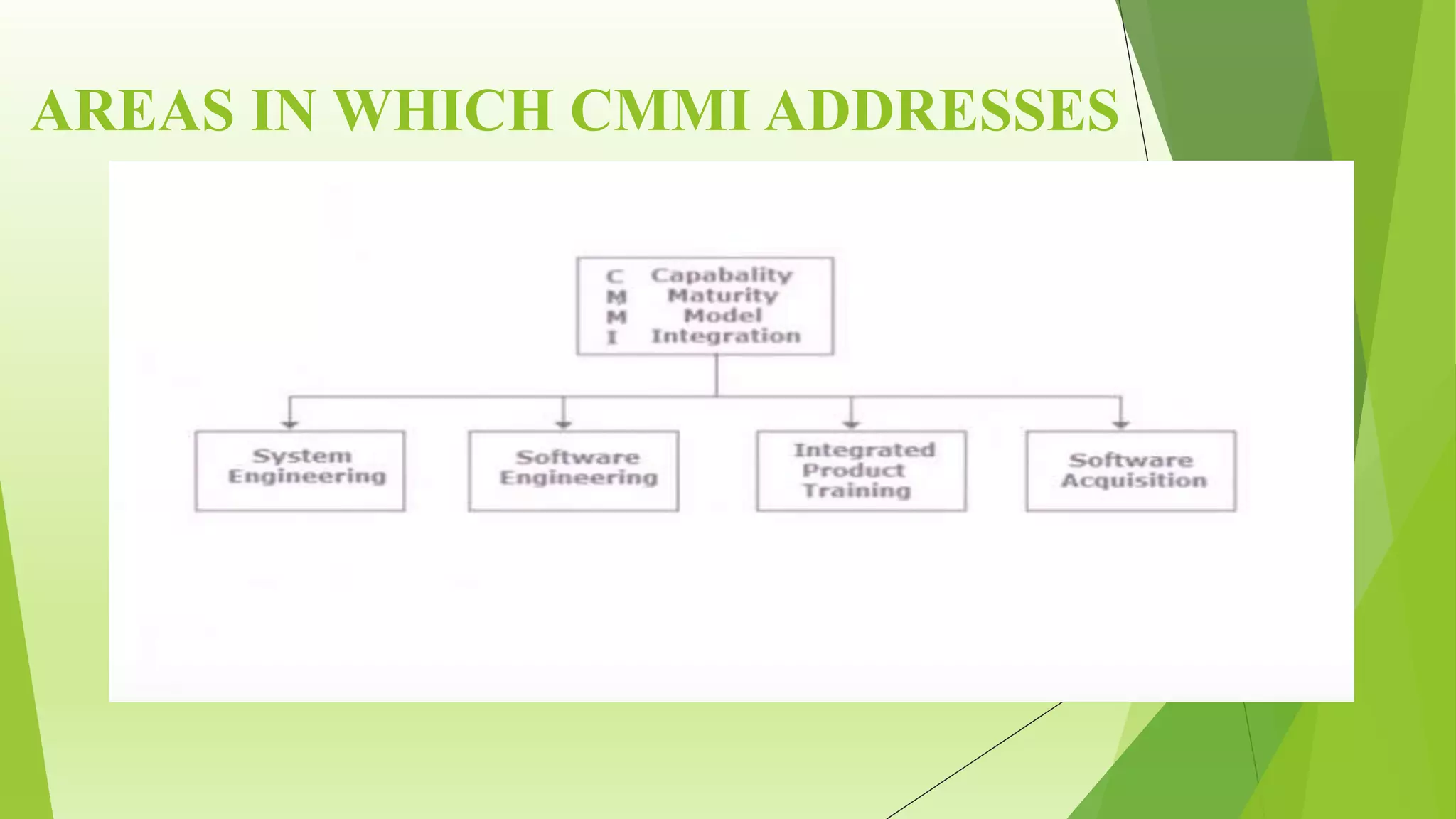
AREAS IN WHICH CMMI ADDRESSES
STRUCTURE OF CMMI MODEL
The basic building blocks in every CMMI model
are called “ process areas ”
A process area describes what those using an
effective process do (practices) and why they
do those things (goals).
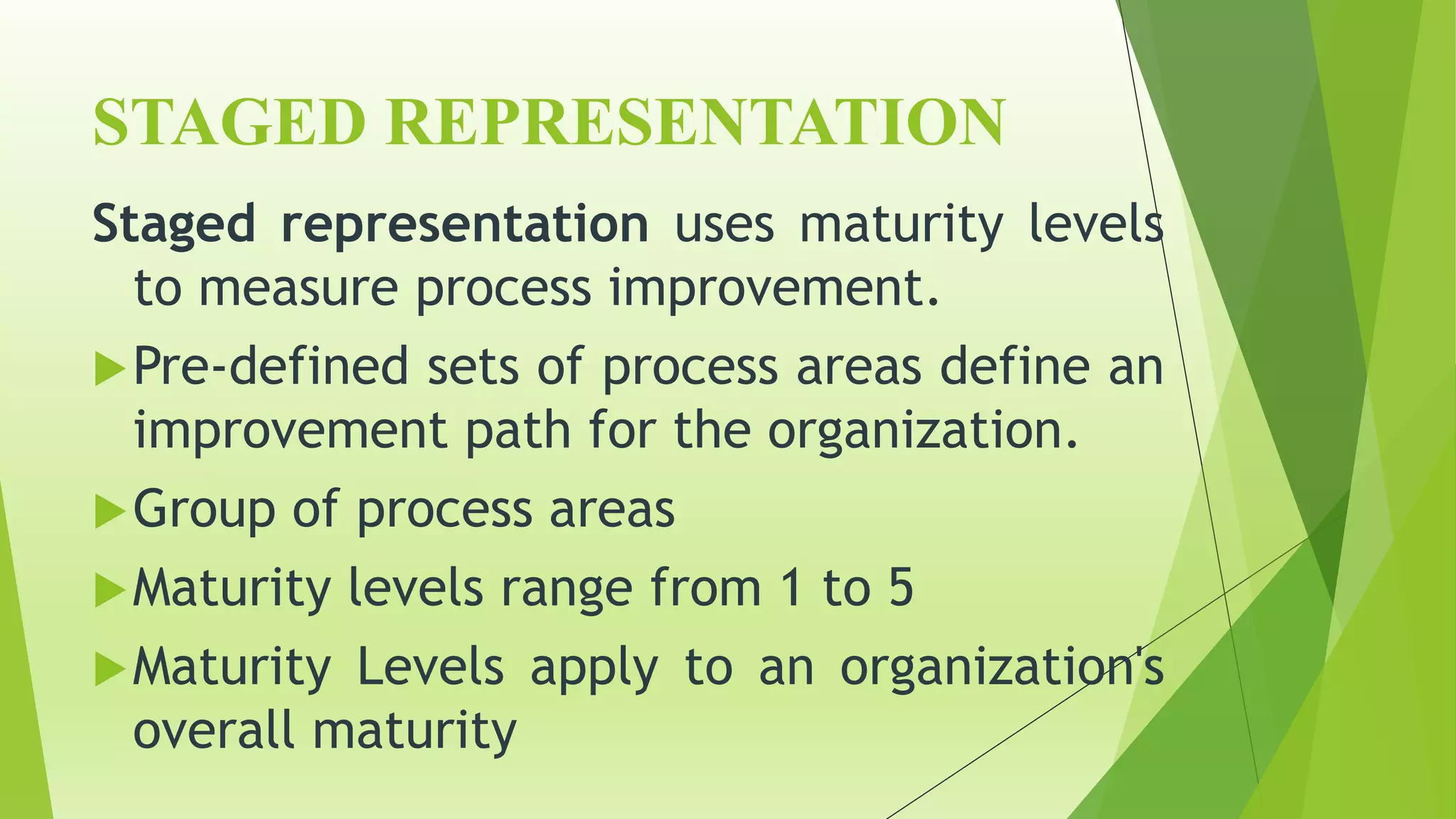
CMMI MODEL REPRESENTATION
Process areas can be organized
into one of two representations.
-Continuous representation
-Staged representation
CMMI MODEL REPRESENTATION
STAGED REPRESENTATION
Staged representation uses maturity levels
to measure process improvement.
Pre-defined sets of process areas define an
improvement path for the organization.
Group of process areas
Maturity levels range from 1 to 5
Maturity Levels apply to an organization's
overall maturity
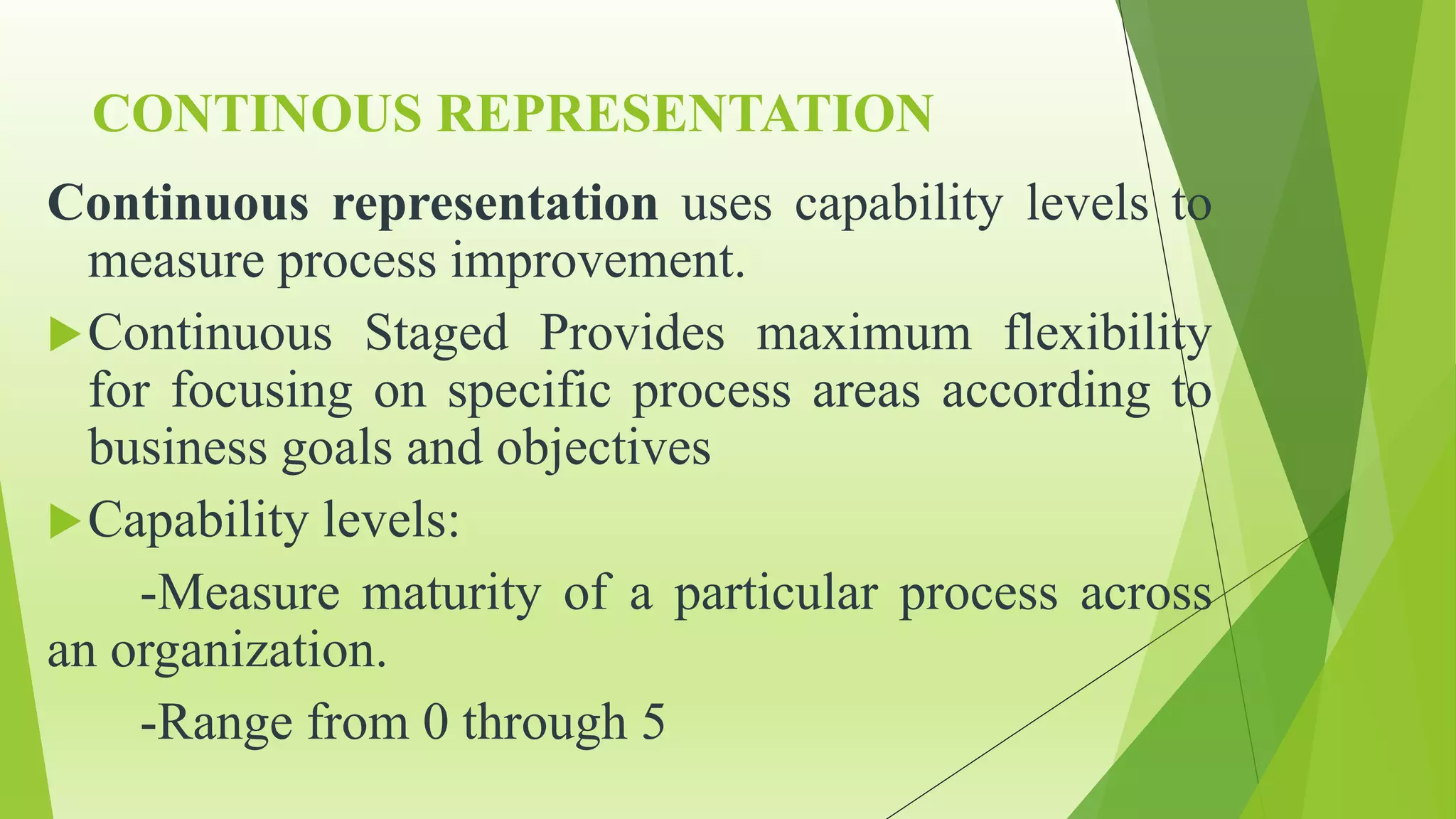
CONTINOUS REPRESENTATION
Continuous representation uses capability levels to
measure process improvement.
Continuous Staged Provides maximum flexibility
for focusing on specific process areas according to
business goals and objectives
Capability levels:
-Measure maturity of a particular process across
an organization.
-Range from 0 through 5
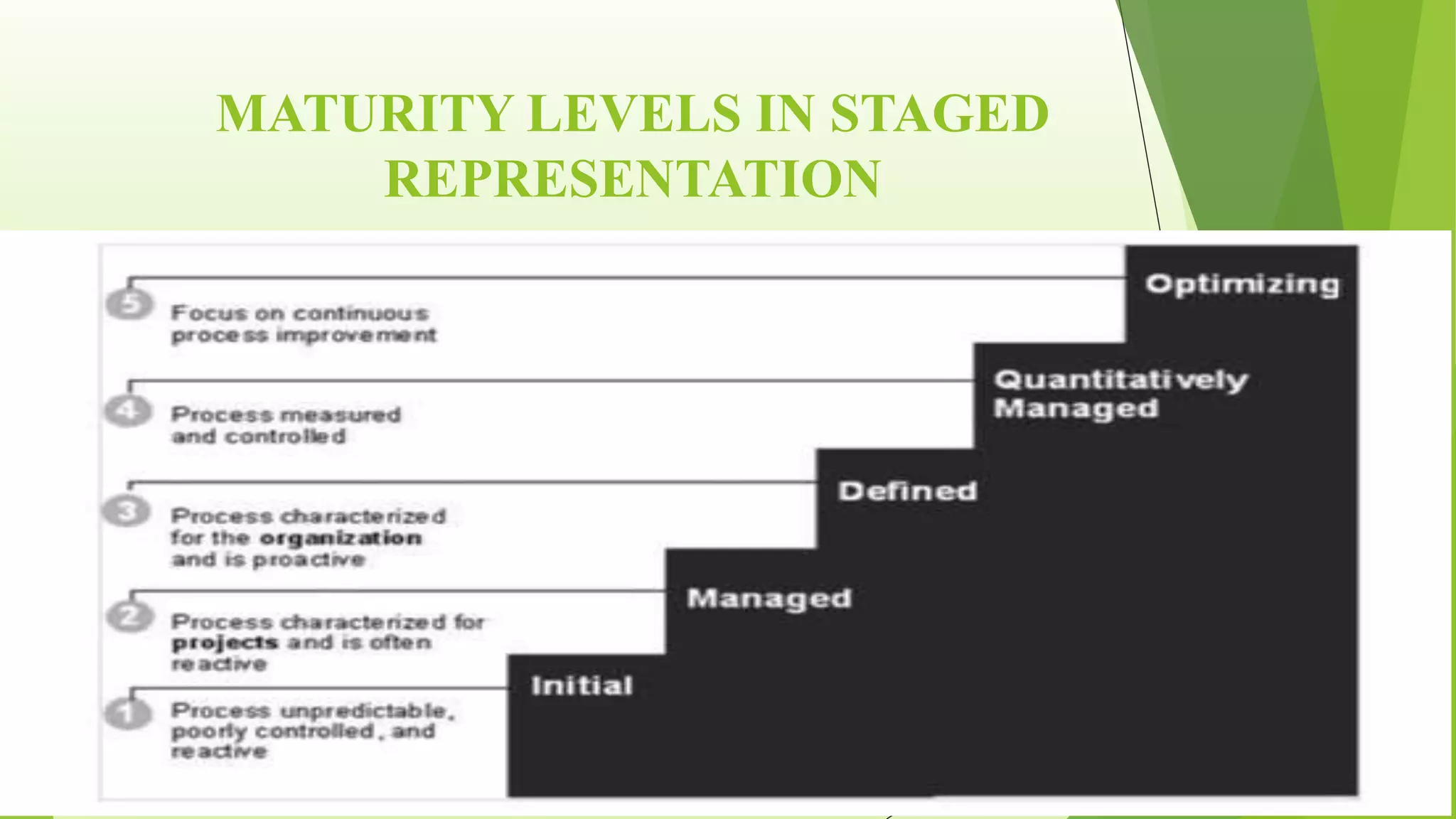
MATURITY LEVELS IN STAGED
REPRESENTATION
MATURITY LEVEL 1 (INITIAL)
At maturity level 1, processes are usually
adhoc. The organization usually does not
provide a stable environment.
Development is completely chaotic with
budget and schedules often exceeded.
In this scenario we can never predict
quality.
MATURITY LEVEL 2 (MANAGED)
 At maturity level 2, an organization has achieved
all the specific and generic goals of the maturity level
2 process areas. In other words, the projects of the
organization have ensured that requirements are
managed and that processes are planned, performed,
measured, and controlled.
 In the managed level basic project management is in
place.
 But the basic project management and practices are
followed only in the project level
MATURITY LEVEL 3 (DEFINED)
 At maturity level 3, an organization has achieved
all specific and generic goals of the process areas assigned to
maturity levels 2 and 3.
 In the previous level all good practices and processes were done
at project level.
 In this level all good practices and processes are brought to the
organizational level.
 At maturity level 3, processes are well characterized and
understood, and are described in standards, procedures, tools,
and methods.
 An important distinction between maturity level 2 and 3 is that
at level 3, processes are described in more detail and more
rigorously than at level 2 and are at an organizational level.
MATURITY LEVEL 4
(QUANTITATIVELY MANAGED)
 At maturity level 4, an organization has achieved all the specific
goals of the process areas assigned to maturity levels 2, 3, and 4.
 At this level processes are controlled by using statistical and
other quantitative techniques.
 Product quality, processes performance and service quality are
understood in statistical terms and are managed throughout the
life of the processes.
 Maturity level 4 concentrate on using metrics to make decisions
and to truly measure whether progress is happening and the
product is becoming better.
 The main difference between level 3 and 4 is that at level 3,
processes are qualitatively predictable.
 Level 4 addresses cause of process variation and take corrective
actions.
MATURITY LEVEL 5 (OPTIMIZING)
 At maturity level 5, an organization has achieved all
the specific goals of the process areas assigned to maturity
levels 2, 3, 4, and 5.
 Maturity level 5 focuses on continually improving process
performance through both incremental and innovative
technological improvements.
 In this level processes are continually improved based on an
understanding of common causes of variation within the
process.
 This is like the final level, defects are minimized, and
products are delivered on time and within the budget
boundary.
CMMI DIFFERENT FROM OTHER
MODELS
 CMMI provides a way to focus and manage hardware
and software development from product inception
through deployment and maintenance.
 It is a process improvement method
 It talks about processes I-e what process means to a
company and how good a process is.
CMMI VS AGILE
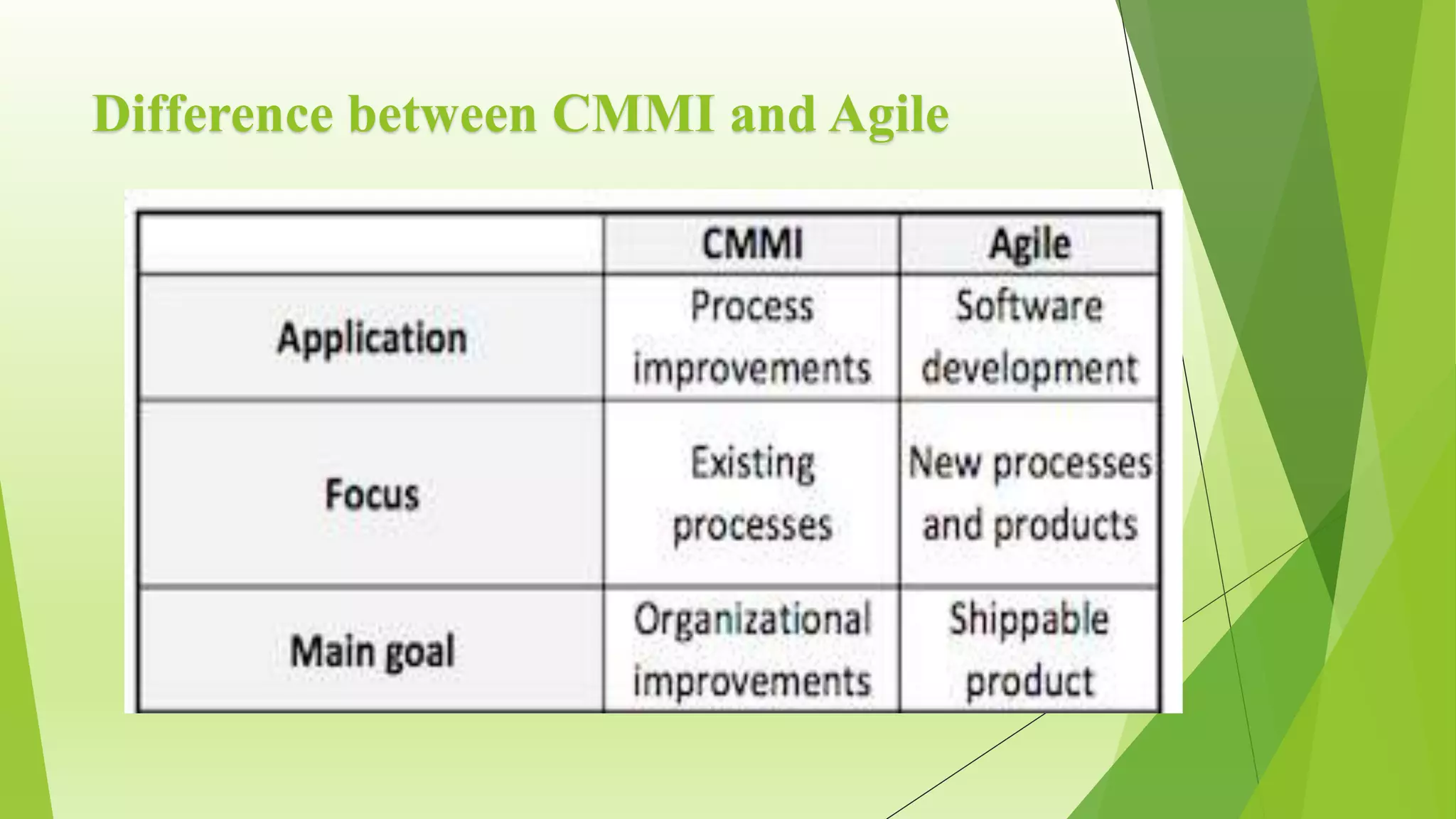
 The main goal of CMMI is organizational improvement. It is
focused on existing processes. Through observing the
existing behaviors, CMMI informs the team about their
current performance and strengths.
 Agile is a software development methodology that breaks
down the development process into iterations, known as
sprints. The goal of each iteration is to produce a shippable
product that can be handed over to a customer. The most
popular Agile methodology type is called Scrum.
Difference between CMMI and Agile
ADVANTAGES OF CMMI MODEL
Develops efficient process in organizations
Allows process improvement in organizations
A well interpreted, developed and properly
followed process shall increase the ability to meet
project goals and improve profitability
Increased Productivity
On Time Deliveries
Increased client satisfaction
Improved cycle time and quality
increased return on investment
DISADVANTAGES OF CMMI MODEL
• May require additional resources and
knowledge in smaller organizations to
initiate CMMI based process improvement.
• May require considerable amount of time
and effort for implementation
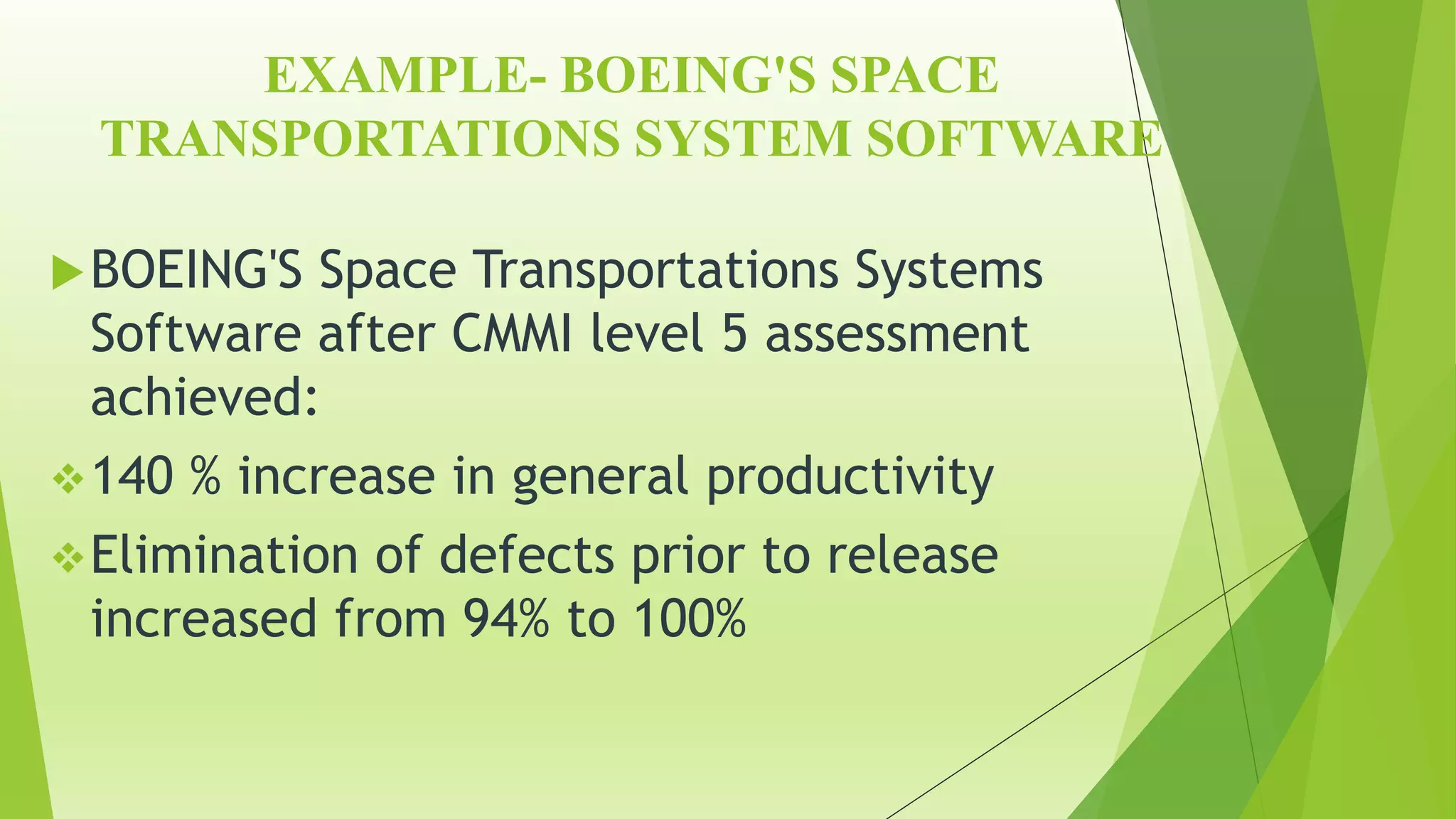
EXAMPLE- BOEING'S SPACE
TRANSPORTATIONS SYSTEM SOFTWARE
BOEING'S Space Transportations Systems
Software after CMMI level 5 assessment
achieved:
140 % increase in general productivity
Elimination of defects prior to release
increased from 94% to 100%
CONCLUSION
CMMI is a model for process improvement from
which organizations will abstract and create
process improvement solution that fit their
unique environment to achieve specific
organizational goals. CMMI is a framework of best
practices. It describes the characteristics of good
process and provides the guidelines for
companies developing their own processes.
Thank You!

Capability Maturity Model Integration (CMMI)

  • 1.
  • 2.
    CMMI-Definition  CMMI standsfor Capability Maturity Model Integration.  Its is a process improvement approach that provides companies with the essential elements of an effective process.  It is a good guide for process improvement across a project or organization.  CMMI is formed by using multiple CMM processes.
  • 3.
    AREAS IN WHICHCMMI ADDRESSES
  • 4.
    STRUCTURE OF CMMIMODEL The basic building blocks in every CMMI model are called “ process areas ” A process area describes what those using an effective process do (practices) and why they do those things (goals).
  • 5.
    CMMI MODEL REPRESENTATION Processareas can be organized into one of two representations. -Continuous representation -Staged representation
  • 6.
  • 7.
    STAGED REPRESENTATION Staged representationuses maturity levels to measure process improvement. Pre-defined sets of process areas define an improvement path for the organization. Group of process areas Maturity levels range from 1 to 5 Maturity Levels apply to an organization's overall maturity
  • 8.
    CONTINOUS REPRESENTATION Continuous representationuses capability levels to measure process improvement. Continuous Staged Provides maximum flexibility for focusing on specific process areas according to business goals and objectives Capability levels: -Measure maturity of a particular process across an organization. -Range from 0 through 5
  • 9.
    MATURITY LEVELS INSTAGED REPRESENTATION
  • 10.
    MATURITY LEVEL 1(INITIAL) At maturity level 1, processes are usually adhoc. The organization usually does not provide a stable environment. Development is completely chaotic with budget and schedules often exceeded. In this scenario we can never predict quality.
  • 11.
    MATURITY LEVEL 2(MANAGED)  At maturity level 2, an organization has achieved all the specific and generic goals of the maturity level 2 process areas. In other words, the projects of the organization have ensured that requirements are managed and that processes are planned, performed, measured, and controlled.  In the managed level basic project management is in place.  But the basic project management and practices are followed only in the project level
  • 12.
    MATURITY LEVEL 3(DEFINED)  At maturity level 3, an organization has achieved all specific and generic goals of the process areas assigned to maturity levels 2 and 3.  In the previous level all good practices and processes were done at project level.  In this level all good practices and processes are brought to the organizational level.  At maturity level 3, processes are well characterized and understood, and are described in standards, procedures, tools, and methods.  An important distinction between maturity level 2 and 3 is that at level 3, processes are described in more detail and more rigorously than at level 2 and are at an organizational level.
  • 13.
    MATURITY LEVEL 4 (QUANTITATIVELYMANAGED)  At maturity level 4, an organization has achieved all the specific goals of the process areas assigned to maturity levels 2, 3, and 4.  At this level processes are controlled by using statistical and other quantitative techniques.  Product quality, processes performance and service quality are understood in statistical terms and are managed throughout the life of the processes.  Maturity level 4 concentrate on using metrics to make decisions and to truly measure whether progress is happening and the product is becoming better.  The main difference between level 3 and 4 is that at level 3, processes are qualitatively predictable.  Level 4 addresses cause of process variation and take corrective actions.
  • 14.
    MATURITY LEVEL 5(OPTIMIZING)  At maturity level 5, an organization has achieved all the specific goals of the process areas assigned to maturity levels 2, 3, 4, and 5.  Maturity level 5 focuses on continually improving process performance through both incremental and innovative technological improvements.  In this level processes are continually improved based on an understanding of common causes of variation within the process.  This is like the final level, defects are minimized, and products are delivered on time and within the budget boundary.
  • 15.
    CMMI DIFFERENT FROMOTHER MODELS  CMMI provides a way to focus and manage hardware and software development from product inception through deployment and maintenance.  It is a process improvement method  It talks about processes I-e what process means to a company and how good a process is.
  • 16.
    CMMI VS AGILE The main goal of CMMI is organizational improvement. It is focused on existing processes. Through observing the existing behaviors, CMMI informs the team about their current performance and strengths.  Agile is a software development methodology that breaks down the development process into iterations, known as sprints. The goal of each iteration is to produce a shippable product that can be handed over to a customer. The most popular Agile methodology type is called Scrum.
  • 17.
  • 18.
    ADVANTAGES OF CMMIMODEL Develops efficient process in organizations Allows process improvement in organizations A well interpreted, developed and properly followed process shall increase the ability to meet project goals and improve profitability Increased Productivity On Time Deliveries Increased client satisfaction Improved cycle time and quality increased return on investment
  • 19.
    DISADVANTAGES OF CMMIMODEL • May require additional resources and knowledge in smaller organizations to initiate CMMI based process improvement. • May require considerable amount of time and effort for implementation
  • 20.
    EXAMPLE- BOEING'S SPACE TRANSPORTATIONSSYSTEM SOFTWARE BOEING'S Space Transportations Systems Software after CMMI level 5 assessment achieved: 140 % increase in general productivity Elimination of defects prior to release increased from 94% to 100%
  • 21.
    CONCLUSION CMMI is amodel for process improvement from which organizations will abstract and create process improvement solution that fit their unique environment to achieve specific organizational goals. CMMI is a framework of best practices. It describes the characteristics of good process and provides the guidelines for companies developing their own processes.
  • 22.