Creative Problem Solving with
    Six Thinking Hats

        How to use Edward de Bono’s
     Parallel Thinking in Problem Solving


                                Prepared By: A.M. Iftekharul Alam
                                              QA & Test Engineer
Agenda
• Define parallel thinking
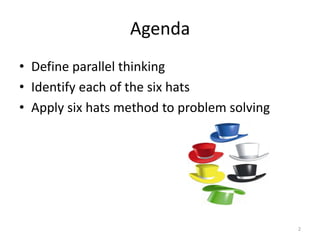
• Identify each of the six hats
• Apply six hats method to problem solving


                                             2
Parallel Thinking
• At any moment everyone is looking in the same
  direction.
• Each thinker puts forward his or her thoughts in
  parallel with the thoughts of others
• Guides thought processes in one direction at a time
  so we can effectively analyze issues, generate new
  ideas, and make better decisions.
• Constructive alternative to arguments


                                                        3
So the six hats are…?
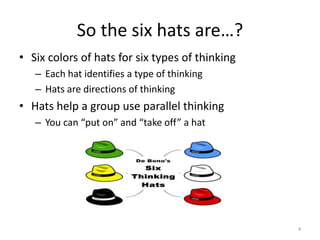
• Six colors of hats for six types of thinking
   – Each hat identifies a type of thinking
   – Hats are directions of thinking
• Hats help a group use parallel thinking
   – You can “put on” and “take off” a hat


                                                 4
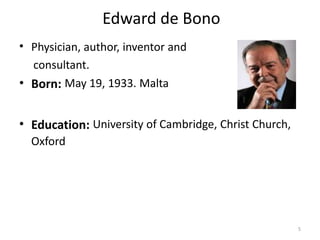
Edward de Bono
• Physician, author, inventor and
  consultant.
• Born: May 19, 1933. Malta


• Education: University of Cambridge, Christ Church,
  Oxford


                                                       5
Six colors…
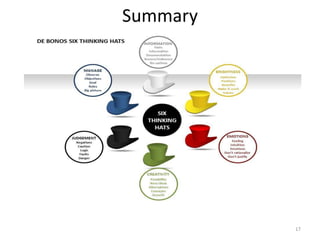
•   White: neutral, objective
•   Red: emotional, angry
•   Black: serious, somber
•   Yellow: sunny, positive
•   Green: growth, fertility
•   Blue: cool, sky above


                                6
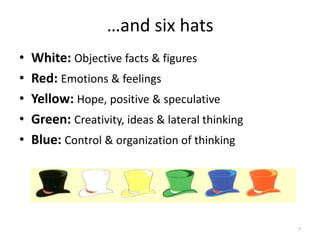
…and six hats
•   White: Objective facts & figures
•   Red: Emotions & feelings
•   Yellow: Hope, positive & speculative
•   Green: Creativity, ideas & lateral thinking
•   Blue: Control & organization of thinking


                                                  7
Using the hats
• Use any hat, as often as needed
• Sequence can be preset or evolving
• Not necessary to use every hat
• Time under each hat: generally, short
• Requires discipline from each person
   – While using it, stay in the idiom
• Can be used by individuals and groups


                                          8
Blue Hat
                Managing the Thinking Process

•   Control of thinking & the process
•   Instructions for thinking
•   The organization of thinking
•   Control of the other hats
•   Begin & end session with blue hat
•   Discipline and focus
•   Facilitator, session leader’s role

                                                9
Open with the blue hat…
•   Why we are here
•   what we are thinking about
•   definition of the situation or problem
•   what we want to achieve
•   where we want to end up
•   the background to the thinking
•   a plan for the sequence of hats


                                             10
White Hat
              Information Available & Needed

• Neutral, objective information
• Facts & figures
• Questions: what do we know, what don’t we know,
  what do we need to know
• Excludes opinions, hunches, judgements
• Removes feelings & impressions


                                                    11
Red Hat
                     Intuition and Feelings

•   Emotions & feelings
•   Hunches, intuitions, impressions
•   Doesn’t have to be logical or consistent
•   No justifications, reasons or basis
•   All decisions are emotional in the end


                                               12
Black Hat
                Caution, Difficulties, and Problems

•   Cautious and careful
•   Logical negative – why it won’t work
•   Critical judgment, pessimistic view
•   Separates logical negative from emotional
•   Focus on errors, evidence, conclusions
•   Logical & truthful, but not necessarily fair


                                                      13
Yellow Hat
                    Benefits and Feasibility

•   Positive & speculative
•   Positive thinking, optimism, opportunity
•   Benefits
•   Best-case scenarios
•   Exploration


                                               14
Green Hat
                 Alternatives and Creative Ideas

•   New ideas, concepts, perceptions
•   Deliberate creation of new ideas
•   Alternatives and more alternatives
•   New approaches to problems
•   Creative & lateral thinking


                                                   15
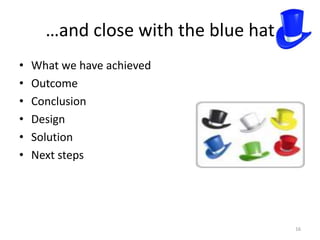
…and close with the blue hat
•   What we have achieved
•   Outcome
•   Conclusion
•   Design
•   Solution
•   Next steps


                                     16
Summary


          17
General hat issues
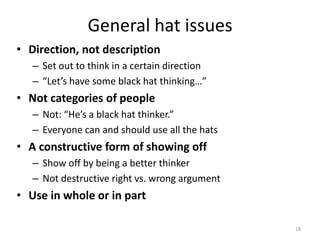
• Direction, not description
   – Set out to think in a certain direction
   – “Let’s have some black hat thinking…”
• Not categories of people
   – Not: “He’s a black hat thinker.”
   – Everyone can and should use all the hats
• A constructive form of showing off
   – Show off by being a better thinker
   – Not destructive right vs. wrong argument
• Use in whole or in part

                                                18
Benefits of Six Thinking Hats
• Provides a common language
• Experience & intelligence of each person (Diversity of
  thought)
• Helps people work against type, preference
• Removal of ego (reduce confrontation)
• Focus (one thing at a time)
• Create, evaluate & implement action plans


                                                           19
Thank You

•   Questions/comments?


                           20

6 Thinking Hats

  • 1.
    Creative Problem Solvingwith Six Thinking Hats How to use Edward de Bono’s Parallel Thinking in Problem Solving Prepared By: A.M. Iftekharul Alam QA & Test Engineer
  • 2.
    Agenda • Define parallelthinking • Identify each of the six hats • Apply six hats method to problem solving 2
  • 3.
    Parallel Thinking • Atany moment everyone is looking in the same direction. • Each thinker puts forward his or her thoughts in parallel with the thoughts of others • Guides thought processes in one direction at a time so we can effectively analyze issues, generate new ideas, and make better decisions. • Constructive alternative to arguments 3
  • 4.
    So the sixhats are…? • Six colors of hats for six types of thinking – Each hat identifies a type of thinking – Hats are directions of thinking • Hats help a group use parallel thinking – You can “put on” and “take off” a hat 4
  • 5.
    Edward de Bono •Physician, author, inventor and consultant. • Born: May 19, 1933. Malta • Education: University of Cambridge, Christ Church, Oxford 5
  • 6.
    Six colors… • White: neutral, objective • Red: emotional, angry • Black: serious, somber • Yellow: sunny, positive • Green: growth, fertility • Blue: cool, sky above 6
  • 7.
    …and six hats • White: Objective facts & figures • Red: Emotions & feelings • Yellow: Hope, positive & speculative • Green: Creativity, ideas & lateral thinking • Blue: Control & organization of thinking 7
  • 8.
    Using the hats •Use any hat, as often as needed • Sequence can be preset or evolving • Not necessary to use every hat • Time under each hat: generally, short • Requires discipline from each person – While using it, stay in the idiom • Can be used by individuals and groups 8
  • 9.
    Blue Hat Managing the Thinking Process • Control of thinking & the process • Instructions for thinking • The organization of thinking • Control of the other hats • Begin & end session with blue hat • Discipline and focus • Facilitator, session leader’s role 9
  • 10.
    Open with theblue hat… • Why we are here • what we are thinking about • definition of the situation or problem • what we want to achieve • where we want to end up • the background to the thinking • a plan for the sequence of hats 10
  • 11.
    White Hat Information Available & Needed • Neutral, objective information • Facts & figures • Questions: what do we know, what don’t we know, what do we need to know • Excludes opinions, hunches, judgements • Removes feelings & impressions 11
  • 12.
    Red Hat Intuition and Feelings • Emotions & feelings • Hunches, intuitions, impressions • Doesn’t have to be logical or consistent • No justifications, reasons or basis • All decisions are emotional in the end 12
  • 13.
    Black Hat Caution, Difficulties, and Problems • Cautious and careful • Logical negative – why it won’t work • Critical judgment, pessimistic view • Separates logical negative from emotional • Focus on errors, evidence, conclusions • Logical & truthful, but not necessarily fair 13
  • 14.
    Yellow Hat Benefits and Feasibility • Positive & speculative • Positive thinking, optimism, opportunity • Benefits • Best-case scenarios • Exploration 14
  • 15.
    Green Hat Alternatives and Creative Ideas • New ideas, concepts, perceptions • Deliberate creation of new ideas • Alternatives and more alternatives • New approaches to problems • Creative & lateral thinking 15
  • 16.
    …and close withthe blue hat • What we have achieved • Outcome • Conclusion • Design • Solution • Next steps 16
  • 17.
  • 18.
    General hat issues •Direction, not description – Set out to think in a certain direction – “Let’s have some black hat thinking…” • Not categories of people – Not: “He’s a black hat thinker.” – Everyone can and should use all the hats • A constructive form of showing off – Show off by being a better thinker – Not destructive right vs. wrong argument • Use in whole or in part 18
  • 19.
    Benefits of SixThinking Hats • Provides a common language • Experience & intelligence of each person (Diversity of thought) • Helps people work against type, preference • Removal of ego (reduce confrontation) • Focus (one thing at a time) • Create, evaluate & implement action plans 19
  • 20.
    Thank You • Questions/comments? 20