1
Software Engineering Institute
(SEI)’s
Capability Maturity Model
(CMM)
And
(CMMI)
Srihari Techsoft (Internet), KK Agarwal, and Cotterell
Srihari Techsoft
SEI – CMM
Software Engineering Institute (SEI) developed Capability
Maturity Model (CMM)
CMM describes the prime elements - planning, engineering,
managing software development and maintenance
CMM can be used for
• Software process improvement
• Software process assessment
• Software capability evaluations
Srihari Techsoft
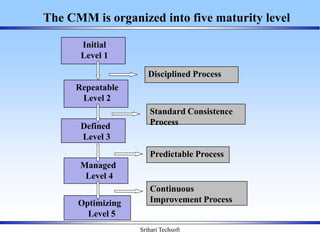
The CMM is organized into five maturity level
Initial
Level 1
Repeatable
Level 2
Defined
Level 3
Managed
Level 4
Optimizing
Level 5
Disciplined Process
Standard Consistence
Process
Predictable Process
Continuous
Improvement Process
Srihari Techsoft and KK Agarwal
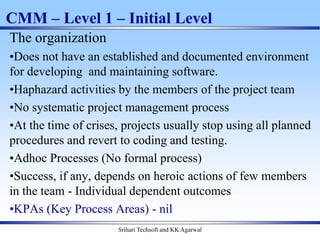
CMM – Level 1 – Initial Level
The organization
•Does not have an established and documented environment
for developing and maintaining software.
•Haphazard activities by the members of the project team
•No systematic project management process
•At the time of crises, projects usually stop using all planned
procedures and revert to coding and testing.
•Adhoc Processes (No formal process)
•Success, if any, depends on heroic actions of few members
in the team - Individual dependent outcomes
•KPAs (Key Process Areas) - nil
Srihari Techsoft and KK Agarwal
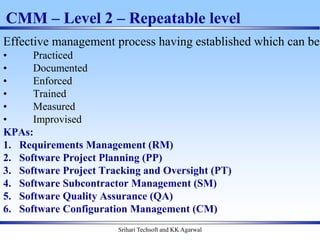
CMM – Level 2 – Repeatable level
Effective management process having established which can be
• Practiced
• Documented
• Enforced
• Trained
• Measured
• Improvised
KPAs:
1. Requirements Management (RM)
2. Software Project Planning (PP)
3. Software Project Tracking and Oversight (PT)
4. Software Subcontractor Management (SM)
5. Software Quality Assurance (QA)
6. Software Configuration Management (CM)
Srihari Techsoft and KK Agarwal
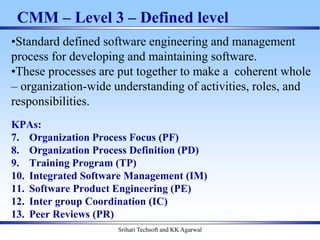
CMM – Level 3 – Defined level
•Standard defined software engineering and management
process for developing and maintaining software.
•These processes are put together to make a coherent whole
– organization-wide understanding of activities, roles, and
responsibilities.
KPAs:
7. Organization Process Focus (PF)
8. Organization Process Definition (PD)
9. Training Program (TP)
10. Integrated Software Management (IM)
11. Software Product Engineering (PE)
12. Inter group Coordination (IC)
13. Peer Reviews (PR)
Srihari Techsoft and KK Agarwal
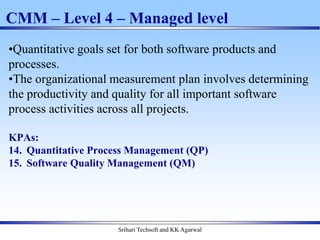
CMM – Level 4 – Managed level
•Quantitative goals set for both software products and
processes.
•The organizational measurement plan involves determining
the productivity and quality for all important software
process activities across all projects.
KPAs:
14. Quantitative Process Management (QP)
15. Software Quality Management (QM)
Srihari Techsoft and KK Agarwal
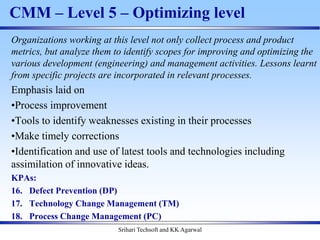
CMM – Level 5 – Optimizing level
Organizations working at this level not only collect process and product
metrics, but analyze them to identify scopes for improving and optimizing the
various development (engineering) and management activities. Lessons learnt
from specific projects are incorporated in relevant processes.
Emphasis laid on
•Process improvement
•Tools to identify weaknesses existing in their processes
•Make timely corrections
•Identification and use of latest tools and technologies including
assimilation of innovative ideas.
KPAs:
16. Defect Prevention (DP)
17. Technology Change Management (TM)
18. Process Change Management (PC)
KK Agarwal
CMM – Common Features
Common features are attributes that indicate whether the
implementation and institutionalization of KPAs are
effective, repeatable, and lasting. These are:
1. Commitment to Perform (CO) - Describes the actions the
organizations must take to ensure that the process is established and
will endure. It includes practices on policy and leadership.
2. Ability to Perform (AB) – Describes the preconditions that must
exist. It includes practices on resources, organizational structure,
training and tools.
3. Activities Performed (AP) – Describes role and procedures necessary
to implement a KPA.
4. Measurement and Analysis (ME) – Describes the need to measure
the process and analyze the measurements.
5. Verifying Implementation (VE) – Reviews, audits etc.
CMMI
• CMMs were developed for disciplines such as System Engineering
(SE-CMM), People Management (PCMM), Software Acquisition
(SA-CMM) etc.
• CMMI is generalized to be applicable to many domains using a
single framework; thus making CMMI much more abstract – all the
terminologies used are very generic in nature, and even the word
software does not appear in the definition document of CMMI.
• CMMI, however, follows same five levels of maturity. The KRAs
are more or less on the similar lines with slight modifications to make
them generic.
Cotterell Vth Edition 10

Unit4 Software Engineering Institute (SEI)’s Capability Maturity Model (CMM) And (CMMI)

  • 1.
    1 Software Engineering Institute (SEI)’s CapabilityMaturity Model (CMM) And (CMMI) Srihari Techsoft (Internet), KK Agarwal, and Cotterell
  • 2.
    Srihari Techsoft SEI –CMM Software Engineering Institute (SEI) developed Capability Maturity Model (CMM) CMM describes the prime elements - planning, engineering, managing software development and maintenance CMM can be used for • Software process improvement • Software process assessment • Software capability evaluations
  • 3.
    Srihari Techsoft The CMMis organized into five maturity level Initial Level 1 Repeatable Level 2 Defined Level 3 Managed Level 4 Optimizing Level 5 Disciplined Process Standard Consistence Process Predictable Process Continuous Improvement Process
  • 4.
    Srihari Techsoft andKK Agarwal CMM – Level 1 – Initial Level The organization •Does not have an established and documented environment for developing and maintaining software. •Haphazard activities by the members of the project team •No systematic project management process •At the time of crises, projects usually stop using all planned procedures and revert to coding and testing. •Adhoc Processes (No formal process) •Success, if any, depends on heroic actions of few members in the team - Individual dependent outcomes •KPAs (Key Process Areas) - nil
  • 5.
    Srihari Techsoft andKK Agarwal CMM – Level 2 – Repeatable level Effective management process having established which can be • Practiced • Documented • Enforced • Trained • Measured • Improvised KPAs: 1. Requirements Management (RM) 2. Software Project Planning (PP) 3. Software Project Tracking and Oversight (PT) 4. Software Subcontractor Management (SM) 5. Software Quality Assurance (QA) 6. Software Configuration Management (CM)
  • 6.
    Srihari Techsoft andKK Agarwal CMM – Level 3 – Defined level •Standard defined software engineering and management process for developing and maintaining software. •These processes are put together to make a coherent whole – organization-wide understanding of activities, roles, and responsibilities. KPAs: 7. Organization Process Focus (PF) 8. Organization Process Definition (PD) 9. Training Program (TP) 10. Integrated Software Management (IM) 11. Software Product Engineering (PE) 12. Inter group Coordination (IC) 13. Peer Reviews (PR)
  • 7.
    Srihari Techsoft andKK Agarwal CMM – Level 4 – Managed level •Quantitative goals set for both software products and processes. •The organizational measurement plan involves determining the productivity and quality for all important software process activities across all projects. KPAs: 14. Quantitative Process Management (QP) 15. Software Quality Management (QM)
  • 8.
    Srihari Techsoft andKK Agarwal CMM – Level 5 – Optimizing level Organizations working at this level not only collect process and product metrics, but analyze them to identify scopes for improving and optimizing the various development (engineering) and management activities. Lessons learnt from specific projects are incorporated in relevant processes. Emphasis laid on •Process improvement •Tools to identify weaknesses existing in their processes •Make timely corrections •Identification and use of latest tools and technologies including assimilation of innovative ideas. KPAs: 16. Defect Prevention (DP) 17. Technology Change Management (TM) 18. Process Change Management (PC)
  • 9.
    KK Agarwal CMM –Common Features Common features are attributes that indicate whether the implementation and institutionalization of KPAs are effective, repeatable, and lasting. These are: 1. Commitment to Perform (CO) - Describes the actions the organizations must take to ensure that the process is established and will endure. It includes practices on policy and leadership. 2. Ability to Perform (AB) – Describes the preconditions that must exist. It includes practices on resources, organizational structure, training and tools. 3. Activities Performed (AP) – Describes role and procedures necessary to implement a KPA. 4. Measurement and Analysis (ME) – Describes the need to measure the process and analyze the measurements. 5. Verifying Implementation (VE) – Reviews, audits etc.
  • 10.
    CMMI • CMMs weredeveloped for disciplines such as System Engineering (SE-CMM), People Management (PCMM), Software Acquisition (SA-CMM) etc. • CMMI is generalized to be applicable to many domains using a single framework; thus making CMMI much more abstract – all the terminologies used are very generic in nature, and even the word software does not appear in the definition document of CMMI. • CMMI, however, follows same five levels of maturity. The KRAs are more or less on the similar lines with slight modifications to make them generic. Cotterell Vth Edition 10