Radiation Carcinogenesis
Two types of late effects of
irradiation
• Deterministic (non-stochastic) effects
– Severity increases with dose. There is a threshold.
Eg tissue fibrosis, cataracts.
– Mechanism involves effects (often cell kill) on
many cells.
• Stochastic Effects
– No threshold, probability increases with dose but
severity is independent of dose (eg cancer and
genetic effects)
Both Marie Curie (the
discoverer of radium)
and her daughter Irene
died of leukemia -
probably due to their
radiation exposures
It was known early after the discovery of
radiation that it could cause cancer
Mutations produce Cancer
• H J Muller (1927) found that X-rays induce
gene mutations in Drosophila (fruit flies)
and that they do so linearly with dose.
“The effect of X-rays, in occasionally producing cancer, may also be
associated with their action in producing mutations”.
• Bruce Ames. 1970’s: developed test in bacteria for
potency of chemicals to cause mutations - these
correlated with potency to cause cancer in rodents.
Simple idea: mutagens = carcinogens.
Radiation induced cancers
• Spectrum of cancers is same as that occurring
naturally.
• Severity of induced cancer is independent of
dose.
• Probability of cancer induction increases with
dose with no threshold.
• This is known as stochastic effect
• Mechanism is that cancer can arise from a
single mutation in a single cell.
Risk Estimates for Radiation Induced
Cancers
Information principally from…
1. Occupationally Exposed: e.g., radium dial
painters, uranium miners, early x-ray users.
2. Medically Exposed: e.g., ankylosing spondylitis,
tinea capitis, tuberculosis patients, children
irradiated for enlarged thymus
3. Atomic Bomb Exposed: e.g., Hiroshima and
Nagasaki survivors.
Occupational exposure:
Bone cancer developed in the “radium dial painters”
Thyroid cancer development in individuals given X-
irradiation for enlarged thymus in childhood
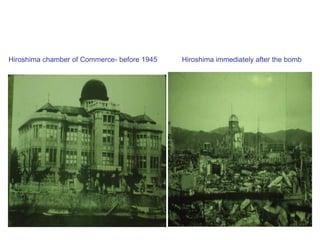
Hiroshima chamber of Commerce- before 1945 Hiroshima immediately after the bomb
The A-bomb dome today
Latent Periods
• For leukemias: Rise started 2 yrs after bomb
and reached peak 7-12 yrs after bomb. Most
cases observed by 15 yrs
• Solid Cancers: Excess risk started about 10
years after bomb, excess still continues 60
years after bomb. Thyroid cancer in children
has shorter latent period of ~5 yrs.
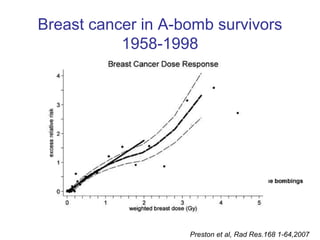
Breast cancer in A-bomb survivors
1958-1998
Preston et al, Rad Res.168 1-64,2007
Breast cancer in various irradiated
populations
Relative vs
Absolute Risk
A-bomb survivors
1950-1990
Dose response curve (relative risk) for all
cancers in A-bomb survivors 1958-1998
Preston et al, Rad Res.168 1-64,2007
Data consistent with linear
dose response curve
Compared to the number of people in H & N killed
outright (~100,000) the number of cancer deaths
attributable to the radiation dose is small
Preston et al, Rad Res.168 1-64,2007
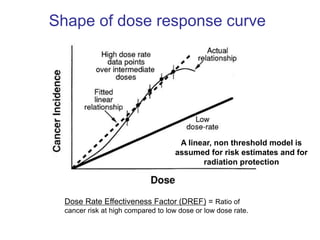
Shape of dose response curve
A linear, non threshold model is
assumed for risk estimates and for
radiation protection
Dose Rate Effectiveness Factor (DREF) = Ratio of
cancer risk at high compared to low dose or low dose rate.
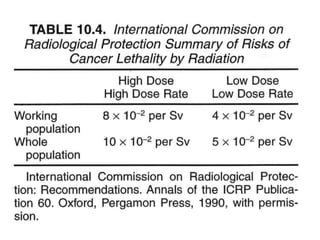
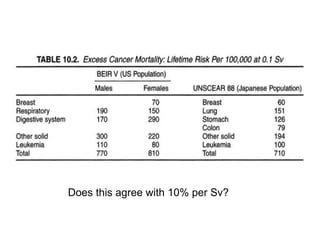
Best overall estimate of total
radiation induced cancer mortality
10% per Sv (high doses/dose rates)
US Normal is ~ 16% for all cancers
Does this agree with 10% per Sv?
Cancer Risk after Radiotherapy 1
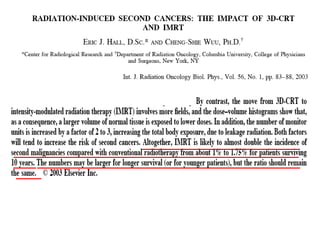
Increase in Relative Risk after Radiotherapy for Prostate Cancer
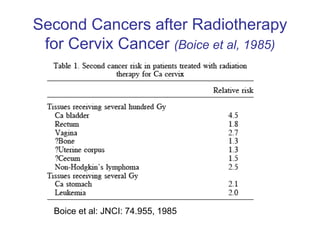
Second Cancers after Radiotherapy
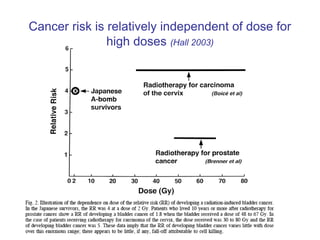
for Cervix Cancer (Boice et al, 1985)
Boice et al: JNCI: 74.955, 1985
Cancer risk is relatively independent of dose for
high doses (Hall 2003)
Estimating cancer risk in any organ
after radiotherapy
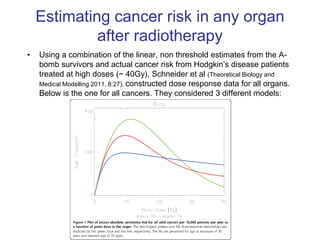
• Using a combination of the linear, non threshold estimates from the A-
bomb survivors and actual cancer risk from Hodgkin’s disease patients
treated at high doses (~ 40Gy), Schneider et al (Theoretical Biology and
Medical Modelling 2011, 8:27), constructed dose response data for all organs.
Below is the one for all cancers. They considered 3 different models:
Organ doses from Medical Radiation
Brenner & Hall, NEJM, 2007
Cancer incidence from CT scans
Brenner & Hall, NEJM, 2007
Of the 62 million CT scans, 4 million are on small children.
4 x 106 x 0.1% = 4 x 10³ excess ca deaths per year
Summary
• Radiation is both a mutagen and a carcinogen
• Human risk estimates are based on a linear, non
threshold assumption for the dose response curve
• Human risks are based largely on the data from the
A-bomb survivors.
• Rule of thumb: 1 Sv (= 1Gy of X-rays) gives 10%
cancer death rate over spontaneous rate. Reduce by
factor of 2 for low doses and/or low dose rates.
• Radiation induces genomic instability by as yet
unknown mechanisms

RADIATION CARCINOGENESIS

  • 1.
  • 2.
    Two types oflate effects of irradiation • Deterministic (non-stochastic) effects – Severity increases with dose. There is a threshold. Eg tissue fibrosis, cataracts. – Mechanism involves effects (often cell kill) on many cells. • Stochastic Effects – No threshold, probability increases with dose but severity is independent of dose (eg cancer and genetic effects)
  • 3.
    Both Marie Curie(the discoverer of radium) and her daughter Irene died of leukemia - probably due to their radiation exposures It was known early after the discovery of radiation that it could cause cancer
  • 4.
    Mutations produce Cancer •H J Muller (1927) found that X-rays induce gene mutations in Drosophila (fruit flies) and that they do so linearly with dose. “The effect of X-rays, in occasionally producing cancer, may also be associated with their action in producing mutations”. • Bruce Ames. 1970’s: developed test in bacteria for potency of chemicals to cause mutations - these correlated with potency to cause cancer in rodents. Simple idea: mutagens = carcinogens.
  • 5.
    Radiation induced cancers •Spectrum of cancers is same as that occurring naturally. • Severity of induced cancer is independent of dose. • Probability of cancer induction increases with dose with no threshold. • This is known as stochastic effect • Mechanism is that cancer can arise from a single mutation in a single cell.
  • 6.
    Risk Estimates forRadiation Induced Cancers Information principally from… 1. Occupationally Exposed: e.g., radium dial painters, uranium miners, early x-ray users. 2. Medically Exposed: e.g., ankylosing spondylitis, tinea capitis, tuberculosis patients, children irradiated for enlarged thymus 3. Atomic Bomb Exposed: e.g., Hiroshima and Nagasaki survivors.
  • 7.
    Occupational exposure: Bone cancerdeveloped in the “radium dial painters”
  • 8.
    Thyroid cancer developmentin individuals given X- irradiation for enlarged thymus in childhood
  • 9.
    Hiroshima chamber ofCommerce- before 1945 Hiroshima immediately after the bomb
  • 10.
  • 11.
    Latent Periods • Forleukemias: Rise started 2 yrs after bomb and reached peak 7-12 yrs after bomb. Most cases observed by 15 yrs • Solid Cancers: Excess risk started about 10 years after bomb, excess still continues 60 years after bomb. Thyroid cancer in children has shorter latent period of ~5 yrs.
  • 12.
    Breast cancer inA-bomb survivors 1958-1998 Preston et al, Rad Res.168 1-64,2007
  • 13.
    Breast cancer invarious irradiated populations Relative vs Absolute Risk A-bomb survivors 1950-1990
  • 14.
    Dose response curve(relative risk) for all cancers in A-bomb survivors 1958-1998 Preston et al, Rad Res.168 1-64,2007 Data consistent with linear dose response curve
  • 15.
    Compared to thenumber of people in H & N killed outright (~100,000) the number of cancer deaths attributable to the radiation dose is small Preston et al, Rad Res.168 1-64,2007
  • 16.
    Shape of doseresponse curve A linear, non threshold model is assumed for risk estimates and for radiation protection Dose Rate Effectiveness Factor (DREF) = Ratio of cancer risk at high compared to low dose or low dose rate.
  • 18.
    Best overall estimateof total radiation induced cancer mortality 10% per Sv (high doses/dose rates) US Normal is ~ 16% for all cancers
  • 19.
    Does this agreewith 10% per Sv?
  • 20.
    Cancer Risk afterRadiotherapy 1 Increase in Relative Risk after Radiotherapy for Prostate Cancer
  • 21.
    Second Cancers afterRadiotherapy for Cervix Cancer (Boice et al, 1985) Boice et al: JNCI: 74.955, 1985
  • 23.
    Cancer risk isrelatively independent of dose for high doses (Hall 2003)
  • 24.
    Estimating cancer riskin any organ after radiotherapy • Using a combination of the linear, non threshold estimates from the A- bomb survivors and actual cancer risk from Hodgkin’s disease patients treated at high doses (~ 40Gy), Schneider et al (Theoretical Biology and Medical Modelling 2011, 8:27), constructed dose response data for all organs. Below is the one for all cancers. They considered 3 different models:
  • 26.
    Organ doses fromMedical Radiation Brenner & Hall, NEJM, 2007
  • 27.
    Cancer incidence fromCT scans Brenner & Hall, NEJM, 2007 Of the 62 million CT scans, 4 million are on small children. 4 x 106 x 0.1% = 4 x 10³ excess ca deaths per year
  • 28.
    Summary • Radiation isboth a mutagen and a carcinogen • Human risk estimates are based on a linear, non threshold assumption for the dose response curve • Human risks are based largely on the data from the A-bomb survivors. • Rule of thumb: 1 Sv (= 1Gy of X-rays) gives 10% cancer death rate over spontaneous rate. Reduce by factor of 2 for low doses and/or low dose rates. • Radiation induces genomic instability by as yet unknown mechanisms