Shri Shankaracharya Mahavidyalaya, Junwani , Bhilai
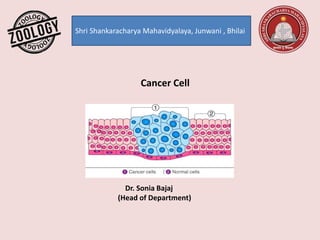
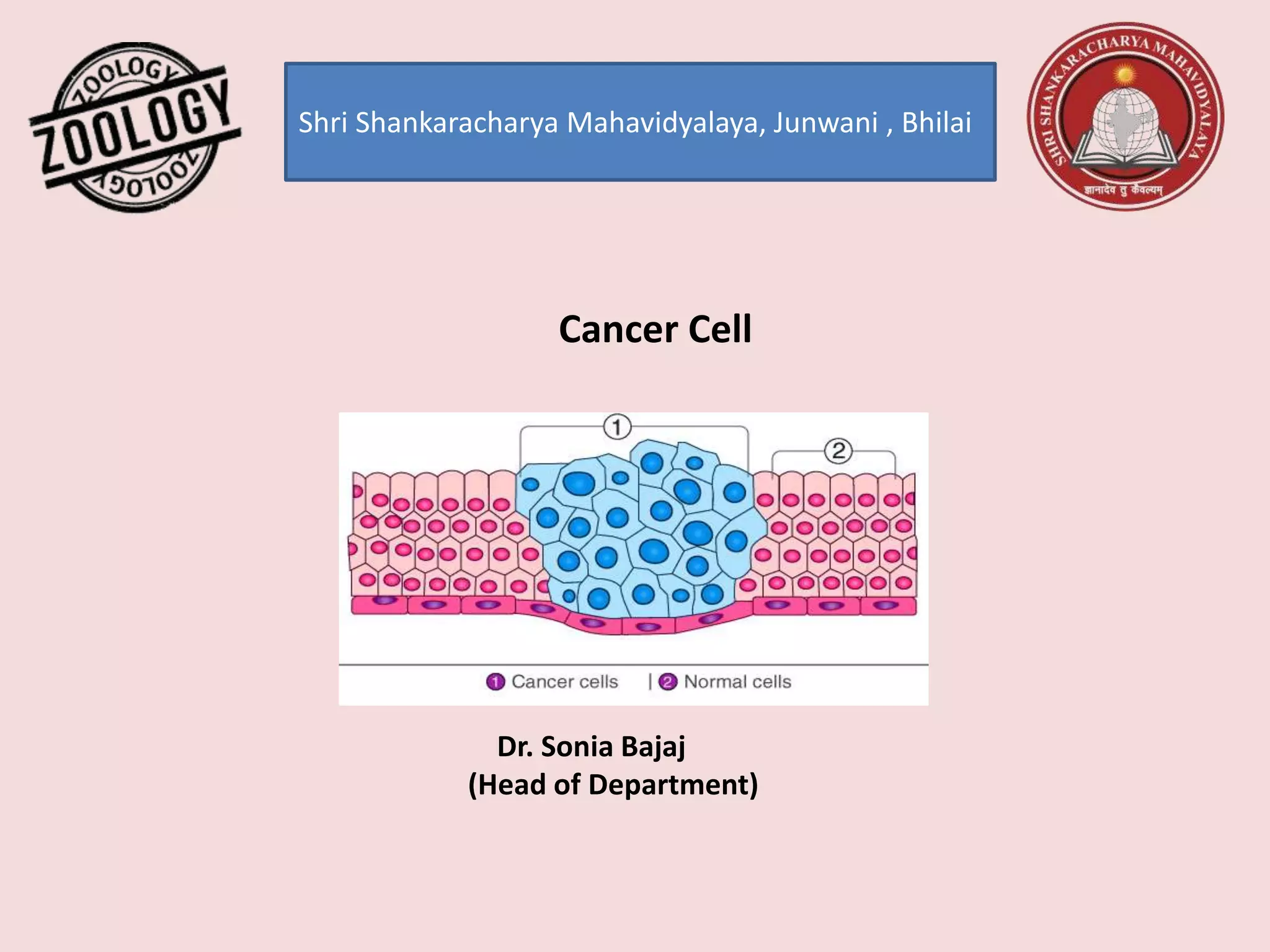
Cancer Cell
Dr. Sonia Bajaj
(Head of Department)
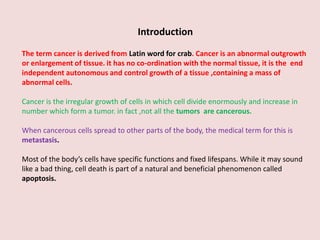
Introduction
The term cancer is derived from Latin word for crab. Cancer is an abnormal outgrowth
or enlargement of tissue. it has no co-ordination with the normal tissue, it is the end
independent autonomous and control growth of a tissue ,containing a mass of
abnormal cells.
Cancer is the irregular growth of cells in which cell divide enormously and increase in
number which form a tumor. in fact ,not all the tumors are cancerous.
When cancerous cells spread to other parts of the body, the medical term for this is
metastasis.
Most of the body’s cells have specific functions and fixed lifespans. While it may sound
like a bad thing, cell death is part of a natural and beneficial phenomenon called
apoptosis.
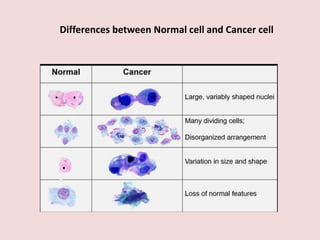
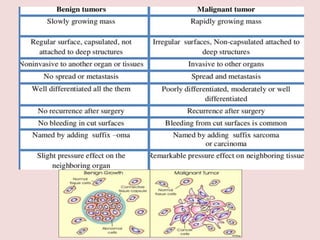
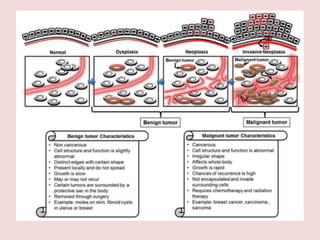
Differences between Normal cell and Cancer cell
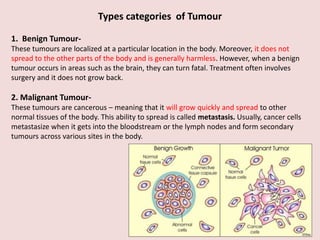
Types categories of Tumour
1. Benign Tumour-
These tumours are localized at a particular location in the body. Moreover, it does not
spread to the other parts of the body and is generally harmless. However, when a benign
tumour occurs in areas such as the brain, they can turn fatal. Treatment often involves
surgery and it does not grow back.
2. Malignant Tumour-
These tumours are cancerous – meaning that it will grow quickly and spread to other
normal tissues of the body. This ability to spread is called metastasis. Usually, cancer cells
metastasize when it gets into the bloodstream or the lymph nodes and form secondary
tumours across various sites in the body.
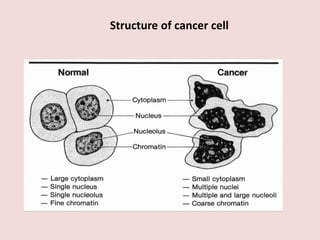
Structure of cancer cell
Characteristics of cancer cells
• These cell are monoclonal in origin develop from one parent cell.
• They lost power of control on the process of their division activity which
lead to the abnormal growth in number.
• They do not possess contact inhibition.
• They are Immortal in nature.
• They migrate from one part to other parts of the body, invade the
tissue and form secondary tumors. this stage is called metastasis.
• During the process of tissue culture, normal cell divide and form a thin
layer of cells but cancerous cell form a budding of cells.
• The cells do not show cellular differentiation.
• The gap junction between the cells become disappeared .
• The tumor in of fibronectin in the cell cost become reduced .
• Glycolytic activities highly increased in the cells.
• These cells possess abnormal karyotype.
Types of cancer
1. Lymphoma- this type of cancer occur in lymph nodes, spleen liver and bone
marrow they may be 5% cases belong to this category of cancer.
2. Leukemia -in this type of cancer, the Leucocytes cells in 4% cases these type of
cancer may occur .
3. Sarcoma - it may occur in 2% cases. it cases cancerous tumor in muscle
,cartilage bones and connective tissue.
4. carcinoma -this type of cancer occur in most of the cases. it may cause cancer
in breast ,neck ,brain and skin.
4. Melanoma - it causes tumor in pigment cells.
Development of cancer
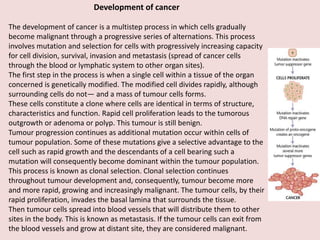
The development of cancer is a multistep process in which cells gradually
become malignant through a progressive series of alternations. This process
involves mutation and selection for cells with progressively increasing capacity
for cell division, survival, invasion and metastasis (spread of cancer cells
through the blood or lymphatic system to other organ sites).
The first step in the process is when a single cell within a tissue of the organ
concerned is genetically modified. The modified cell divides rapidly, although
surrounding cells do not— and a mass of tumour cells forms.
These cells constitute a clone where cells are identical in terms of structure,
characteristics and function. Rapid cell proliferation leads to the tumorous
outgrowth or adenoma or polyp. This tumour is still benign.
Tumour progression continues as additional mutation occur within cells of
tumour population. Some of these mutations give a selective advantage to the
cell such as rapid growth and the descendants of a cell bearing such a
mutation will consequently become dominant within the tumour population.
This process is known as clonal selection. Clonal selection continues
throughout tumour development and, consequently, tumour become more
and more rapid, growing and increasingly malignant. The tumour cells, by their
rapid proliferation, invades the basal lamina that surrounds the tissue.
Then tumour cells spread into blood vessels that will distribute them to other
sites in the body. This is known as metastasis. If the tumour cells can exit from
the blood vessels and grow at distant site, they are considered malignant.
Causes of Cancer
Many factors are attributed to causing cancer. The most probable factors include:
Physical factors – Ionizing radiation, such as X-rays and gamma rays
Chemical factors – Such as tobacco and smoke
Biological factors – Viral oncogenes, proto-oncogenes and cellular oncogenes
The above factors are called carcinogens
Diagnosis of Cancer
The detection and diagnosis of cancer are very important before it spreads to other parts of
the body. Identification of cancer genes is pivotal to prevent cancer.
The following methods are used to detect cancer –
• Biopsy.
• Histopathological studies of tissue.
• Radiography technique.
• Computed tomography.
• Magnetic resonance imaging.
• Molecular biology techniques.
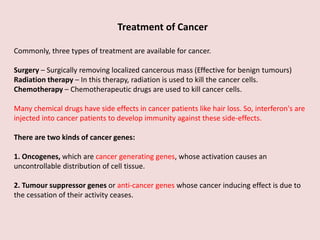
Treatment of Cancer
Commonly, three types of treatment are available for cancer.
Surgery – Surgically removing localized cancerous mass (Effective for benign tumours)
Radiation therapy – In this therapy, radiation is used to kill the cancer cells.
Chemotherapy – Chemotherapeutic drugs are used to kill cancer cells.
Many chemical drugs have side effects in cancer patients like hair loss. So, interferon's are
injected into cancer patients to develop immunity against these side-effects.
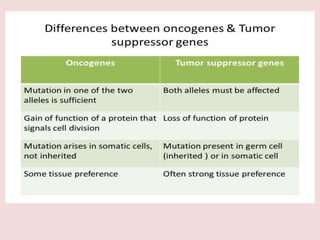
There are two kinds of cancer genes:
1. Oncogenes, which are cancer generating genes, whose activation causes an
uncontrollable distribution of cell tissue.
2. Tumour suppressor genes or anti-cancer genes whose cancer inducing effect is due to
the cessation of their activity ceases.
References-
Genetics-P.S. Verma &V.K. Agarwal
Cell Biology-Alberts
Text books of Biotechnology –U. Satyanarayana
Jantu Vigyan- S.M. sexsena
Jantu Vigyan- Dr.H.N. Baijal

Cancer cell

  • 1.
    Shri Shankaracharya Mahavidyalaya,Junwani , Bhilai Cancer Cell Dr. Sonia Bajaj (Head of Department)
  • 2.
    Introduction The term canceris derived from Latin word for crab. Cancer is an abnormal outgrowth or enlargement of tissue. it has no co-ordination with the normal tissue, it is the end independent autonomous and control growth of a tissue ,containing a mass of abnormal cells. Cancer is the irregular growth of cells in which cell divide enormously and increase in number which form a tumor. in fact ,not all the tumors are cancerous. When cancerous cells spread to other parts of the body, the medical term for this is metastasis. Most of the body’s cells have specific functions and fixed lifespans. While it may sound like a bad thing, cell death is part of a natural and beneficial phenomenon called apoptosis.
  • 3.
    Differences between Normalcell and Cancer cell
  • 4.
    Types categories ofTumour 1. Benign Tumour- These tumours are localized at a particular location in the body. Moreover, it does not spread to the other parts of the body and is generally harmless. However, when a benign tumour occurs in areas such as the brain, they can turn fatal. Treatment often involves surgery and it does not grow back. 2. Malignant Tumour- These tumours are cancerous – meaning that it will grow quickly and spread to other normal tissues of the body. This ability to spread is called metastasis. Usually, cancer cells metastasize when it gets into the bloodstream or the lymph nodes and form secondary tumours across various sites in the body.
  • 7.
  • 8.
    Characteristics of cancercells • These cell are monoclonal in origin develop from one parent cell. • They lost power of control on the process of their division activity which lead to the abnormal growth in number. • They do not possess contact inhibition. • They are Immortal in nature. • They migrate from one part to other parts of the body, invade the tissue and form secondary tumors. this stage is called metastasis. • During the process of tissue culture, normal cell divide and form a thin layer of cells but cancerous cell form a budding of cells. • The cells do not show cellular differentiation. • The gap junction between the cells become disappeared . • The tumor in of fibronectin in the cell cost become reduced . • Glycolytic activities highly increased in the cells. • These cells possess abnormal karyotype.
  • 9.
    Types of cancer 1.Lymphoma- this type of cancer occur in lymph nodes, spleen liver and bone marrow they may be 5% cases belong to this category of cancer. 2. Leukemia -in this type of cancer, the Leucocytes cells in 4% cases these type of cancer may occur . 3. Sarcoma - it may occur in 2% cases. it cases cancerous tumor in muscle ,cartilage bones and connective tissue. 4. carcinoma -this type of cancer occur in most of the cases. it may cause cancer in breast ,neck ,brain and skin. 4. Melanoma - it causes tumor in pigment cells.
  • 10.
    Development of cancer Thedevelopment of cancer is a multistep process in which cells gradually become malignant through a progressive series of alternations. This process involves mutation and selection for cells with progressively increasing capacity for cell division, survival, invasion and metastasis (spread of cancer cells through the blood or lymphatic system to other organ sites). The first step in the process is when a single cell within a tissue of the organ concerned is genetically modified. The modified cell divides rapidly, although surrounding cells do not— and a mass of tumour cells forms. These cells constitute a clone where cells are identical in terms of structure, characteristics and function. Rapid cell proliferation leads to the tumorous outgrowth or adenoma or polyp. This tumour is still benign. Tumour progression continues as additional mutation occur within cells of tumour population. Some of these mutations give a selective advantage to the cell such as rapid growth and the descendants of a cell bearing such a mutation will consequently become dominant within the tumour population. This process is known as clonal selection. Clonal selection continues throughout tumour development and, consequently, tumour become more and more rapid, growing and increasingly malignant. The tumour cells, by their rapid proliferation, invades the basal lamina that surrounds the tissue. Then tumour cells spread into blood vessels that will distribute them to other sites in the body. This is known as metastasis. If the tumour cells can exit from the blood vessels and grow at distant site, they are considered malignant.
  • 11.
    Causes of Cancer Manyfactors are attributed to causing cancer. The most probable factors include: Physical factors – Ionizing radiation, such as X-rays and gamma rays Chemical factors – Such as tobacco and smoke Biological factors – Viral oncogenes, proto-oncogenes and cellular oncogenes The above factors are called carcinogens Diagnosis of Cancer The detection and diagnosis of cancer are very important before it spreads to other parts of the body. Identification of cancer genes is pivotal to prevent cancer. The following methods are used to detect cancer – • Biopsy. • Histopathological studies of tissue. • Radiography technique. • Computed tomography. • Magnetic resonance imaging. • Molecular biology techniques.
  • 12.
    Treatment of Cancer Commonly,three types of treatment are available for cancer. Surgery – Surgically removing localized cancerous mass (Effective for benign tumours) Radiation therapy – In this therapy, radiation is used to kill the cancer cells. Chemotherapy – Chemotherapeutic drugs are used to kill cancer cells. Many chemical drugs have side effects in cancer patients like hair loss. So, interferon's are injected into cancer patients to develop immunity against these side-effects. There are two kinds of cancer genes: 1. Oncogenes, which are cancer generating genes, whose activation causes an uncontrollable distribution of cell tissue. 2. Tumour suppressor genes or anti-cancer genes whose cancer inducing effect is due to the cessation of their activity ceases.
  • 14.
    References- Genetics-P.S. Verma &V.K.Agarwal Cell Biology-Alberts Text books of Biotechnology –U. Satyanarayana Jantu Vigyan- S.M. sexsena Jantu Vigyan- Dr.H.N. Baijal