
www.oecd.org/eco/surveys/economic-survey-canada.htm
OECD
OECD Economics
2016 OECD ECONOMIC
SURVEY OF CANADA
Boosting productivity and
inclusiveness
13 June 2016
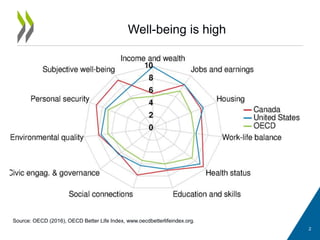
Well-being is high
2
Source: OECD (2016), OECD Better Life Index, www.oecdbetterlifeindex.org.
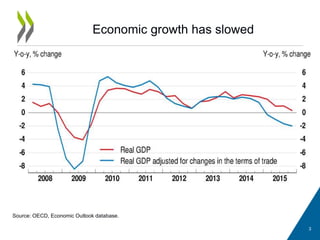
Economic growth has slowed
3
Source: OECD, Economic Outlook database.
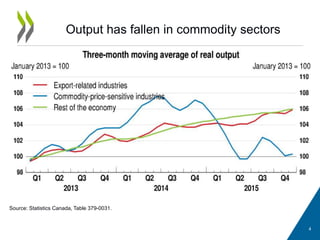
Output has fallen in commodity sectors
4
Source: Statistics Canada, Table 379-0031.
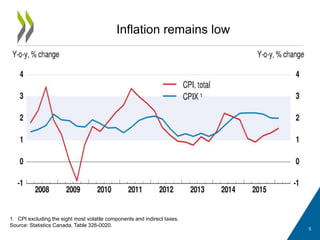
Inflation remains low
5
1. CPI excluding the eight most volatile components and indirect taxes.
Source: Statistics Canada, Table 326-0020.
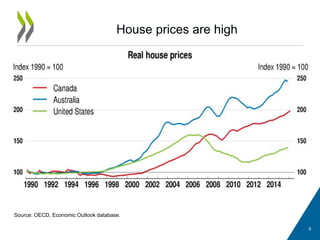
House prices are high
6
Source: OECD, Economic Outlook database.
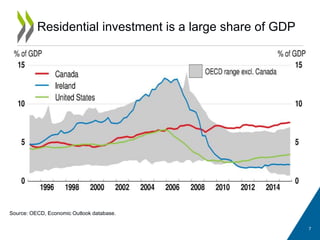
Residential investment is a large share of GDP
7
Source: OECD, Economic Outlook database.
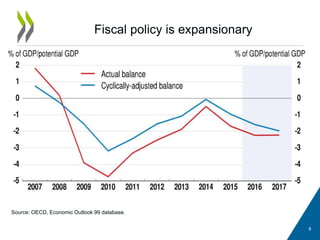
Fiscal policy is expansionary
8
Source: OECD, Economic Outlook 99 database.
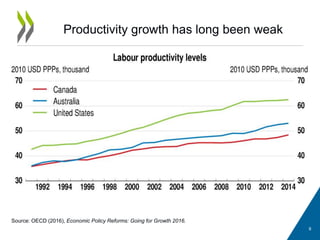
Productivity growth has long been weak
9
Source: OECD (2016), Economic Policy Reforms: Going for Growth 2016.
10
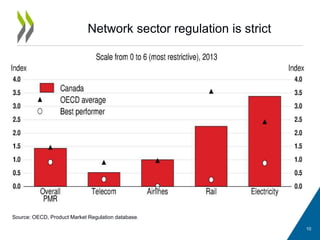
Source: OECD, Product Market Regulation database.
Network sector regulation is strict
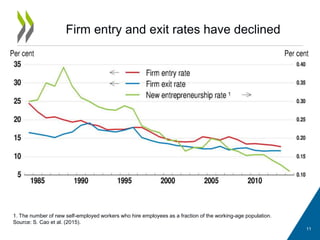
Firm entry and exit rates have declined
11
1. The number of new self-employed workers who hire employees as a fraction of the working-age population.
Source: S. Cao et al. (2015).
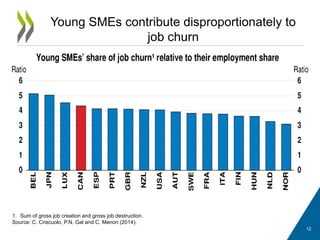
Young SMEs contribute disproportionately to
job churn
12
1. Sum of gross job creation and gross job destruction.
Source: C. Criscuolo, P.N. Gal and C. Menon (2014).
Recommendations to enhance
sustainability and increase
productivity
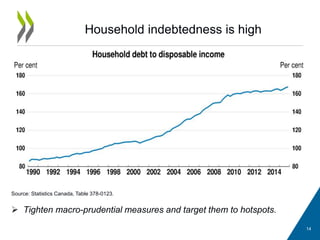
Household indebtedness is high
14
 Tighten macro-prudential measures and target them to hotspots.
Source: Statistics Canada, Table 378-0123.
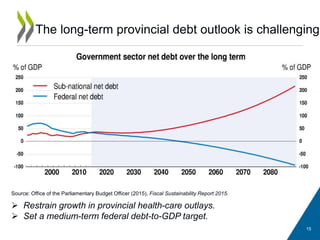
The long-term provincial debt outlook is challenging
15
 Restrain growth in provincial health-care outlays.
 Set a medium-term federal debt-to-GDP target.
Source: Office of the Parliamentary Budget Officer (2015), Fiscal Sustainability Report 2015.
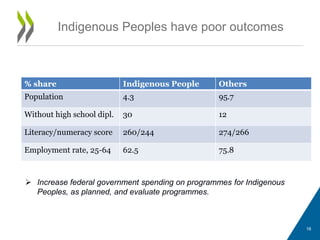
Indigenous Peoples have poor outcomes
% share Indigenous People Others
Population 4.3 95.7
Without high school dipl. 30 12
Literacy/numeracy score 260/244 274/266
Employment rate, 25-64 62.5 75.8
16
 Increase federal government spending on programmes for Indigenous
Peoples, as planned, and evaluate programmes.
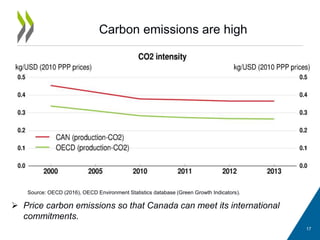
Carbon emissions are high
17
 Price carbon emissions so that Canada can meet its international
commitments.
Source: OECD (2016), OECD Environment Statistics database (Green Growth Indicators).
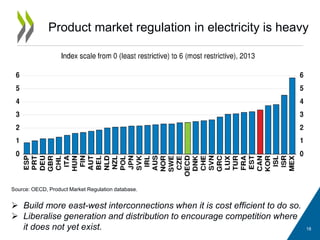
18
 Build more east-west interconnections when it is cost efficient to do so.
 Liberalise generation and distribution to encourage competition where
it does not yet exist.
Source: OECD, Product Market Regulation database.
Product market regulation in electricity is heavy
19
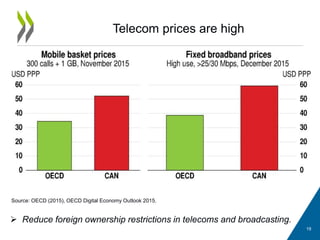
 Reduce foreign ownership restrictions in telecoms and broadcasting.
Source: OECD (2015), OECD Digital Economy Outlook 2015.
Telecom prices are high
20
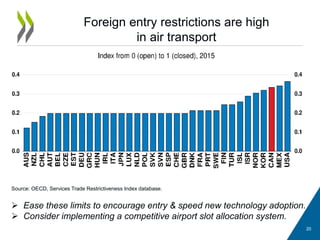
 Ease these limits to encourage entry & speed new technology adoption.
 Consider implementing a competitive airport slot allocation system.
Source: OECD, Services Trade Restrictiveness Index database.
Foreign entry restrictions are high
in air transport
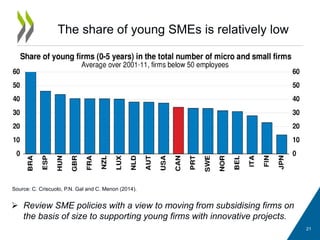
The share of young SMEs is relatively low
21
 Review SME policies with a view to moving from subsidising firms on
the basis of size to supporting young firms with innovative projects.
Source: C. Criscuolo, P.N. Gal and C. Menon (2014).
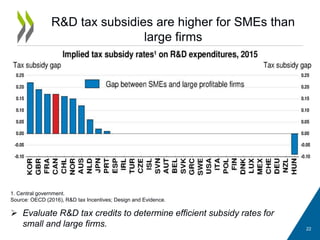
R&D tax subsidies are higher for SMEs than
large firms
22
 Evaluate R&D tax credits to determine efficient subsidy rates for
small and large firms.
1. Central government.
Source: OECD (2016), R&D tax Incentives; Design and Evidence.
KEY RECOMMENDATIONS
23
Reducing financial stability risks
• Continue to tighten macro-prudential
measures and target them regionally,
including through increasing capital
requirements in regions with high house
price-to-income ratios, as planned.
24
Making growth stronger, greener and
more inclusive
25
• Increase federal investment in physical infrastructure,
social housing, education and innovation, as planned
• Continue towards sharing more of the fruits of growth
with Canada's Indigenous Peoples through providing
more resources for their education, training, health
care, housing, entrepreneurship and environmental
infrastructure servicing their communities, as planned
• Canadian governments should act on their recent
Vancouver declaration to ensure that an adequate
price is placed on carbon emissions across the country
to allow Canada to meet its international
commitments.
Raising productivity
• Reduce foreign ownership restrictions in air transportation on
a reciprocal basis and in telecoms and broadcasting, where
cultural objectives could be achieved by other means.
• Develop more east-west interconnections through provincial
cooperation when there is an economic case to do so.
Liberalise the generation and distribution segments to
encourage wholesale and retail competition in jurisdictions
that have not done so yet.
• Broaden the AIT's sectoral coverage as much as possible. Seek
to reconcile remaining regulatory differences (possibly via
mutual recognition). Establish a pan-Canadian regulatory
cooperation council. Raise monetary penalties for non-
compliance, and expedite dispute resolution, which remains
protracted.
26
Raising productivity (continued)
• Review small business taxation (e.g. in the context
of the recently announced federal tax expenditure
review) to identify clear market failures and the
policy instruments best suited to addressing them.
• Phase out remaining federal tax credits for
provincial LSVCCs, as previously planned, and
explore whether to make greater use of funds that
operate like private, independent, limited
partnership venture capital funds, as was the case
with the Venture Capital Action Plan.
27
More Information…
Disclaimers:
The statistical data for Israel are supplied by and under the responsibility of the relevant Israeli authorities. The use of such data by the OECD is without prejudice to the status of
the Golan Heights, East Jerusalem and Israeli settlements in the West Bank under the terms of international law.
This document and any map included herein are without prejudice to the status of or sovereignty over any territory, to the delimitation of international frontiers and boundaries
and to the name of any territory, city or area.
www.oecd.org/eco/surveys/economic-survey-canada.htm
@OECDeconomy
@OECD

Canada boosting-growth-inclusiveness-oecd-economic-survey-2016

  • 1.
    www.oecd.org/eco/surveys/economic-survey-canada.htm OECD OECD Economics 2016 OECDECONOMIC SURVEY OF CANADA Boosting productivity and inclusiveness 13 June 2016
  • 2.
    Well-being is high 2 Source:OECD (2016), OECD Better Life Index, www.oecdbetterlifeindex.org.
  • 3.
    Economic growth hasslowed 3 Source: OECD, Economic Outlook database.
  • 4.
    Output has fallenin commodity sectors 4 Source: Statistics Canada, Table 379-0031.
  • 5.
    Inflation remains low 5 1.CPI excluding the eight most volatile components and indirect taxes. Source: Statistics Canada, Table 326-0020.
  • 6.
    House prices arehigh 6 Source: OECD, Economic Outlook database.
  • 7.
    Residential investment isa large share of GDP 7 Source: OECD, Economic Outlook database.
  • 8.
    Fiscal policy isexpansionary 8 Source: OECD, Economic Outlook 99 database.
  • 9.
    Productivity growth haslong been weak 9 Source: OECD (2016), Economic Policy Reforms: Going for Growth 2016.
  • 10.
    10 Source: OECD, ProductMarket Regulation database. Network sector regulation is strict
  • 11.
    Firm entry andexit rates have declined 11 1. The number of new self-employed workers who hire employees as a fraction of the working-age population. Source: S. Cao et al. (2015).
  • 12.
    Young SMEs contributedisproportionately to job churn 12 1. Sum of gross job creation and gross job destruction. Source: C. Criscuolo, P.N. Gal and C. Menon (2014).
  • 13.
  • 14.
    Household indebtedness ishigh 14  Tighten macro-prudential measures and target them to hotspots. Source: Statistics Canada, Table 378-0123.
  • 15.
    The long-term provincialdebt outlook is challenging 15  Restrain growth in provincial health-care outlays.  Set a medium-term federal debt-to-GDP target. Source: Office of the Parliamentary Budget Officer (2015), Fiscal Sustainability Report 2015.
  • 16.
    Indigenous Peoples havepoor outcomes % share Indigenous People Others Population 4.3 95.7 Without high school dipl. 30 12 Literacy/numeracy score 260/244 274/266 Employment rate, 25-64 62.5 75.8 16  Increase federal government spending on programmes for Indigenous Peoples, as planned, and evaluate programmes.
  • 17.
    Carbon emissions arehigh 17  Price carbon emissions so that Canada can meet its international commitments. Source: OECD (2016), OECD Environment Statistics database (Green Growth Indicators).
  • 18.
    18  Build moreeast-west interconnections when it is cost efficient to do so.  Liberalise generation and distribution to encourage competition where it does not yet exist. Source: OECD, Product Market Regulation database. Product market regulation in electricity is heavy
  • 19.
    19  Reduce foreignownership restrictions in telecoms and broadcasting. Source: OECD (2015), OECD Digital Economy Outlook 2015. Telecom prices are high
  • 20.
    20  Ease theselimits to encourage entry & speed new technology adoption.  Consider implementing a competitive airport slot allocation system. Source: OECD, Services Trade Restrictiveness Index database. Foreign entry restrictions are high in air transport
  • 21.
    The share ofyoung SMEs is relatively low 21  Review SME policies with a view to moving from subsidising firms on the basis of size to supporting young firms with innovative projects. Source: C. Criscuolo, P.N. Gal and C. Menon (2014).
  • 22.
    R&D tax subsidiesare higher for SMEs than large firms 22  Evaluate R&D tax credits to determine efficient subsidy rates for small and large firms. 1. Central government. Source: OECD (2016), R&D tax Incentives; Design and Evidence.
  • 23.
  • 24.
    Reducing financial stabilityrisks • Continue to tighten macro-prudential measures and target them regionally, including through increasing capital requirements in regions with high house price-to-income ratios, as planned. 24
  • 25.
    Making growth stronger,greener and more inclusive 25 • Increase federal investment in physical infrastructure, social housing, education and innovation, as planned • Continue towards sharing more of the fruits of growth with Canada's Indigenous Peoples through providing more resources for their education, training, health care, housing, entrepreneurship and environmental infrastructure servicing their communities, as planned • Canadian governments should act on their recent Vancouver declaration to ensure that an adequate price is placed on carbon emissions across the country to allow Canada to meet its international commitments.
  • 26.
    Raising productivity • Reduceforeign ownership restrictions in air transportation on a reciprocal basis and in telecoms and broadcasting, where cultural objectives could be achieved by other means. • Develop more east-west interconnections through provincial cooperation when there is an economic case to do so. Liberalise the generation and distribution segments to encourage wholesale and retail competition in jurisdictions that have not done so yet. • Broaden the AIT's sectoral coverage as much as possible. Seek to reconcile remaining regulatory differences (possibly via mutual recognition). Establish a pan-Canadian regulatory cooperation council. Raise monetary penalties for non- compliance, and expedite dispute resolution, which remains protracted. 26
  • 27.
    Raising productivity (continued) •Review small business taxation (e.g. in the context of the recently announced federal tax expenditure review) to identify clear market failures and the policy instruments best suited to addressing them. • Phase out remaining federal tax credits for provincial LSVCCs, as previously planned, and explore whether to make greater use of funds that operate like private, independent, limited partnership venture capital funds, as was the case with the Venture Capital Action Plan. 27
  • 28.
    More Information… Disclaimers: The statisticaldata for Israel are supplied by and under the responsibility of the relevant Israeli authorities. The use of such data by the OECD is without prejudice to the status of the Golan Heights, East Jerusalem and Israeli settlements in the West Bank under the terms of international law. This document and any map included herein are without prejudice to the status of or sovereignty over any territory, to the delimitation of international frontiers and boundaries and to the name of any territory, city or area. www.oecd.org/eco/surveys/economic-survey-canada.htm @OECDeconomy @OECD