Rubric
www.ecb.europa.eu ©
Session discussion
Roel Beetsma (UvA & European Fiscal Board)
and
Martin Larch (Head of Secretariat, EFB)
Should the EU budget be
used for stabilization?
Rubric
www.ecb.europa.eu ©
• Current state of play
• Some specific risk sharing schemes
• Risk sharing and reduction should be combined
Overview
2
Rubric
www.ecb.europa.eu ©
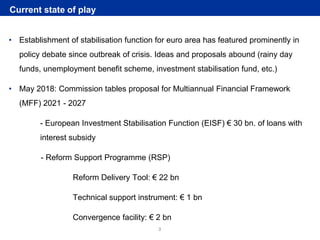
• Establishment of stabilisation function for euro area has featured prominently in
policy debate since outbreak of crisis. Ideas and proposals abound (rainy day
funds, unemployment benefit scheme, investment stabilisation fund, etc.)
• May 2018: Commission tables proposal for Multiannual Financial Framework
(MFF) 2021 - 2027
- European Investment Stabilisation Function (EISF) € 30 bn. of loans with
interest subsidy
- Reform Support Programme (RSP)
Reform Delivery Tool: € 22 bn
Technical support instrument: € 1 bn
Convergence facility: € 2 bn
Current state of play
3
Rubric
www.ecb.europa.eu ©
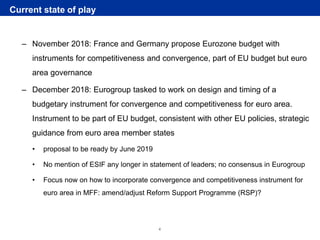
– November 2018: France and Germany propose Eurozone budget with
instruments for competitiveness and convergence, part of EU budget but euro
area governance
– December 2018: Eurogroup tasked to work on design and timing of a
budgetary instrument for convergence and competitiveness for euro area.
Instrument to be part of EU budget, consistent with other EU policies, strategic
guidance from euro area member states
• proposal to be ready by June 2019
• No mention of ESIF any longer in statement of leaders; no consensus in Eurogroup
• Focus now on how to incorporate convergence and competitiveness instrument for
euro area in MFF: amend/adjust Reform Support Programme (RSP)?
Current state of play
4
Rubric
www.ecb.europa.eu ©
Convergence and competitiveness vs stabilisation:
competitors or complements?
Two extreme camps:
– (i) they are competitors. If you converge and remain competitive you will
withstand shocks and need less or no stabilisation. (Risk reduction)
– (ii) What matters is size and inertia. Any government spending has stabilising
effects as long as it is significant and is not cut during downturns; purpose of
spending secondary. In case of large common shocks pooling may not be
enough, you need borrowing (Risk sharing).
Both RSP and EISF are useful in principle, but amounts on the table are far too
small to make a difference in both cases. Underlying idea seems to be: first
create the instrument, we can make it grow in time.
Current state of play
5
Rubric
www.ecb.europa.eu ©
• What triggers transfers?
– Unemployment: Arnold et al. (IMF, 2018), Pradhan (?)
– Double condition (Commission / Martinez-Mongay): (1) unemployment higher than
average over past 15 years; (2) Unemployment should be increasing fast.
• Earmarking
– Not necessarily (Pradhan)
– Investment (Commission / Martinez-Mongay)
• Based on exports on world market (Beetsma, Cima, Cimadomo, 2018)
– Less prone to moral hazard: based on exogenous shock in world markets and given
export weights
– Based on relative effects of shocks
– No prescription on how to use transfer, although it could be marked
– Scheme turns out to be strongly countercyclical
Some specific risk-sharing schemes
6
Rubric
www.ecb.europa.eu ©7
Export-based risk sharing scheme (BCC, 2018): simple example
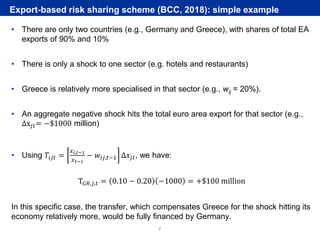
• There are only two countries (e.g., Germany and Greece), with shares of total EA
exports of 90% and 10%
• There is only a shock to one sector (e.g. hotels and restaurants)
• Greece is relatively more specialised in that sector (e.g., wij = 20%).
• An aggregate negative shock hits the total euro area export for that sector (e.g.,
∆x𝑗𝑡= −$1000 million)
• Using 𝑇𝑖𝑗𝑡 =
𝑥 𝑖,𝑡−1
𝑥 𝑡−1
− 𝑤𝑖𝑗,𝑡−1 ∆𝑥𝑗𝑡, we have:
T𝐺𝑅,𝑗,𝑡 = 0.10 − 0.20 −1000 = +$100 million
In this specific case, the transfer, which compensates Greece for the shock hitting its
economy relatively more, would be fully financed by Germany.
Rubric
www.ecb.europa.eu ©8
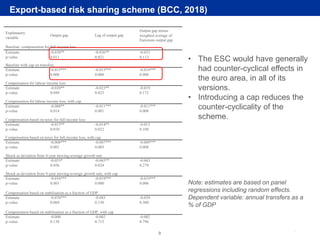
Export-based risk sharing scheme (BCC, 2018)
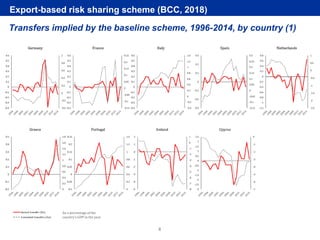
Transfers implied by the baseline scheme, 1996-2014, by country (1)
As a percentage of the
country’s GDP in the year
Rubric
www.ecb.europa.eu ©
9
Export-based risk sharing scheme (BCC, 2018)
• The ESC would have generally
had counter-cyclical effects in
the euro area, in all of its
versions.
• Introducing a cap reduces the
counter-cyclicality of the
scheme.
Note: estimates are based on panel
regressions including random effects.
Dependent variable: annual transfers as a
% of GDP
Explanatory
variable
Output gap Lag of output gap
Output gap minus
weighted average of
Eurozone output gap
Baseline: compensation for full income loss
Estimate -0.038** -0.036** -0.033
p-value 0.011 0.021 0.113
Baseline with cap on transfers
Estimate -0.015*** -0.015*** -0.018***
p-value 0.000 0.000 0.000
Compensation for labour income loss
Estimate -0.020** -0.023** -0.019
p-value 0.049 0.023 0.172
Compensation for labour income loss, with cap
Estimate -0.008** -0.011*** -0.011***
p-value 0.014 0.001 0.008
Compensation based on taxes for full income loss
Estimate -0.015** -0.014** -0.013
p-value 0.010 0.022 0.108
Compensation based on taxes for full income loss, with cap
Estimate -0.008*** -0.007*** -0.009***
p-value 0.001 0.005 0.008
Shock as deviation from 4-year moving-average growth rate
Estimate -0.053* -0.065** -0.043
p-value 0.056 0.024 0.279
Shock as deviation from 4-year moving-average growth rate, with cap
Estimate -0.016*** -0.019*** -0.019***
p-value 0.001 0.000 0.006
Compensation based on stabilisation as a fraction of GDP
Estimate -0.076*** -0.043 -0.039
p-value 0.004 0.130 0.300
Compensation based on stabilisation as a fraction of GDP, with cap
Estimate -0.008 -0.002 -0.002
p-value 0.138 0.715 0.796
Rubric
www.ecb.europa.eu ©
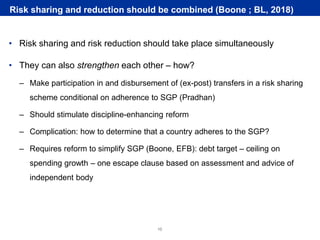
• Risk sharing and risk reduction should take place simultaneously
• They can also strengthen each other – how?
– Make participation in and disbursement of (ex-post) transfers in a risk sharing
scheme conditional on adherence to SGP (Pradhan)
– Should stimulate discipline-enhancing reform
– Complication: how to determine that a country adheres to the SGP?
– Requires reform to simplify SGP (Boone, EFB): debt target – ceiling on
spending growth – one escape clause based on assessment and advice of
independent body
Risk sharing and reduction should be combined (Boone ; BL, 2018)
10
Rubric
www.ecb.europa.eu ©
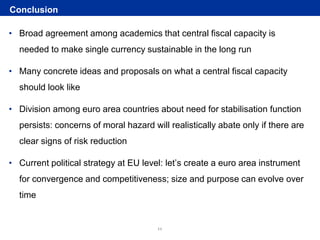
• Broad agreement among academics that central fiscal capacity is
needed to make single currency sustainable in the long run
• Many concrete ideas and proposals on what a central fiscal capacity
should look like
• Division among euro area countries about need for stabilisation function
persists: concerns of moral hazard will realistically abate only if there are
clear signs of risk reduction
• Current political strategy at EU level: let’s create a euro area instrument
for convergence and competitiveness; size and purpose can evolve over
time
Conclusion
11
Rubric
www.ecb.europa.eu ©
Thank you!
12

Should the EU budget be used for stabilization

  • 1.
    Rubric www.ecb.europa.eu © Session discussion RoelBeetsma (UvA & European Fiscal Board) and Martin Larch (Head of Secretariat, EFB) Should the EU budget be used for stabilization?
  • 2.
    Rubric www.ecb.europa.eu © • Currentstate of play • Some specific risk sharing schemes • Risk sharing and reduction should be combined Overview 2
  • 3.
    Rubric www.ecb.europa.eu © • Establishmentof stabilisation function for euro area has featured prominently in policy debate since outbreak of crisis. Ideas and proposals abound (rainy day funds, unemployment benefit scheme, investment stabilisation fund, etc.) • May 2018: Commission tables proposal for Multiannual Financial Framework (MFF) 2021 - 2027 - European Investment Stabilisation Function (EISF) € 30 bn. of loans with interest subsidy - Reform Support Programme (RSP) Reform Delivery Tool: € 22 bn Technical support instrument: € 1 bn Convergence facility: € 2 bn Current state of play 3
  • 4.
    Rubric www.ecb.europa.eu © – November2018: France and Germany propose Eurozone budget with instruments for competitiveness and convergence, part of EU budget but euro area governance – December 2018: Eurogroup tasked to work on design and timing of a budgetary instrument for convergence and competitiveness for euro area. Instrument to be part of EU budget, consistent with other EU policies, strategic guidance from euro area member states • proposal to be ready by June 2019 • No mention of ESIF any longer in statement of leaders; no consensus in Eurogroup • Focus now on how to incorporate convergence and competitiveness instrument for euro area in MFF: amend/adjust Reform Support Programme (RSP)? Current state of play 4
  • 5.
    Rubric www.ecb.europa.eu © Convergence andcompetitiveness vs stabilisation: competitors or complements? Two extreme camps: – (i) they are competitors. If you converge and remain competitive you will withstand shocks and need less or no stabilisation. (Risk reduction) – (ii) What matters is size and inertia. Any government spending has stabilising effects as long as it is significant and is not cut during downturns; purpose of spending secondary. In case of large common shocks pooling may not be enough, you need borrowing (Risk sharing). Both RSP and EISF are useful in principle, but amounts on the table are far too small to make a difference in both cases. Underlying idea seems to be: first create the instrument, we can make it grow in time. Current state of play 5
  • 6.
    Rubric www.ecb.europa.eu © • Whattriggers transfers? – Unemployment: Arnold et al. (IMF, 2018), Pradhan (?) – Double condition (Commission / Martinez-Mongay): (1) unemployment higher than average over past 15 years; (2) Unemployment should be increasing fast. • Earmarking – Not necessarily (Pradhan) – Investment (Commission / Martinez-Mongay) • Based on exports on world market (Beetsma, Cima, Cimadomo, 2018) – Less prone to moral hazard: based on exogenous shock in world markets and given export weights – Based on relative effects of shocks – No prescription on how to use transfer, although it could be marked – Scheme turns out to be strongly countercyclical Some specific risk-sharing schemes 6
  • 7.
    Rubric www.ecb.europa.eu ©7 Export-based risksharing scheme (BCC, 2018): simple example • There are only two countries (e.g., Germany and Greece), with shares of total EA exports of 90% and 10% • There is only a shock to one sector (e.g. hotels and restaurants) • Greece is relatively more specialised in that sector (e.g., wij = 20%). • An aggregate negative shock hits the total euro area export for that sector (e.g., ∆x𝑗𝑡= −$1000 million) • Using 𝑇𝑖𝑗𝑡 = 𝑥 𝑖,𝑡−1 𝑥 𝑡−1 − 𝑤𝑖𝑗,𝑡−1 ∆𝑥𝑗𝑡, we have: T𝐺𝑅,𝑗,𝑡 = 0.10 − 0.20 −1000 = +$100 million In this specific case, the transfer, which compensates Greece for the shock hitting its economy relatively more, would be fully financed by Germany.
  • 8.
    Rubric www.ecb.europa.eu ©8 Export-based risksharing scheme (BCC, 2018) Transfers implied by the baseline scheme, 1996-2014, by country (1) As a percentage of the country’s GDP in the year
  • 9.
    Rubric www.ecb.europa.eu © 9 Export-based risksharing scheme (BCC, 2018) • The ESC would have generally had counter-cyclical effects in the euro area, in all of its versions. • Introducing a cap reduces the counter-cyclicality of the scheme. Note: estimates are based on panel regressions including random effects. Dependent variable: annual transfers as a % of GDP Explanatory variable Output gap Lag of output gap Output gap minus weighted average of Eurozone output gap Baseline: compensation for full income loss Estimate -0.038** -0.036** -0.033 p-value 0.011 0.021 0.113 Baseline with cap on transfers Estimate -0.015*** -0.015*** -0.018*** p-value 0.000 0.000 0.000 Compensation for labour income loss Estimate -0.020** -0.023** -0.019 p-value 0.049 0.023 0.172 Compensation for labour income loss, with cap Estimate -0.008** -0.011*** -0.011*** p-value 0.014 0.001 0.008 Compensation based on taxes for full income loss Estimate -0.015** -0.014** -0.013 p-value 0.010 0.022 0.108 Compensation based on taxes for full income loss, with cap Estimate -0.008*** -0.007*** -0.009*** p-value 0.001 0.005 0.008 Shock as deviation from 4-year moving-average growth rate Estimate -0.053* -0.065** -0.043 p-value 0.056 0.024 0.279 Shock as deviation from 4-year moving-average growth rate, with cap Estimate -0.016*** -0.019*** -0.019*** p-value 0.001 0.000 0.006 Compensation based on stabilisation as a fraction of GDP Estimate -0.076*** -0.043 -0.039 p-value 0.004 0.130 0.300 Compensation based on stabilisation as a fraction of GDP, with cap Estimate -0.008 -0.002 -0.002 p-value 0.138 0.715 0.796
  • 10.
    Rubric www.ecb.europa.eu © • Risksharing and risk reduction should take place simultaneously • They can also strengthen each other – how? – Make participation in and disbursement of (ex-post) transfers in a risk sharing scheme conditional on adherence to SGP (Pradhan) – Should stimulate discipline-enhancing reform – Complication: how to determine that a country adheres to the SGP? – Requires reform to simplify SGP (Boone, EFB): debt target – ceiling on spending growth – one escape clause based on assessment and advice of independent body Risk sharing and reduction should be combined (Boone ; BL, 2018) 10
  • 11.
    Rubric www.ecb.europa.eu © • Broadagreement among academics that central fiscal capacity is needed to make single currency sustainable in the long run • Many concrete ideas and proposals on what a central fiscal capacity should look like • Division among euro area countries about need for stabilisation function persists: concerns of moral hazard will realistically abate only if there are clear signs of risk reduction • Current political strategy at EU level: let’s create a euro area instrument for convergence and competitiveness; size and purpose can evolve over time Conclusion 11
  • 12.