A European
Stabilisation Function :
A difficult debate
Carlos Martinez Mongay
DG ECFIN, European Commission
OECD-France Stratégie Workshop
5 February 2019
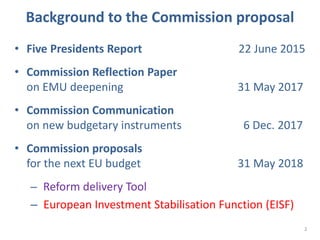
Background to the Commission proposal
• Five Presidents Report 22 June 2015
• Commission Reflection Paper
on EMU deepening 31 May 2017
• Commission Communication
on new budgetary instruments 6 Dec. 2017
• Commission proposals
for the next EU budget 31 May 2018
– Reform delivery Tool
– European Investment Stabilisation Function (EISF)
2
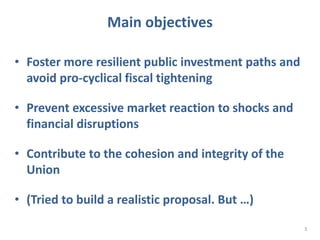
Main objectives
• Foster more resilient public investment paths and
avoid pro-cyclical fiscal tightening
• Prevent excessive market reaction to shocks and
financial disruptions
• Contribute to the cohesion and integrity of the
Union
• (Tried to build a realistic proposal. But …)
3
4
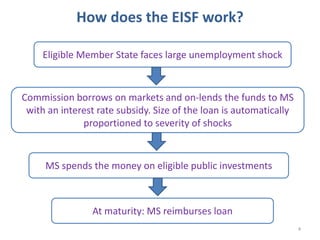
Eligible Member State faces large unemployment shock
Commission borrows on markets and on-lends the funds to MS
with an interest rate subsidy. Size of the loan is automatically
proportioned to severity of shocks
MS spends the money on eligible public investments
At maturity: MS reimburses loan
How does the EISF work?
5
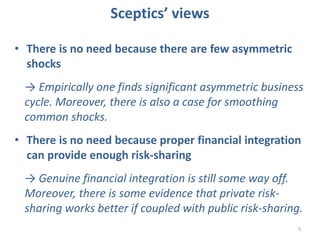
Sceptics’ views
• There is no need because there are few asymmetric
shocks
→ Empirically one finds significant asymmetric business
cycle. Moreover, there is also a case for smoothing
common shocks.
• There is no need because proper financial integration
can provide enough risk-sharing
→ Genuine financial integration is still some way off.
Moreover, there is some evidence that private risk-
sharing works better if coupled with public risk-sharing.
6
Sceptics’ views
• There is no need if only Member States ran prudent
fiscal policies providing enough national fiscal space
→ For severe shocks, even MS respecting the rules may
be constrained. Moreover, highly indebted MS will be
constrained in running countercyclical policies for a
long time.
• Any scheme presented as providing stabilisation will
generate moral hazard and permanent transfers
→ Design features matter: targeting severe shocks;
eligibility conditions; nature of support.
7
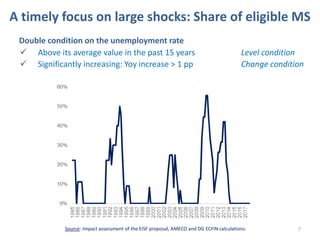
A timely focus on large shocks: Share of eligible MS
Source: Impact assessment of the EISF proposal, AMECO and DG ECFIN calculations.
Double condition on the unemployment rate
 Above its average value in the past 15 years Level condition
 Significantly increasing: Yoy increase > 1 pp Change condition
8
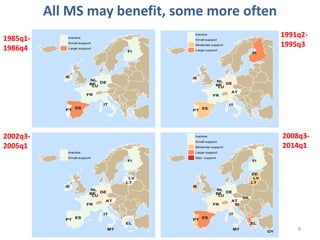
All MS may benefit, some more often
1985q1-
1986q4
1991q2-
1995q3
2002q3-
2005q1
2008q3-
2014q1
9
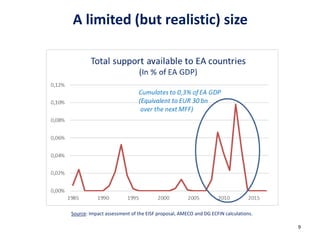
A limited (but realistic) size
Source: Impact assessment of the EISF proposal, AMECO and DG ECFIN calculations.
10
State of play
• No take up by the Council
→ No consensus on stabilisation at Eurosummit
→ Current political focus on convergence and
competitiveness instrument (useful but no substitute)
→ Technical discussions to continue on stabilisation
function (e.g. on unemployment reinsurance funds)
• Debate might gain traction when discussing
simplification of fiscal rules? Or next crisis? …
Thank you

A European Stabilisation Function

  • 1.
    A European Stabilisation Function: A difficult debate Carlos Martinez Mongay DG ECFIN, European Commission OECD-France Stratégie Workshop 5 February 2019
  • 2.
    Background to theCommission proposal • Five Presidents Report 22 June 2015 • Commission Reflection Paper on EMU deepening 31 May 2017 • Commission Communication on new budgetary instruments 6 Dec. 2017 • Commission proposals for the next EU budget 31 May 2018 – Reform delivery Tool – European Investment Stabilisation Function (EISF) 2
  • 3.
    Main objectives • Fostermore resilient public investment paths and avoid pro-cyclical fiscal tightening • Prevent excessive market reaction to shocks and financial disruptions • Contribute to the cohesion and integrity of the Union • (Tried to build a realistic proposal. But …) 3
  • 4.
    4 Eligible Member Statefaces large unemployment shock Commission borrows on markets and on-lends the funds to MS with an interest rate subsidy. Size of the loan is automatically proportioned to severity of shocks MS spends the money on eligible public investments At maturity: MS reimburses loan How does the EISF work?
  • 5.
    5 Sceptics’ views • Thereis no need because there are few asymmetric shocks → Empirically one finds significant asymmetric business cycle. Moreover, there is also a case for smoothing common shocks. • There is no need because proper financial integration can provide enough risk-sharing → Genuine financial integration is still some way off. Moreover, there is some evidence that private risk- sharing works better if coupled with public risk-sharing.
  • 6.
    6 Sceptics’ views • Thereis no need if only Member States ran prudent fiscal policies providing enough national fiscal space → For severe shocks, even MS respecting the rules may be constrained. Moreover, highly indebted MS will be constrained in running countercyclical policies for a long time. • Any scheme presented as providing stabilisation will generate moral hazard and permanent transfers → Design features matter: targeting severe shocks; eligibility conditions; nature of support.
  • 7.
    7 A timely focuson large shocks: Share of eligible MS Source: Impact assessment of the EISF proposal, AMECO and DG ECFIN calculations. Double condition on the unemployment rate  Above its average value in the past 15 years Level condition  Significantly increasing: Yoy increase > 1 pp Change condition
  • 8.
    8 All MS maybenefit, some more often 1985q1- 1986q4 1991q2- 1995q3 2002q3- 2005q1 2008q3- 2014q1
  • 9.
    9 A limited (butrealistic) size Source: Impact assessment of the EISF proposal, AMECO and DG ECFIN calculations.
  • 10.
    10 State of play •No take up by the Council → No consensus on stabilisation at Eurosummit → Current political focus on convergence and competitiveness instrument (useful but no substitute) → Technical discussions to continue on stabilisation function (e.g. on unemployment reinsurance funds) • Debate might gain traction when discussing simplification of fiscal rules? Or next crisis? …
  • 11.