OECD ECONOMIC OUTLOOK
Better, but not good enough
www.oecd.org/economy/economicoutlook.htm
ECOSCOPE blog: oecdecoscope.wordpress.com
Catherine L. Mann
OECD Chief Economist
7 June 2017
Paris
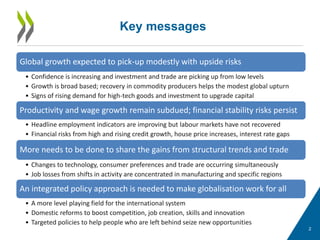
Key messages
2
Global growth expected to pick-up modestly with upside risks
• Confidence is increasing and investment and trade are picking up from low levels
• Growth is broad based; recovery in commodity producers helps the modest global upturn
• Signs of rising demand for high-tech goods and investment to upgrade capital
Productivity and wage growth remain subdued; financial stability risks persist
• Headline employment indicators are improving but labour markets have not recovered
• Financial risks from high and rising credit growth, house price increases, interest rate gaps
More needs to be done to share the gains from structural trends and trade
• Changes to technology, consumer preferences and trade are occurring simultaneously
• Job losses from shifts in activity are concentrated in manufacturing and specific regions
An integrated policy approach is needed to make globalisation work for all
• A more level playing field for the international system
• Domestic reforms to boost competition, job creation, skills and innovation
• Targeted policies to help people who are left behind seize new opportunities
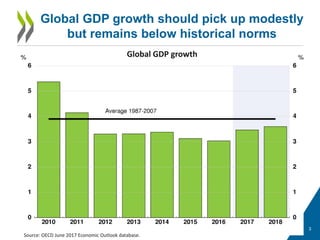
Global GDP growth should pick up modestly
but remains below historical norms
3
Source: OECD June 2017 Economic Outlook database.
Global GDP growth
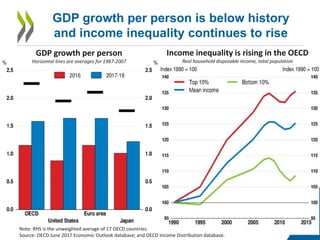
GDP growth per person is below history
and income inequality continues to rise
4
GDP growth per person
Horizontal lines are averages for 1987-2007
Income inequality is rising in the OECD
Real household disposable income, total population
Note: RHS is the unweighted average of 17 OECD countries.
Source: OECD June 2017 Economic Outlook database; and OECD Income Distribution database.
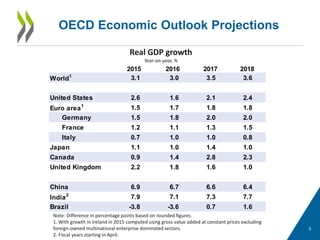
OECD Economic Outlook Projections
5
Real GDP growth
Year-on-year, %
Note: Difference in percentage points based on rounded figures.
1. With growth in Ireland in 2015 computed using gross value added at constant prices excluding
foreign-owned multinational enterprise dominated sectors.
2. Fiscal years starting in April.
2015 2016 2017 2018
World1
3.1 3.0 3.5 3.6
United States 2.6 1.6 2.1 2.4
Euro area1
1.5 1.7 1.8 1.8
Germany 1.5 1.8 2.0 2.0
France 1.2 1.1 1.3 1.5
Italy 0.7 1.0 1.0 0.8
Japan 1.1 1.0 1.4 1.0
Canada 0.9 1.4 2.8 2.3
United Kingdom 2.2 1.8 1.6 1.0
China 6.9 6.7 6.6 6.4
India2
7.9 7.1 7.3 7.7
Brazil -3.8 -3.6 0.7 1.6
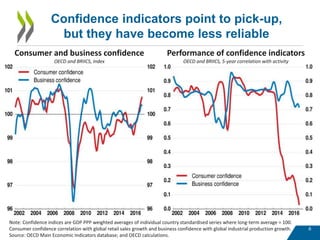
Confidence indicators point to pick-up,
but they have become less reliable
6
Consumer and business confidence
OECD and BRIICS, Index
Note: Confidence indices are GDP PPP weighted averages of individual country standardised series where long-term average = 100.
Consumer confidence correlation with global retail sales growth and business confidence with global industrial production growth.
Source: OECD Main Economic Indicators database; and OECD calculations.
Performance of confidence indicators
OECD and BRIICS, 5-year correlation with activity
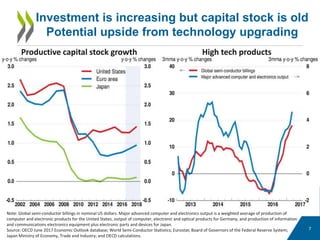
Investment is increasing but capital stock is old
Potential upside from technology upgrading
7
Note: Global semi-conductor billings in nominal US dollars. Major advanced computer and electronics output is a weighted average of production of
computer and electronic products for the United States, output of computer, electronic and optical products for Germany, and production of information
and communications electronics equipment plus electronic parts and devices for Japan.
Source: OECD June 2017 Economic Outlook database; World Semi-Conductor Statistics; Eurostat; Board of Governors of the Federal Reserve System;
Japan Ministry of Economy, Trade and Industry; and OECD calculations.
High tech productsProductive capital stock growth
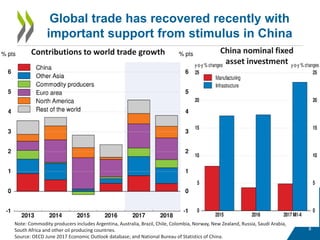
Global trade has recovered recently with
important support from stimulus in China
8
Contributions to world trade growth
Note: Commodity producers includes Argentina, Australia, Brazil, Chile, Colombia, Norway, New Zealand, Russia, Saudi Arabia,
South Africa and other oil producing countries.
Source: OECD June 2017 Economic Outlook database; and National Bureau of Statistics of China.
China nominal fixed
asset investment
9
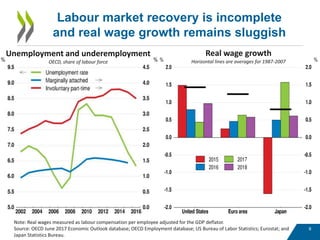
Labour market recovery is incomplete
and real wage growth remains sluggish
Unemployment and underemployment
OECD, share of labour force
Note: Real wages measured as labour compensation per employee adjusted for the GDP deflator.
Source: OECD June 2017 Economic Outlook database; OECD Employment database; US Bureau of Labor Statistics; Eurostat; and
Japan Statistics Bureau.
Real wage growth
Horizontal lines are averages for 1987-2007
10
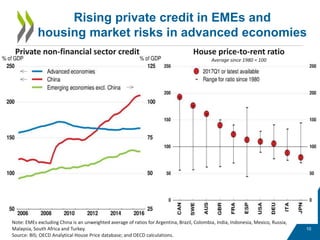
Rising private credit in EMEs and
housing market risks in advanced economies
Note: EMEs excluding China is an unweighted average of ratios for Argentina, Brazil, Colombia, India, Indonesia, Mexico, Russia,
Malaysia, South Africa and Turkey.
Source: BIS; OECD Analytical House Price database; and OECD calculations.
Private non-financial sector credit House price-to-rent ratio
Average since 1980 = 100
11
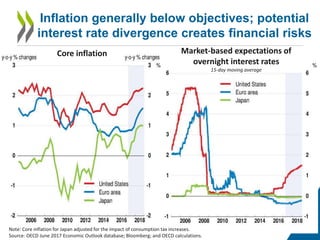
Inflation generally below objectives; potential
interest rate divergence creates financial risks
Core inflation Market-based expectations of
overnight interest rates
15-day moving average
Note: Core inflation for Japan adjusted for the impact of consumption tax increases.
Source: OECD June 2017 Economic Outlook database; Bloomberg; and OECD calculations.
12
Diagnosing the challenge
of structural trends
13
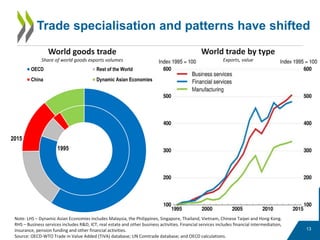
Trade specialisation and patterns have shifted
World goods trade
Share of world goods exports volumes
World trade by type
Exports, value
OECD Rest of the World
China Dynamic Asian Economies
1995
2015
Note: LHS – Dynamic Asian Economies includes Malaysia, the Philippines, Singapore, Thailand, Vietnam, Chinese Taipei and Hong Kong.
RHS – Business services includes R&D, ICT, real estate and other business activities. Financial services includes financial intermediation,
insurance, pension funding and other financial activities.
Source: OECD-WTO Trade in Value Added (TiVA) database; UN Comtrade database; and OECD calculations.
14
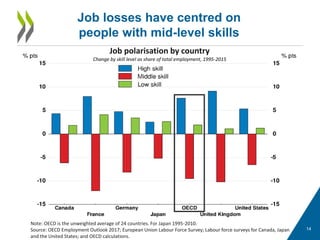
Job losses have centred on
people with mid-level skills
Note: OECD is the unweighted average of 24 countries. For Japan 1995-2010.
Source: OECD Employment Outlook 2017; European Union Labour Force Survey; Labour force surveys for Canada, Japan
and the United States; and OECD calculations.
Job polarisation by country
Change by skill level as share of total employment, 1995-2015
15
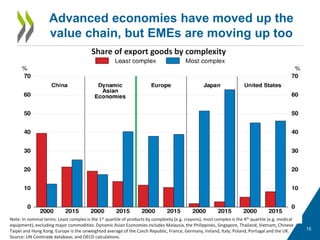
Advanced economies have moved up the
value chain, but EMEs are moving up too
Note: In nominal terms. Least complex is the 1st quartile of products by complexity (e.g. crayons), most complex is the 4th quartile (e.g. medical
equipment), excluding major commodities. Dynamic Asian Economies includes Malaysia, the Philippines, Singapore, Thailand, Vietnam, Chinese
Taipei and Hong Kong. Europe is the unweighted average of the Czech Republic, France, Germany, Ireland, Italy, Poland, Portugal and the UK.
Source: UN Comtrade database; and OECD calculations.
Share of export goods by complexity
16
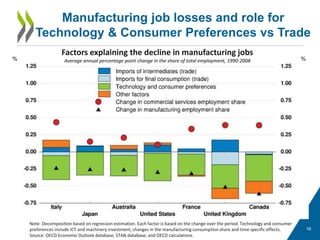
Manufacturing job losses and role for
Technology & Consumer Preferences vs Trade
Factors explaining the decline in manufacturing jobs
Average annual percentage point change in the share of total employment, 1990-2008
Note: Decomposition based on regression estimation. Each factor is based on the change over the period. Technology and consumer
preferences include ICT and machinery investment, changes in the manufacturing consumption share and time specific effects.
Source: OECD Economic Outlook database; STAN database; and OECD calculations.
17
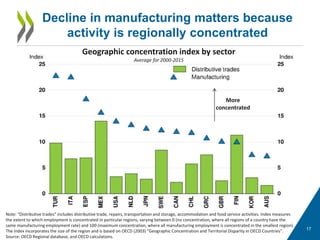
Decline in manufacturing matters because
activity is regionally concentrated
Geographic concentration index by sector
Average for 2000-2015
Note: “Distributive trades” includes distributive trade, repairs, transportation and storage, accommodation and food service activities. Index measures
the extent to which employment is concentrated in particular regions, varying between 0 (no concentration, where all regions of a country have the
same manufacturing employment rate) and 100 (maximum concentration, where all manufacturing employment is concentrated in the smallest region).
The index incorporates the size of the region and is based on OECD (2003) “Geographic Concentration and Territorial Disparity in OECD Countries”.
Source: OECD Regional database; and OECD calculations.
More
concentrated
18
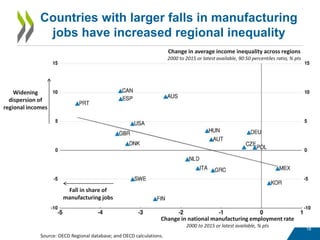
Countries with larger falls in manufacturing
jobs have increased regional inequality
Source: OECD Regional database; and OECD calculations.
Change in average income inequality across regions
2000 to 2015 or latest available, 90:50 percentiles ratio, % pts
Change in national manufacturing employment rate
2000 to 2015 or latest available, % pts
Widening
dispersion of
regional incomes
Fall in share of
manufacturing jobs
19
An integrated policy approach
is needed to respond to
structural trends and make
globalisation work for all
20
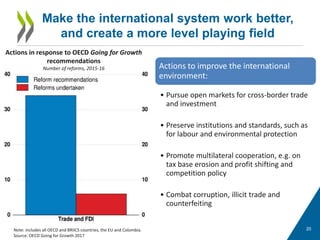
Make the international system work better,
and create a more level playing field
Actions in response to OECD Going for Growth
recommendations
Number of reforms, 2015-16 Actions to improve the international
environment:
• Pursue open markets for cross-border trade
and investment
• Preserve institutions and standards, such as
for labour and environmental protection
• Promote multilateral cooperation, e.g. on
tax base erosion and profit shifting and
competition policy
• Combat corruption, illicit trade and
counterfeiting
Note: includes all OECD and BRIICS countries, the EU and Colombia.
Source: OECD Going for Growth 2017
21
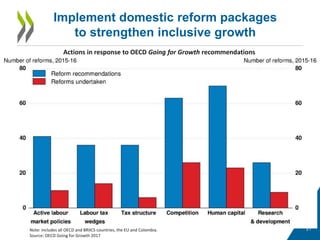
Implement domestic reform packages
to strengthen inclusive growth
Actions in response to OECD Going for Growth recommendations
Note: includes all OECD and BRIICS countries, the EU and Colombia.
Source: OECD Going for Growth 2017
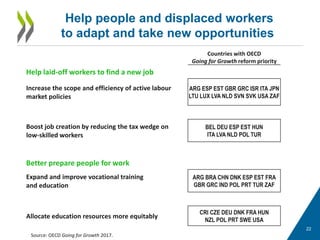
Help people and displaced workers
to adapt and take new opportunities
22
Source: OECD Going for Growth 2017.
Countries with OECD
Going for Growth reform priority
Help laid-off workers to find a new job
Increase the scope and efficiency of active labour
market policies
ARG ESP EST GBR GRC ISR ITA JPN
LTU LUX LVA NLD SVN SVK USA ZAF
Boost job creation by reducing the tax wedge on
low-skilled workers
BEL DEU ESP EST HUN
ITA LVA NLD POL TUR
Better prepare people for work
Expand and improve vocational training
and education
ARG BRA CHN DNK ESP EST FRA
GBR GRC IND POL PRT TUR ZAF
Allocate education resources more equitably
CRI CZE DEU DNK FRA HUN
NZL POL PRT SWE USA
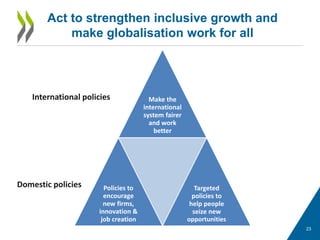
Act to strengthen inclusive growth and
make globalisation work for all
23
Make the
international
system fairer
and work
better
Policies to
encourage
new firms,
innovation &
job creation
Targeted
policies to
help people
seize new
opportunities
International policies
Domestic policies

Better but-not-good-enough-oecd-economic-outlook-presentation-june-2017

  • 1.
    OECD ECONOMIC OUTLOOK Better,but not good enough www.oecd.org/economy/economicoutlook.htm ECOSCOPE blog: oecdecoscope.wordpress.com Catherine L. Mann OECD Chief Economist 7 June 2017 Paris
  • 2.
    Key messages 2 Global growthexpected to pick-up modestly with upside risks • Confidence is increasing and investment and trade are picking up from low levels • Growth is broad based; recovery in commodity producers helps the modest global upturn • Signs of rising demand for high-tech goods and investment to upgrade capital Productivity and wage growth remain subdued; financial stability risks persist • Headline employment indicators are improving but labour markets have not recovered • Financial risks from high and rising credit growth, house price increases, interest rate gaps More needs to be done to share the gains from structural trends and trade • Changes to technology, consumer preferences and trade are occurring simultaneously • Job losses from shifts in activity are concentrated in manufacturing and specific regions An integrated policy approach is needed to make globalisation work for all • A more level playing field for the international system • Domestic reforms to boost competition, job creation, skills and innovation • Targeted policies to help people who are left behind seize new opportunities
  • 3.
    Global GDP growthshould pick up modestly but remains below historical norms 3 Source: OECD June 2017 Economic Outlook database. Global GDP growth
  • 4.
    GDP growth perperson is below history and income inequality continues to rise 4 GDP growth per person Horizontal lines are averages for 1987-2007 Income inequality is rising in the OECD Real household disposable income, total population Note: RHS is the unweighted average of 17 OECD countries. Source: OECD June 2017 Economic Outlook database; and OECD Income Distribution database.
  • 5.
    OECD Economic OutlookProjections 5 Real GDP growth Year-on-year, % Note: Difference in percentage points based on rounded figures. 1. With growth in Ireland in 2015 computed using gross value added at constant prices excluding foreign-owned multinational enterprise dominated sectors. 2. Fiscal years starting in April. 2015 2016 2017 2018 World1 3.1 3.0 3.5 3.6 United States 2.6 1.6 2.1 2.4 Euro area1 1.5 1.7 1.8 1.8 Germany 1.5 1.8 2.0 2.0 France 1.2 1.1 1.3 1.5 Italy 0.7 1.0 1.0 0.8 Japan 1.1 1.0 1.4 1.0 Canada 0.9 1.4 2.8 2.3 United Kingdom 2.2 1.8 1.6 1.0 China 6.9 6.7 6.6 6.4 India2 7.9 7.1 7.3 7.7 Brazil -3.8 -3.6 0.7 1.6
  • 6.
    Confidence indicators pointto pick-up, but they have become less reliable 6 Consumer and business confidence OECD and BRIICS, Index Note: Confidence indices are GDP PPP weighted averages of individual country standardised series where long-term average = 100. Consumer confidence correlation with global retail sales growth and business confidence with global industrial production growth. Source: OECD Main Economic Indicators database; and OECD calculations. Performance of confidence indicators OECD and BRIICS, 5-year correlation with activity
  • 7.
    Investment is increasingbut capital stock is old Potential upside from technology upgrading 7 Note: Global semi-conductor billings in nominal US dollars. Major advanced computer and electronics output is a weighted average of production of computer and electronic products for the United States, output of computer, electronic and optical products for Germany, and production of information and communications electronics equipment plus electronic parts and devices for Japan. Source: OECD June 2017 Economic Outlook database; World Semi-Conductor Statistics; Eurostat; Board of Governors of the Federal Reserve System; Japan Ministry of Economy, Trade and Industry; and OECD calculations. High tech productsProductive capital stock growth
  • 8.
    Global trade hasrecovered recently with important support from stimulus in China 8 Contributions to world trade growth Note: Commodity producers includes Argentina, Australia, Brazil, Chile, Colombia, Norway, New Zealand, Russia, Saudi Arabia, South Africa and other oil producing countries. Source: OECD June 2017 Economic Outlook database; and National Bureau of Statistics of China. China nominal fixed asset investment
  • 9.
    9 Labour market recoveryis incomplete and real wage growth remains sluggish Unemployment and underemployment OECD, share of labour force Note: Real wages measured as labour compensation per employee adjusted for the GDP deflator. Source: OECD June 2017 Economic Outlook database; OECD Employment database; US Bureau of Labor Statistics; Eurostat; and Japan Statistics Bureau. Real wage growth Horizontal lines are averages for 1987-2007
  • 10.
    10 Rising private creditin EMEs and housing market risks in advanced economies Note: EMEs excluding China is an unweighted average of ratios for Argentina, Brazil, Colombia, India, Indonesia, Mexico, Russia, Malaysia, South Africa and Turkey. Source: BIS; OECD Analytical House Price database; and OECD calculations. Private non-financial sector credit House price-to-rent ratio Average since 1980 = 100
  • 11.
    11 Inflation generally belowobjectives; potential interest rate divergence creates financial risks Core inflation Market-based expectations of overnight interest rates 15-day moving average Note: Core inflation for Japan adjusted for the impact of consumption tax increases. Source: OECD June 2017 Economic Outlook database; Bloomberg; and OECD calculations.
  • 12.
  • 13.
    13 Trade specialisation andpatterns have shifted World goods trade Share of world goods exports volumes World trade by type Exports, value OECD Rest of the World China Dynamic Asian Economies 1995 2015 Note: LHS – Dynamic Asian Economies includes Malaysia, the Philippines, Singapore, Thailand, Vietnam, Chinese Taipei and Hong Kong. RHS – Business services includes R&D, ICT, real estate and other business activities. Financial services includes financial intermediation, insurance, pension funding and other financial activities. Source: OECD-WTO Trade in Value Added (TiVA) database; UN Comtrade database; and OECD calculations.
  • 14.
    14 Job losses havecentred on people with mid-level skills Note: OECD is the unweighted average of 24 countries. For Japan 1995-2010. Source: OECD Employment Outlook 2017; European Union Labour Force Survey; Labour force surveys for Canada, Japan and the United States; and OECD calculations. Job polarisation by country Change by skill level as share of total employment, 1995-2015
  • 15.
    15 Advanced economies havemoved up the value chain, but EMEs are moving up too Note: In nominal terms. Least complex is the 1st quartile of products by complexity (e.g. crayons), most complex is the 4th quartile (e.g. medical equipment), excluding major commodities. Dynamic Asian Economies includes Malaysia, the Philippines, Singapore, Thailand, Vietnam, Chinese Taipei and Hong Kong. Europe is the unweighted average of the Czech Republic, France, Germany, Ireland, Italy, Poland, Portugal and the UK. Source: UN Comtrade database; and OECD calculations. Share of export goods by complexity
  • 16.
    16 Manufacturing job lossesand role for Technology & Consumer Preferences vs Trade Factors explaining the decline in manufacturing jobs Average annual percentage point change in the share of total employment, 1990-2008 Note: Decomposition based on regression estimation. Each factor is based on the change over the period. Technology and consumer preferences include ICT and machinery investment, changes in the manufacturing consumption share and time specific effects. Source: OECD Economic Outlook database; STAN database; and OECD calculations.
  • 17.
    17 Decline in manufacturingmatters because activity is regionally concentrated Geographic concentration index by sector Average for 2000-2015 Note: “Distributive trades” includes distributive trade, repairs, transportation and storage, accommodation and food service activities. Index measures the extent to which employment is concentrated in particular regions, varying between 0 (no concentration, where all regions of a country have the same manufacturing employment rate) and 100 (maximum concentration, where all manufacturing employment is concentrated in the smallest region). The index incorporates the size of the region and is based on OECD (2003) “Geographic Concentration and Territorial Disparity in OECD Countries”. Source: OECD Regional database; and OECD calculations. More concentrated
  • 18.
    18 Countries with largerfalls in manufacturing jobs have increased regional inequality Source: OECD Regional database; and OECD calculations. Change in average income inequality across regions 2000 to 2015 or latest available, 90:50 percentiles ratio, % pts Change in national manufacturing employment rate 2000 to 2015 or latest available, % pts Widening dispersion of regional incomes Fall in share of manufacturing jobs
  • 19.
    19 An integrated policyapproach is needed to respond to structural trends and make globalisation work for all
  • 20.
    20 Make the internationalsystem work better, and create a more level playing field Actions in response to OECD Going for Growth recommendations Number of reforms, 2015-16 Actions to improve the international environment: • Pursue open markets for cross-border trade and investment • Preserve institutions and standards, such as for labour and environmental protection • Promote multilateral cooperation, e.g. on tax base erosion and profit shifting and competition policy • Combat corruption, illicit trade and counterfeiting Note: includes all OECD and BRIICS countries, the EU and Colombia. Source: OECD Going for Growth 2017
  • 21.
    21 Implement domestic reformpackages to strengthen inclusive growth Actions in response to OECD Going for Growth recommendations Note: includes all OECD and BRIICS countries, the EU and Colombia. Source: OECD Going for Growth 2017
  • 22.
    Help people anddisplaced workers to adapt and take new opportunities 22 Source: OECD Going for Growth 2017. Countries with OECD Going for Growth reform priority Help laid-off workers to find a new job Increase the scope and efficiency of active labour market policies ARG ESP EST GBR GRC ISR ITA JPN LTU LUX LVA NLD SVN SVK USA ZAF Boost job creation by reducing the tax wedge on low-skilled workers BEL DEU ESP EST HUN ITA LVA NLD POL TUR Better prepare people for work Expand and improve vocational training and education ARG BRA CHN DNK ESP EST FRA GBR GRC IND POL PRT TUR ZAF Allocate education resources more equitably CRI CZE DEU DNK FRA HUN NZL POL PRT SWE USA
  • 23.
    Act to strengtheninclusive growth and make globalisation work for all 23 Make the international system fairer and work better Policies to encourage new firms, innovation & job creation Targeted policies to help people seize new opportunities International policies Domestic policies