OECD-France Stratégie workshop
Session 2
How can the EU budget be used for
stabilisation?
Laurence Boone, February 5th 2018, Paris
Advancing new tools for the EU budget
to foster crisis management and
economic convergence
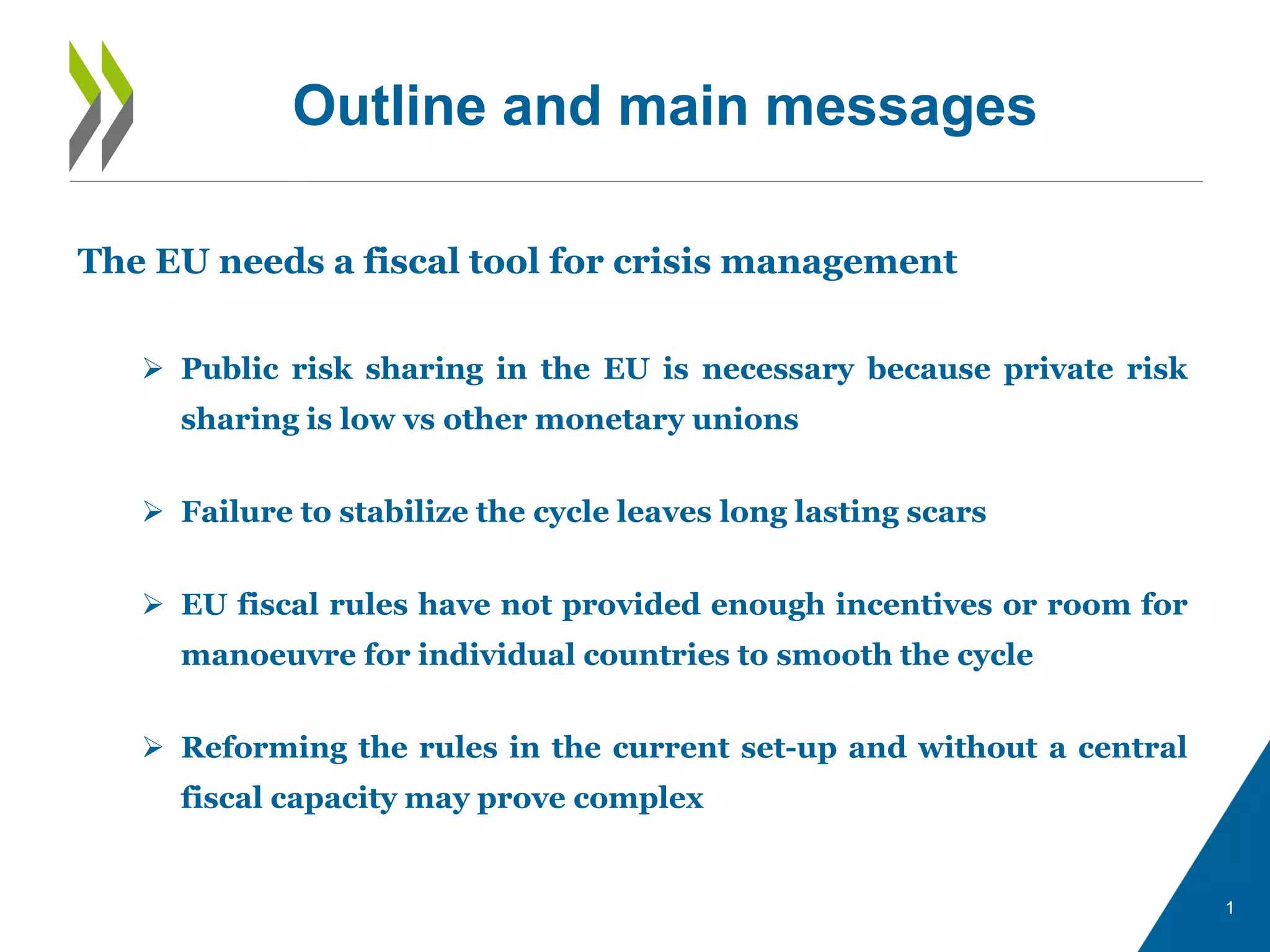
The EU needs a fiscal tool for crisis management
 Public risk sharing in the EU is necessary because private risk
sharing is low vs other monetary unions
 Failure to stabilize the cycle leaves long lasting scars
 EU fiscal rules have not provided enough incentives or room for
manoeuvre for individual countries to smooth the cycle
 Reforming the rules in the current set-up and without a central
fiscal capacity may prove complex
1
Outline and main messages
2
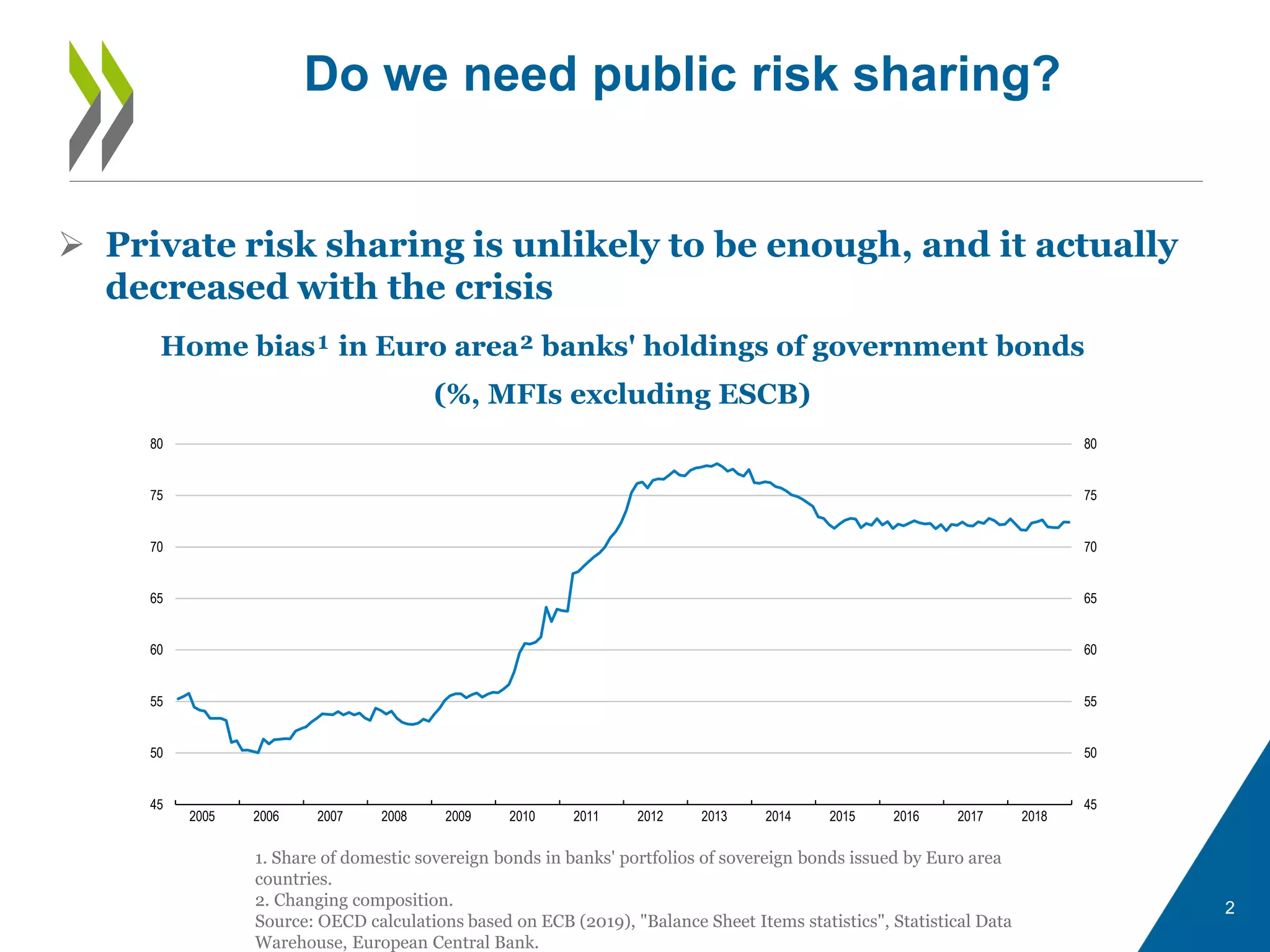
 Private risk sharing is unlikely to be enough, and it actually
decreased with the crisis
Home bias¹ in Euro area² banks' holdings of government bonds
(%, MFIs excluding ESCB)
Do we need public risk sharing?
45
50
55
60
65
70
75
80
45
50
55
60
65
70
75
80
2005 2006 2007 2008 2009 2010 2011 2012 2013 2014 2015 2016 2017 2018
1. Share of domestic sovereign bonds in banks' portfolios of sovereign bonds issued by Euro area
countries.
2. Changing composition.
Source: OECD calculations based on ECB (2019), "Balance Sheet Items statistics", Statistical Data
Warehouse, European Central Bank.
3
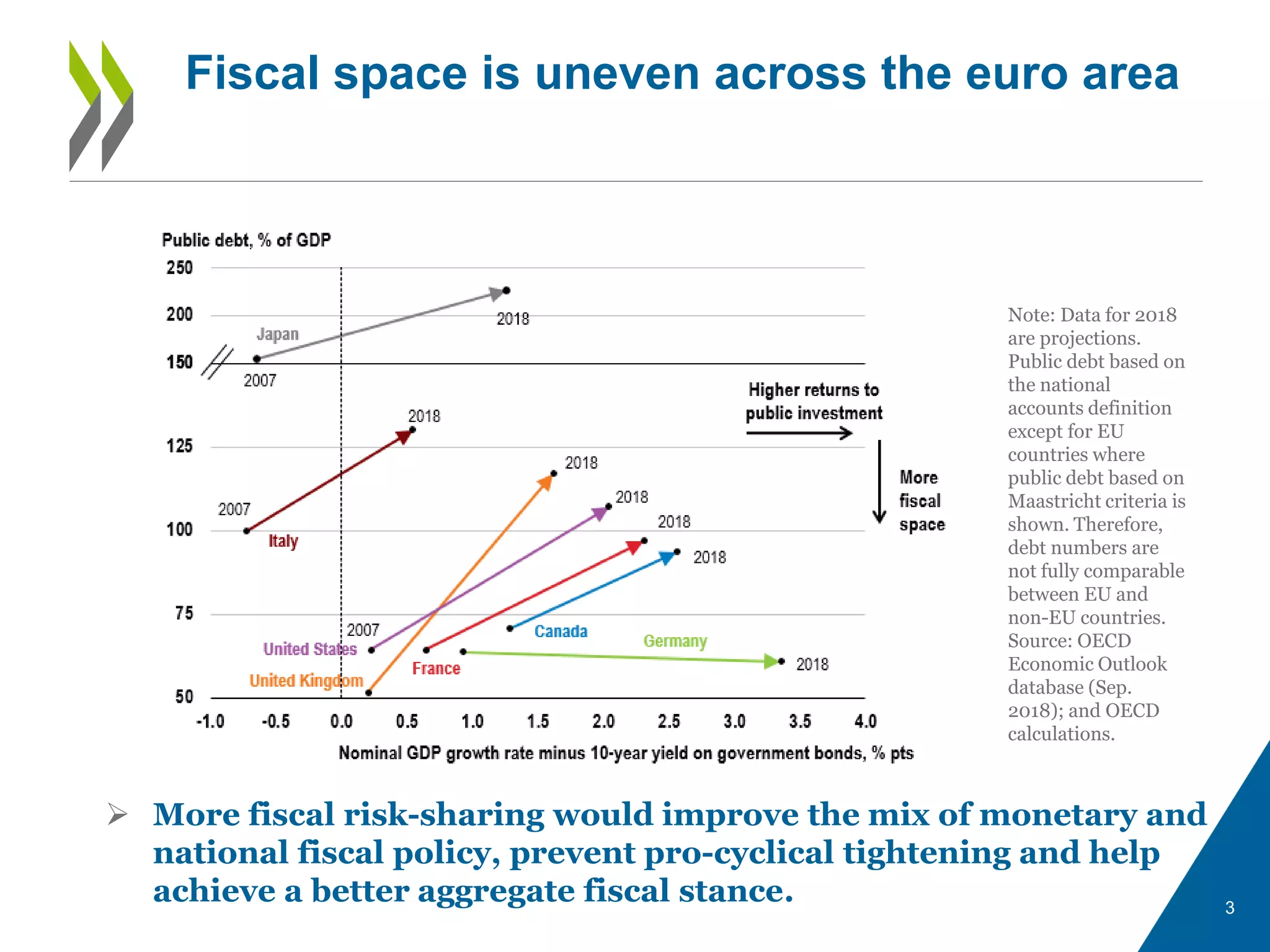
 More fiscal risk-sharing would improve the mix of monetary and
national fiscal policy, prevent pro-cyclical tightening and help
achieve a better aggregate fiscal stance.
Fiscal space is uneven across the euro area
Note: Data for 2018
are projections.
Public debt based on
the national
accounts definition
except for EU
countries where
public debt based on
Maastricht criteria is
shown. Therefore,
debt numbers are
not fully comparable
between EU and
non-EU countries.
Source: OECD
Economic Outlook
database (Sep.
2018); and OECD
calculations.
Strengthening resilience through a common
fiscal capacity
4
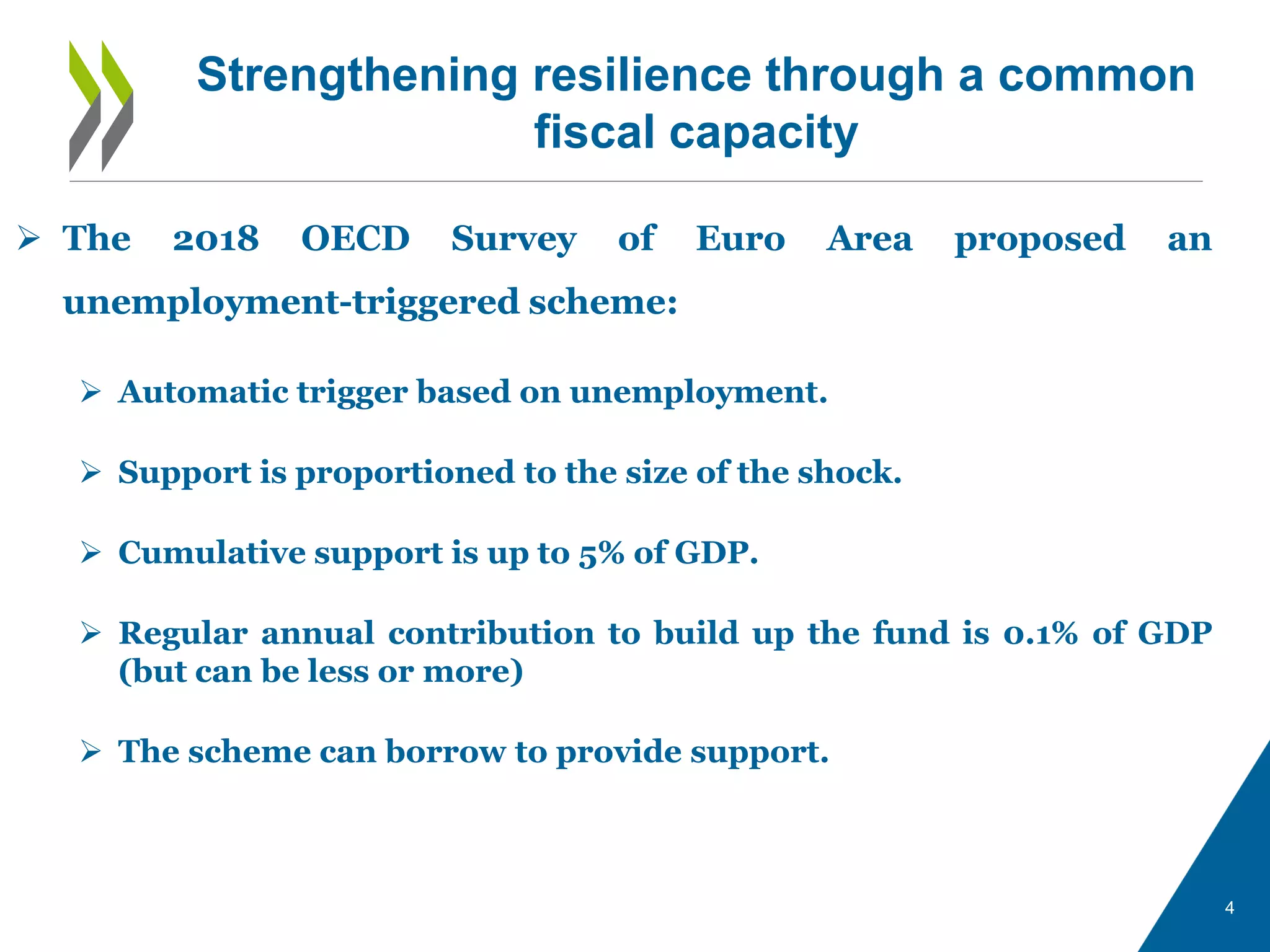
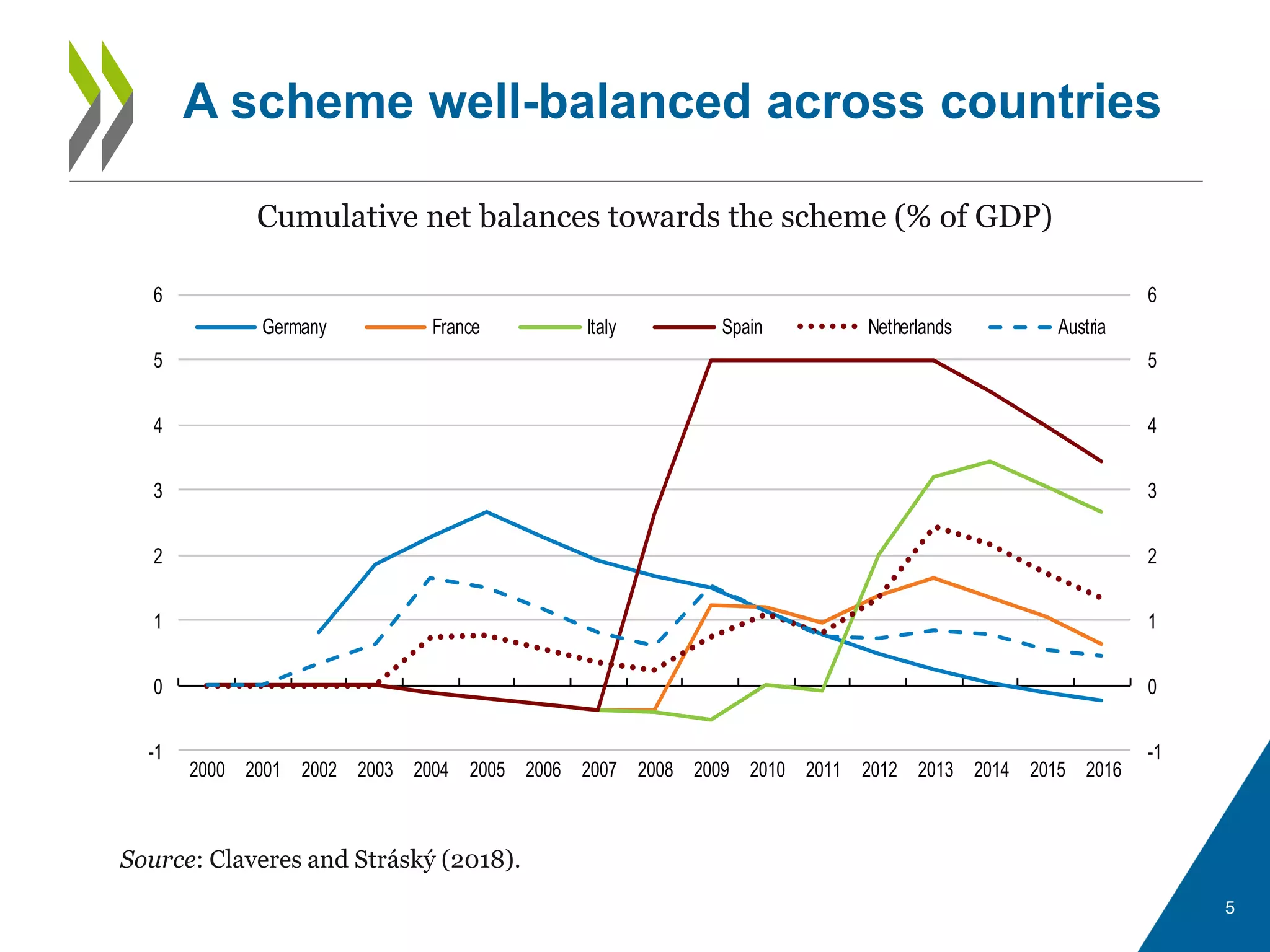
 The 2018 OECD Survey of Euro Area proposed an
unemployment-triggered scheme:
 Automatic trigger based on unemployment.
 Support is proportioned to the size of the shock.
 Cumulative support is up to 5% of GDP.
 Regular annual contribution to build up the fund is 0.1% of GDP
(but can be less or more)
 The scheme can borrow to provide support.
A scheme well-balanced across countries
5
Source: Claveres and Stráský (2018).
Cumulative net balances towards the scheme (% of GDP)
-1
0
1
2
3
4
5
6
-1
0
1
2
3
4
5
6
2000 2001 2002 2003 2004 2005 2006 2007 2008 2009 2010 2011 2012 2013 2014 2015 2016
Germany France Italy Spain Netherlands Austria
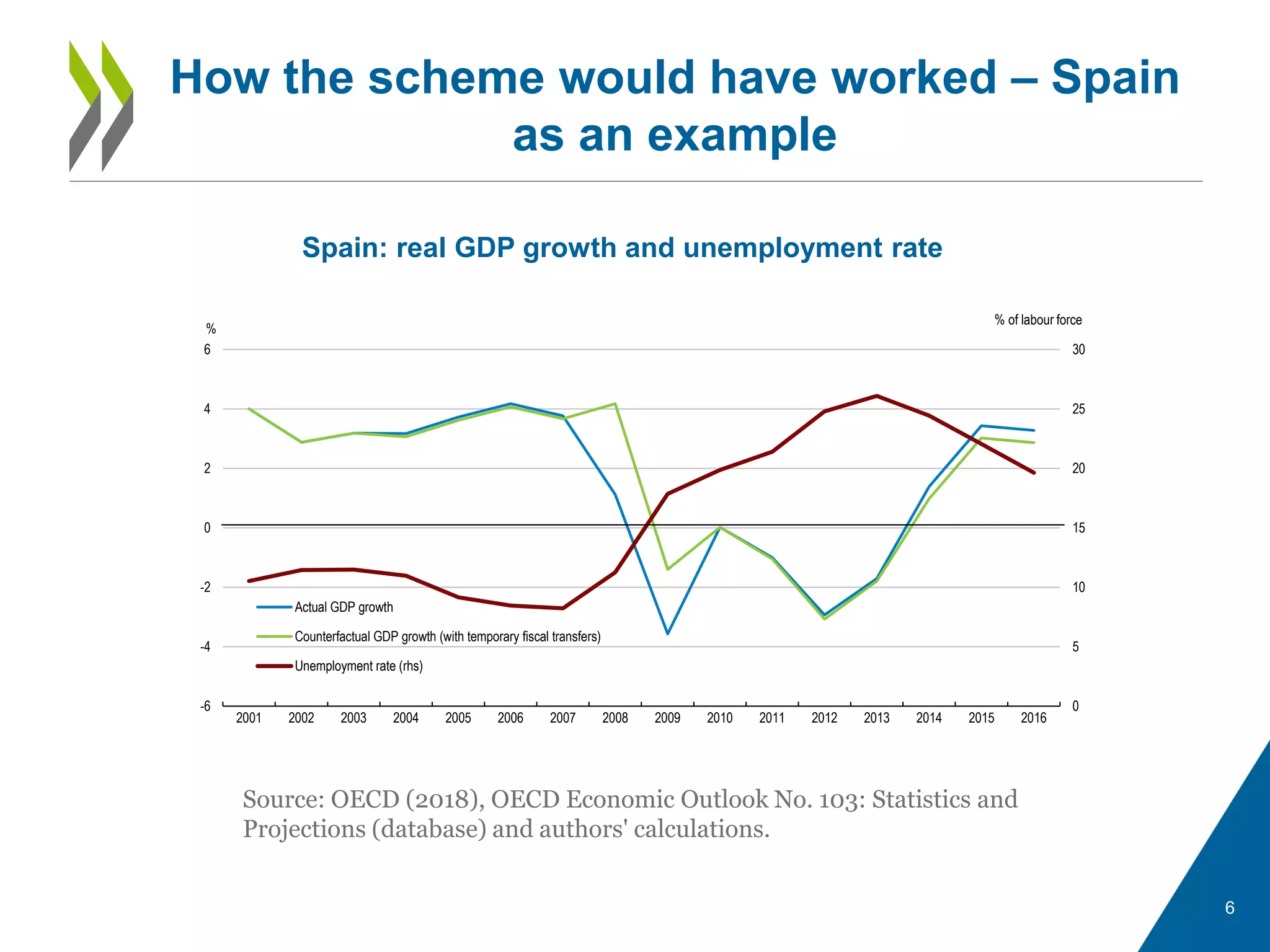
How the scheme would have worked – Spain
as an example
6
Spain: real GDP growth and unemployment rate
Source: OECD (2018), OECD Economic Outlook No. 103: Statistics and
Projections (database) and authors' calculations.
0
5
10
15
20
25
30
-6
-4
-2
0
2
4
6
2001 2002 2003 2004 2005 2006 2007 2008 2009 2010 2011 2012 2013 2014 2015 2016
Actual GDP growth
Counterfactual GDP growth (with temporary fiscal transfers)
Unemployment rate (rhs)
% of labour force
%
7
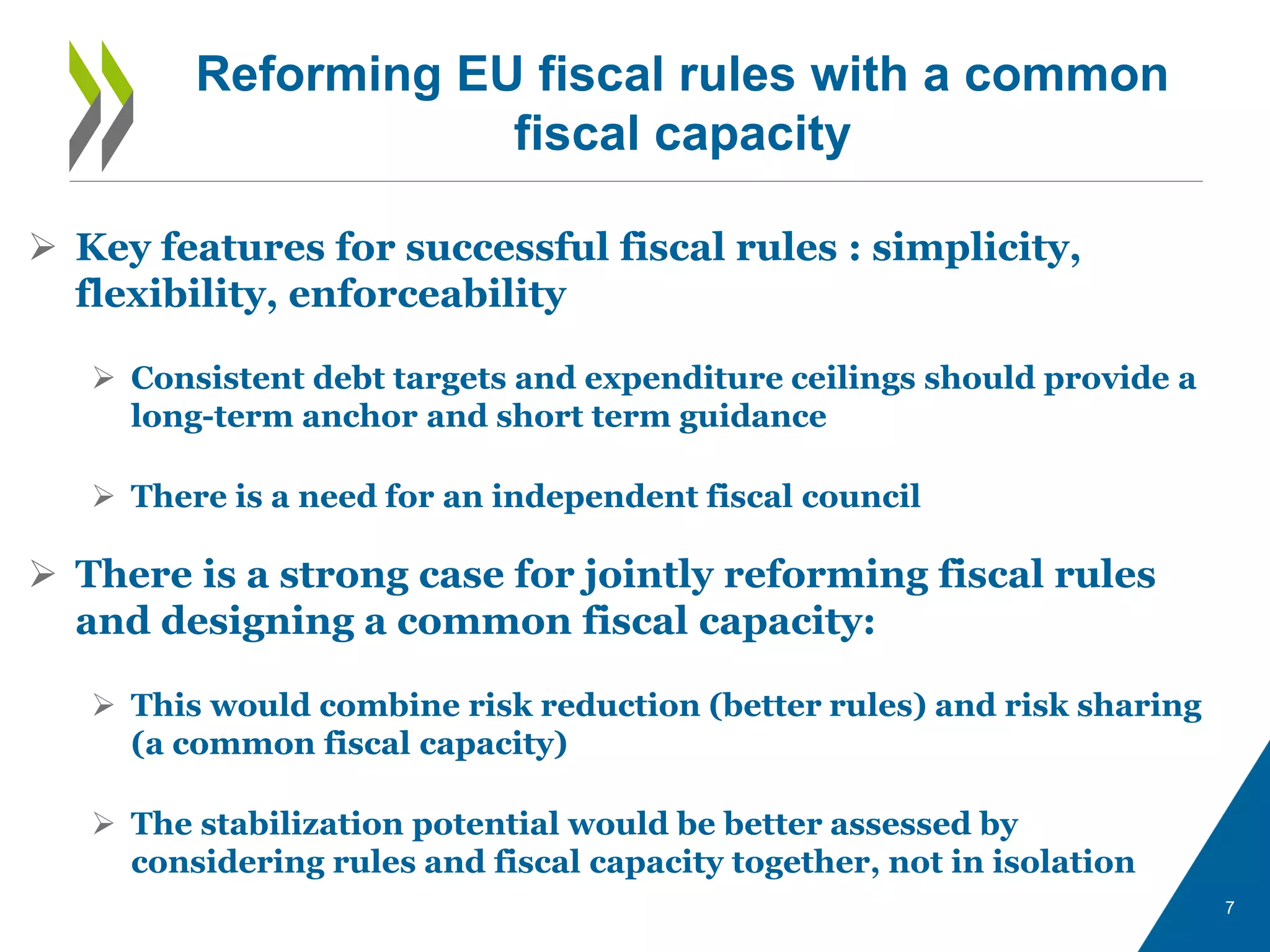
 Key features for successful fiscal rules : simplicity,
flexibility, enforceability
 Consistent debt targets and expenditure ceilings should provide a
long-term anchor and short term guidance
 There is a need for an independent fiscal council
 There is a strong case for jointly reforming fiscal rules
and designing a common fiscal capacity:
 This would combine risk reduction (better rules) and risk sharing
(a common fiscal capacity)
 The stabilization potential would be better assessed by
considering rules and fiscal capacity together, not in isolation
Reforming EU fiscal rules with a common
fiscal capacity
8
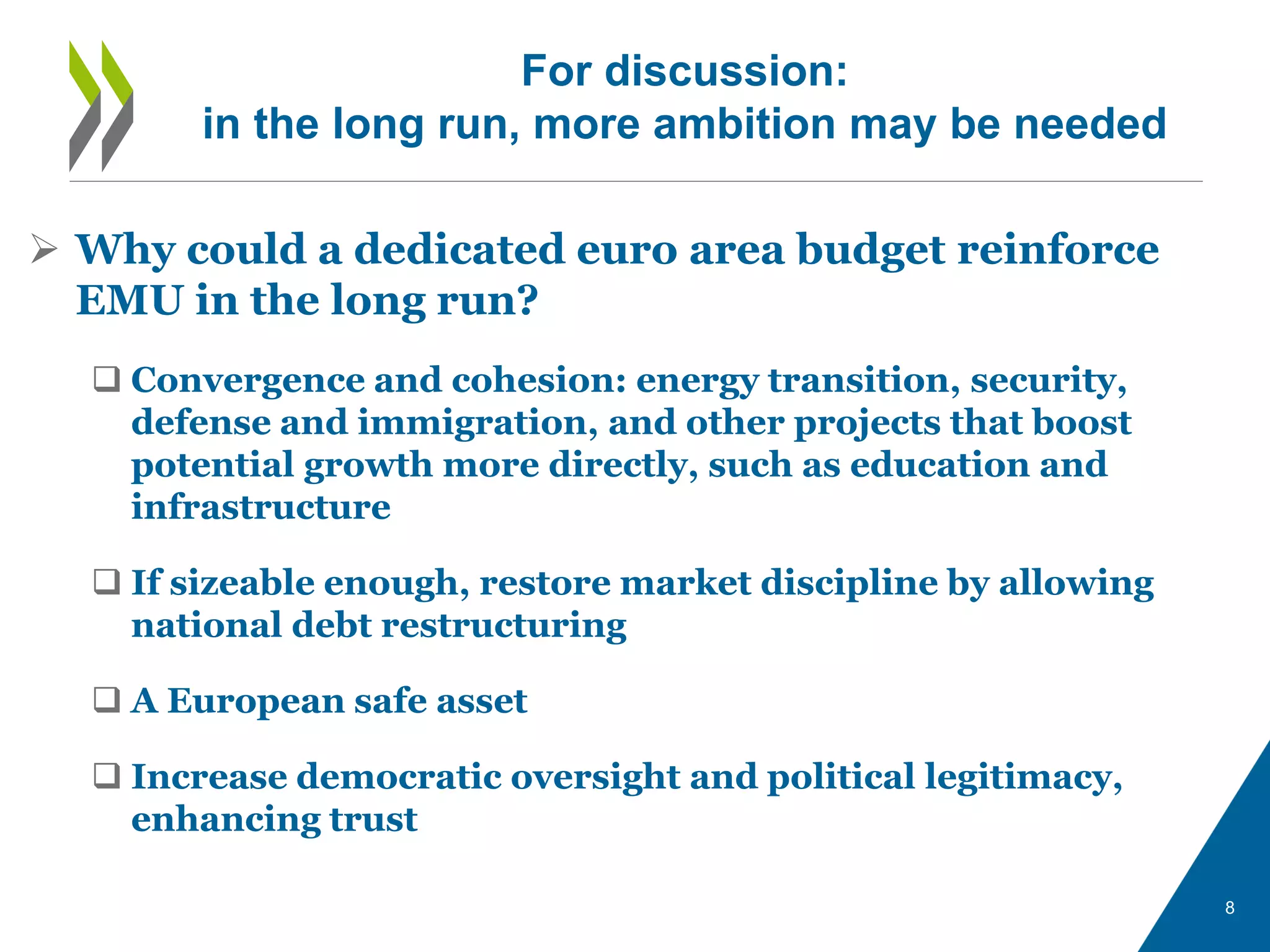
 Why could a dedicated euro area budget reinforce
EMU in the long run?
 Convergence and cohesion: energy transition, security,
defense and immigration, and other projects that boost
potential growth more directly, such as education and
infrastructure
 If sizeable enough, restore market discipline by allowing
national debt restructuring
 A European safe asset
 Increase democratic oversight and political legitimacy,
enhancing trust
For discussion:
in the long run, more ambition may be needed
THANK YOU!
9

How can the EU budget be used for stabilisation?

  • 1.
    OECD-France Stratégie workshop Session2 How can the EU budget be used for stabilisation? Laurence Boone, February 5th 2018, Paris Advancing new tools for the EU budget to foster crisis management and economic convergence
  • 2.
    The EU needsa fiscal tool for crisis management  Public risk sharing in the EU is necessary because private risk sharing is low vs other monetary unions  Failure to stabilize the cycle leaves long lasting scars  EU fiscal rules have not provided enough incentives or room for manoeuvre for individual countries to smooth the cycle  Reforming the rules in the current set-up and without a central fiscal capacity may prove complex 1 Outline and main messages
  • 3.
    2  Private risksharing is unlikely to be enough, and it actually decreased with the crisis Home bias¹ in Euro area² banks' holdings of government bonds (%, MFIs excluding ESCB) Do we need public risk sharing? 45 50 55 60 65 70 75 80 45 50 55 60 65 70 75 80 2005 2006 2007 2008 2009 2010 2011 2012 2013 2014 2015 2016 2017 2018 1. Share of domestic sovereign bonds in banks' portfolios of sovereign bonds issued by Euro area countries. 2. Changing composition. Source: OECD calculations based on ECB (2019), "Balance Sheet Items statistics", Statistical Data Warehouse, European Central Bank.
  • 4.
    3  More fiscalrisk-sharing would improve the mix of monetary and national fiscal policy, prevent pro-cyclical tightening and help achieve a better aggregate fiscal stance. Fiscal space is uneven across the euro area Note: Data for 2018 are projections. Public debt based on the national accounts definition except for EU countries where public debt based on Maastricht criteria is shown. Therefore, debt numbers are not fully comparable between EU and non-EU countries. Source: OECD Economic Outlook database (Sep. 2018); and OECD calculations.
  • 5.
    Strengthening resilience througha common fiscal capacity 4  The 2018 OECD Survey of Euro Area proposed an unemployment-triggered scheme:  Automatic trigger based on unemployment.  Support is proportioned to the size of the shock.  Cumulative support is up to 5% of GDP.  Regular annual contribution to build up the fund is 0.1% of GDP (but can be less or more)  The scheme can borrow to provide support.
  • 6.
    A scheme well-balancedacross countries 5 Source: Claveres and Stráský (2018). Cumulative net balances towards the scheme (% of GDP) -1 0 1 2 3 4 5 6 -1 0 1 2 3 4 5 6 2000 2001 2002 2003 2004 2005 2006 2007 2008 2009 2010 2011 2012 2013 2014 2015 2016 Germany France Italy Spain Netherlands Austria
  • 7.
    How the schemewould have worked – Spain as an example 6 Spain: real GDP growth and unemployment rate Source: OECD (2018), OECD Economic Outlook No. 103: Statistics and Projections (database) and authors' calculations. 0 5 10 15 20 25 30 -6 -4 -2 0 2 4 6 2001 2002 2003 2004 2005 2006 2007 2008 2009 2010 2011 2012 2013 2014 2015 2016 Actual GDP growth Counterfactual GDP growth (with temporary fiscal transfers) Unemployment rate (rhs) % of labour force %
  • 8.
    7  Key featuresfor successful fiscal rules : simplicity, flexibility, enforceability  Consistent debt targets and expenditure ceilings should provide a long-term anchor and short term guidance  There is a need for an independent fiscal council  There is a strong case for jointly reforming fiscal rules and designing a common fiscal capacity:  This would combine risk reduction (better rules) and risk sharing (a common fiscal capacity)  The stabilization potential would be better assessed by considering rules and fiscal capacity together, not in isolation Reforming EU fiscal rules with a common fiscal capacity
  • 9.
    8  Why coulda dedicated euro area budget reinforce EMU in the long run?  Convergence and cohesion: energy transition, security, defense and immigration, and other projects that boost potential growth more directly, such as education and infrastructure  If sizeable enough, restore market discipline by allowing national debt restructuring  A European safe asset  Increase democratic oversight and political legitimacy, enhancing trust For discussion: in the long run, more ambition may be needed
  • 10.