Camera Shot Size & Angles
Teaching Resource
Camera Movement
• To achieve smooth movement you
will need to pan and tilt so that the
frame moves evenly, without any
jerky or sudden movements.
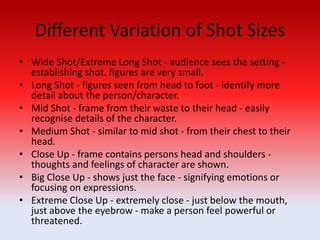
Different Variation of Shot Sizes
• Wide Shot/Extreme Long Shot - audience sees the setting -
establishing shot. figures are very small.
• Long Shot - figures seen from head to foot - identify more
detail about the person/character.
• Mid Shot - frame from their waste to their head - easily
recognise details of the character.
• Medium Shot - similar to mid shot - from their chest to their
head.
• Close Up - frame contains persons head and shoulders -
thoughts and feelings of character are shown.
• Big Close Up - shows just the face - signifying emotions or
focusing on expressions.
• Extreme Close Up - extremely close - just below the mouth,
just above the eyebrow - make a person feel powerful or
threatened.
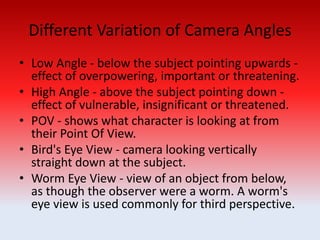
Different Variation of Camera Angles
• Low Angle - below the subject pointing upwards -
effect of overpowering, important or threatening.
• High Angle - above the subject pointing down -
effect of vulnerable, insignificant or threatened.
• POV - shows what character is looking at from
their Point Of View.
• Bird's Eye View - camera looking vertically
straight down at the subject.
• Worm Eye View - view of an object from below,
as though the observer were a worm. A worm's
eye view is used commonly for third perspective.
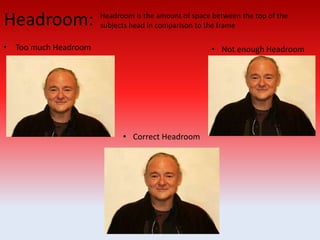
Headroom:
• Too much Headroom
Headroom is the amount of space between the top of the
subjects head in comparison to the frame
• Not enough Headroom
• Correct Headroom
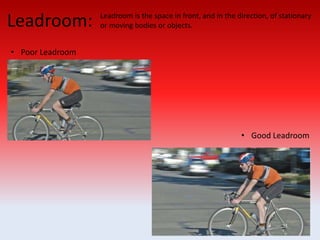
Leadroom: Leadroom is the space in front, and in the direction, of stationary
or moving bodies or objects.
• Poor Leadroom
• Good Leadroom
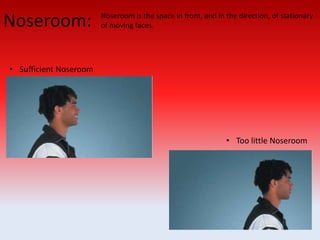
Noseroom: Noseroom is the space in front, and in the direction, of stationary
of moving faces.
• Too little Noseroom
• Sufficient Noseroom
Anticipatory Framing
• We use panning to follow a person walking, to
do this correctly you need to become
proficient at anticipatory framing.
• To achieve this you need to be able to
anticipate the direction of your subject’s
movement and move the frame fluidly to
constantly ensure a sufficient amount of
headroom and Leadroom.

Camera shot size & angles teaching resource

  • 1.
    Camera Shot Size& Angles Teaching Resource
  • 2.
    Camera Movement • Toachieve smooth movement you will need to pan and tilt so that the frame moves evenly, without any jerky or sudden movements.
  • 3.
    Different Variation ofShot Sizes • Wide Shot/Extreme Long Shot - audience sees the setting - establishing shot. figures are very small. • Long Shot - figures seen from head to foot - identify more detail about the person/character. • Mid Shot - frame from their waste to their head - easily recognise details of the character. • Medium Shot - similar to mid shot - from their chest to their head. • Close Up - frame contains persons head and shoulders - thoughts and feelings of character are shown. • Big Close Up - shows just the face - signifying emotions or focusing on expressions. • Extreme Close Up - extremely close - just below the mouth, just above the eyebrow - make a person feel powerful or threatened.
  • 4.
    Different Variation ofCamera Angles • Low Angle - below the subject pointing upwards - effect of overpowering, important or threatening. • High Angle - above the subject pointing down - effect of vulnerable, insignificant or threatened. • POV - shows what character is looking at from their Point Of View. • Bird's Eye View - camera looking vertically straight down at the subject. • Worm Eye View - view of an object from below, as though the observer were a worm. A worm's eye view is used commonly for third perspective.
  • 5.
    Headroom: • Too muchHeadroom Headroom is the amount of space between the top of the subjects head in comparison to the frame • Not enough Headroom • Correct Headroom
  • 6.
    Leadroom: Leadroom isthe space in front, and in the direction, of stationary or moving bodies or objects. • Poor Leadroom • Good Leadroom
  • 7.
    Noseroom: Noseroom isthe space in front, and in the direction, of stationary of moving faces. • Too little Noseroom • Sufficient Noseroom
  • 8.
    Anticipatory Framing • Weuse panning to follow a person walking, to do this correctly you need to become proficient at anticipatory framing. • To achieve this you need to be able to anticipate the direction of your subject’s movement and move the frame fluidly to constantly ensure a sufficient amount of headroom and Leadroom.